


Japan Gene Therapy Market Overview
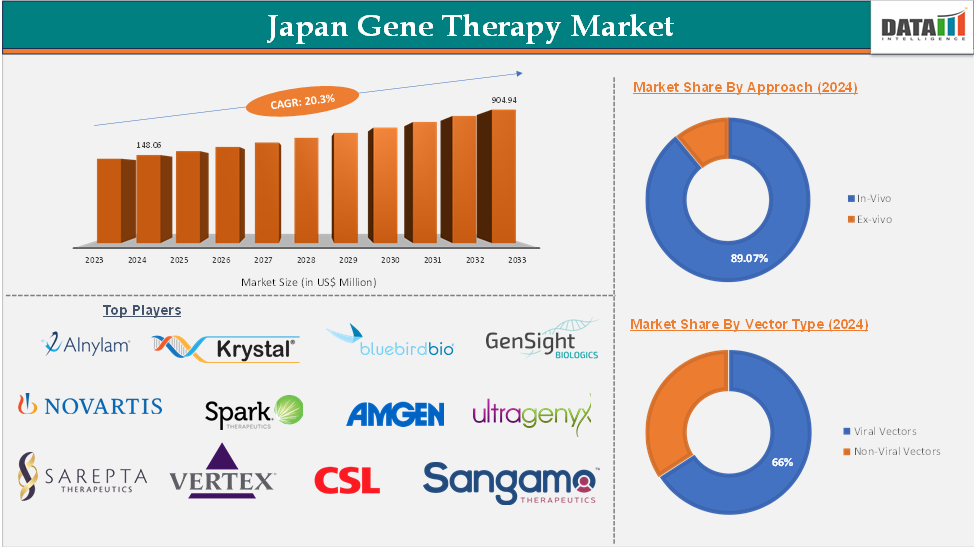
The Japan gene therapy market reached US$ 148.06 Million in 2024 and is expected to reach US$ 904.94 Million by 2033, growing at a CAGR of 20.3% during the forecast period 2025-2033.
Gene therapy is a medical approach that involves modifying, replacing, or supplementing a patient's genetic material to treat or cure diseases caused by genetic mutations or dysfunctions. It works by introducing functional genes, editing defective ones (e.g., using CRISPR-Cas9), or deactivating harmful genes to address conditions like genetic disorders, cancers, and chronic diseases at their root cause. This innovative method can employ viral vectors (e.g., adeno-associated viruses) or non-viral techniques to deliver therapeutic genes, offering potential cures rather than temporary symptom management.
One of the major market drivers is the rising product development activities and product approvals, advancements in gene editing and delivery technologies, and high unmet needs in oncology and rare diseases.
Opportunities in Japan are abundant, growing focus on personalized medicine, especially given the nation’s aging population and high prevalence of genetic and rare diseases. There is a strong demand for curative therapies targeting conditions such as hemophilia, spinal muscular atrophy, and certain inherited retinal disorders. Additionally, Japan’s government is investing in precision medicine and fostering collaborations between academia, industry, and government agencies, creating a fertile environment for research and commercialization.
Key trends shaping the market include a surge in partnerships between Japanese pharmaceutical companies and global biotech firms, increased adoption of advanced gene editing technologies like CRISPR, and a growing pipeline of both ex vivo and in vivo gene therapies.
Japan Gene Therapy Market Key Takeaways
- Japan’s gene therapy market is advancing through regulatory support, clinical development, and growing investment in advanced therapies.
- The regulatory environment is supporting faster development and commercialization of gene therapy products, particularly for rare and difficult-to-treat diseases.
- Pharmaceutical companies and biotechnology firms are expanding gene therapy pipelines, with greater focus on oncology, genetic disorders, and ophthalmic diseases.
- Japan’s aging population and increasing prevalence of chronic and rare diseases are creating demand for innovative treatment approaches.
- Partnerships between Japanese pharmaceutical companies, global biotech firms, and research institutions are strengthening clinical development and technology transfer.
- Manufacturing capabilities for viral vectors and other gene therapy components are gaining importance as companies prepare for larger-scale commercialization.
- The market is gradually shifting from early-stage clinical research toward commercialization, supported by Japan’s established framework for regenerative and advanced therapies.
- High treatment costs, complex manufacturing processes, patient access, and reimbursement remain key challenges for broader adoption of gene therapies.
Executive Summary
For more details on this report, Request for Sample
Japan Gene Therapy Market Dynamics: Drivers
Rising research and development activities and product approvals
Japan has long been a leader in biotechnology and pharmaceutical innovation, and this legacy extends to the gene therapy sector. The rapid development of gene editing techniques such as CRISPR-Cas9 and viral vector-based gene delivery systems has opened up new avenues for gene therapy research. Japanese companies and research institutions are leveraging these technologies to explore potential treatments for a wide range of genetic diseases, including rare conditions and those with no current treatment options.
As gene therapies continue to demonstrate their efficacy and safety in clinical trials, Japan's regulatory body (the PMDA, Pharmaceuticals and Medical Devices Agency) has been approving more gene therapy products. These approvals provide a significant boost to the market.
Also, in August 2024, Chugai Pharmaceutical submitted Elevidys (delandistrogene moxeparvovec/SRP-9001) for approval in Japan as a gene therapy for Duchenne muscular dystrophy (DMD). This regulatory filing is supported by data from a global phase III study (likely including the EMBARK trial), which demonstrated significant functional and clinical benefits in ambulatory patients.
Japan Gene Therapy Market Dynamics: Restraints
High cost of gene therapies
The high developmental and treatment costs of gene therapies are expected to be a major barrier to the growth of the gene therapy market in Japan, despite the significant potential health benefits these treatments offer. The costs of developing, manufacturing, and administering gene therapies are often exorbitantly high, making them inaccessible for many patients, especially in countries like Japan, where economic constraints are more pronounced.
Gene therapies are cutting-edge treatments that typically involve one-time procedures to correct or replace defective genes in a patient's cells. However, the development process for these therapies is expensive, involving complex research, manufacturing, and regulatory approvals. As a result, the cost of cell and gene therapies can range from USD 300,000 to USD 4 million per patient, depending on the specific therapy and condition being treated. One of the most well-known examples is Zolgensma, a gene therapy for spinal muscular atrophy (SMA). Zolgensma is priced at around USD 2.1 million per patient, which makes it one of the most expensive treatments in the world.
Japan Gene Therapy Market Segment Analysis
The Japan gene therapy market is segmented based on approach, vector type, technique, and application.
Approach: The in vivo segment was valued at US$ 131.77 million in 2024 and is estimated to reach US$ 832.54 million by 2033, growing at a CAGR of 22.7% during the forecast period from 2025-2033
In vivo gene therapy involves directly delivering the therapeutic gene into the patient’s body, typically using a viral vector to transport the gene to the target cells. Unlike ex vivo gene therapy, which involves extracting cells from the patient, editing them in a lab, and then reintroducing them into the body, in vivo therapy works by directly modifying genes within the patient’s body.
In vivo gene therapy offers the advantage of treating the disease directly within the patient’s body, without the need for complex cell collection and manipulation outside the body. This makes the process more efficient and minimizes the risk of complications that could arise from the ex vivo approach.
Japan is known for its strong scientific research capabilities and technological innovation, making it a prime location for cutting-edge gene therapy advancements. The continued improvements in vector technology and delivery methods make in vivo gene therapy a highly attractive option for both researchers and healthcare providers in the country.
Japan has a well-established healthcare system that prioritizes minimally invasive treatments and patient comfort, making in vivo therapy an appealing choice due to its simpler administration process. For instance, in March 2024, YolTech Therapeutics is a biotech company focused on developing in vivo gene editing therapies, which involve directly editing genes inside the body to treat genetic disorders. The company recently announced its participation in TIDES Asia 2024, a significant conference on drug discovery, development, and manufacturing in the field of biologics and gene therapies in Japan.
Why does this report matter in 2026?
The year 2026 represents a critical transition point for the Japan Gene Therapy Market. Japan is moving from a predominantly clinical-development-focused environment toward broader commercial adoption of gene therapies, supported by regulatory advancement, increasing clinical research, domestic manufacturing capabilities, and growing investment in advanced therapeutics. The market is therefore shifting from a high-potential innovation category into an increasingly structured commercial healthcare segment. Developers must evaluate viral vectors, non-viral delivery systems, ex vivo and in vivo approaches, manufacturing capacity, clinical pathways, reimbursement considerations, and patient access, with each route carrying different development, cost, and commercialization implications.
The report matters because gene therapy is not a single therapeutic platform. AAV-based therapies, lentiviral therapies, gene-modified cell therapies, genome-editing approaches, and emerging non-viral systems differ significantly in manufacturing requirements, safety considerations, delivery mechanisms, scalability, and clinical applications. Commercial opportunities therefore depend on therapeutic area and technology fit rather than broad market presence. The study evaluates oncology, rare diseases, inherited disorders, neurological conditions, ophthalmic diseases, and other applications while linking each segment to clinical development requirements, treatment economics, regulatory considerations, and commercialization potential.
The timing is also important for investment and portfolio planning. Companies that establish clinical and manufacturing capabilities in Japan can strengthen their position across the wider Asia-Pacific advanced-therapy ecosystem. Pharmaceutical companies can expand portfolios through licensing and strategic partnerships, while biotechnology companies can leverage Japan's clinical infrastructure and regulatory expertise to accelerate development. Decisions made during 2026 regarding vector platforms, manufacturing partnerships, clinical pipelines, regulatory strategy, and commercialization models are expected to influence competitive positioning through the remainder of the decade.
Japan Gene Therapy Market White Space & Investment Opportunities
Rare disease and ultra-rare disease therapies remain significant white-space opportunities because gene therapy can address conditions with limited treatment options and substantial unmet medical needs.
AAV-based therapies for inherited disorders offer expansion potential as developers seek targeted treatments for genetic conditions affecting neurological, ophthalmic, metabolic, and other organ systems.
Domestic vector manufacturing and CDMO capacity presents investment opportunities as developers seek reliable Japanese production capabilities for clinical and commercial-scale gene therapy programs.
In vivo gene-editing platforms could create new opportunities as delivery technologies and precision-editing approaches mature and move toward broader clinical validation.
Non-viral delivery technologies represent an emerging opportunity for developers seeking alternatives to conventional viral-vector systems, particularly for repeat dosing and scalable manufacturing.
Gene therapies for oncology and hematological disorders remain important growth areas, supported by advances in gene-modified cell therapies and personalized treatment approaches.
Specialized cold-chain, logistics, and treatment-center infrastructure can support commercialization as gene therapies increasingly require coordinated handling, administration, monitoring, and long-term patient follow-up.
Japan Gene Therapy Future Market Transformation
The Japan Gene Therapy Market is expected to transform from a limited number of specialized clinical programs into a broader advanced-therapy ecosystem encompassing discovery, clinical development, manufacturing, treatment delivery, and long-term patient monitoring. Early commercial activity has concentrated on therapies addressing serious and rare conditions. Future market differentiation will increasingly depend on treatment durability, safety, delivery efficiency, manufacturing scalability, patient selection, and overall treatment economics.
The commercial model will also become more integrated. Biotechnology companies, pharmaceutical manufacturers, academic institutions, hospitals, CDMOs, and specialized technology providers are expected to collaborate more closely across the development cycle. Advances in vector engineering, genome editing, cell manufacturing, analytics, and automated production can help improve consistency and reduce manufacturing complexity. Greater integration between clinical data and manufacturing processes can also support faster qualification and more predictable commercialization.
By 2035, leading portfolios are likely to combine multiple delivery platforms, specialized manufacturing capabilities, strong clinical pipelines, and established regulatory and commercialization expertise. Pharmaceutical companies may increasingly pursue licensing, co-development, and acquisition strategies to secure differentiated gene therapy assets. Hospitals and treatment centers will also play a greater role as therapies require specialized administration and long-term patient monitoring. This creates recurring opportunities across manufacturing, diagnostics, logistics, data management, and technical services in addition to direct therapy sales.
Japan Gene Therapy Market Buyer Decision-Making Criteria
Pharmaceutical and biotechnology companies prioritize clinical efficacy, safety, durability of therapeutic response, delivery efficiency, and manufacturing scalability when evaluating gene therapy platforms. Developers also assess vector yield, purity, potency, batch consistency, immunogenicity, storage requirements, and the ability to manufacture therapies at increasingly larger scales. A platform that demonstrates strong clinical performance but presents high manufacturing complexity or inconsistent yields can face significant commercialization barriers.
Procurement, healthcare, and commercialization teams increasingly evaluate regulatory readiness, manufacturing capacity, treatment economics, patient eligibility, reimbursement potential, and supply continuity. The ability to maintain consistent quality across clinical and commercial production is particularly important for advanced therapies. Long-term decisions depend not only on therapy efficacy but also on total treatment cost, manufacturing reliability, treatment-center capabilities, patient monitoring requirements, and post-treatment follow-up.
Japan Gene Therapy Market Economic & Investment Analysis
Commercial planning should distinguish between the theoretical patient population and the qualified addressable patient population. Only a portion of patients with a particular genetic or acquired disease may meet clinical eligibility criteria, while treatment availability can also depend on diagnosis rates, genetic testing, physician referral, manufacturing capacity, regulatory status, and reimbursement. A realistic market forecast therefore considers eligible patient pools, diagnosis rates, treatment adoption, clinical success probability, approval timelines, treatment pricing, and manufacturing capacity by therapeutic area.
The category remains attractive because gene therapy can address diseases with substantial unmet medical needs and, in selected indications, potentially provide long-lasting therapeutic benefits from a single administration. Investment is concentrated in vector development, clinical trials, manufacturing facilities, CDMO partnerships, analytical testing, regulatory submissions, specialized treatment centers, and patient identification infrastructure. Companies with differentiated delivery technologies and scalable manufacturing capabilities can potentially capture premium value, while service providers can benefit from increasing development complexity.
Investment risk remains meaningful. Clinical failures, safety concerns, manufacturing challenges, regulatory requirements, high development costs, limited patient populations, and reimbursement uncertainty can significantly affect commercial outcomes. Gene therapy programs may also require long-term patient monitoring, creating additional operational and financial commitments. Successful investment therefore requires a balanced portfolio across technologies, therapeutic areas, development stages, and manufacturing strategies rather than reliance on a single clinical asset.
From an investment perspective, milestone-adjusted scenarios should distinguish discovery programs, preclinical candidates, clinical-stage assets, regulatory submissions, approved therapies, and recurring commercial treatment volumes. Near-term opportunities are concentrated in advanced clinical and commercial programs, while longer-term growth depends on improved delivery technologies, genome editing, expanded indications, and more efficient manufacturing. Companies should model gross margins alongside R&D, manufacturing, regulatory, patient-identification, and treatment-center costs because commercialization requires significant infrastructure beyond therapy development.
Japan Gene Therapy Market Investment Trends in the Market
- Investment is increasing in AAV and next-generation vector platforms designed to improve tissue targeting, therapeutic durability, safety, and manufacturing efficiency.
- Pharmaceutical and biotechnology companies are expanding strategic partnerships and licensing activity to access differentiated gene therapy candidates and technology platforms.
- Domestic manufacturing and CDMO capabilities are gaining importance as developers seek reliable Japanese production, analytical testing, and quality-control infrastructure.
- Genome-editing technologies are attracting growing investment as companies pursue more precise approaches to correcting or modifying disease-causing genetic material.
- Investment is increasing in genetic testing and patient-identification infrastructure, particularly for rare diseases where diagnosis remains a major barrier to treatment adoption.
- Specialized treatment-center infrastructure and long-term patient monitoring are becoming increasingly important as more advanced therapies move toward commercialization.
- Collaborations between pharmaceutical companies, biotechnology firms, hospitals, universities, and research institutes are becoming central to clinical validation, technology development, manufacturing scale-up, and market access.
- Personalized and precision gene therapy approaches are attracting attention as developers seek therapies tailored to specific genetic mutations, patient groups, and disease profiles.
Strategic Indicators for Japan Gene Therapy Market
High Regulatory Impact
Japan’s gene therapy landscape is strongly influenced by regulatory requirements governing clinical development, manufacturing, quality control, and product approvals. Requirements from Japanese authorities shape development timelines, evidence standards, and commercialization strategies. Companies must align clinical programs, manufacturing processes, safety documentation, and post-market monitoring with evolving regulatory expectations.
High Investment Activity
Investment is increasing across gene therapy research, clinical development, manufacturing infrastructure, and advanced delivery technologies. Capital is particularly focused on platforms demonstrating clinical progress, differentiated mechanisms, scalable manufacturing, and strong therapeutic potential. Strategic collaborations between biotechnology companies, pharmaceutical firms, research institutions, and specialized manufacturers are supporting market development.
Supply Chain Complexity
Gene therapy production depends on specialized viral vectors, plasmids, cell-based materials, critical raw materials, and highly controlled manufacturing capabilities. Limited availability of qualified suppliers can affect production schedules and clinical timelines. Companies are therefore strengthening supplier networks, expanding local manufacturing capabilities, and improving supply-chain resilience.
Pricing Pressure
Gene therapies typically involve complex manufacturing processes, specialized administration, and significant development costs. Pricing considerations increasingly extend beyond treatment cost to include clinical outcomes, durability of response, healthcare resource utilization, and long-term patient benefits. Manufacturers must demonstrate clear therapeutic and economic value to support market access.
Procurement Pressure
Healthcare providers and stakeholders require therapies that demonstrate strong clinical efficacy, safety, reliable supply, and manageable administration requirements. Procurement decisions increasingly consider manufacturing consistency, treatment infrastructure, patient eligibility, reimbursement conditions, and long-term evidence. Companies with robust commercialization and support capabilities can strengthen adoption.
New Technology Adoption
Innovations in viral vectors, non-viral delivery systems, gene editing, next-generation sequencing, cell engineering, and manufacturing automation are reshaping Japan’s gene therapy ecosystem. Technologies that improve delivery efficiency, safety, scalability, and manufacturing consistency are likely to accelerate clinical translation and commercialization.
Regional Expansion Opportunity
Japan represents an important Asia-Pacific market for advanced gene therapies, supported by its healthcare infrastructure, biotechnology ecosystem, research capabilities, and established pharmaceutical industry. Opportunities are emerging across oncology, rare diseases, genetic disorders, and other areas where targeted genetic interventions can address significant unmet medical needs.
Government Policy Support
Government initiatives supporting regenerative medicine, advanced therapies, biotechnology research, and innovative healthcare technologies can strengthen the development environment. Japan’s regulatory framework provides pathways designed to support innovative therapies while maintaining requirements for safety and clinical evidence. Continued policy development will influence commercialization timelines and investment priorities.
Pricing Intelligence
Pricing strategies increasingly depend on clinical differentiation, treatment durability, manufacturing complexity, patient population, and reimbursement considerations. High-cost therapies must demonstrate measurable clinical and economic value to support adoption. Companies should assess manufacturing costs, treatment delivery requirements, reimbursement pathways, and long-term outcomes when developing pricing strategies for the Japanese market.
Files, images, and data analysis are unavailable until usage resets at 8:28 PM. Continue chatting with text only, or upgrade for more access.Try Plus freeJapan Gene Therapy Market Major Players
The major players in the Japan gene therapy market include Alnylam Pharmaceuticals, Inc., NOVARTIS AG, Sarepta Therapeutics, Inc., Krystal Biotech, Inc., CSL, Bluebird Bio, Inc., SPARK THERAPEUTICS, INC., Ferring, Vertex Pharmaceuticals Incorporated, Amgen, Inc., Orchard Therapeutics Plc, Gensight Biologics, Ultragenyx Pharmaceutical Inc., REGENXBIO Inc., Oxford Biomedica PLC, Benitec Biopharma Inc., Transgene, and Sangamo Therapeutics, among others.
Japan Gene Therapy Market Key Developments
July 2026: Restore Vision partnered with Forge Biologics to advance AAV development and cGMP manufacturing for RV-001, its investigational optogenetic gene therapy for retinitis pigmentosa, supporting clinical development in Japan.
- June 2026: ONODERA GT Pharma received Japan’s SAKIGAKE designation for GT0003X, its gene therapy product targeting Parkinson’s disease, supporting an accelerated development pathway for the therapy.
- May 2026: Restore Vision reported interim Phase I/II results for RV-001 in Japan, with no dose-limiting toxicities or drug-related serious adverse events reported in the analyzed low- and high-dose cohorts.
- April 2026: Restore Vision secured JPY 1.3 billion in Pre-Series B financing, bringing its total funding including grants to more than JPY 5.8 billion to support development of RV-001 and additional gene therapy programs.
- March 2026: Nippon Shinyaku continued advancing its RGX-121 collaboration with REGENXBIO, while Nikon CeLL innovation reported completion of technology transfer supporting commercial-scale manufacturing capabilities relevant to advanced cell and gene therapy production.
- February 2026: Chugai Pharmaceutical launched ELEVIDYS in Japan as the country’s first regenerative medical product for Duchenne muscular dystrophy, following its inclusion on Japan’s National Health Insurance reimbursement price list.
- January 2026: Nanoscope Therapeutics received Japan’s MHLW Sakigake and Orphan Drug designations for MCO-010, an optogenetic gene therapy for severe inherited retinal diseases, creating an accelerated regulatory pathway in Japan.
Japan Gene Therapy Market Scope
Metrics | Details | |
CAGR | 20.3% | |
Market Size Available for Years | 2022-2033 | |
Estimation Forecast Period | 2025-2033 | |
Revenue Units | Value (US$ Mn) | |
Segments Covered | Approach | In-Vivo, Ex-vivo |
Vector Type | Viral Vectors, Non-Viral Vectors | |
Technique | Gene Addition, Gene Silencing, Gene Editing | |
Application | Rare Diseases, Musculoskeletal Conditions, Blood Disorders, Oncology, Ophthalmology, Others | |




























































