


Clinical Trials Market Size
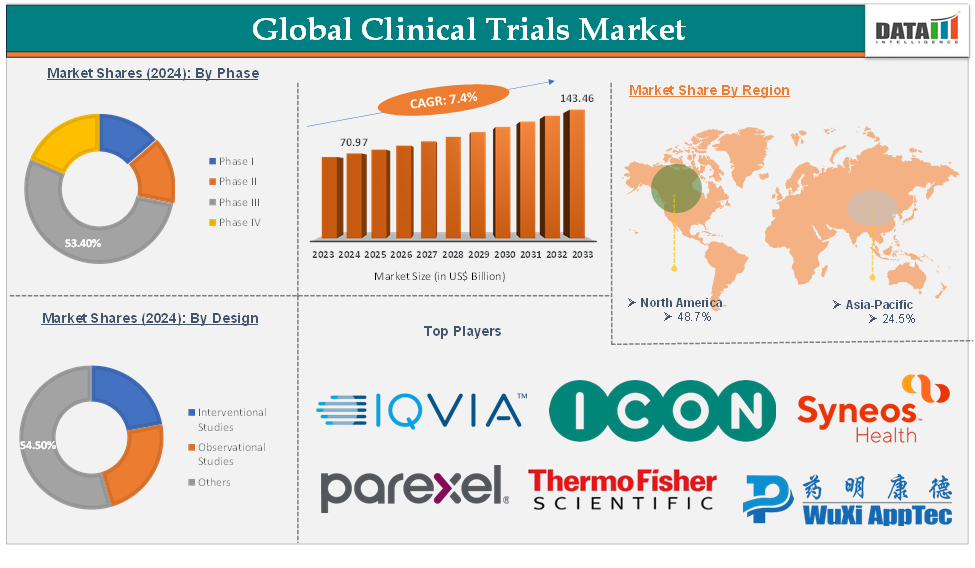
The Global Clinical Trials Market reached US$ 76.22 Billion in 2025 and is expected to reach US$ 155.64 Billion by 2035, growing at a CAGR of 7.4% during the forecast period (2026–2035).
The global clinical trials market refers to the industry segment dedicated to conducting research studies that evaluate the safety, efficacy, and outcomes of new medical interventions, including drugs, devices, and therapies on human participants.
Key drivers of the global clinical trials market include the rising prevalence of chronic diseases such as cancer, diabetes, and cardiovascular disorders, which fuel the demand for novel therapies and interventions. Additionally, increasing investments in pharmaceutical and biotechnology R&D, the adoption of decentralized and virtual clinical trial models, and technological advancements, such as artificial intelligence, big data analytics, and digital biomarkers, are accelerating drug development and enhancing trial efficiency.
Major trends shaping the clinical trials market include the rapid adoption of decentralized clinical trials (DCTs), which leverage digital platforms to allow remote participation and improve patient engagement. The integration of AI and real-world evidence (RWE) is transforming trial design, execution, and monitoring, enabling more adaptive, patient-centric, and cost-effective studies.
Clinical Trials Market Key Takeaways
- USD 76.22 billion in 2025 establishes a substantial commercial base for the clinical trials industry, with the market recalculated to USD 155.64 billion by 2035 at a 7.4% CAGR.
- Phase III accounted for 53.3% of the global clinical trials market, reflecting the scale and investment required to validate therapies before regulatory submission.
- North America represented 48.7% of the market, supported by pharmaceutical R&D, established CRO infrastructure, regulatory capabilities, and technology adoption.
- Asia-Pacific held 24.5%, benefiting from large patient populations, comparatively cost-efficient trial operations, expanding biomedical research, and regulatory development.
- CRO outsourcing is becoming an important operating strategy as sponsors seek specialized capabilities, global trial infrastructure, regulatory expertise, and improved development efficiency.
- Decentralized and virtual clinical trials are creating new approaches to recruitment, remote monitoring, patient engagement, and trial participation, particularly for populations facing geographic or mobility constraints.
- AI, big data analytics, digital health platforms, and real-world evidence are increasingly influencing how trials are designed, monitored, and optimized.
Global Clinical Trials Market – Executive Summary
Global Clinical Trials Market Dynamics: Drivers
Growth in pharmaceutical and biotech R&D
The sustained growth in pharmaceutical and biotech research and development (R&D) is a major driver for the global clinical trials market. As pharmaceutical and biotechnology companies increase their investments in R&D, there is a corresponding rise in the number of new drug candidates and innovative therapies entering the clinical pipeline. This expansion directly fuels demand for clinical trials, which are essential for evaluating the safety and efficacy of these new products before regulatory approval and commercialization.
Rising demand for outsourcing to contract research organizations (CROs)
The rising demand for outsourcing to contract research organizations (CROs) is a major driver in the global clinical trials market. CROs provide essential services to pharmaceutical, biotechnology, and medical device companies, supporting every stage of the clinical trial process from protocol design and site management to patient recruitment, data analysis, and regulatory compliance.
This outsourcing model allows sponsors to access specialized expertise, advanced technology, and global infrastructure without investing heavily in their internal resources, leading to significant cost savings and operational efficiencies. As clinical trials become increasingly complex and globalized, the need for experienced partners who can navigate regulatory requirements and manage multi-country studies has grown. CROs offer end-to-end solutions that help sponsors accelerate drug development timelines and bring new therapies to market faster.
For instance, in January 2025, Advarra, a leading provider of clinical research solutions, announced the launch of a new product called Study Collaboration. This innovative solution is designed to make it easier for organizations involved in clinical trials (such as sponsors, research sites, and contract research organizations) to work together more efficiently. All these factors demand the global clinical trials market.
Clinical Trials Market Scope
| Metric | Details |
| Market Size, 2025 | USD 76.22 billion |
| Market Forecast, 2035 | USD 155.64 billion |
| CAGR | 7.40% |
| Historic Years | 2023-2024 |
| Base Year | 2025 |
| Forecast Period | 2026-2035 |
| Segments Covered | Phase, Service Type, Design, Indication, Region |
| Leading Region | North America |
| Fastest-Growing Region | Asia-Pacific |
Global Clinical Trials Market Dynamics: Restraints
High cost and complexity
High cost and complexity are major restraints for the global clinical trials market. The expense of conducting modern clinical trials has risen dramatically, driven by a combination of factors including more intricate study designs, increasing regulatory requirements, and the need to collect and analyze vast amounts of data.
The growing complexity of clinical trials further compounds these challenges. Trials now often target smaller, more specific patient populations, require more protocol amendments, and involve a greater number of procedures and data points. This complexity leads to longer timelines, higher personnel and administrative costs, and an increased likelihood of delays.
Regulatory compliance is another significant cost driver. Navigating the evolving and often stringent requirements across multiple regions demands specialized expertise and resources, increasing both the direct and indirect costs of clinical trials. The need for compliance with global standards, coupled with the administrative burden of managing multiple sites and complex logistics, further elevates costs and slows down the process of bringing new therapies to market. Thus, the above factors could be limiting the global clinical trials market's potential growth.
Global Clinical Trials Market Dynamics: Opportunities
Expansion of decentralized and virtual trials
The expansion of decentralized and virtual trials represents a significant opportunity for the global clinical trials market. Decentralized clinical trials (DCTs) leverage digital technologies such as telemedicine, wearable devices, mobile health applications, and remote monitoring to allow participants to take part in studies from their homes or local healthcare settings, rather than traveling to centralized research sites. This model increases accessibility for diverse patient populations, reduces geographic and logistical barriers, and enhances convenience, leading to improved recruitment and retention rates.
Moreover, decentralized trials are particularly valuable for reaching underrepresented groups, elderly or disabled patients, and those living in rural or remote areas who might otherwise be excluded from research due to travel constraints. As healthcare systems and sponsors continue to invest in digital maturity and integrated research infrastructure, the shift toward decentralized and virtual trials is expected to transform the clinical research landscape, making studies more flexible, inclusive, and efficient.
For instance, in March 2025, IQVIA, a global leader in healthcare analytics and clinical research services, was recognized as a "Leader" in the 2024 IDC MarketScape assessment for decentralized clinical trial (DCT) technologies and consulting services. This recognition highlights IQVIA’s expertise and strong capabilities in supporting pharmaceutical and life sciences companies as they shift toward decentralized, virtual, and hybrid clinical trial models.
Also, in February 2024, Curavit Clinical Research, a virtual contract research organization (VCRO) specializing in decentralized clinical trials (DCTs) for digital therapeutics (DTx), successfully concluded a decentralized study evaluating the Sana Device. Sana has now submitted the trial results to the U.S. Food and Drug Administration (FDA) for consideration of Breakthrough Device Designation. The Sana Device is a wearable, virtual-reality-style mask that utilizes audiovisual stimulation to help alleviate symptoms of post-traumatic stress disorder (PTSD). Thus, the above factors could be limiting the global clinical trials market's potential growth.
For more details on this report, Request for Sample
Global Clinical Trials Market - Segment Analysis
The global clinical trials market is segmented based on phase, service type, design, indication, and region.
Phase:
The phase III segment is expected to hold 53.3% of the global clinical trials market
The Phase III segment is the largest and most critical phase within the global clinical trials market. This dominance is due to the extensive scale, complexity, and investment required for Phase III studies, which are essential for validating the safety and efficacy of new drugs or therapies before they are submitted for regulatory approval.
Phase III trials are large-scale, multicenter studies typically involving hundreds to thousands of participants across diverse geographic locations. The primary goal is to confirm the therapeutic benefits and monitor adverse reactions in a broad patient population, providing robust statistical evidence for regulatory agencies such as the FDA or EMA. These trials often include randomized, double-blind, and controlled designs to minimize bias and ensure reliable results.
The Phase III segment is experiencing transformation due to technological advancements such as artificial intelligence, big data analytics, and the adoption of decentralized and hybrid trial models. These innovations are streamlining trial management, enhancing patient recruitment, and reducing operational costs. There is also a growing emphasis on patient-centric and adaptive trial designs, which allow for more flexible and efficient study protocols.
For instance, in March 2025, Biogen Inc. started dosing patients in its global Phase 3 clinical trial, called TRANSCEND, to evaluate the efficacy and safety of the investigational drug felzartamab in adult kidney transplant recipients who have developed late antibody-mediated rejection (AMR). These factors have solidified the segment's position in the global clinical trials market.
Global Clinical Trials Market – Geographical Analysis
North America is expected to hold 48.7% of the global clinical trials market
North America, particularly the United States, is home to many of the world’s leading pharmaceutical, biopharmaceutical, and medical device companies. These firms invest heavily in research and development, fueling a continuous pipeline of new drugs and therapies that require extensive clinical testing. The presence of well-established contract research organizations (CROs) and a mature ecosystem for outsourcing further supports market growth.
The adoption of advanced technologies such as artificial intelligence, big data analytics, and decentralized clinical trial platforms is transforming the region’s clinical research landscape. These innovations streamline data collection, improve patient recruitment and retention, and enhance trial efficiency, making North America a leader in modern clinical trial methodologies.
A surge in chronic diseases such as cancer, diabetes, and cardiovascular conditions, along with the need for advanced treatments for rare and emerging diseases, is driving demand for clinical trials in North America. The region’s diverse and aging population further increases the need for innovative therapies and supports the expansion of clinical research activities.
North America benefits from strong regulatory frameworks, particularly through the U.S. Food and Drug Administration (FDA), which has implemented programs to fast-track drug development and approval processes. Government funding and initiatives to promote clinical research, including support for diversity and inclusion in trials, also play a significant role in market growth.
For instance, in January 2024, in the US, BioStem Technologies launched a pivotal clinical trial to evaluate the effectiveness of its Vendaje product, which utilizes the company’s proprietary BioREtain technology, in treating non-healing diabetic foot ulcers (DFUs). This trial is a significant step for BioStem as it aims to demonstrate that Vendaje provides superior wound healing compared to the current standard of care, supporting broader market adoption and expansion.
Asia Pacific is expected to hold 24.5% of the global clinical trials market
Asia-Pacific offers access to a vast and diverse patient population, which enables faster and more efficient patient recruitment for clinical trials. This diversity is particularly valuable for studies targeting a broad range of diseases and for generating data across different ethnic groups, enhancing the global applicability of trial results.
Conducting clinical trials in Asia-Pacific is generally more cost-effective compared to Western countries. Lower operational costs, competitive investigator fees, and affordable infrastructure make the region attractive for pharmaceutical and biotech companies seeking to optimize R&D budgets while maintaining high-quality standards.
Governments in countries such as China, India, Japan, and Singapore are actively promoting biomedical research through funding, regulatory reforms, and incentives. Fast-track approvals, orphan drug designations, and streamlined regulatory pathways have accelerated the initiation and completion of trials, especially for rare and life-threatening diseases.
The region faces a rising prevalence of chronic diseases like cancer, diabetes, and cardiovascular disorders, as well as infectious diseases. This growing disease burden drives demand for innovative therapies and fuels the need for extensive clinical research to address unmet medical needs.
Asia-Pacific is rapidly adopting new clinical research technologies, including digital health platforms, decentralized trial models, and personalized medicine approaches. These innovations improve trial efficiency, patient engagement, and data quality, further propelling market growth.
For instance, in May 2025, India’s “dual potential” in the clinical trials sector refers to its emerging role both as a hub for advanced, global clinical research and as an untapped market for more inclusive, diverse studies. This duality was a major focus at the ETPharma Clinical Research and Excellence Conference (CREC), where industry leaders, regulators, and innovators discussed how India can simultaneously drive cutting-edge innovation and expand access to research for its vast, diverse population. Thus, the above factors are consolidating the region's position as a dominant force in the global clinical trials market.
Global Clinical Trials Market – Competitive Landscape
The major global players in the clinical trials market include IQVIA, ICON plc, Parexel, PPD (Thermo Fisher Scientific), Syneos Health, WuXi AppTec, PSI, Medpace, Lindus Health, Precision for Medicine, Charles River Laboratories International, Inc., Syneos Health, Inc., Pharmaron Beijing Co., Ltd., Clinipace (Caidya), Celero, SGS SA, Chiltern International Ltd (Laboratory Corporation of America, LabCorp/Covance), Eli Lilly and Company, Novo Nordisk A/S, and Pfizer, among others.
Recent Developments
August 2026: North America continued leading the clinical trials market, accounting for 43.9% of global revenue in 2025, supported by strong pharmaceutical R&D spending, CRO activity, advanced clinical infrastructure, and regulatory modernization.
July 2026: Asia-Pacific remained the fastest-growing regional market, supported by large patient populations, cost-efficient trial operations, expanding CRO networks, and increasing clinical research activity in India, China, and South Korea.
June 2026: Europe continued strengthening clinical research through greater adoption of digital technologies and decentralized trial approaches, while sponsors increasingly used remote data collection and patient-centered trial models to improve participation and efficiency.
May 2026: The U.S. FDA advanced its Real-Time Clinical Trials (RTCT) initiative, reporting successful proof-of-concept trials and proposing a pilot program designed to enable real-time sharing of clinical-trial data signals and potentially reduce delays between development phases.
April 2026: The global clinical trials industry increasingly focused on AI-enabled recruitment, data monitoring, digital health technologies, and decentralized trial operations.
Target Audience
- Pharmaceutical and biotechnology companies
- Contract research organizations
- Medical device manufacturers
- Clinical research service providers
- Healthcare technology companies
- AI and data analytics providers
- Digital health and decentralized trial technology companies
- Laboratory and bioanalytical service providers
- Clinical research investors and financial institutions
- Procurement and sourcing teams
- Pharmaceutical strategy and business development teams
- Research institutions and clinical trial organizations
- Regulatory and clinical development professionals
Clinical Trials Market: Analyst Conclusion
The clinical trials market is positioned for sustained expansion as pharmaceutical and biotechnology companies continue investing in new therapies while facing greater pressure to control development costs, improve recruitment, and generate high-quality evidence efficiently. From a 2025 base of USD 76.22 billion, the market is recalculated to reach USD 155.64 billion by 2035 at a 7.4% CAGR, indicating a sizeable opportunity across clinical research services, CROs, digital trial technologies, data platforms, and specialized testing.
The commercial picture is differentiated by phase and geography. Phase III accounted for 53.3% of the market, demonstrating the economic importance of late-stage development, while North America held 48.7% and Asia-Pacific accounted for 24.5%. These concentrations reflect differences in pharmaceutical R&D intensity, clinical infrastructure, patient access, regulatory environments, and trial economics.
The next stage of competition will be shaped by the ability to manage complexity rather than simply increase trial volume. Sponsors and service providers must address high operating costs, difficult recruitment, regulatory demands, fragmented data, and increasingly specialized study populations. Decentralized trials, AI, real-world evidence, and digital monitoring provide practical avenues for improving selected parts of this equation.
For buyers and investors, the timing is important because clinical research is becoming a broader technology and services ecosystem. Companies with strong clinical expertise, scalable infrastructure, effective patient-recruitment capabilities, and integrated digital solutions are better positioned to capture value as sponsors seek more efficient development models through 2035.
The report provides 100 key tables, more than 80 figures, and 173 pages of analysis, offering a detailed framework for evaluating the clinical trials market, its major segments, regional dynamics, competitive environment, and strategic opportunities.



























































