


Continuous Positive Airway Pressure (CPAP) Devices Market Size
The Continuous Positive Airway Pressure (CPAP) Devices Market will reach US$ 1.97 billion in 2026, up from US$ 1.88 billion in 2025, and is projected to reach US$ 3.02 billion by 2035, registering steady growth at a CAGR of 4.88% during the forecast period from 2026 to 2035.
The market for CPAP equipment is being driven by cost-containment strategies and the move to home healthcare. Patients with obstructive sleep apnea (OSA) can conveniently manage their disease at home using home-based therapy, which eliminates the need for overnight sleep studies and hospital stays. Remote monitoring made possible by cloud-connected CPAP equipment enables medical professionals to efficiently check adherence and modify treatment. This method improves patient outcomes while reducing healthcare expenses. Adoption is also encouraged by the growing support for home therapy provided by insurance coverage. The demand for CPAP devices is being driven by convenience, affordability, and increased compliance; as a result, home-based management is a major factor driving market expansion.
Owing to factors like the shift to home healthcare and cost-containment measures, for instance, in August 2024, SoClean announced that it had received FDA De Novo clearance for the SoClean 3+, a bacterial reduction device for certain compatible CPAP masks and hoses. Designed for single-patient home use after recommended cleaning procedures, the device was intended to continually reduce bacteria buildup by sanitizing masks and tubing with activated oxygen, without using chemicals.
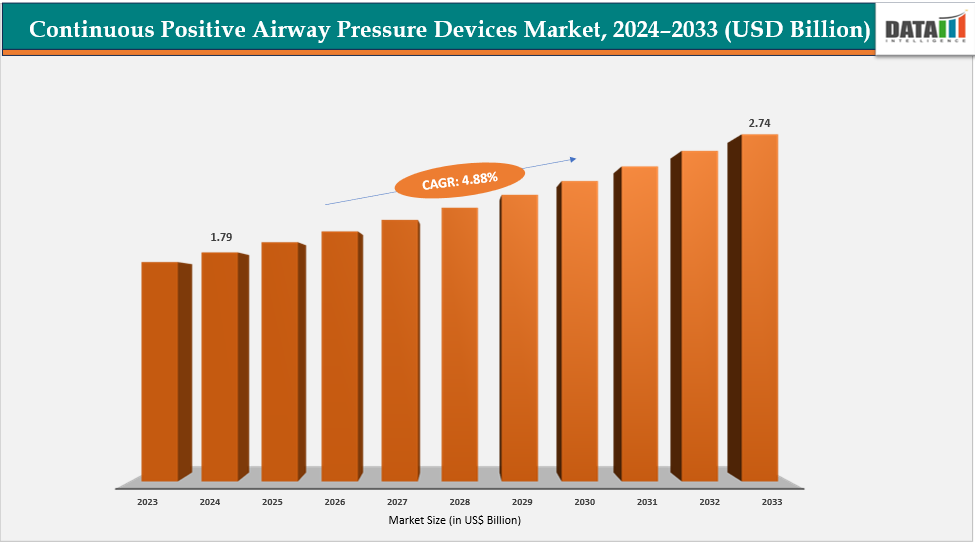
Key Takeaways
- North America accounted for approximately 42-46% of the global Continuous Positive Airway Pressure (CPAP) Devices Market share in 2025, driven by increasing sleep apnea diagnosis rates, favorable reimbursement frameworks, and widespread adoption of connected respiratory care technologies.
- CPAP devices represented nearly 55-60% of total market revenue in 2025 owing to their established clinical efficacy across obstructive sleep apnea management and increasing adoption across home healthcare settings.
- Home care settings contributed approximately 50-55% of overall market demand in 2025, supported by growing patient preference for home-based respiratory care solutions and expanding telemedicine capabilities worldwide.
- More than 65% of newly launched CPAP products globally incorporate connected healthcare capabilities including wireless monitoring technologies, cloud-based patient management systems, and automated treatment optimization functionalities.
- Obstructive sleep apnea applications accounted for nearly 70-75% of total market demand in 2025, reflecting increasing disease prevalence and growing awareness regarding early diagnosis and treatment interventions.
- Asia-Pacific is projected to register the fastest regional growth during the forecast period owing to improving healthcare infrastructure, increasing awareness of sleep disorders, and expanding investments supporting respiratory care technologies.
- Disposable masks and consumables are anticipated to contribute approximately 30-35% of recurring market revenues through 2033 owing to increasing replacement requirements and growing adoption across home healthcare environments.
- Connected CPAP technologies supporting remote patient monitoring capabilities are expected to account for approximately 40-45% of future product innovations globally, substantially strengthening personalized respiratory care initiatives.
- More than 60% of strategic investments announced across the market involve digital healthcare integration initiatives, manufacturing capacity expansion programs, and next-generation respiratory monitoring technologies highlighting the increasing importance of technological innovation worldwide.
Continuous Positive Airway Pressure (CPAP) Devices Market Scope
| Metrics | Details | |
| CAGR | 4.88% | |
| Market Size Available for Years | 2022-2033 | |
| Estimation Forecast Period | 2025-2033 | |
| Revenue Units | Value (US$ Bn) | |
| Segments Covered | Product Type | CPAP Devices, CPAP Humidifiers, CPAP Masks and Accessories |
| Application | Obstructive Sleep Apnea, Chronic Obstructive Pulmonary Disease and Other | |
| End User | Hospitals, Clinics, Sleep Centers, Home Care Settings and Other | |
| Regions Covered | North America, Europe, Asia-Pacific, South America and the Middle East & Africa | |
Continuous Positive Airway Pressure (CPAP) Devices Market Dynamics
Drivers: Rising prevalence of obstructive sleep apnea (OSA) are significantly driving the continuous positive airway pressure devices market growth
The rising prevalence of obstructive sleep apnea is driving growth in the Continuous Positive Airway Pressure (CPAP) devices market. Adoption is being accelerated by growing knowledge of the health hazards of untreated sleep apnea as well as improvements in technologically advanced and home-based CPAP systems. Patient adherence is being improved by innovations like alternative therapies, quieter and more comfortable designs, and networked gadgets. Increased illness incidence is a result of lifestyle variables like obesity and sedentary behavior. Access is further facilitated by insurance coverage, supportive healthcare legislation, and improved interaction with digital health systems. In general, demand is rising as more people look for efficient sleep apnea treatment.
For instance, in May 2025, according to Oxford Academic, an estimated 80.6 million individuals were living with obstructive sleep apnea (OSA) in the United States in 2024, comprising 47,623,848 (59%) males and 32,967,117 (41%) females. This corresponded to an overall prevalence of 32.2% among adults aged 20 years and older, with 39% in males and 25.8% in females, after adjusting for obesity. The severity of OSA, based on the apnea-hypopnea index (AHI), was distributed as 61% mild, 24% moderate, and 15% severe.
Restraints: High upfront costs of CPAP devices are hampering the growth of the continuous positive airway pressure devices market
The high upfront costs of CPAP devices are restraining the growth of the continuous positive airway pressure market. A major financial obstacle is the cost of expensive equipment, masks, and accessories, especially in areas with little insurance coverage. The financial burden is further increased by additional costs for routine mask, tubing, and filter replacements, which deters long-term use. In poor countries, patient adoption rates are lowered by income limits and partial or nonexistent insurance reimbursement. Despite the growing frequency of obstructive sleep apnea, these cost obstacles hinder the number of new users and postpone the start of therapy, which eventually slows market expansion.
For instance, according to CPAP, the high upfront costs of Continuous Positive Airway Pressure (CPAP) devices had been a significant barrier to market growth, particularly in regions with limited insurance coverage. CPAP machines typically ranged from $700 to $1,300, depending on the type, brand, and features. Additional expenses included masks, which cost between $60 and $170, and ongoing maintenance, such as tubing and filter replacements, which amounted to $220 to $1,600 annually.
Continuous Positive Airway Pressure (CPAP) Devices Market Trends & Insights
Shift Toward Auto-Adjusting PAP Devices
Auto-adjusting positive airway pressure devices are gaining adoption because they can automatically adjust pressure according to changes in a patient's breathing pattern and airway resistance. This provides a more personalized treatment approach and can improve comfort compared with fixed-pressure systems.
Connected and Remote CPAP Monitoring
Connected CPAP devices are increasingly incorporating wireless connectivity, cloud-based platforms and remote monitoring capabilities. These technologies allow healthcare professionals to review adherence, usage duration, mask leakage and therapy-related data, supporting more personalized follow-up and early intervention.
Focus on Patient Adherence
Patient adherence remains one of the most important factors affecting CPAP therapy outcomes. Manufacturers are therefore focusing on quieter motors, improved humidification, advanced pressure algorithms, comfortable masks and user-friendly interfaces to reduce treatment discomfort and encourage long-term use.
Integration of Digital Health
Digital health is becoming increasingly integrated into CPAP therapy. Smartphone applications, cloud-based dashboards and remote patient-management platforms can provide users and clinicians with therapy information, reminders and adherence insights.
Growing Demand for Portable CPAP Devices
Compact and travel-friendly CPAP systems are gaining attention among patients seeking greater mobility. Smaller device designs, integrated batteries and simplified interfaces are creating opportunities for manufacturers targeting frequent travelers and home-based users.
Advanced Mask Technologies
Mask comfort remains a critical factor in CPAP adoption and adherence. Manufacturers are developing lighter masks, improved facial seals, reduced contact points and alternative nasal and full-face designs to address leakage, pressure discomfort and claustrophobia.
Home-Based Sleep Apnea Management
The expansion of home-based diagnosis and treatment is supporting demand for CPAP devices outside traditional sleep centers. Home sleep testing, telemedicine and remote monitoring are helping healthcare providers manage obstructive sleep apnea with fewer in-person visits.
AI-Enabled Sleep Therapy
Artificial intelligence and advanced analytics represent an emerging opportunity in CPAP therapy. AI-based algorithms can potentially identify therapy patterns, detect abnormalities, predict adherence issues and support personalized pressure management.
For more details on this report, see Request for Sample
Continuous Positive Airway Pressure (CPAP) Devices Market Segmentation Analysis
The Continuous Positive Airway Pressure Devices Market is segmented based on product type, application, end user, and region.
Application: The obstructive sleep apnea segment from application is dominating the continuous positive airway pressure devices market with a 52.3% share in 2024
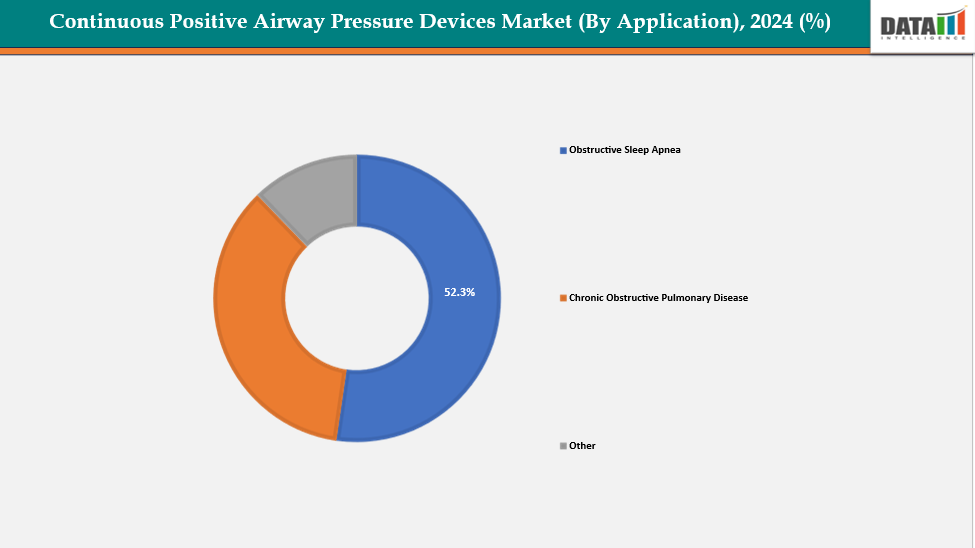
The obstructive sleep apnea (OSA) segment dominates the continuous positive airway pressure (CPAP) devices market due to its large patient base and the clinical effectiveness of CPAP therapy. CPAP devices are the main option for managing OSA because they were created especially to treat the disorder and maintain an open airway while you sleep. The patient pool has grown even more as a result of increased awareness, better screening, and increased diagnostic rates. Furthermore, CPAP therapy is frequently supported by insurance, which promotes uptake. Its standing as the top CPAP application is supported by established advantages such better sleep, fewer apneas, and lower cardiovascular risks.
For instance, in August 2025, Nyxoah announced that the FDA had approved the Genio system for a subset of patients with moderate to severe obstructive sleep apnea (OSA) who had an apnea-hypopnea index (AHI) between 15 and 65. Developed by Nyxoah, Genio therapy provided a new option for patients who had failed, refused, or could not tolerate positive airway pressure therapy such as CPAP and met additional eligibility criteria.
Product type: The CPAP devices segment from product type is dominating the continuous positive airway pressure devices market with a 43.3% share in 2024
The CPAP devices segment dominates the Continuous Positive Airway Pressure market because the machine is the core therapy enabler without it, masks, tubing, or humidifiers cannot function. High prescription rates are caused by the growing frequency of obstructive sleep apnea, and adoption is further encouraged by clinical recommendations and insurance coverage. High-value products, CPAP machines bring considerably more money per unit than accessories. Upgrades and recurrent purchases are encouraged by ongoing technological improvements, such as smart, connected gadgets with remote monitoring. CPAP devices are the largest and most important product class due to regulatory emphasis on devices as the primary therapeutic tool and the ongoing need for better machines.
Continuous Positive Airway Pressure (CPAP) Devices Market Geographical Analysis
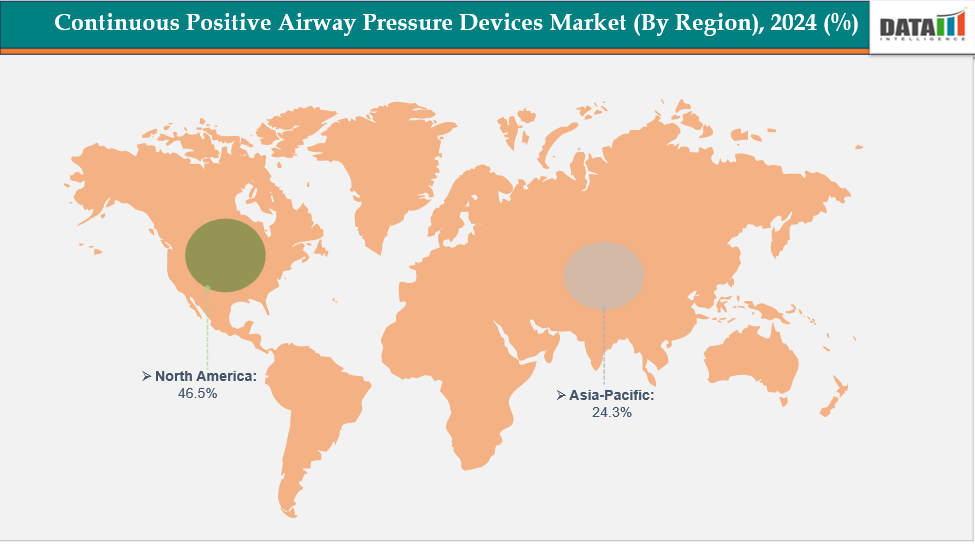
North America dominates the continuous positive airway pressure devices market with 46.5% in 2024
North America dominates the Continuous Positive Airway Pressure (CPAP) devices market due to a combination of high obstructive sleep apnea (OSA) prevalence and advanced healthcare infrastructure. Strong demand for CPAP therapy is driven by widespread awareness and routine diagnosis, and clinics and hospitals are well-equipped to facilitate treatment. In order to improve patient comfort and compliance, the area quickly embraces cutting-edge technology, such as humidifiers and auto-adjusting equipment with smart connectivity. Furthermore, government payment programs and insurance coverage increase the accessibility of CPAP therapy. Further securing North America's market dominance is the robust presence of major manufacturers like as ResMed and Philips, which guarantee device availability and ongoing innovation.
Owing to factors like the presence of key manufacturers in the USA, in September 2024, ResMed led CPAP (Continuous Positive Airway Pressure) mask innovation with the launch of the AirTouch N30i. Designed to provide a natural and comfortable sleep experience, the AirTouch N30i featured a fabric-wrapped frame with a soft, breathable, and moisture-wicking design, offering optimal comfort in a tube-up configuration.
Europe is the second region after North America, which is expected to dominate the continuous positive airway pressure devices market with 35.5% in 2024
The European Continuous Positive Airway Pressure (CPAP) Devices Market is expected to be the second largest globally, with significant contributions from countries such as Germany, the UK, and France. The primary factors driving growth include the region's sophisticated healthcare system, the increasing incidence of obstructive sleep apnea (OSA), and the quick uptake of cutting-edge CPAP technology including integrated humidifiers, smart connection features, and auto-adjusting devices. An aging population, risk factors linked to lifestyle choices, and heightened awareness of early diagnosis and long-term care are further reasons driving demand. Supportive legislative frameworks and programs from groups like the European Sleep Research Society (ESRS) strengthen Europe's position by improving patient outcomes, facilitating prompt intervention, and encouraging therapy adherence.
Germany leads the European CPAP devices market due to high healthcare spending, advanced medical infrastructure, and an aging population. Rising prevalence of obstructive sleep apnea (OSA) and other respiratory disorders drives demand, while early adoption of innovative technologies such as auto adjusting CPAP machines, smart-connected devices, and integrated humidifiers accelerates growth.
Owing to the factors like initiatives from organizations like the European Sleep Research Society (ESRS), for instance, in March 2025, ESRS introduced Sleep Awareness Month Europe, a new initiative dedicated to raising awareness about sleep health across the continent. The campaign aimed to inform families, educators, and healthcare professionals about the importance of sleep and to promote healthy sleep habits. ESRS developed dedicated resources, providing guidance and practical tools to support these efforts. While initially a pilot project, there are plans for a European-wide launch in 2026.
The Asia Pacific region is the fastest-growing region in the continuous positive airway pressure devices market, with a CAGR of 7.37% in 2024
The Asia Pacific (APAC) region is the fastest-growing market for CPAP devices, driven by rising obstructive sleep apnea (OSA) prevalence, lifestyle changes, and an aging population. More instances are being found as a result of improved diagnosis rates, growing healthcare infrastructure, and more public awareness, while advancements in home-based therapy and portable, smart CPAP machines are enhancing adherence. Access and affordability are increasing in nations like China and India due to economic expansion, urbanization, and government initiatives. APAC is a significant contributor to the growth of CPAP devices worldwide due to regulatory support, insurance expansion, and local manufacture, all of which speed up market acceptance.
Japan’s CPAP devices market is growing steadily, driven by an aging population, rising prevalence of obstructive sleep apnea (OSA), and a strong focus on effective, patient-friendly treatments. High demand for advanced CPAP technologies, such as auto-adjusting devices, smart-connected machines, and integrated humidifiers, and fast approvals for medical devices and government support further support the growth of sleep apnea management solutions in Japan.
Owing to the factors like fast approvals for medical devices and government support, for instance, in May 2025, Japan amended its Pharmaceutical and Medical Device Act (PMD Act), introducing a conditional approval system for innovative medical devices and drugs. This system aims to expedite the commercialization of products addressing serious diseases with unmet medical needs, potentially impacting the approval process for CPAP devices in the future.
Continuous Positive Airway Pressure (CPAP) Devices Market Regulatory & Product Safety Insights
Regulatory compliance is an important factor in the development and commercialization of CPAP devices because these systems deliver continuous positive airway pressure and are used for long-term patient management. Manufacturers must address device safety, performance, electrical safety, electromagnetic compatibility, software functionality and, where applicable, connected-device cybersecurity.
Increasing integration of wireless connectivity and digital health platforms is also expanding regulatory considerations beyond traditional hardware performance toward data security, software updates and patient-data management.
Continuous Positive Airway Pressure (CPAP) Devices Market Replacement & Recurring Revenue Opportunity
The CPAP market offers recurring revenue opportunities beyond the initial device purchase. Patients may require replacement masks, cushions, tubing, filters, humidification components and other accessories during long-term therapy.
Manufacturers and healthcare providers can therefore develop integrated patient-support models combining device sales, replacement components, remote monitoring, adherence programs and digital services. This recurring ecosystem can improve customer retention while creating additional revenue streams throughout the therapy lifecycle.
Continuous Positive Airway Pressure (CPAP) Devices Market Competitive Landscape
Top companies in the Continuous Positive Airway Pressure Devices Market include ResMed, Koninklijke Philips N.V., Fisher & Paykel Healthcare Limited, BMC, Wellell Inc., Oxymed India, DeVilbiss Healthcare LLC, Hamilton Medical, Löwenstein Medical SE & Co. KG, and Lincare Holdings Inc., among others.
ResMed: ResMed, founded in 1989 and headquartered in San Diego, is a global leader in sleep health, specializing in CPAP devices for obstructive sleep apnea. Its AirSense and AirCurve series feature advanced technology, digital health integration, and remote monitoring, driving patient adherence. Strong innovation and market leadership underpin its global prominence.
Key Developments in Continuous Positive Airway Pressure (CPAP) Devices Market
- June 2026: ResMed Inc. expanded its digital sleep health ecosystem by enhancing cloud-connected CPAP technologies and AI-enabled patient monitoring solutions to improve therapy adherence and clinical outcomes.
- June 2026: Koninklijke Philips N.V. continued strengthening its sleep and respiratory care portfolio through innovations in connected CPAP devices and patient-centric sleep therapy solutions.
- May 2026: Fisher & Paykel Healthcare Limited advanced its respiratory care technologies by expanding humidification and CPAP therapy solutions designed to improve patient comfort and treatment effectiveness.
- May 2026: BMC Medical Co., Ltd. enhanced its sleep apnea treatment portfolio by introducing advanced auto-adjusting CPAP technologies for home and clinical care applications.
- April 2026: Wellell Inc. strengthened its respiratory therapy offerings through continued investments in intelligent PAP devices featuring integrated data management and remote monitoring capabilities.
- April 2026: Oxymed India expanded its sleep care product portfolio by enhancing the availability of CPAP and BiPAP systems across domestic and international healthcare markets.
- March 2026: DeVilbiss Healthcare LLC continued advancing respiratory care solutions by improving portable and home-based sleep therapy devices designed for obstructive sleep apnea management.
- March 2026: Hamilton Medical AG strengthened its respiratory care technologies through innovations in non-invasive ventilation systems that support comprehensive patient care across healthcare settings.
- February 2026: Löwenstein Medical SE & Co. KG expanded its sleep medicine portfolio by advancing connected CPAP technologies that improve therapy personalization and long-term patient compliance.
Continuous Positive Airway Pressure (CPAP) Devices Market Future Market Trends (2026-2035)
The Continuous Positive Airway Pressure Devices Market is expected to witness sustained growth throughout the forecast period driven by increasing sleep apnea prevalence, expanding home healthcare adoption trends, and continuous technological advancements across respiratory care technologies. Future market expansion will be supported by connected healthcare innovations, remote patient monitoring capabilities, and increasing adoption of personalized respiratory care solutions globally. Additionally, strategic investments supporting manufacturing innovations and digital health integration initiatives are anticipated to significantly influence future market dynamics across major healthcare markets.
Why Choose DataM?
Technological Innovations: DataM evaluates advances in auto-adjusting CPAP, connected devices, remote monitoring, AI-assisted therapy, digital health platforms, portable CPAP systems, advanced humidification technologies, noise-reduction systems and next-generation mask designs.
Product Performance & Market Positioning: The report evaluates CPAP devices based on pressure-delivery accuracy, automatic pressure adjustment, patient comfort, noise level, portability, humidification, connectivity, mask compatibility, data-monitoring capabilities, ease of use and overall therapy performance.
Real-World Evidence: DataM connects market developments with real-world applications across sleep clinics, hospitals, home healthcare, ambulatory settings and long-term home therapy. The report evaluates factors influencing patient adherence, device utilization, mask comfort and ongoing therapy management.
Market Updates & Industry Changes: The report tracks connected-device launches, digital sleep-management platforms, remote monitoring, AI integration, mask innovations, product developments, regulatory changes, reimbursement developments, strategic partnerships and investments in home-based sleep care.
Competitive Strategies: DataM analyzes how leading companies strengthen their positions through connected CPAP platforms, advanced mask portfolios, digital patient-management solutions, product innovation, strategic partnerships, acquisitions, healthcare-provider relationships and expansion into emerging markets.
Pricing & Market Access: The report evaluates pricing based on device type, automatic pressure functionality, connectivity, portability, humidification, mask type, accessories, digital services and healthcare setting while assessing access through hospitals, sleep clinics, home healthcare providers and direct-to-patient channels.
Market Entry & Expansion: DataM identifies opportunities created by increasing sleep apnea awareness, home-based diagnosis, telemedicine, connected healthcare, patient-adherence initiatives and expanding healthcare infrastructure. The report outlines strategies involving local distribution networks, digital-health partnerships, sleep-clinic relationships, affordable product development and expansion into high-growth Asia-Pacific markets.
Target Audience
- CPAP Device Manufacturers - For product development and competitive strategy.
- Sleep Clinics & Hospitals - For technology adoption and procurement.
- Respiratory Care Companies - For product and service opportunities.
- Digital Health Companies - For connected therapy and remote monitoring.
- Investors & Financial Institutions - For market and investment analysis.
- Distributors & Healthcare Providers - For market entry and expansion.
The continuous positive airway pressure devices market report delivers a detailed analysis with 62 key tables, more than 54 visually impactful figures, and 159 pages of expert insights, providing a complete view of the market landscape.
Suggestions for Related Report
For more medical device-related reports, please click here




























































