


Respiratory Devices Market Size
The global respiratory devices market size reached US$ 25.51 billion in 2025 and is expected to reach USD 59.15 billion by 2035, growing at a CAGR of 8.8% during the forecast period 2026-2035
Respiratory devices are instruments that sustain a patient's lungs' normal function or shield the user from airborne dangers. By eliminating carbon dioxide and supplying oxygen, these devices support healthy lung function. For the treatment of a variety of respiratory conditions, respiratory devices are essential. The need for sophisticated, effective, and easily accessible respiratory equipment is only growing as chronic respiratory conditions become more common and healthcare moves toward home-based solutions. Aging demographics, increased awareness, and technology advancements all contribute to this market's continued growth in the years to come. Industry leaders like Fisher & Paykel Healthcare Limited, ResMed, Koninklijke Philips N.V., GE HealthCare, and Medtronic are driving innovation with advanced systems to meet shifting clinical and economic needs.
For instance, in August 2024, the FDA approved the next-generation Inspire V therapy system. Inspire upper airway stimulation is used to treat patients with moderate to severe obstructive sleep apnea (OSA) who cannot tolerate PAP treatments and who do not have a complete concentric collapse at the soft palate level.
Respiratory Devices Market Key Takeaways
- The market is expected to expand from USD 25.51 billion in 2025 to USD 59.15 billion by 2035, supported by sustained demand for respiratory disease management.
- Therapeutic devices accounted for 42.1% of total market revenue, reflecting their central role in managing COPD, asthma, sleep apnea, and critical respiratory conditions.
- Monitoring devices represented 35.4% of the market, benefiting from increasing adoption of remote patient monitoring and digital healthcare.
- North America held the leading regional share of 40.2%, supported by advanced healthcare infrastructure and strong reimbursement systems.
- Asia-Pacific continues to record the fastest expansion as governments strengthen healthcare infrastructure and increase investments in respiratory care.
- Product innovation continues to focus on connected ventilation systems, AI-assisted diagnostics, portable respiratory devices, and homecare solutions.
- Leading manufacturers continue expanding manufacturing capacity, connected healthcare capabilities, and intelligent respiratory monitoring platforms to strengthen competitive positioning.
Respiratory Devices Market Scope
| Metrics | Details |
| Market Size (2025) | USD 25.51 Billion |
| Market Size (2035) | USD 59.15 Billion |
| CAGR (2026-2035) | 8.80% |
| Historic Years | 2023-2024 |
| Base Year | 2025 |
| Forecast Period | 2026-2035 |
| Segments Covered | Product Type, Application/Indication, Portability, End User, Region |
| Leading Region | North America |
| Fastest Growing Region | Asia-Pacific |
Respiratory Devices Market Dynamics
Drivers:
The rising prevalence of respiratory diseases significantly driving the respiratory devices market growth
The rising prevalence of respiratory diseases is one of the most significant growth drivers for the respiratory devices market, as it directly increases the number of patients with respiratory diseases. Conditions such as COPD, asthma, bronchitis, and pneumonia are becoming more common due to smoking, air pollution, allergies, viral infections, bacterial infections, and environmental changes. According to the World Health Organization (WHO), over 80 million people are affected with respiratory diseases, and many more are undiagnosed worldwide.
Moreover, even though 81.7 million people in the region are living with a chronic respiratory disease (CRD) and 6.8 million are newly diagnosed each year, CRDs have slipped from policy priorities, leaving millions without the care and attention they need. COPD and asthma account for the majority of CRD cases in the region. Hospitalization from asthma also remain high, particularly among young people, despite the availability of effective treatments.
Restraints:
The high cost of advanced devices and procedures hampers the growth of the respiratory devices market
The devices are expensive because they are life-sustaining medical technology that needs to be manufactured in relatively small quantities in comparison to consumer electronics and requires advanced engineering, stringent safety regulations, premium materials, and long-term service support. Because of this, acquiring a hospital's fleet of ventilators is a significant choice. One aspect of that decision-making process is the price of purchasing new equipment. Numerous ventilator options are available to meet the needs of different types of patients.
These can cost anywhere from $5,000 to $50,000 USD. Most frequently encountered in hospital intensive care units, premium or high-acuity ventilators usually include a PSOL gas delivery configuration and can currently cost anywhere from $25,000 to $50,000 for mechanical ventilators.
For more details on this report, Request for Sample
Respiratory Devices Market Segment Analysis
The global respiratory devices market is segmented based on product type, application/indication, portability, end-user, and region.
By Product Type: The therapeutic devices from product type are expected to be dominating the respiratory devices market with a 42.1% share
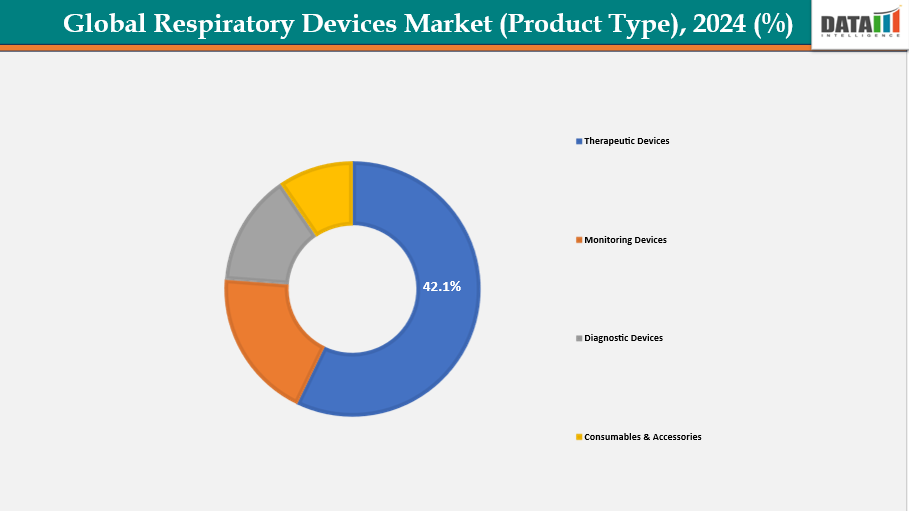
The therapeutic devices in the respiratory devices segment are expected to dominate the respiratory devices market owing to the high global prevalence of asthma and chronic obstructive pulmonary disease (COPD) conditions. Better disease management is made possible by the incorporation of cutting-edge technologies into respiratory equipment, which improves patient outcomes. Additionally, patients are actively looking for therapeutic options that will improve their quality of life as they become more conscious of chronic respiratory difficulties. A wider variety of treatment choices on the market and an expanding healthcare infrastructure both contribute to this tendency.
Owing to this, for the management of critical care in hospitals and the management of respiratory diseases, mechanical ventilators, CPAP/BiPAP machines, nebulizers, and inhalers are widely used. For the management of asthma and COPD, inhalers are widely used. For instance, according to the Global Initiative for Asthma (GINA), asthma is a serious global health problem, affecting approximately 300 million people around the world.
The monitoring devices from product type are expected to be dominating the respiratory devices market with a 35.4% share
In the respiratory devices market, the monitoring device segment plays a crucial role as it enables real-time assessment of lung function, oxygen levels, and ventilation status, supporting both diagnosis and disease management. Devices such as pulse oximeters, capnographs, and spirometers are increasingly used across hospitals, homecare, and ambulatory settings to track patient conditions, guide treatment decisions, and prevent complications in chronic respiratory diseases like COPD, asthma, and sleep apnea. The rising prevalence of respiratory disorders, coupled with growing demand for home-based monitoring and integration of digital health technologies, is driving strong adoption of this segment, making it an essential component for improving clinical outcomes and reducing healthcare costs.
Respiratory Devices Market Geographical Analysis
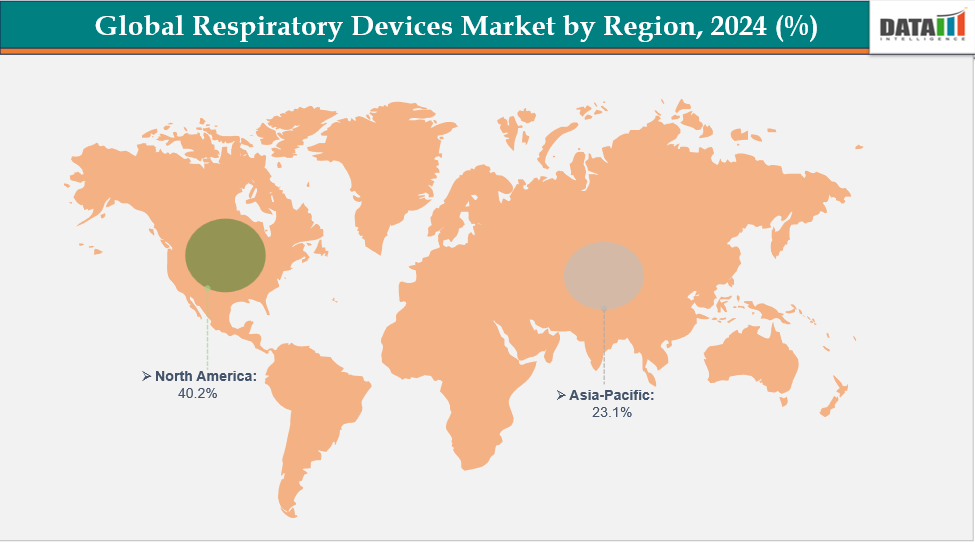
North America dominates the global respiratory devices market with 40.2%
North America has established itself as the dominant region in the global respiratory devices market, largely due to its advanced healthcare ecosystem, high burden of COPD diseases, robust reimbursement ecosystem, strong market presence of leading device manufacturers, and strong reimbursement frameworks. The US, in particular, accounts for the majority of respiratory incidences, fueled by both a high incidence of asthma and COPD and a rapidly aging population prone to respiratory problems.
For instance, recent data published by Asthma Canada states that 4.6 million Canadians are living with asthma, 92% have experienced stress because of their asthma, 26% had an emergency room visit in the past year due to asthma, and 98% say wildfire smoke and poor air quality worsen their symptoms.
The rise in prevalence is one of the key factors that helps the US respiratory devices market to grow during the forecast period.
Europe is expected to dominate the global respiratory devices market share with 32.3% in 2025.
The respiratory devices market in Europe is witnessing strong growth, driven by the rising prevalence of asthma, COPD, and sleep apnea, alongside a rapidly aging population. Increasing demand for home-based care, supported by user-friendly CPAP, BiPAP, and oxygen therapy devices, further boosts adoption. Technological advancements, including smart inhalers and portable ventilators, enhance treatment efficiency. Favorable reimbursement policies and government initiatives promoting early diagnosis also support market expansion, making Europe a key growth hub for respiratory device innovation.
Owing to this, in March 2025 the TidalSense received clearance under EU Medical Device Regulations for N-Tidal Diagnose is the first new non-spirometry-based AI COPD diagnostic test. Set to launch in the NHS in the UK from April 2025, this groundbreaking technology offers a game-changing alternative to traditional spirometry - a diagnostic technique
The Asia Pacific region is the fastest-growing region in the global respiratory devices market, with a CAGR of 7.8% .
Asia-Pacific is emerging as the fastest-growing region in the global respiratory devices market, driven by rapid improvements in healthcare infrastructure, a huge disease burden, high pollution, aging populations, rising income, better healthcare infrastructure, and post-COVID investment in respiratory care.
Countries such as China is witnessing a sharp rise in the prevalence of respiratory diseases, creating a robust demand for the respiratory device market. Increasing government investments in healthcare modernization, along with the expansion of private hospitals and centers, are enabling wider adoption of therapeutic devices, monitoring devices, diagnostic devices, and consumables & accessories.
This extra investment will bring the total in the factory, which will produce its budesonide, glycopyrronium bromide, and formoterol fumarate inhalers for chronic obstructive pulmonary diseases such as asthma, to US$ 700 million.
Respiratory Devices Market Competitive Landscape
Top companies in the respiratory devices market include Fisher & Paykel Healthcare Limited, ResMed, Koninklijke Philips N.V., GE HealthCare, Medtronic, Drägerwerk AG & Co. KGaA, Getinge, Masimo, Baxter, Invacare International Holdings Corp., CorVent Medical Inc., and AstraZeneca.
Koninklijke Philips N.V.:
Koninklijke Philips N.V. is a global leader in the respiratory devices market with a broad portfolio. It specializes in CPAP/BiPAP machines for sleep apnea, ventilators for COPD and asthma, and related accessories. The company benefits from recurring revenues through its masks and consumables. Its worldwide reach and innovation-driven approach make it a key player in advancing respiratory care.
Respiratory Devices Market Key Developments
April 2026: ResMed Inc. expanded its respiratory device portfolio with advanced connected CPAP, BiPAP, and home ventilation systems, supporting improved management of sleep apnea and chronic respiratory diseases through remote patient monitoring.
March 2026: Philips Healthcare strengthened its respiratory care business through the introduction of next-generation ventilation and oxygen therapy solutions, enhancing patient outcomes across hospital and homecare settings.
February 2026: Medtronic plc accelerated development of intelligent respiratory support technologies, integrating digital monitoring and automation features to improve critical care and respiratory disease management.
January 2026: The United States increased investments in respiratory healthcare infrastructure and homecare technologies, supporting wider adoption of advanced respiratory devices for chronic obstructive pulmonary disease (COPD), asthma, and sleep disorders.
December 2025: Fisher & Paykel Healthcare expanded manufacturing capabilities for respiratory humidification and ventilation devices, addressing rising global demand for critical care and home respiratory support solutions.
November 2025: Japan strengthened investments in respiratory care innovation and aging population healthcare programs, driving adoption of advanced oxygen therapy and respiratory monitoring devices.
October 2025: GE HealthCare introduced enhanced respiratory monitoring and ventilation technologies, improving clinical workflow efficiency and patient management in intensive care and emergency care environments.
September 2025: China increased investments in respiratory healthcare infrastructure and medical device manufacturing, supporting broader access to ventilators, oxygen concentrators, and respiratory monitoring systems.
July 2025: Drägerwerk AG & Co. KGaA expanded its critical care respiratory device portfolio with advanced ventilators and respiratory monitoring solutions designed for hospital and emergency care applications.
May 2025: Europe accelerated adoption of respiratory care technologies across Germany, France, and the United Kingdom, supporting improvements in critical care capacity and chronic respiratory disease management.
March 2025: Masimo Corporation enhanced its respiratory monitoring solutions through advanced sensor technologies and real-time patient surveillance systems, supporting early detection of respiratory complications.
January 2025: India increased investments in respiratory healthcare services and medical device manufacturing, supporting growing demand for ventilators, oxygen therapy equipment, and home respiratory care solutions across the country.
Market Impact Assessment
Healthcare investments, expanding reimbursement support, increasing adoption of connected respiratory technologies, and stronger government focus on chronic disease management continue improving long-term market fundamentals. Simultaneously, manufacturers are strengthening supply chains and regional manufacturing capacity to meet growing global demand while improving equipment availability.
How This Report Supports Business Decisions
This report enables manufacturers to evaluate product positioning and commercialization strategies while helping investors identify long-term growth opportunities within respiratory care. Suppliers can better understand procurement trends, technology adoption, and regional demand patterns. Healthcare providers and procurement teams can benchmark vendor capabilities and evaluate future purchasing priorities. Strategy teams gain detailed insight into competitive positioning, product innovation, investment direction, and emerging market opportunities through 2035.
Target Audience
- Respiratory Device Manufacturers
- Medical Technology Companies
- Hospitals and Healthcare Networks
- Homecare Service Providers
- Healthcare Investors
- Private Equity Firms
- Procurement Managers
- Healthcare Distributors
- Medical Device Suppliers
- Government Healthcare Agencies
- Regulatory Authorities
- Research and Development Teams
- Healthcare Strategy Consultants
- Digital Health Technology Providers
Conclusion
The respiratory devices market is positioned for sustained expansion as healthcare systems increasingly prioritize chronic respiratory disease management, home-based care, and connected clinical technologies. Rising disease prevalence, aging populations, and continued investment in respiratory infrastructure will remain the principal growth drivers through 2035. Although equipment affordability and capital expenditure requirements present ongoing challenges, manufacturers that combine intelligent monitoring, digital connectivity, reliable clinical performance, and scalable production capabilities will be well positioned to strengthen market share. Organizations monitoring long-term opportunities in respiratory healthcare should closely follow developments in homecare technologies, AI-assisted diagnostics, and integrated respiratory management platforms as these areas continue to influence purchasing decisions across global healthcare systems.
Suggestions for Related Report
For more medical device-related reports, please click here



























































