


Autonomous Last Mile Delivery Market Overview
Global Autonomous Last Mile Delivery Market reached US$ 1.39 billion in 2025 and is expected to reach US$ 7.74 billion by 2033, growing at a CAGR of 24.0% during the forecast period 2026-2033. The autonomous last-mile delivery market is experiencing rapid growth, driven by advancements in artificial intelligence (AI), robotics, and electric vehicle (EV) technology.
Autonomous Last Mile Delivery Market Trends
The surge in e-commerce and online food ordering has significantly increased the need for efficient and contactless delivery solutions. Autonomous last-mile delivery robots and vehicles address this demand by ensuring seamless deliveries with minimal human intervention. The COVID-19 pandemic further emphasized the importance of contactless transactions, encouraging businesses and consumers to adopt autonomous technologies.
Companies such as Starship Technologies, Kiwibot, and Amazon Prime Air are expanding their fleets to cater to rising delivery needs. As urbanization accelerates, autonomous delivery solutions are expected to play a pivotal role in addressing logistical challenges while reducing costs and improving efficiency.
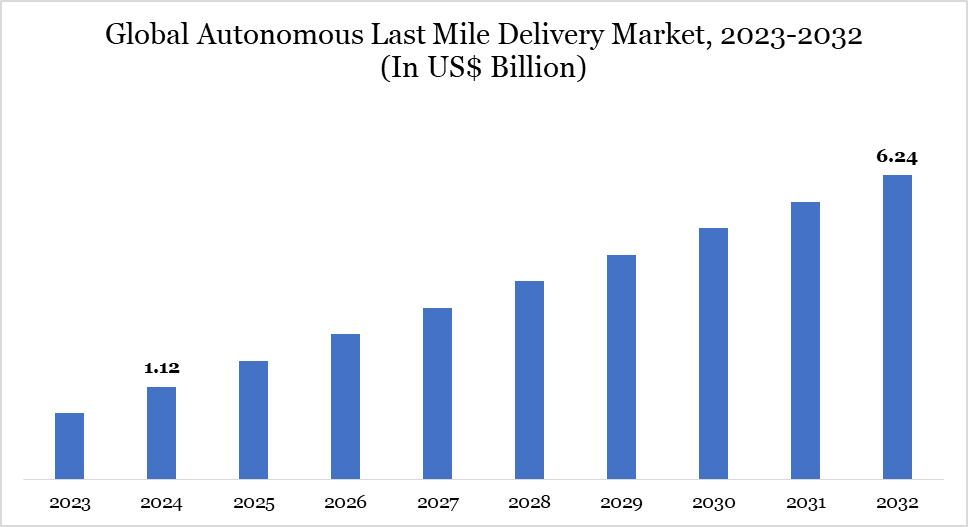
Source: DataM Intelligence
Key Takeaways
- The rapid advancement of autonomous delivery technologies, including AI-powered navigation, computer vision, robotics, and connected vehicle platforms, is emerging as a key industry trend, with logistics providers and technology companies focusing on improving delivery efficiency, reducing operational costs, and enabling scalable last-mile fulfillment.
- North America maintains a leading position, accounting for a significant share of the global autonomous last-mile delivery market, driven by strong investments in autonomous mobility technologies, expanding e-commerce networks, supportive pilot programs, and the presence of leading robotics, automotive, and logistics technology companies.
- Asia-Pacific is projected to record substantial growth during the forecast period, supported by rapid urbanization, increasing online retail penetration, smart city initiatives, rising labor cost pressures, and growing investments in autonomous mobility infrastructure across major economies.
- The continued expansion of e-commerce, food delivery, grocery delivery, and on-demand logistics services is becoming a major factor accelerating the adoption of autonomous last-mile delivery solutions across urban and suburban environments.
- Growing deployment of autonomous delivery robots, self-driving delivery vehicles, and unmanned aerial delivery systems is increasing demand for intelligent fleet management, real-time route optimization, and AI-enabled logistics platforms capable of enhancing delivery speed, accuracy, and customer experience.
- Industry participants are increasingly evaluating investments based on autonomous driving capabilities, artificial intelligence integration, fleet scalability, operational reliability, regulatory readiness, and long-term total cost of ownership rather than focusing solely on vehicle deployment volumes.
- Rising investments in smart transportation infrastructure, connected mobility ecosystems, warehouse automation, 5G connectivity, and digital logistics platforms are creating significant opportunities for autonomous last-mile delivery technology providers, logistics companies, and mobility solution developers worldwide.
Autonomous Last Mile Delivery Market Scope
| Metrics | Details | |
| 1 | CAGR | 24% |
| 2 | Size Available for Years | 2023-2032 |
| 3 | Forecast Period | 2025-2032 |
| 4 | Market Value | In US$ Billion |
For more details on this report – Request for Sample
Autonomous Last Mile Delivery Market Dynamics
Driver - Increasing Demand for Contactless Deliveries
- The surge in e-commerce and online food ordering has significantly increased the need for efficient and contactless delivery solutions. Autonomous last-mile delivery robots and vehicles address this demand by ensuring seamless deliveries with minimal human intervention.
- The COVID-19 pandemic further emphasized the importance of contactless transactions, encouraging businesses and consumers to adopt autonomous technologies.
Restraint - High Initial Investment and Regulatory Challenges
- Developing autonomous delivery robots and vehicles requires substantial funding for research, AI development, and safety compliance.
- Additionally, regulatory frameworks vary across regions, slowing down large-scale deployment.
Autonomous Last Mile Delivery Market Segmentation Analysis
The global autonomous last mile delivery market is segmented based on platform, solution, delivery range, end-user, and region.
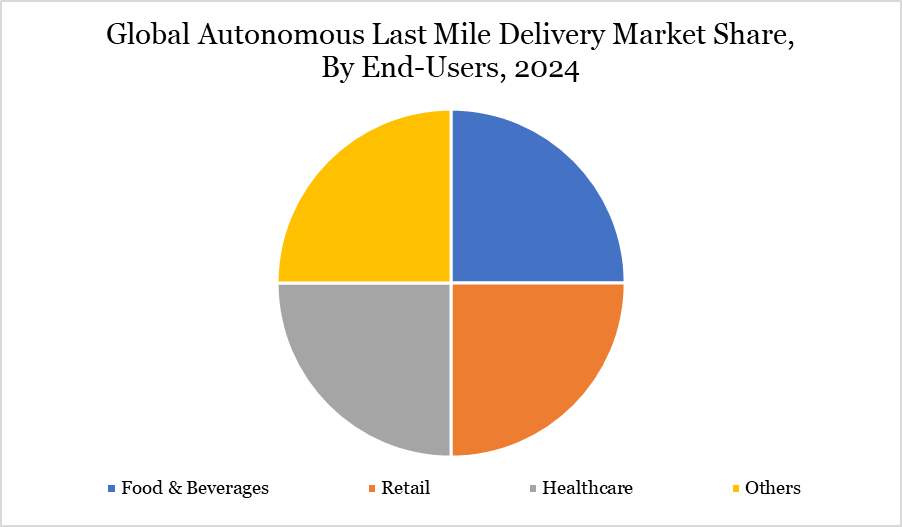
Source: DataM Intelligence
Rising Demand for Cost-Efficient and Contactless Urban Logistics Drives the Ground Delivery Robots Segment
Based on platform, the market is segmented into Ground Delivery Robots, Aerial Delivery Drones, Autonomous Delivery Vehicles, and Others. The Ground Delivery Robots segment is expected to account for a significant share of the autonomous last mile delivery market owing to its growing deployment for short-distance deliveries in urban and suburban environments. These robots offer an efficient solution for reducing delivery costs, minimizing human intervention, and improving delivery speed while addressing increasing consumer demand for contactless and on-demand delivery services. Their ability to operate on sidewalks and designated pathways makes them particularly suitable for food delivery, grocery distribution, healthcare logistics, and campus deliveries.
The segment continues to benefit from ongoing advancements in autonomous navigation, artificial intelligence, computer vision, and sensor technologies. Market participants are increasingly focusing on expanding commercial deployments, improving fleet management capabilities, and integrating autonomous delivery robots into existing logistics networks to enhance operational efficiency and customer experience.
Expanding Adoption of Autonomous Delivery Across Longer Routes Accelerates the Long-Range Delivery Segment
Based on delivery range, the market is segmented into Short Range, Medium Range, and Long Range. The Long-Range Delivery segment is anticipated to witness the fastest growth during the forecast period due to increasing investments in autonomous delivery technologies capable of serving larger delivery zones with minimal operational costs. The expansion of e-commerce, rising demand for rapid parcel delivery, and continuous improvements in battery technology, autonomous navigation, and route optimization are supporting the adoption of long-range autonomous delivery solutions.
Growing collaborations between logistics providers, technology developers, retailers, and e-commerce companies are further accelerating innovation in autonomous delivery ecosystems. As organizations continue to invest in scalable autonomous delivery infrastructure, the long-range delivery segment is expected to play an increasingly important role in enabling efficient, reliable, and sustainable last mile logistics across urban and regional transportation networks.
Autonomous Last Mile Delivery Regional Market Analysis
North America Autonomous Last Mile Delivery Market
North America remains one of the leading markets for autonomous last mile delivery due to strong e-commerce penetration, rapid technological innovation, favorable investment activity, and early commercialization of autonomous mobility solutions.
The United States leads the regional market through significant investments in autonomous vehicle technology, robotics, AI, and pilot programs for autonomous delivery services. Growing consumer demand for same-day delivery and continuous innovation by logistics and technology companies continue to accelerate market adoption.
Major demand-generating industries include:
- E-commerce
- Food & Beverage Delivery
- Grocery Retail
- Healthcare and Pharmaceuticals
- Parcel and Courier Services
- Logistics and Transportation
Asia-Pacific Autonomous Last Mile Delivery Market
Asia-Pacific is expected to register the fastest growth during the forecast period due to rapid urbanization, expanding e-commerce activities, increasing investments in robotics and AI, and supportive government initiatives promoting intelligent transportation technologies.
China remains the largest market in the region, supported by advanced digital infrastructure, large-scale e-commerce operations, rapid commercialization of autonomous delivery technologies, and substantial investments in robotics and autonomous mobility.
India is emerging as a major growth opportunity due to:
- Rapid expansion of e-commerce platforms
- Increasing urban population and delivery demand
- Growth of quick commerce and food delivery services
- Rising investments in AI, robotics, and logistics technology
- Government initiatives supporting digital transformation and smart city development
Japan, South Korea, Singapore, and other Asia-Pacific countries continue investing in autonomous mobility, robotics innovation, and smart logistics infrastructure to improve delivery efficiency and urban transportation systems.
Europe Autonomous Last Mile Delivery Market
Europe is witnessing steady market growth supported by increasing investments in sustainable transportation, logistics automation, smart mobility initiatives, and digital transformation across supply chains.
Germany, France, the United Kingdom, and the Netherlands remain key contributors due to strong innovation ecosystems, advanced logistics infrastructure, and ongoing pilot deployments of autonomous delivery technologies.
The region is increasingly focusing on:
- Sustainable urban logistics
- Autonomous delivery robots
- Drone-enabled logistics services
- AI-driven fleet optimization
- Smart city and connected mobility initiatives
These developments continue to accelerate the adoption of autonomous last mile delivery solutions across commercial and public sectors.
Latin America Autonomous Last Mile Delivery Market
Latin America is gradually expanding its autonomous last mile delivery capabilities through growing digital commerce, logistics modernization, and investments in automation technologies.
Countries such as Brazil, Mexico, and Chile are witnessing increasing adoption of intelligent delivery solutions across retail, food delivery, healthcare logistics, and parcel transportation.
Growing demand for faster delivery services and improvements in digital infrastructure are expected to support future market expansion throughout the region.
Middle East & Africa Autonomous Last Mile Delivery Market
The Middle East & Africa region is experiencing growing demand for autonomous last mile delivery solutions due to smart city initiatives, increasing e-commerce adoption, logistics infrastructure development, and investments in digital transformation.
Saudi Arabia and the UAE are leading investments in autonomous mobility, robotics, AI-enabled logistics, and smart transportation projects as part of broader economic diversification and innovation strategies.
Autonomous Last Mile Delivery Market Technology Roadmap
The global autonomous last mile delivery market is expected to evolve significantly over the coming years, driven by advancements in network infrastructure, the expansion of IoT, and the increasing adoption of artificial intelligence (AI) at the logistics. Government initiatives, regulatory frameworks, and private sector investments are set to accelerate AI adoption in cybersecurity across multiple industries.
Technology Roadmap of Global Autonomous Last Mile Delivery Market
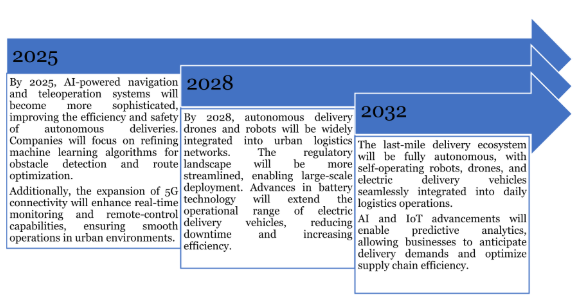
Source: DataM Intelligence
Autonomous Last Mile Delivery Market Players
The major Global players in the market include Airbus S.A.S, Amazon, DHL International GmbH, DPD Group, Drone Delivery Canada, Flirtey, Flytrex, JD.com, MATTERNET, and Savioke.

By Platform
- Ground Delivery Vehicles
- Delivery Bots
- Self-driving Vans & Trucks
- Aerial Delivery Drones
- Fixed-Wing
- Rotary-Wing
- Hybrid
By Solution
- Hardware
- Software
- Services
By Delivery Range
- Short Range (<20 Kilometers)
- Long Range (>20 Kilometers)
By End-User
- Food & Beverages
- Retail
- Healthcare
- Others
By Region
- North America
- US
- Canada
- Mexico
- Europe
- Germany
- UK
- France
- Italy
- Spain
- Rest of Europe
- South America
- Brazil
- Argentina
- Rest of South America
- Asia-Pacific
- China
- India
- Japan
- Australia
- Rest of Asia-Pacific
- Middle East and Africa
Why Choose DataM?
- Data-Driven Insights: Dive into detailed analyses with granular insights such as pricing, market shares and value chain evaluations, enriched by interviews with industry leaders and disruptors.
- Post-Purchase Support and Expert Analyst Consultations: As a valued client, gain direct access to our expert analysts for personalized advice and strategic guidance, tailored to your specific needs and challenges.
- White Papers and Case Studies: Benefit quarterly from our in-depth studies related to your purchased titles, tailored to refine your operational and marketing strategies for maximum impact.
- Annual Updates on Purchased Reports: As an existing customer, enjoy the privilege of annual updates to your reports, ensuring you stay abreast of the latest market insights and technological advancements. Terms and conditions apply.
- Specialized Focus on Emerging Markets: DataM differentiates itself by delivering in-depth, specialized insights specifically for emerging markets, rather than offering generalized geographic overviews. This approach equips our clients with a nuanced understanding and actionable intelligence that are essential for navigating and succeeding in high-growth regions.
- Value of DataM Reports: Our reports offer specialized insights tailored to the latest trends and specific business inquiries. This personalized approach provides a deeper, strategic perspective, ensuring you receive the precise information necessary to make informed decisions. These insights complement and go beyond what is typically available in generic databases.
Target Audience
- Manufacturers/ Buyers
- Industry Investors/Investment Bankers
- Research Professionals
- Emerging Companies




























































