


Global Warehouse Robots Market Size and Forecast
The Warehouse Robots Market will reach US$ 8.68 billion in 2026, up from US$ 7.74 billion in 2025, and is projected to reach US$ 27.54 billion by 2035, registering strong growth at a CAGR of 12.2% during the forecast period from 2026 to 2035.
The global warehouse robots market is experiencing robust growth, driven by the exponential rise of e-commerce, persistent labor shortages, and the critical need for supply chain optimization. These autonomous machines, including autonomous mobile robots (AMRs), robotic arms, and goods-to-person systems, enhance operational efficiency by automating tasks such as sorting, picking, palletizing, and transportation. The demand is further fueled by advancements in AI, machine learning, and sensor technology, which have improved the capabilities and affordability of robotic solutions. The market experiences a high growth as 80% of warehouses still lack any form of automation, presenting a vast untapped opportunity for adoption.
North America, and particularly the United States, represents a rapidly advancing region within this global landscape. The high concentration of major retailers, third-party logistics (3PL) providers, and tech giants, coupled with intense pressure for faster delivery times, makes the US a primary adopter of warehouse automation. Significant investments are being channeled into modernizing fulfillment centers to stay competitive. Reflecting this trend, the US warehouse robotics market is a significant contributor to the global figures.

Warehouse Robots Market Dynamics
Driver: Rising Demand for Faster and Error-Free Order Fulfillment in E-Commerce
A primary driver for the global warehouse robots market is the critical need to enhance order fulfillment speed and accuracy to meet escalating consumer expectations for rapid delivery. The rise of next-day and same-day delivery guarantees has placed immense pressure on logistics networks, making manual processes increasingly untenable. Warehouse robots, particularly autonomous mobile robots (AMRs), excel by navigating facilities autonomously to bring shelves to human pickers, drastically reducing walking time and streamlining the entire picking and packing operation. This directly translates into faster order processing and a significant reduction in errors, which is essential for maintaining customer satisfaction in the competitive e-commerce landscape.
Amazon has deployed over 750,000 robotic drive units in its fulfillment centers worldwide, working in concert with human employees. This massive automation initiative is a core component of its ability to promise and deliver expedited shipping to billions of Prime subscribers. Following its acquisition of Kiva Systems, Amazon's implementation of mobile robotics has been credited with slimming order cycle times by up to 40% and increasing storage capacity by optimizing dense inventory stacking, showcasing a direct correlation between robotic adoption and operational performance.
Warehouses utilizing AMRs for goods-to-person picking can achieve a 200-300% increase in pick rates compared to traditional methods. Furthermore, over 4 billion commercial warehouse robots will be installed by 2025, a figure heavily influenced by the need for speed. This surge is a direct response to the unrelenting growth of e-commerce, where the ability to fulfill orders accurately and swiftly is no longer a luxury but a fundamental requirement for business survival and growth.
Restraint: High Upfront Capital Costs Limiting Adoption among SMEs
A significant restraint on the warehouse robots market is the substantial upfront capital investment required for integration. The costs extend beyond the robots themselves to include necessary warehouse infrastructure modifications, sophisticated software implementation, and ongoing maintenance and specialized operator training. This high initial expenditure creates a formidable barrier to entry, particularly for small and medium-sized enterprises (SMEs) with limited capital. Consequently, many businesses, despite recognizing the long-term benefits in efficiency and cost-saving, are financially unable to adopt this automation technology, slowing overall market penetration outside of large, well-funded corporations.
For more details on this report, Request for Sample
Warehouse Robots Market Key Takeaways
- Asia-Pacific accounts for approximately 50-52% of the global market, driven by rapid expansion of e-commerce, manufacturing automation, and logistics infrastructure.
- Autonomous Mobile Robots (AMRs) and Automated Guided Vehicles (AGVs) contribute nearly 45-50% of total market demand, owing to their flexibility, scalability, and efficiency in warehouse operations.
- Transportation and material handling applications account for more than 40% of warehouse robotics deployments, supported by increasing demand for faster order fulfillment and inventory movement.
- E-commerce and retail industries represent approximately 45-50% of total end-user demand, driven by the need for high-speed, accurate, and cost-effective warehouse operations.
- Warehouse robotics can improve operational productivity by up to 30-40%, while reducing picking errors and labor costs through automated workflows.
- More than 70% of large distribution centers are investing in warehouse automation technologies, driven by labor shortages, rising order volumes, and same-day delivery requirements.
- Cloud-connected warehouse management systems (WMS) integrated with robotics are witnessing double-digit growth, improving inventory visibility, workflow optimization, and operational efficiency.
- AI-powered robotic picking, sorting, and palletizing solutions are expected to experience annual adoption growth exceeding 20%, enhancing warehouse throughput and fulfillment accuracy.
- Growing investments in smart warehouses, Industry 4.0, and supply chain digitalization are expected to accelerate long-term market expansion.
Warehouse Robots Market Ecosystem and Value Chain Analysis
The warehouse robotics market operates through a multi-layered ecosystem involving component suppliers, robotics manufacturers, software developers, automation integrators, logistics providers, warehouse operators, retailers, e-commerce companies, and end users. Component suppliers provide motors, controllers, batteries, sensors, cameras, LiDAR systems, processors, communication modules, and safety components that form the technological foundation of robotic platforms. Robotics companies integrate these components into autonomous mobile robots, automated guided vehicles, robotic arms, picking systems, autonomous forklifts, and other material-handling solutions. Software providers add warehouse management, warehouse execution, fleet orchestration, navigation, inventory tracking, analytics, and predictive-maintenance capabilities. System integrators then connect robotic equipment with conveyors, automated storage and retrieval systems, warehouse software, and existing facility infrastructure. This interconnected structure is increasing the importance of integrated solutions, technology compatibility, lifecycle support, and software capabilities in determining competitive positioning.
Warehouse Robots Market Scope
| Metrics | Details | |
| CAGR | 12.2% | |
| Market Size Available for Years | 2023-2035 | |
| Estimation Forecast Period | 2026-2035 | |
| Revenue Units | Value (US$ Bn) | |
| Segments Covered | Robot Type | Automated Guided Vehicles (AGVs), Autonomous Mobile Robots (AMRs), Collaborative Robots, Articulated Robots, Cylindrical Robots and Others |
| Function | Transportation, Picking & Placing, Palletizing & Depalletizing and Sorting & Packaging | |
| Payload Capacity | Up-to 20 Kg, 21 - 100 Kg, 101 - 200 Kg and More than 200 Kg | |
| End-use Industry | Automotive, Chemicals, Semiconductors & Electronics, Retail & E-Commerce, Food & Beverage, Pharmaceuticals and Others | |
| Regions Covered | North America, Europe, Asia-Pacific, South America, and the Middle East & Africa | |
Artificial Intelligence and Intelligent Warehouse Automation Analysis
Artificial intelligence is fundamentally transforming warehouse operations worldwide by enabling intelligent automation capabilities across inventory management, order fulfillment, and material handling activities. Warehouse robotics solutions integrated with machine learning algorithms, computer vision technologies, and real-time analytics platforms are substantially improving operational efficiencies across modern fulfillment environments. Intelligent warehouse robots are increasingly capable of autonomous decision-making functions involving route optimization, inventory allocation, and dynamic task prioritization capabilities, significantly enhancing overall warehouse productivity.
The growing emphasis on digital supply chain transformation initiatives is substantially strengthening commercialization opportunities across intelligent warehouse technologies globally. Furthermore, increasing adoption of AI-powered warehouse management systems capable of improving inventory visibility and operational scalability is anticipated to significantly influence future technological developments throughout the forecast period. Intelligent warehouse automation ecosystems are expected to remain strategically important across next-generation logistics infrastructures worldwide.
Autonomous Mobile Robots and Smart Fulfillment Centers Analysis
Autonomous Mobile Robots (AMRs) continue representing one of the fastest-growing technological segments across the Warehouse Robotics Market globally. Unlike conventional automated guided vehicles, AMRs utilize intelligent navigation technologies capable of adapting dynamically to warehouse environments while simultaneously improving operational flexibility and deployment efficiencies. Their increasing adoption across e-commerce fulfillment centers, third-party logistics facilities, and industrial warehouses is substantially strengthening future commercialization opportunities worldwide.
Manufacturers are increasingly investing in intelligent robotic systems capable of improving order accuracy, reducing fulfillment timelines, and optimizing labor utilization capabilities across warehouse operations. Furthermore, increasing demand for scalable fulfillment infrastructures designed to support omnichannel retail operations is anticipated to positively influence future market expansion considerably. Smart fulfillment centers incorporating autonomous robotics technologies are expected to become indispensable components of modern supply chain ecosystems throughout the forecast period.
Global Warehouse Robots Market Segment Analysis
The global warehouse robots market is segmented based on robot type, function, payload capacity, end-use industry and region.
Payload Capacity: The up-to 20 Kg segment is estimated to have 58.2% of the warehouse robots market share.
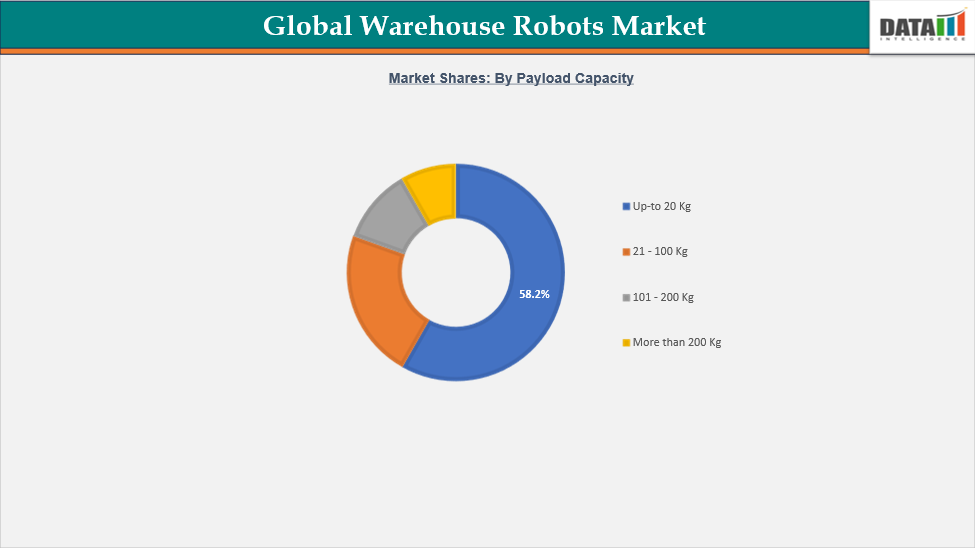
The up-to-20 kg payload segment is the undisputed growth engine of the global warehouse robotics market, primarily driven by the relentless expansion of e-commerce. This category is perfectly suited for the vast majority of items sold online, including electronics, apparel, and pharmaceuticals, which typically fall within this weight range. The core value proposition lies in automating the most labor-intensive process, that is order picking. By deploying fleets of nimble Autonomous Mobile Robots (AMRs) that bring shelves to stationary pickers, companies achieve dramatic gains in speed and accuracy, directly addressing consumer demands for rapid fulfillment. This goods-to-person methodology is revolutionizing warehouse operations, making it the dominant automation strategy for retailers and third-party logistics providers (3PLs).
PUMA implemented a fleet of AMRs from Geek+ at its distribution center in Germany, where the robots were tasked with transporting picking carts filled with shoes and apparel, all well under the 20 kg limit. This system was designed to support a massive throughput goal of over 80,000 items shipped daily. The results were transformative, enabling a 50% reduction in order processing time while simultaneously doubling the average number of lines picked per hour. This direct correlation between AMR adoption and productivity underscores the segment's critical role in achieving competitive advantage through operational excellence.
The massive adoption is fueled by the segment's versatility, encompassing not just AMRs but also collaborative robotic arms for light assembly and drones for inventory counting. The market for these agile robots is projected to grow at a high CAGR as the continuous growth of online retail makes their value proposition indispensable for modern logistics. Their ability to integrate quickly and deliver a rapid return on investment ensures this segment will remain the focal point of warehouse automation innovation.
Warehouse Robots Market Geographical Analysis

The Asia-Pacific warehouse robots market was valued at 39.1% market share in 2024
The Asia-Pacific (APAC) region is the dominant force and primary growth engine in the global warehouse robots market, far surpassing other regions in both scale and adoption rate. This leadership is fueled by a potent combination of massive government initiatives, rising labor costs, and e-commerce expansion. Countries such as China, South Korea, and Japan are aggressively promoting industrial automation through policies such as "Made in China 2025," directly subsidizing and incentivizing robotic adoption in logistics. The sheer volume of goods moving through APAC's supply chains makes automation a critical necessity for maintaining economic momentum and global competitiveness.
A landmark case study is Japanese logistics giant Yamato Holdings, which faced crippling labor shortages amid rising delivery demand. The company deployed a massive fleet of autonomous mobile robots (AMRs) from a local vendor in a new, highly automated sorting facility. This system handles billions of parcels, with most individual items falling well below 20 kg. The implementation was a success, boosting sorting efficiency by 40% and enabling the facility to operate with a 30% smaller workforce despite handling a significantly higher parcel volume, showcasing automation's role in solving demographic challenges. The growth is further propelled by the dense concentration of global manufacturing and the emergence of massive e-commerce platforms such as Alibaba and JD.com in the region.
The North America warehouse robots market was valued at 27.5% market share in 2024
The North American warehouse robots market is characterized as a mature, high-value arena defined by its rapid adoption of cutting-edge technology to solve acute logistical challenges. Its growth is primarily driven by the relentless pressure of e-commerce giants, severe labor shortages in the warehousing sector, and the intense consumer demand for next-day and same-day delivery. Unlike regions focused on manufacturing automation, North American deployment is concentrated in fulfillment and distribution centers, where speed and scalability are paramount. This environment has made it the global testing ground for sophisticated autonomous mobile robots (AMRs) and complex fleet management software.
A pivotal case study is Walmart Canada, which addressed capacity constraints by implementing a vast system of robotic fulfillment technology from Symbotic across its regional distribution centers. This end-to-end automation system, which includes fleets of robots working in unison, sorts and transports billions of individual items. The results were transformative, increasing the facility’s throughput by up to 40% while achieving nearly 100% inventory accuracy. This demonstrates how major retailers are leveraging automation not for incremental gains but for fundamental, large-scale operational transformation.
The United States accounts for more than 90% of the regional market share, with sustained growth fueled by the need to maximize storage density in expensive real estate markets and to build resilient supply chains capable of weathering future disruptions, cementing automation as a cornerstone of modern North American logistics strategy.
Warehouse Robots Market ROI, Pricing and Deployment Economics Analysis
The economic attractiveness of warehouse robotics depends on more than the purchase price of robotic equipment. Total deployment costs may include hardware, software licenses, charging infrastructure, system integration, facility modifications, networking, employee training, maintenance, cybersecurity, technical support, and periodic upgrades. Warehouse operators increasingly evaluate robotics based on total cost of ownership, labor savings, throughput improvements, inventory accuracy, utilization rates, space optimization, energy consumption, and expected payback period. The financial case varies according to warehouse size, order volume, SKU characteristics, labor costs, operating hours, automation density, and facility layout. Modular systems can reduce deployment risk by allowing organizations to automate selected workflows before expanding across the entire facility.
Warehouse Robots Market Robotics-as-a-Service and Flexible Deployment Models Analysis
Robotics-as-a-Service is creating an alternative commercial model for organizations that want automation without committing significant capital expenditure at the beginning of a project. Subscription, leasing, usage-based, and managed-service models can allow warehouse operators to obtain robotic capacity according to operational requirements. These arrangements can be particularly attractive for SMEs, third-party logistics providers, seasonal businesses, and companies experiencing fluctuating order volumes. RaaS providers may also assume responsibility for maintenance, software updates, fleet optimization, and technical support. As the model develops, pricing is expected to increasingly reflect robot utilization, throughput, service availability, and operational outcomes rather than equipment ownership alone.
Warehouse Robots Market Competitive Benchmarking Analysis
Competition in the warehouse robotics market is expanding beyond traditional industrial robotics toward specialized AMR developers, warehouse automation companies, material-handling providers, software companies, and integrated logistics technology providers. Competitive positioning can be assessed across several parameters, including robot portfolio, payload capability, navigation technology, autonomous functionality, machine vision, AI capabilities, fleet-management software, WMS/WES integration, RaaS availability, industry specialization, geographic presence, system integration expertise, customer deployment scale, aftermarket support, and technology partnerships. Companies with broad hardware portfolios and strong software integration capabilities can address more complex warehouse automation requirements, while specialized providers may compete through flexibility, rapid deployment, lower infrastructure requirements, or industry-specific solutions.
Warehouse Robots Market Competitive Landscape
The global warehouse robots market features several prominent players, including ABB Group, KUKA AG, FANUC Corporation, Yaskawa Electric Corporation, Honeywell International Inc, Omron Corporation, Toyota Material Handling Solutions, Daifuku Co., Ltd., KION GROUP AG, and Geekplus Technology Co., Ltd., among others.
ABB Group: ABB Group is a global powerhouse in industrial automation and a key player in the warehouse robotics market, primarily through its comprehensive range of robotic arms. Unlike companies focused on mobile robots, ABB excels in automated palletizing, depalletizing, and case-picking solutions. Their robots are engineered for high-speed, heavy-payload applications, integrating advanced vision systems and software to handle complex tasks in distribution and fulfillment centers. A major client such as Walmart utilizes ABB's robotic solutions to automate distribution, highlighting their role in providing robust, precision automation for the demanding logistics sector, particularly for tasks beyond the scope of smaller, mobile units.
Warehouse Robots Market Recent Developments
- June 2026 - ABB Group: Expanded its AI-powered robotic automation portfolio with new solutions designed to improve warehouse productivity and order fulfillment.
- June 2026 - Honeywell International Inc.: Introduced advanced warehouse automation software and robotics technologies to optimize distribution center operations.
- May 2026 - KION GROUP AG: Expanded its autonomous mobile robot (AMR) portfolio to enhance warehouse automation and intralogistics efficiency.
- May 2026 - Daifuku Co., Ltd.: Launched next-generation automated storage and retrieval systems (AS/RS) for high-throughput warehouse operations.
- April 2026 - FANUC Corporation: Introduced new industrial robots with enhanced AI and vision capabilities for warehouse picking and material handling.
- April 2026 - Geekplus Technology Co., Ltd.: Expanded its warehouse robotics solutions with AI-driven autonomous mobile robots for e-commerce and logistics applications.
- March 2026 - KUKA AG: Launched advanced robotic automation solutions to improve warehouse flexibility and intelligent material handling.
- March 2026 - Omron Corporation: Expanded its autonomous mobile robot portfolio with enhanced fleet management and navigation technologies for smart warehouses.
Warehouse Robots Market Emerging Technologies Analysis
The next stage of warehouse automation is being shaped by physical AI, advanced machine vision, digital twins, edge computing, cloud robotics, autonomous forklifts, intelligent picking systems, multi-robot coordination, predictive maintenance, and increasingly sophisticated robotic manipulation. Physical AI enables robots to respond to less structured environments and changing operational conditions, while vision-based systems improve object recognition and handling of products with different shapes and characteristics. Digital twins can help warehouse operators simulate layouts, robot traffic, storage configurations, and workflow changes before implementing physical modifications. Humanoid robots represent an emerging technology area that could eventually perform multiple warehouse activities using environments designed for human workers, although their commercial role remains less mature than established AMR, AGV, ASRS, and robotic picking technologies.
Warehouse Robots Market Investment Opportunity Analysis
The Warehouse Robotics Market presents substantial investment opportunities as businesses increasingly automate warehouse operations to improve productivity, reduce labor dependency, and optimize supply chain efficiency. The rapid growth of e-commerce, omnichannel retail, third-party logistics (3PL), and manufacturing is accelerating demand for intelligent robotic systems capable of handling picking, sorting, packaging, palletizing, and inventory management. Continuous advancements in artificial intelligence, machine vision, autonomous navigation, IoT connectivity, and cloud-based warehouse management systems are expanding the capabilities of warehouse robots while reducing operational costs. Increasing investments in smart warehouses, automated fulfillment centers, and digital supply chain infrastructure across emerging economies further strengthen the market's long-term investment potential.
Warehouse Robots Market Future Trends (2026-2035)
The Warehouse Robotics Market is expected to witness substantial growth throughout the forecast period driven by increasing adoption across e-commerce fulfillment operations, intelligent supply chain ecosystems, and autonomous warehouse technologies worldwide. Future market expansion will be supported by artificial intelligence innovations, Robotics-as-a-Service deployment models, sustainable warehouse initiatives, and Industry 4.0 technologies across global markets.
Increasing investments supporting intelligent logistics infrastructures, technological advancements, and digital transformation initiatives are anticipated to substantially strengthen commercialization opportunities globally. Furthermore, growing demand for scalable and highly automated warehouse environments capable of improving operational efficiencies while reducing fulfillment timelines is expected to significantly influence future market dynamics across major industrial economies through 2035.
Why Choose DataM?
Technological Innovations: DataM provides comprehensive insights into the latest technological advancements transforming the Warehouse Robotics Market, including artificial intelligence-enabled warehouse automation, autonomous mobile robots (AMRs), collaborative robots (cobots), robotic picking and sorting systems, cloud-connected warehouse management platforms, digital twin technologies, and machine vision-based robotics solutions. The report evaluates how intelligent automation technologies are improving operational efficiencies, inventory accuracy, fulfillment speed, and scalability across modern warehouse environments worldwide.
Product Performance & Market Positioning: The report analyzes how leading market participants differentiate their warehouse robotics solutions based on critical performance parameters such as navigation accuracy, payload capacity, battery life, fulfillment speed, operational flexibility, warehouse integration capabilities, scalability, and software interoperability. It highlights the competitive positioning of intelligent robotic platforms designed to address the evolving requirements of e-commerce fulfillment centers, third-party logistics providers, manufacturing facilities, and omnichannel retail operations globally.
Real-World Evidence: DataM delivers valuable insights into the practical adoption of warehouse robotics technologies across intelligent fulfillment centers, e-commerce distribution hubs, industrial warehouses, and automated logistics facilities worldwide. The report highlights measurable business outcomes including improved inventory visibility, reduced operational costs, enhanced labor productivity, minimized fulfillment errors, faster order processing capabilities, and strengthened supply chain resilience achieved through intelligent warehouse automation initiatives.
Market Updates & Industry Changes: The report tracks significant industry developments including investments supporting warehouse automation initiatives, technological advancements involving artificial intelligence-assisted robotics platforms, strategic partnerships among logistics and automation providers, expansion of robotics manufacturing capabilities, and emerging trends influencing intelligent supply chain transformation activities across major global markets. It provides comprehensive analyses of evolving market dynamics supporting next-generation warehouse ecosystems and autonomous logistics infrastructures.
Competitive Strategies: DataM evaluates how leading organizations strengthen their competitive positioning through artificial intelligence innovations, Robotics-as-a-Service (RaaS) deployment models, strategic acquisitions, intelligent warehouse management capabilities, product portfolio expansions, and regional commercialization initiatives. The report further examines how robotics manufacturers collaborate with cloud technology providers, logistics organizations, and e-commerce companies to address increasing demand for scalable and highly automated warehouse environments globally.
Pricing & Market Access: The report provides strategic insights into pricing variations across warehouse robotics solutions based on deployment models, automation capabilities, software integration requirements, payload specifications, warehouse configurations, and operational complexities. Additionally, it evaluates market accessibility through direct sales channels, warehouse automation solution providers, system integrators, cloud technology partnerships, and Robotics-as-a-Service business models supporting both large enterprises and small-to-medium-sized organizations worldwide.
Market Entry & Expansion: DataM identifies attractive growth opportunities driven by accelerating e-commerce activities, increasing investments supporting intelligent logistics infrastructures, labor optimization requirements, and digital supply chain transformation initiatives globally. The report outlines strategic approaches involving regional expansion activities, intelligent automation investments, customized warehouse solutions, and strategic collaborations designed to support successful market entry and long-term business expansion strategies across emerging and established warehouse automation markets. By delivering actionable intelligence on technological innovations, commercialization opportunities, and competitive developments, DataM enables stakeholders to make informed strategic decisions while strengthening their market positioning within the rapidly evolving global Warehouse Robotics Market.
Target Audience
The Warehouse Robotics Market report is designed for warehouse operators, e-commerce companies, retailers, third-party logistics providers, logistics companies, distribution-center operators, robotics manufacturers, AMR and AGV developers, ASRS providers, warehouse automation integrators, WMS and WES providers, AI and machine-vision companies, industrial automation companies, manufacturing organizations, pharmaceutical distributors, food and beverage companies, cold-chain operators, investors, private equity firms, venture capital firms, technology consultants, supply-chain strategists, and corporate decision-makers seeking to evaluate warehouse automation technologies, competitive positioning, investment opportunities, deployment economics, and future technology trends.
The global warehouse robots market report delivers a detailed analysis with 70 key tables, more than 71 visually impactful figures, and 234 pages of expert insights, providing a complete view of the market landscape.
Suggestions for Related Report
For more related reports, please click here



























































