


Automotive Battery Thermal Management System Market Size and Overview
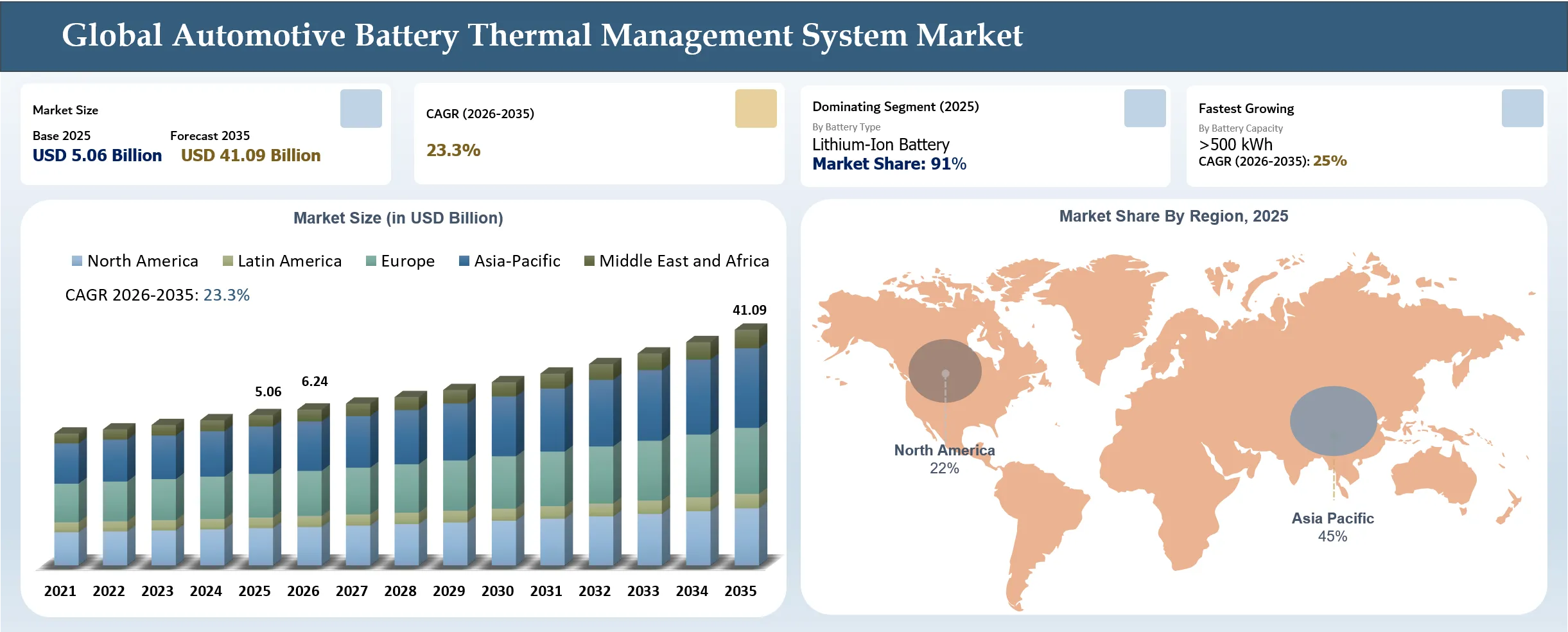
The global automotive battery thermal management system market reached USD 5.06 billion in 2025 and is expected to reach USD 41.09 billion by 2035, growing with a CAGR of 23.3% during the forecast period 2026-2035. The market is gaining momentum as EV manufacturers seek more efficient thermal architectures to support fast-charging, increased battery efficiency, reduced size of battery packs, and better energy use by vehicles. In June 2026, Shell unveiled its Triple 10 Challenge concept car, presenting a thermal management architecture that is based on one cooling loop and Shell Recharge dielectric thermal fluid.
The vehicle has a 10 to 80% battery charging time of 9 minutes 54 seconds via a 175-kW charger, while providing a 10 km/kWh driving efficiency and more than 30% better energy efficiency than many current-generation EVs. Additionally, the thermal-fluid architecture has allowed a decrease in the overall cost of the battery pack by about 25%, whereas the lifecycle carbon footprint of the vehicle has been calculated to be about 10 tonnes CO₂e, which is 50% lower than average European BEV cars.
Automotive Battery Thermal Management System Market Key Takeaways
- Asia-Pacific leads the global industry with a 45% market share as of 2025. The region acts as the dominant regional market and fastest-growing hub driven by localized EV and battery production.
- Lithium-ion battery systems held a commanding 91% global market share in 2025. This is reinforced by global EV battery deployments reaching 1.2 TWh, reflecting a 30% year-over-year increase.
- DENSO’s specialized heavy-truck thermal control module achieved over 20% higher Coefficient of Performance (COP) than comparable modules. It was implemented in Hino's fuel-cell heavy-duty trucks to enhance battery longevity.
- Demand for cell-to-cell temperature uniformity carries a 28% market growth impact factor. Liquid-cooling solutions lower maximum battery temperatures by 15-30% compared to air cooling and limit cell temperature gaps to under 5°C.
Automotive Battery Thermal Management System Market Scope
| Metrics | Details | |
| 2025 Market Size | USD 5.06 Billion | |
| 2035 Projected Market Size | USD 41.09 Billion | |
| CAGR (2026-2035) | 23.3% | |
| Largest Market | Asia-Pacific | |
| Fastest Growing Market | Asia-Pacific | |
| By Battery Type | Lithium-Ion (Li-ion), Nickel-Metal Hydride (Ni-MH), Lead-Acid, Nickel-Cadmium (Ni-Cd), Others | |
| By Cooling System | Air Cooling, Liquid Cooling, Refrigerant Cooling, Phase Change Material (PCM) Cooling, Immersion Cooling, Hybrid Cooling, Others | |
| By Battery Capacity | <100 kWh, 100–200 kWh, 200–500 kWh, >500 kWh | |
| By Vehicle | Passenger Vehicle, Commercial Vehicle | |
| By Propulsion | Battery Electric Vehicle (BEV), Hybrid Electric Vehicle (HEV), Fuel Cell Vehicle (FCV) | |
| By Technology | Active, Passive | |
| By Region | North America | U.S., Canada, Mexico |
| Europe | Germany, UK, France, Spain, Italy, Poland, Netherlands, Switzerland | |
| Asia-Pacific | China, India, Japan, Australia, South Korea, Indonesia, Malaysia | |
| Latin America | Brazil, Argentina | |
| Middle East and Africa | UAE, Saudi Arabia, South Africa, Israel, Türkiye | |
| Report Insights Covered | Competitive Landscape Analysis, Company Profile Analysis, Market Size, Share, Growth | |
Automotive Battery Thermal Management System Market BCG Matrix: Company Evaluation

Stars include LG Chem, Samsung SDI, Continental AG, and Valeo, as these companies have strong positions in EV battery technologies, thermal-management systems, electrification components, and integrated vehicle thermal architectures. Question Marks include Gentherm, Robert Bosch, Hanon Systems, and MAHLE, which have significant automotive thermal-management, HVAC, electrification, or component capabilities but face strong competition from battery manufacturers, Tier-1 suppliers, and integrated thermal-system providers.
The Potential category includes VOSS Automotive and Danam, which can benefit from the increasing adoption of liquid-cooled EV battery systems, thermal-fluid management, coolant routing, connectors, hoses, and related thermal components. There are no tailenders in this selected group, because all 10 companies have a meaningful connection with automotive thermal management, electrification, battery systems, or related vehicle thermal technologies.
Automotive Battery Thermal Management System Market Dynamics
Driver Impact Analysis
| Driver | Market Growth Impact (%) | Demand Concentration | Impacted Use Case | Strategic Impact |
Increasing requirements for temperature uniformity across battery cells are accelerating advanced cold-plate, liquid-cooling, and hybrid BTMS designs. | 28% | High concentration in high-energy-density EV battery packs, premium EVs and fast-charging platforms | Cell-to-cell temperature balancing, battery pack cooling, high-power driving and fast charging | Accelerates adoption of liquid cold plates, optimized flow channels and hybrid liquid-PCM architectures, while increasing demand for precise temperature monitoring and thermal-control components. |
Expansion of ultra-fast EV charging is increasing the need for high-performance liquid, immersion, PCM, and hybrid cooling systems to manage higher heat generation. | 32% | High concentration in BEVs, high-voltage EV platforms and fast-charging passenger/commercial vehicles | DC fast charging, extreme fast charging, high-C-rate charging and repeated charging cycles | Drives development of higher heat-transfer-capacity cooling systems, battery pre-cooling and advanced thermal architectures. |
Increasing focus on preventing battery thermal runaway is accelerating the development of PCM, hybrid cooling and advanced heat-dissipation technologies. | 24% | High concentration in high-energy-density Li-ion packs, EV passenger vehicles and commercial EVs | Thermal runaway prevention, hot-spot suppression, thermal propagation mitigation and battery safety | Increases demand for PCM, immersion cooling, thermal barriers, advanced sensing and hybrid BTMS, shifting BTMS design from temperature control alone toward integrated thermal-safety management. |
Integration of AI and predictive controls into BTMS is enabling real-time temperature prediction, adaptive cooling, and lower auxiliary energy consumption. | 20% | Concentrated in premium EVs, intelligent BMS platforms and next-generation connected EV architectures | Predictive cooling, thermal-fault detection, adaptive coolant control and energy-efficient fast charging | Creates demand for AI-enabled BMS, predictive thermal models, digital twins and real-time thermal sensing. |
Increasing requirements for temperature uniformity across battery cells are accelerating advanced cold-plate, liquid-cooling, and hybrid BTMS designs
The increasing use of high-energy-density lithium-ion batteries and high-rate charging in electric vehicles is intensifying the need to maintain consistent temperatures across individual cells and modules. Temperature non-uniformity can accelerate battery degradation, reduce performance, and increase thermal-safety risks, making precise thermal control an increasingly important requirement for automotive battery thermal management systems.
In parallel, innovations in cold-plate and hybrid BTMS solutions are contributing to rapid advancements towards attaining better temperature management of individual cells when facing tough operating conditions in electric vehicles. In February 2026, Springer Nature reported that liquid-cooling systems were proven to lower maximum temperatures of the battery by around 15-30% compared with air-cooling systems, and advanced cold-plate systems can ensure that cell-to-cell temperature differences are no more than 5°C. Furthermore, the review shows that hybrid BTMS systems based on both liquid and PCM can minimize temperature spikes, while new interleaved cold-plate solutions can lower maximum temperature by up to 15% compared with conventional cold-plates.
Automotive Battery Thermal Management System Market Segment Analysis
The global automotive battery thermal management system market is segmented based on battery type, cooling system, battery capacity, vehicle, propulsion, technology, and region.
Lithium-Ion Battery Segment Dominating the Automotive Battery Thermal Management System Market
The lithium-ion (Li-ion) segment dominates the automotive battery thermal management system market, with a 91% market share in 2025, due to lithium-ion batteries being the most common type of battery used in battery electric, hybrid, and plug-in hybrid cars. The rise in the use of EVs will also mean a greater number of installations requiring thermal management since lithium-ion batteries produce heat when charged and discharged.
The rapid expansion of electric vehicle adoption is increasing the deployment of high-capacity lithium-ion battery packs, strengthening demand for effective thermal management systems. According to the International Energy Agency (IEA), there has been a global deployment of EV batteries amounting to 1.2 TWh, which is a rise of 30% in one year, and light-duty vehicles have contributed to more than 85% of EV battery deployment. Such massive deployment further increases the need for BTMS that will help to keep batteries within safe temperatures and support performance, longevity, and safety.
Automotive Battery Thermal Management System Market Geographical Penetration
Rapid EV Production and Battery Manufacturing Expansion in Asia-Pacific Driving Dominance of Automotive Battery Thermal Management Systems
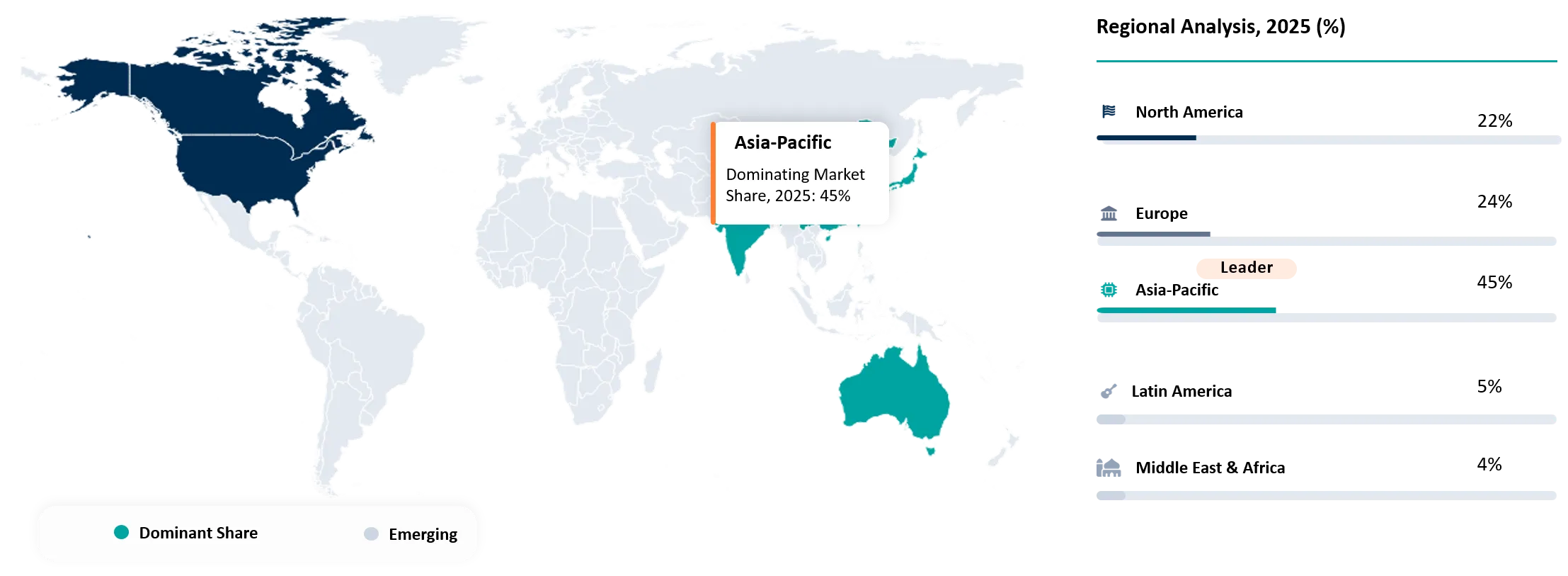
The Asia-Pacific region dominates the automotive battery thermal management system market, with a 45% market share in 2025, supported by its strong concentration of electric-vehicle manufacturing, battery-cell production, automotive supply chains, and EV component suppliers. China, Japan, South Korea, and Southeast Asian economies have developed extensive EV and battery manufacturing ecosystems, creating a large addressable market for battery thermal-management technologies.
China’s expanding electric-vehicle industry is increasing demand for advanced battery thermal-safety and thermal-runaway prevention technologies. In June 2026, NanoTIM Co., Ltd., a South Korea-based battery-materials company, signed a memorandum of understanding (MOU) with Anhui Xingaole New Material Technology Co., Ltd. (AGW), a China-based new-materials company, to collaborate on thermal-runaway prevention materials and fire-suppression systems for electric-vehicle batteries in China.
China Automotive Battery Thermal Management System Market Trends
China holds a dominant position in the Asia-Pacific automotive battery thermal management system market due to its large-scale electric vehicle manufacturing base, extensive battery-cell production capacity, strong domestic battery supply chain, and rapid commercialization of new-energy vehicles. The country’s concentration of EV manufacturers and battery producers supports the deployment of advanced battery thermal management technologies, including liquid cooling, cooling plates, refrigerant cooling, and integrated thermal-management architectures.
Strategic acquisitions are strengthening domestic capabilities across the EV battery thermal-management supply chain. In November 2025, Shenzhen Aike Lighter Technology Co., Ltd. (Aike Group), a China-based technology and manufacturing company, received approval from the Shenzhen Stock Exchange’s M&A Review Committee to acquire 100% of Dongguan Sixiang Insulation Materials Co., Ltd., a China-based battery thermal-management and electronic-component manufacturer.
Japan Automotive Battery Thermal Management System Market Outlook
Japan is an important country in the Asia-Pacific automotive battery thermal management system market, supported by its established automotive industry, advanced battery-manufacturing capabilities, and strong expertise in vehicle thermal-management technologies. The presence of major Japanese automakers and battery manufacturers encourages the development of integrated solutions covering battery cooling, heating, temperature monitoring, heat recovery, and charging-temperature control.
Japan’s electrified commercial-vehicle sector is increasing demand for advanced battery temperature-control technologies that improve thermal performance and reliability. In December 2025, DENSO Corporation, a Japan-based automotive components and thermal-management technology company, developed Japan’s first battery temperature control module for electrified heavy-duty trucks. The module, installed in the Hino Profia Z FCV fuel-cell heavy truck launched by Hino Motors, Ltd., a Japan-based commercial vehicle manufacturer, integrates a heat-pump cycle, radiator, heater, and pump to independently control battery temperature; DENSO achieved more than 20% higher COP than comparable modules with equivalent cooling capacity, supporting vehicle performance and battery life.
Expanding EV Production and Localized Battery Manufacturing Strengthening North America’s Position in the Automotive Battery Thermal Management System Market
North America holds a significant position in the automotive battery thermal management system market, accounting for a 22% market share in 2025, supported by the region’s established automotive industry, expanding EV manufacturing base, and increasing localization of battery-cell production. The presence of major automakers, battery manufacturers, and technology suppliers across the U.S. and Canada is encouraging the development and adoption of advanced thermal-management solutions for high-capacity EV batteries.
The growing adoption of electric vehicles is increasing demand for advanced thermal insulation solutions that enhance battery safety and prevent thermal propagation. In June 2025, Alkegen, a U.S.-based advanced materials manufacturer, launched full-scale commercial production of AlkeGel, a fiber-enhanced aerogel insulation material designed for EV battery fire protection and thermal-runaway prevention. The low-dust, lightweight material provides thermal propagation protection without requiring full battery-pack encapsulation and complements Alkegen’s portfolio of cell compression pads, wraps and thermal barriers.
U.S. Automotive Battery Thermal Management System Market Trends
The U.S. holds a dominant position in the North American automotive battery thermal management system market owing to its large automotive industry, expanding domestic EV and battery manufacturing ecosystem, and increasing adoption of high-capacity electric vehicles. The presence of major automakers, battery manufacturers, and technology companies supports the development and commercialization of advanced battery thermal-management solutions, including liquid cooling, battery pre-conditioning, integrated heat-pump systems, and thermal monitoring.
Growing deployment of lithium-ion batteries is increasing demand for early-warning technologies that can detect abnormal battery conditions before thermal runaway occurs. In July 2025, Honeywell, a U.S.-based industrial technology and automation company, acquired the Li-ion Tamer business from Nexceris, a U.S.-based clean-energy technology and advanced-materials company. Li-ion Tamer provides early detection of battery off-gassing that can precede thermal runaway by up to 30 minutes, and its portfolio includes more than 30 global patents.
Automotive Battery Thermal Management System Market Competitive Landscape
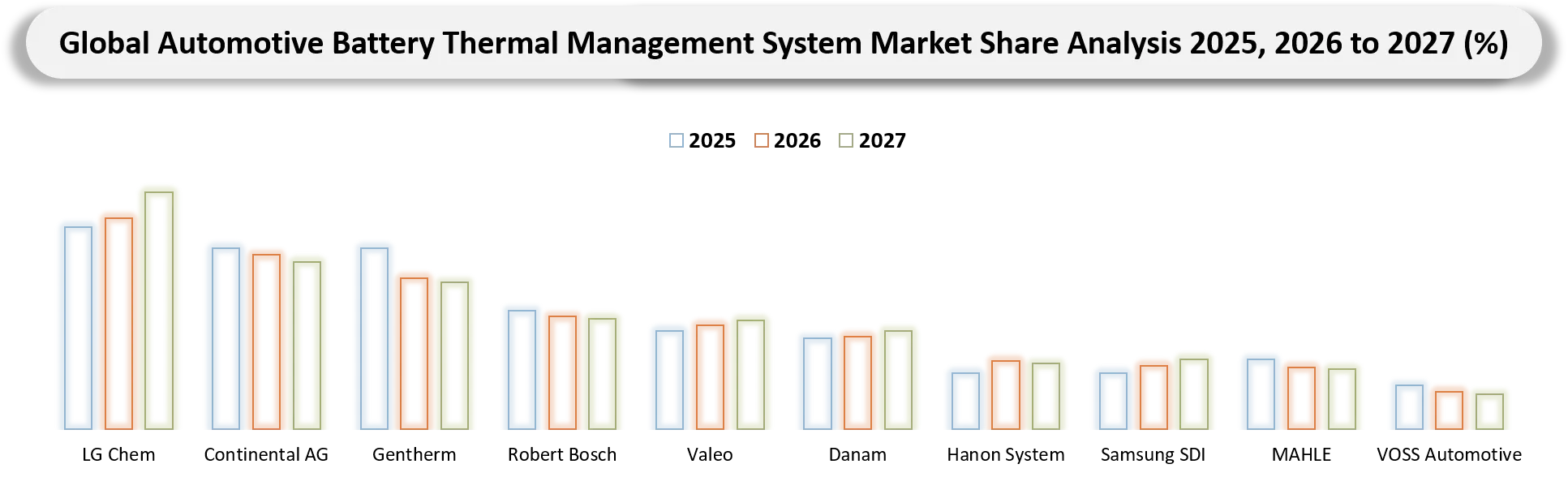
- The market is characterized by three key participant groups: diversified automotive thermal-management suppliers, automotive component and electrification specialists, and battery-focused companies. Continental AG, Robert Bosch, Valeo, Hanon Systems, MAHLE, Gentherm, Dana, and VOSS Automotive compete through battery cooling plates, chillers, heat exchangers, coolant modules, heat pumps, and integrated thermal-management systems; LG Chem and Samsung SDI leverage their battery-cell and battery-system expertise to support thermal-management integration for EV platforms. It’s creating an ecosystem-driven competitive landscape where thermal-management integration, energy efficiency, fast-charging capability, battery safety, and OEM collaboration define competitiveness.
- Key players include LG Chem (South Korea), Continental AG (Germany), Gentherm (U.S.), Robert Bosch (Germany), Valeo (France), Dana (U.S.), Hanon Systems (South Korea), Samsung SDI (South Korea), MAHLE (Germany), and VOSS Automotive (Germany).
Key Developments
- March 2026: SK On, a South Korea-based electric-vehicle battery manufacturer, unveiled immersion-cooled battery-pack prototypes incorporating SK Enmove, a South Korea-based lubricant and thermal-management solutions company and SK Innovation subsidiary.
- September 2026: XD Thermal, a China-based battery thermal-management components manufacturer, developed an integrated dual-sided liquid-cooling architecture for a European electric-bus platform.
- February 2025: KULR Technology Group, a U.S.-based advanced energy-management and battery-technology company, entered into a strategic partnership with Worksport Ltd., a U.S.-based automotive-accessory and portable-energy-storage company.
- August 2026: Gamma Technologies (GT), a U.S.-based multi-physics simulation software company, partnered with Gotion Illinois, a U.S.-based battery and energy-storage manufacturer, to accelerate next-generation battery design.
- September 2025: Beam Global, a U.S.-based clean-technology and sustainable infrastructure company, was granted U.S. Patent No. 12,431,549 for its Intelligent Battery Thermal Management (iBTM) system.
Key Procurement Priorities and Buyer Evaluation Criteria
- Organizations procuring Automotive Battery Thermal Management Systems increasingly select suppliers based on their ability to provide efficient, reliable, and scalable thermal solutions that maintain battery cells within the required temperature range during driving, high-power charging, and extreme ambient conditions.
- The procurement decision-making process is increasingly influenced by the shift toward higher-energy-density batteries, larger EV battery packs, ultra-fast charging, and longer driving-range requirements, which increase the need for advanced liquid cooling, battery pre-conditioning, heat-pump integration, and thermal-runaway mitigation technologies.
- Buyers consider factors such as thermal performance, temperature uniformity, cooling and heating response time, energy consumption, thermal safety, system reliability, component durability, weight, packaging size, and total system cost when evaluating BTMS suppliers.
Why Choose DataM?
- Technological Innovations: Explores advancements in Automotive Battery Thermal Management Systems, including liquid cooling, immersion cooling, phase-change materials, heat-pump integration, battery pre-conditioning, hybrid cooling, and intelligent thermal controls, enabling improved temperature uniformity, fast-charging performance, battery safety, and energy efficiency.
- Product Performance & Market Positioning: Evaluates how different players deliver BTMS solutions based on cooling and heating efficiency, thermal uniformity, response time, energy consumption, system weight, compactness, reliability, and cost efficiency, highlighting how leading companies differentiate through integrated and scalable thermal architectures.
- Real-World Evidence: Highlights the deployment of battery thermal-management technologies across battery-electric vehicles, plug-in hybrids, hybrid vehicles, passenger cars, commercial vehicles, and high-performance EV platforms, demonstrating benefits such as improved battery durability, charging capability, driving range, thermal safety, and overall vehicle efficiency.
- Market Updates & Industry Changes: Tracks key developments such as battery manufacturing expansions, advanced cooling-system launches, immersion-cooling technologies, heat-pump integration, fast-charging platforms, and EV production investments across Asia-Pacific, North America, and Europe, supporting the transition toward increasingly sophisticated battery thermal-management systems.
- Competitive Strategies: Analyzes how leading companies expand through thermal-technology innovation, OEM partnerships, battery-system integration, manufacturing capacity expansion, acquisitions, and development of next-generation cooling and heating solutions to address growing EV and high-energy-density battery requirements.
- Pricing & Market Access: Explains pricing variations based on battery capacity, cooling technology, system complexity, component configuration, thermal-performance requirements, and vehicle application, while assessing market access through automotive OEMs, Tier-1 suppliers, battery manufacturers, and specialized thermal-system providers.
- Market Entry & Expansion: Identifies growth opportunities driven by EV adoption, ultra-fast charging, larger battery packs, high-energy-density chemistries, commercial electrification, and thermal-safety requirements, while outlining strategies such as localized production, technology differentiation, OEM collaboration, modular system design, and integration with broader vehicle thermal-management architectures.
Target Audience 2026
- Automotive OEMs and EV Manufacturers
- Battery Cell and Battery Pack Manufacturers
- Automotive Tier-1 Suppliers
- BTMS Technology Providers
- Automotive Component Manufacturers
- Charging Infrastructure Providers
- Commercial EV and Fleet Operators





























































