


Cutting Tools Supply-Chain Intelligence
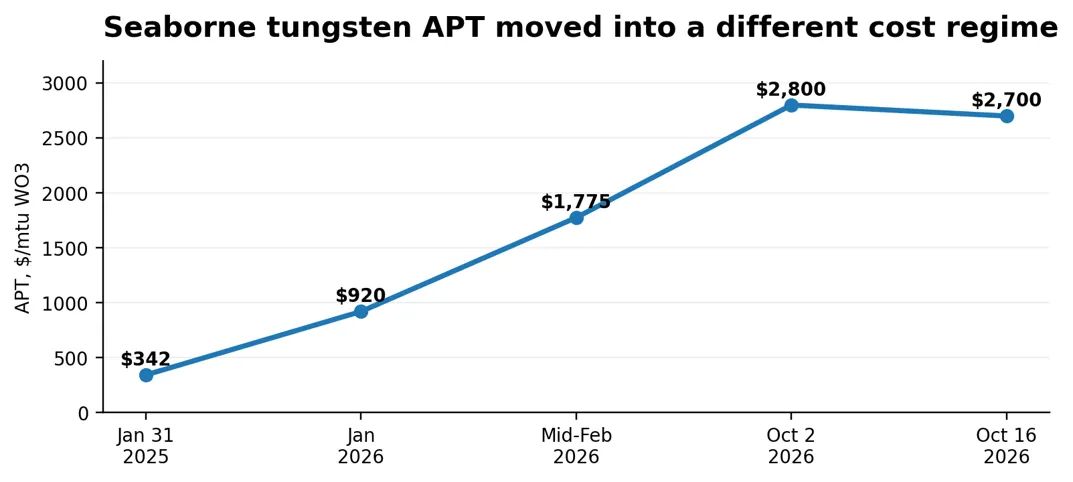
| RAW-MATERIAL SHOCK | Fastmarkets says seaborne APT prices have risen more than 600% since China introduced tungsten export controls, pushing carbide input costs into a new regime. |
| TOOLING INFLATION | USCTI says the carbide crisis has raised user costs by double digits, with larger cutting tools among the most exposed categories. |
| COMMERCIAL SIGNAL | Shops are no longer optimizing only for price per insert. Inventory cover, tool life, geometry, regrindability and supplier access to carbide are becoming purchasing variables. |
The Price Shock Is Upstream, but the Pain Lands on the Shop Floor
Tungsten carbide is the material backbone of high-performance drills, end mills, reamers and indexable inserts. That makes tungsten one of the few upstream minerals whose price can quickly move the operating cost of thousands of machining lines.
The 2026 squeeze is unusually severe because the industry is dealing with two pressures at once: a supply system still heavily concentrated in China and strong demand from aerospace, defense, automotive, energy and general industrial machining. China introduced export controls on selected tungsten items in February 2025, and international availability tightened as inventories outside China were drawn down.
The result is not simply a commodity-price story. It is a tooling-strategy story. When carbide costs rise faster than part prices, machine shops have to recover economics through tool life, regrinding, indexable geometries, chip control, alternate grades and better inventory planning.
Request Executive Sample: https://www.datamintelligence.com/download-sample/cutting-tools-and-inserts-market
From $342.50 to Roughly $2,700 per mtu: Carbide Economics Have Been Reset
Fastmarkets assessed seaborne APT at $2,500-$2,900 per mtu on October 16, 2026, versus a $342.50 midpoint on January 31, 2025. By early October, the benchmark was still around 355% above its level a year earlier. That gap is large enough to alter quoting behavior across the hardmetal and cutting-tool chain.
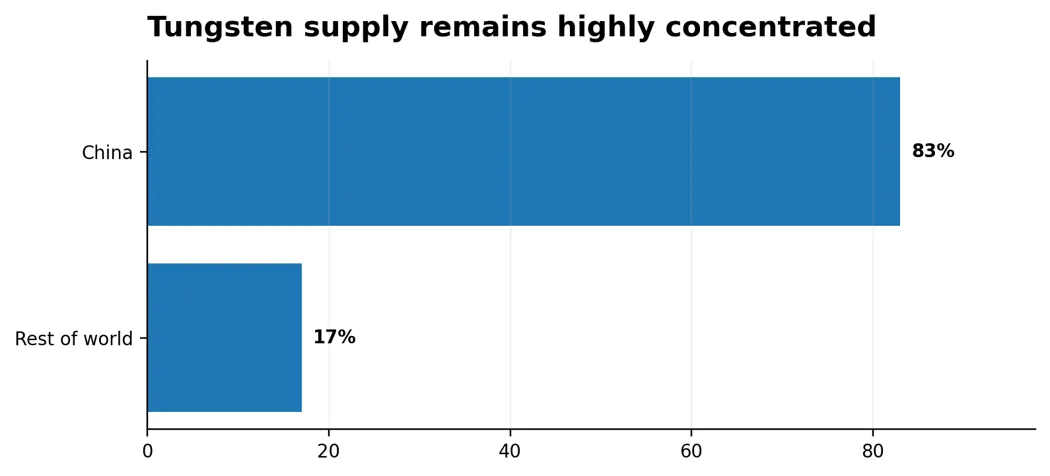
The supply concentration explains why downstream users cannot treat this like a normal cyclical input. USGS estimates China accounted for 83% of global mined tungsten production in 2023, while its 2025 production capacity share was still roughly 70%. New mines can take five to ten years to bring online, which leaves recycling, scrap recovery and alternative sourcing as the most practical near-term release valves.
The Cutting-Tool Market Is Growing - but Inflation Is Doing Part of the Work
Request a Customized Report According to Your Business Strategy: https://www.datamintelligence.com/customize/cutting-tools-and-inserts-market
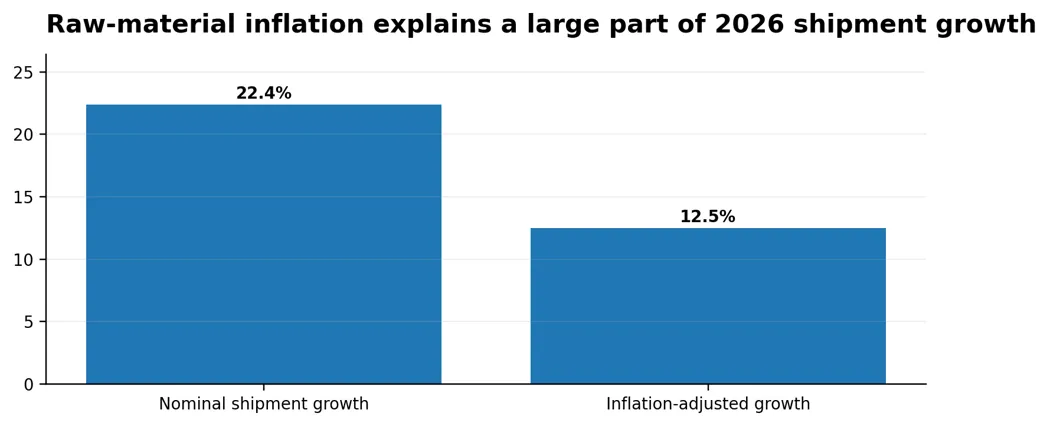
Through August 2026, cutting-tool shipment value was up 22.4% year over year. AMT estimates growth was 12.5% after factoring out price increases.
That distinction matters. The market is genuinely expanding, supported by rising machinery investment, but shipment dollars are overstating unit-demand growth because raw-material inflation is being passed downstream. For suppliers, this creates a two-speed opportunity: higher revenue per tool, but more pressure from customers to prove productivity per cutting edge.
The “Record Shipment” Story Is Also a Carbide-Cost Story
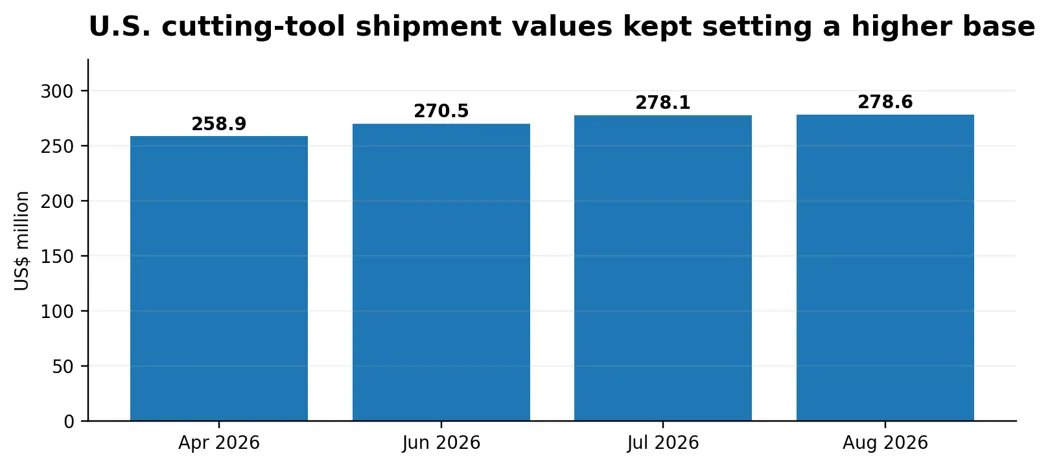
Sources: AMT / U.S. Cutting Tool Institute monthly Cutting Tool Market Report.
July cutting-tool shipments reached $278.1 million, up 29% year over year. August followed at $278.6 million, up 32.2% from August 2025. USCTI described the carbide crisis as a key reason user costs have increased by double digits, especially for larger tools.
For buyers, the risk is that a rising shipment-value chart can look like pure demand strength when it is partly a cost-transfer mechanism. For cutting-tool manufacturers, the opposite risk applies: higher prices can lift revenue while weakening customer willingness to carry deep inventories or standardize on premium solid-carbide designs.
Why Larger Solid-Carbide Tools Feel the Shock First
| APT / carbide powder | Carbide blank | Tool grinding | Distributor / OEM | Machine shop |
| Upstream price shock | More material per blank | Geometry + coating value | Inventory + margin pressure | Cost per part decision |
The more carbide mass embedded in the tool, the larger the direct exposure to tungsten input inflation. This is why larger-diameter drills, end mills and specials can show greater absolute price increases than small inserts, even when both use premium carbide grades.
The Buying Response Is Moving Beyond “Buy Before the Next Increase”
Inventory building can protect a shop against the next list-price increase, but it can also lock cash into the wrong geometry or grade. The more durable response is to reduce tungsten consumed per finished part.
That is pushing more attention toward indexable architectures where appropriate, regrinding and recoating programs, geometry optimization, higher-feed strategies, longer-life grades and application engineering that increases parts produced per edge. The commercial battle therefore shifts from unit tool price to verified cost per component.
Four Procurement Questions Now Matter More Than the List Price
| Signal | What it reveals | Likely response | Why it matters |
| Carbide price increase | Supplier is passing upstream tungsten cost through | Rebid grades, geometry and tool-life assumptions | Price-only sourcing can raise total machining cost |
| Longer carbide lead time | Powder or blank availability is tightening | Increase critical-stock cover and qualify alternates | A low-cost tool has no value if the spindle is waiting |
| Large-tool inflation | Carbide mass is amplifying raw-material exposure | Evaluate indexable or modular alternatives | Diameter now changes procurement exposure |
| Regrind utilization rises | Users are preserving carbide already in circulation | Expand regrind / recoat loops | Recycling becomes both a cost and supply strategy |
Purchase This Exclusive Report: https://www.datamintelligence.com/buy-now-page?report=cutting-tools-and-inserts-market&from=report
The Near-Term Release Valve Is Recycling, Not a New Mine
Fastmarkets notes that new tungsten mining capacity can require five to ten years to come online. Recycling infrastructure can scale faster because the raw material already exists in used carbide tools, scrap and hardmetal products circulating in Western economies.
This changes the strategic value of used-tool recovery. Regrind programs, scrap buyback and closed-loop carbide recycling are no longer only sustainability initiatives. They are mechanisms for reducing exposure to a geopolitical raw-material bottleneck.
Why a Cutting Tools Report Matters More During a Carbide Shock
A tungsten spike does not affect every cutting-tool category in the same way. Exposure changes with carbide content, diameter, tool architecture, coating, regrindability, end-use mix and the ability of suppliers to secure powder or blanks. That makes headline tungsten prices useful, but insufficient for purchasing or competitive planning.
A decision-ready Cutting Tools report should connect upstream tungsten availability to downstream tool categories and end users. Buyers need to know where price increases are being passed through fastest, which applications can migrate toward indexable or modular designs, where regrind economics improve, which suppliers have sourcing or recycling advantages and how aerospace, automotive, defense and general machining demand are affecting availability.
The 2026 carbide crisis is therefore not only a temporary procurement event. It is exposing which cutting-tool business models can defend margins when the material inside the tool becomes the most volatile part of the product.
Use the Cutting Tools report to map carbide-cost exposure by tool type, end-use demand, supplier positioning, pricing pressure, sourcing risk and the shift toward regrinding, recycling and indexable alternatives.