


Diamond Cutting Tools and Inserts Market Overview
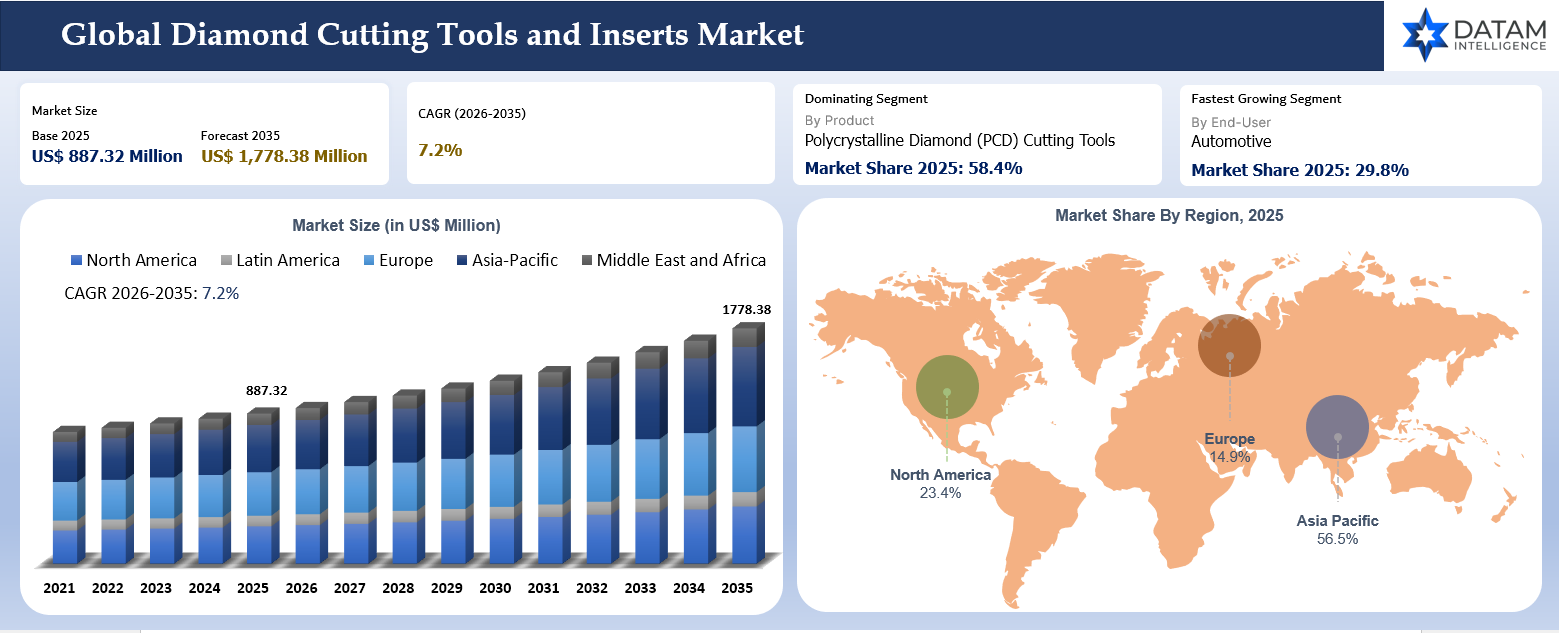
The global diamond cutting tools and inserts market reached US$ 887.32 million in 2025 and is expected to reach US$ 1,778.38 million by 2035, growing with a CAGR of 7.2% during the forecast period 2026-2035.
The need for precision manufacturing in the industry and the aerospace industry and the electronics industry and the construction industry is making the global market for diamond cutting tools and inserts grow steadily. Diamond is very important for cutting hard materials like composites and ceramics and non-ferrous metals. It has good cutting ability, and it lasts a long time, and it makes a nice smooth surface. Countries and industries are spending a lot of money to make semiconductors and electric vehicles. For example, the U.S. Department of Energy is spending billions of dollars on manufacturing and battery development, where diamond cutting tools are necessary for making high quality components. Diamond cutting tools and inserts are becoming a part of the future of industry because of these changes. Diamond cutting tools are very important for the industry and the aerospace industry and the electronics industry and the construction industry.
Diamond Cutting Tools and Inserts Industry Trends and Strategic Insights
- Between 2027 and 2030 Asia-Pacific will make up 38% to 42% of total market revenues. This is because of infrastructure growth electric vehicles becoming more common and more need for precise electronics production in countries such as China and India.
- Artificial intelligence and digital twin capabilities are used to check on things like how machines vibrate and how hot they get. This is done on time, so manufacturers do not have to wait for someone to do a periodic check on the machines. Artificial intelligence and digital twin capabilities are always looking at the machines.
Global Diamond Cutting Tools and Inserts Market Size and Future Outlook
- 2025 Market Size: US$ 887.32 million
- 2035 Projected Market Size: US$ 1,778.38 million
- CAGR (2026-2035): 7.2%
- Largest Market: Asia-Pacific
- Fastest Market: North America
For More Detailed Information, Request for Sample
Diamond Cutting Tools and Inserts Market Scope
| Metrics | Details | |
| By Product | Polycrystalline Diamond (PCD) Cutting Tools, Microcrystalline Diamond (MCD) Cutting Tools, Single Crystal Diamond (SCD) Cutting Tools, Natural Diamond Cutting Tools | |
| By Product Form | Indexable Tools, Solid Tools, Cutting and Sawing Tools, Finishing and Surface Generation Tools, Custom Engineered Tools | |
| By Material | Metals, Composites, Ceramics, Others | |
| By Application | Cutting and Sawing, Drilling, Grinding, Turning, Milling, Grooving and, Boring, Polishing and Lapping | |
| By End-User | Automotive, Defense and Space, Electro Optics, Medical, Ophthalmic, Rotogravure, Jewelry and Watches, Semiconductors, Electronics and Connectors, Industrial Molds and Dies, Energy Components, Others | |
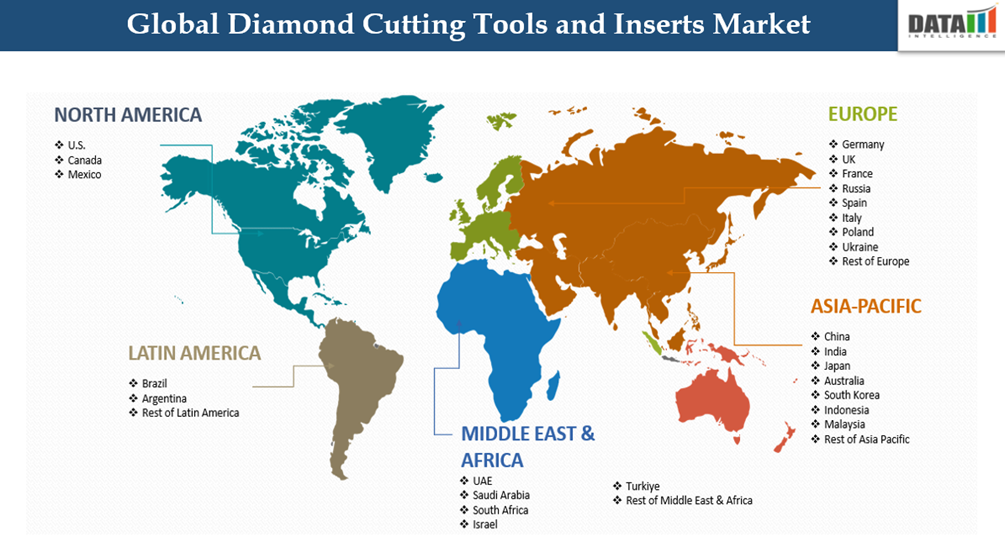
| By Region | North America | U.S., Canada, Mexico |
| Europe | Germany, UK, France, Spain, Italy, Norway, Netherlands, Poland, Ukraine | |
| Asia-Pacific | China, India, Japan, Australia, South Korea, Indonesia, Malaysia | |
| Latin America | Brazil, Argentina | |
| Middle East and Africa | UAE, Saudi Arabia, South Africa, Israel, Egypt, Türkiye | |
| Report Insights Covered | Competitive Landscape Analysis, Company Profile Analysis, Market Size, Market Share, Market Growth | |
Diamond Cutting Tools and Inserts Market Dynamics
Rising Demand for Advanced Manufacturing Ecosystems
The global demand for diamond-tipped machining equipment is currently exploding at an unprecedented rate, largely because massive industries like electric vehicle production, aerospace design, and green energy are scaling up so aggressively. These tools aren't just a fancy upgrade; they’ve become essential because they stay sharp under extreme heat and last much longer than traditional steel or carbide, making them perfect for carving out delicate battery parts or tough, modern composites.
In the aerospace world, where every ounce of weight matters, manufacturers are leaning heavily on carbon fiber materials that are notoriously difficult to cut without specialized gear. As global air travel bounces back and airlines scramble to get more fuel-efficient planes into the sky, the pressure on factories to deliver perfect parts has never been higher.
The evolution shows that diamond technology has officially moved out of its niche corner and straight into the heart of the modern assembly line, proving itself as the ultimate backbone for any sector that refuses to compromise on speed or pinpoint accuracy.
High Cost and Technical Constraints
The diamond industry is still having a lot of trouble with the cost of making diamonds and some big technical problems. Making lab-grown diamonds is not easy. It is an expensive and difficult thing to do. The methods used to make lab-grown diamonds, like Chemical Vapor Deposition and High-Pressure High-Temperature systems use a lot of electricity.
The cost of lab-grown diamonds is not the problem. There are also some problems, with how well they work. For example diamond tools are very sharp. They do not work well with materials that have iron in them. When diamond tools get very hot they react with the iron. Start to wear down much faster than you would think. The diamond industry and lab-grown diamonds are still trying to solve these problems.
Diamond Cutting Tools and Inserts Market Segmentation Analysis
The global diamond cutting tools and inserts market is segmented based on the product, product form, material, application, end user and region.
Automotive and Transportation Segment Leads Demand
The push for making vehicles lighter combined with the shift to electric vehicles has made the automotive industry very important for the diamond cutting tool market. In manufacturing places in Europe, Asia and North America these high-tech tools are now a must-have on modern production lines. By using diamond tools factories are reducing stops in production and making their equipment last longer. This change helps high-volume assembly stay reliable and profitable which is the way to stay competitive today. The automotive industry relies heavily on diamond cutting tools. These tools help factories keep producing without pauses. The use of diamond tools is crucial for the industrys success. It keeps production lines running and makes them more profitable. The shift to vehicles and lighter cars will continue to drive demand. Diamond cutting tools are essential for this process. They help factories meet the demand for lightweight vehicles.
Electronics and Semiconductor Applications Gain Traction
The electronics industry is leading the way in -precision machining. This is because they need to work with materials like silicon wafers and special ceramics very accurately. It's not just about having the machines anymore. Diamond tools are now a must-have for cutting, grinding and polishing. A small mistake, one micron can ruin the whole production. The goal is to make hardware that's smaller, faster and more efficient. This has made diamond tools very important, for the electronics industry. They are a part of making electronics working behind the scenes. The electronics industry relies on diamond tools for its supply chain. They help make the tiny parts needed for electronics. The use of diamond tools is growing in the electronics industry. It helps them make things more accurately. The industry needs diamond tools to make high-quality electronics.
Diamond Cutting Tools and Inserts Market Geographical Penetration
North America Focuses on High-Precision and Aerospace Applications
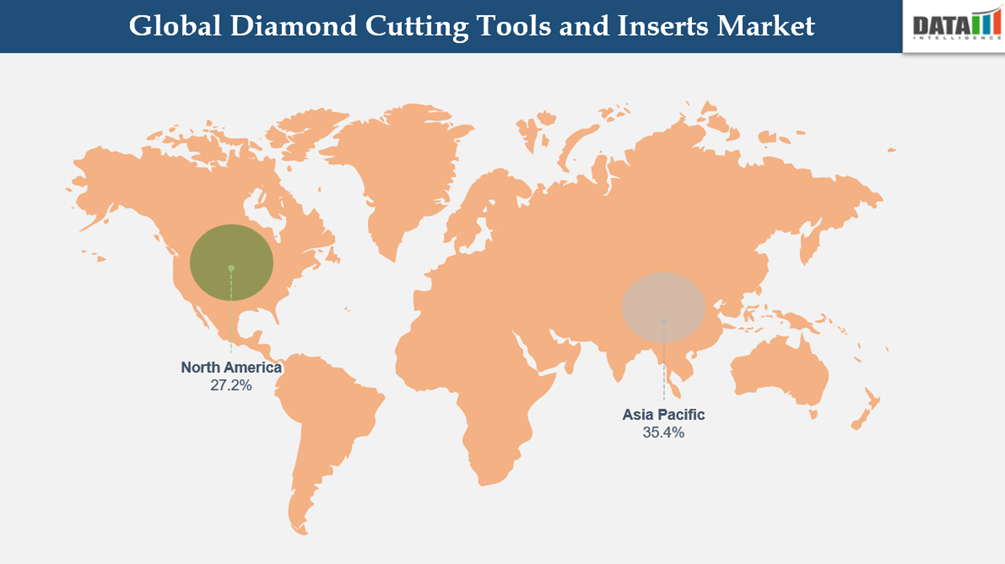
The growth of military aviation is causing a big strain on manufacturing. This is making factories use machines that can work non-stop. Modern airplanes are made with materials, like titanium alloys and carbon fiber. These materials are hard to work with so regular steel tools are not good enough. Diamond-tipped tools are now used because they can make edges without damaging expensive parts. Factories are changing the way they think about tools. They used to think that tools were cheap and could be easily replaced. Now they want tools that're very precise and last a long time. Up to ten times longer. This change is happening now with factory managers choosing high-performance tools. They want tools that can help them make high-quality parts quickly and efficiently. The aviation industry needs these tools to keep up with demand. They help make airplane parts that're strong and precise.
Asia-Pacific Dominates Global Market Activity
The Asia-Pacific region is the heartbeat of the diamond edge tools and inserts market. This is because countries like China, Japan and South Korea have a lot of power and manufacturing expertise. These nations produce an amount of diamond edge tools and insert and have supply chains that are closely linked to the automotive, electronics and heavy machinery sectors. As a result, the diamond edge tools and inserts market and these sectors are now closely connected. China plays a role in this with industrial production making up over 25 percent of its GDP. This shows why the Asia-Pacific region, China is the main powerhouse for the diamond edge tools and inserts industry. The region’s industrial might and expertise make it a key player, in the diamond edge tools and inserts market.
Sustainability Analysis
The diamond cutting tools industry is going through a change. It is moving away from ways of doing things that use a lot of resources. Now it is focusing on making things in a way that's better for the environment. Changing an industry takes a long time but the diamond cutting tools industry is really moving towards being more sustainable. The diamond cutting tools industry is making progress. It is hard to ignore the momentum of the diamond cutting tools industry as it becomes more environmentally friendly.
Diamond Cutting Tools and Inserts Market Competitive Landscape
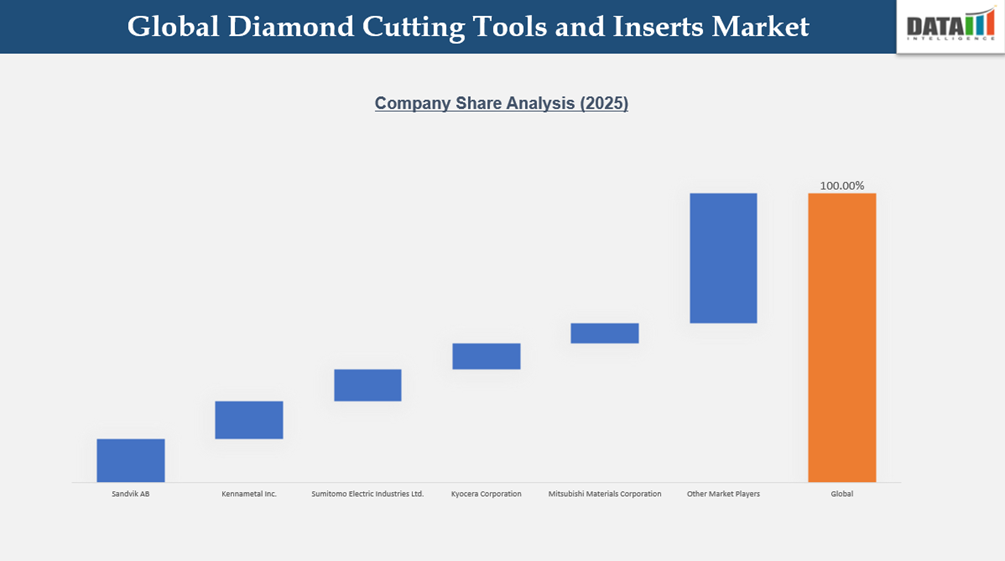
- The diamond cutting tools market is changing a lot now. It is moving away from making a lot of tools and towards making tools that are good at what they do. This is because modern machines do not allow mistakes. In fields like making semiconductors or airplanes the value of a diamond cutting tool is not how cheap it is but how well it works and how long it lasts when it is hot.
- Companies like Sandvik, Kennametal and Sumitomo are still the best because they have been working hard to make their tools better. They have been putting a lot of money into learning about materials so they can make tools that're very precise. They can make tools that're so good they were thought to be impossible to make.
Key Developments in the Diamond Cutting Tools and Inserts Market
August 2026: Sumitomo Electric Hardmetal expanded the SEC-PB Bite SPB Type lineup by reintroducing three highly customizable blank insert models, enabling customers to optimize cutting-edge geometries and reduce edge-grinding time for complex precision machining applications. The development supports greater process flexibility for small and automatic lathes.
- June 2026: Sumitomo Electric Hardmetal expanded its PCD insert portfolio for the SEC-WaveMill WEZ series with the DA1000 polycrystalline diamond grade optimized for aluminum alloy machining. The high-density ultra-fine diamond grade is designed to improve fracture and wear resistance while supporting high-precision machining and longer tool life.
- June 2026: Sumitomo Electric Hardmetal developed and commercialized SUMIBORON binderless endmills using ultra-ultra-fine CBN grains for precision mold finishing. The technology advancement targets mirror-like surface finishes and extended tool life, reflecting continued innovation in ultra-hard cutting-tool materials.
- December 2025: Sumitomo Electric Hardmetal developed the high-efficiency SEC-Wave Radius Mill RSC series, expanding advanced milling capabilities for improved machining productivity. The launch reflects continued innovation in cutting-tool geometries and high-efficiency indexable tooling solutions.
Why Choose DataM?
- Technological Innovations: Explores advancements in diamond cutting and machining technologies, including polycrystalline diamond (PCD), chemical vapor deposition (CVD) diamond, metal-bonded and resin-bonded diamond tools, advanced coatings, precision-engineered cutting geometries, and optimized tool designs. The analysis examines how these technologies improve wear resistance, cutting accuracy, tool life, surface finish, and machining efficiency across demanding industrial applications.
- Product Performance & Market Positioning: Evaluates diamond cutting tools and inserts based on critical performance parameters such as hardness, abrasion resistance, thermal conductivity, edge retention, dimensional accuracy, cutting speed, surface quality, tool life, and compatibility with different workpiece materials. It highlights how manufacturers differentiate through specialized tool geometries, substrate technologies, bonding methods, and application-specific solutions.
- Real-World Evidence: Highlights the use of diamond cutting tools and inserts across automotive manufacturing, aerospace, electronics, construction, stone and ceramics processing, woodworking, and precision engineering. The research examines their role in machining non-ferrous metals, composites, ceramics, engineered materials, and other highly abrasive workpieces where precision and extended tool life are critical.
- Market Updates & Industry Changes: Tracks key industry developments, including advancements in synthetic diamond technologies, new cutting-tool product developments, manufacturing capacity investments, automation in machining operations, growth in high-precision manufacturing, and evolving demand from automotive, aerospace, electronics, and industrial production sectors across major global markets.
- Competitive Strategies: Analyzes how leading manufacturers strengthen their market position through product innovation, application-specific tool development, advanced material technologies, geographic expansion, strategic collaborations, distribution network development, and investments in precision manufacturing capabilities. The analysis also assesses how companies respond to increasing customer requirements for productivity, longer tool life, and improved machining quality.
- Pricing & Market Access: Explains pricing variations based on diamond type and grade, tool or insert design, manufacturing technology, bonding material, cutting geometry, application requirements, and expected tool life. It also evaluates market access through direct industrial sales, authorized distributors, cutting-tool specialists, original equipment manufacturers, and industrial supply networks serving global end-use industries.
- Market Entry & Expansion: Identifies growth opportunities arising from increasing demand for precision machining, advanced manufacturing, lightweight materials, electric vehicle components, aerospace-grade materials, electronics production, and high-performance industrial tooling. The analysis outlines potential expansion strategies, including technology differentiation, development of application-specific solutions, partnerships with machining and manufacturing companies, regional distribution expansion, and investment in advanced diamond tool production capabilities.
Target Audience
- Cutting Tool & Machine Tool Manufacturers
- Diamond Tool and Industrial Abrasive Manufacturers
- PCD, CVD Diamond & Advanced Material Suppliers
- Automotive & Electric Vehicle Component Manufacturers
- Aerospace & Defense Manufacturing Companies
- Electronics & Semiconductor Manufacturing Companies
- Precision Engineering & Metalworking Companies
- Construction, Stone & Ceramic Processing Companies





























































