


Food Processing Blades Market Size and Overview
The global food processing blades market reached USD 1.3 billion in 2025 and is expected to reach USD 3.11 billion by 2035, growing with a CAGR of 9.1% during the forecast period 2026-2035. The market is being shaped by greater automation, higher processing throughput, and demand for consistent cutting quality across food-processing lines. In September 2026, JBT Marel upgraded its ACM-T automated turkey cut-up system to handle heavier birds and higher line speeds, with capacity of up to 2,000 turkeys per hour, highlighting the shift toward robust, high-capacity automated cutting systems.
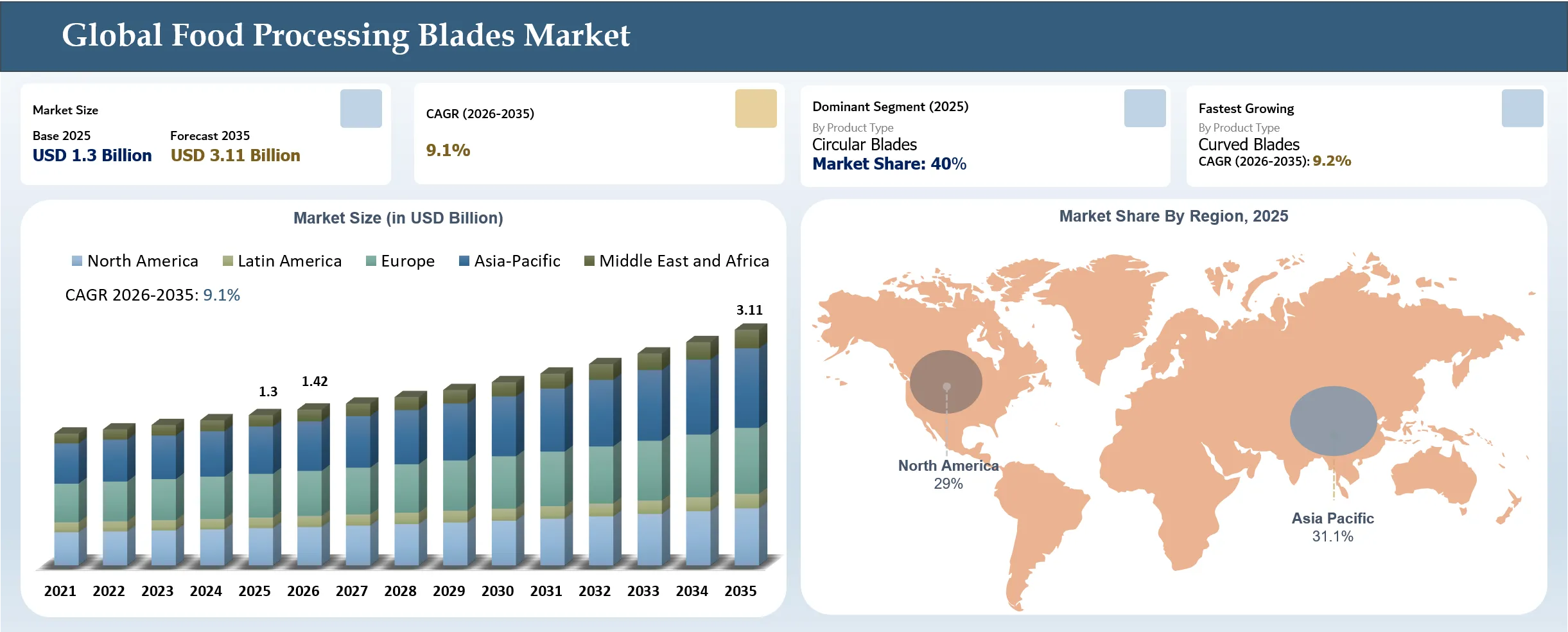
Blade development is also focusing on precision, longer service life, and application-specific cutting performance. In September 2025, LUTZ BLADES introduced its Midnight Blue potato-processing blade, designed to maintain a sharp edge for longer service life while producing smooth, consistent potato slices and reducing oil absorption during frying. These developments indicate increasing demand for durable precision blades, automated cutting, consistent product quality, and blades optimized for high-throughput processing.
White-Space Opportunities for Processing-Capacity Expansion and Specialized Cutting Equipment
The USDA announced $60 million in July 2026 under Phase 4 of the Meat and Poultry Processing Expansion Program to expand U.S. meat and poultry processing capacity. The program provides $50,000–$2 million for processing expansion projects, including equipment purchases above $250,000, and $10,000–$250,000 for equipment-only projects. This creates an opportunity for blade manufacturers to target processors upgrading cutting, portioning, deboning, and other equipment as facilities expand capacity.
In April 2026, Frimesa launched a new automated pork-processing plant in Brazil, using JBT Marel automation, robotics, and software to increase capacity, improve yields, and standardize cuts. The plant is designed for 12,000 slaughters per day initially, expanding to 15,000 in 2026 and 23,000 by 2032. These investments create white space for durable, precision-engineered blades designed for automated cutting and deboning lines operating at higher throughput.
Food Processing Blades Market Key Takeaways
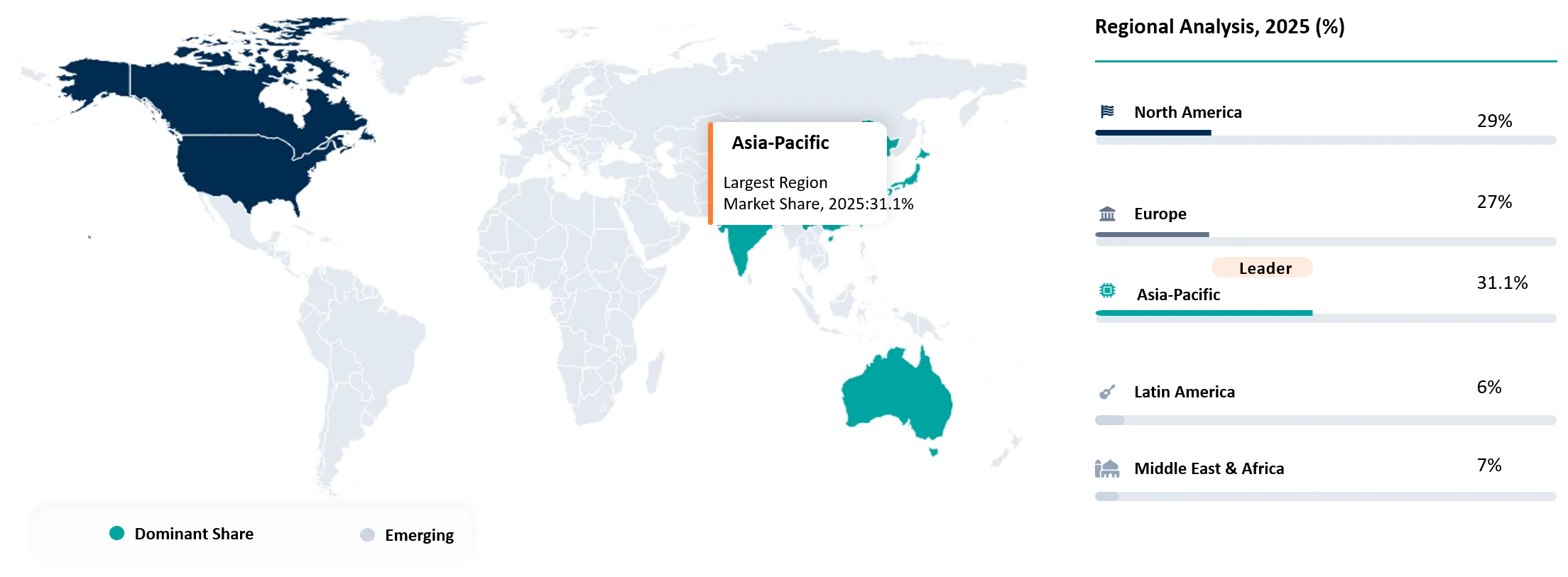
- Asia-Pacific dominated the Food Processing Blades market in 2025 with a 31.10% share and is also projected to be the fastest-growing regional market during 2026-2035, driven by expanding food-processing capacity, increasing automation, and rising adoption of high-throughput meat, poultry, seafood, and packaged-food processing equipment.
- Circular blades dominated by blade type, accounting for approximately 40.0% of the market share in 2025, supported by widespread use in slicing, trimming, portioning, and continuous processing applications requiring consistent cuts and high operating speeds. Curved blade is projected to be the fastest-growing blade type with CAGR 2026-2035 is of 9.2%.
- Proteins dominated the market by application, accounting for approximately 63.2% of the 2025 market share, reflecting extensive blade requirements across meat, poultry, and seafood processing. High-volume processing and increasing automation continue to reinforce demand for durable and precision-engineered cutting solutions.
- Cutting & portioning is projected to be the fastest-growing purpose segment at a 9.4% CAGR from 2026-2035, driven by greater automation, consistent portion requirements, yield optimization, and modernization of food-processing lines.
Food Processing Blades Market Industry Trends and Strategic Insight
- The shift toward automated high-throughput food processing is accelerating demand for precision blades capable of maintaining cutting accuracy, edge retention, and consistent performance across continuous production lines.
- Food processors are increasingly adopting application-specific blade designs, creating demand for blades optimized for meat, poultry, seafood, potatoes, vegetables, and other products with different cutting, thickness, and yield requirements.
- The growing use of robotics and automated cutting, portioning, and deboning systems is expanding demand for blades compatible with machine-controlled operations, where dimensional consistency, repeatability, and low replacement frequency are critical.
- Rising emphasis on yield optimization and waste reduction is increasing demand for sharper, longer-life blades that improve cutting precision and maximize usable product from each processing cycle.
- Expansion and modernization of protein-processing capacity is sustaining demand for durable blades for high-volume slicing, trimming, cutting, and deboning applications, particularly across automated meat, poultry, and seafood processing facilities.
Food Processing Blades Market Scope
| Metrics | Details | |
| 2025 Market Size | USD 1.3 Billion | |
| 2035 Projected Market Size | USD 3.11 Billion | |
| CAGR (2026-2035) | 9.1% | |
| Largest Market | Asia-Pacific | |
| Fastest Growing Market | Asia-Pacific | |
| By Product Type | Straight, Curved, Circular, Others | |
| By Material | Stainless Steel, Carbon / Tool Steel, High-Speed Steel (HSS), Tungsten, Carbide, Ceramic, Others | |
| By Purpose | Slicing, Cutting, Dicing, Chopping, Shredding, Mincing, Peeling, Trimming, Deboning, Others | |
| By Application | Meat Processing, Poultry Processing, Seafood Processing, Fruit and Vegetable Processing, Bakery and Confectionery Processing, Dairy Processing, Pet Processing, Others | |
| By Region | North America | U.S., Canada, Mexico |
| Europe | Germany, United Kingdom, France, Italy, Spain, Netherlands, Switzerland, Sweden, Norway, Denmark, Belgium, Poland, Austria, Ireland, Portugal, Greece, Finland, Rest of Europe | |
| Asia-Pacific | China, Japan, India, South Korea, Australia, New Zealand, Singapore, Malaysia, Thailand, Indonesia, Vietnam, Philippines, Taiwan, Rest of Asia Pacific | |
| Latin America | Brazil, Argentina, Chile, Colombia, Peru, Rest of Latin America | |
| Middle East and Africa | Saudi Arabia, United Arab Emirates, Qatar, Kuwait, Oman, Bahrain, South Africa, Egypt, Nigeria, Morocco, Rest of Middle East & Africa | |
| Report Insights Covered | Competitive Landscape Analysis, Company Profile Analysis, Market Size, Share, Growth | |
Food Processing Blades Market Disruption Analysis
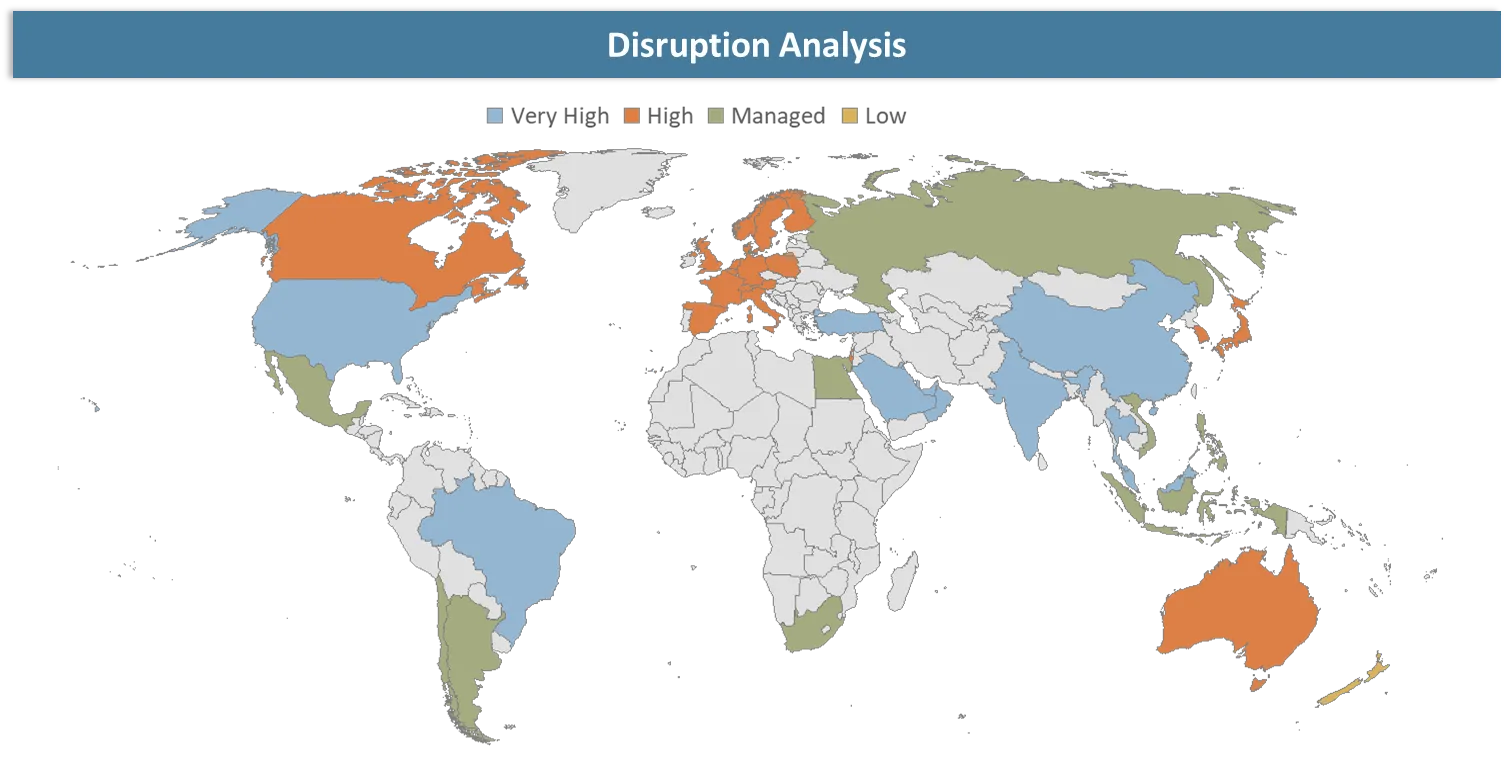
Shift Toward Smart, Precision-Controlled Cutting Systems
The Food Processing Blades market is being disrupted by the integration of robotics, product recognition, automated blade positioning, and recipe-based cutting into processing lines. In June 2026, Grasselli showcased its SCARA + OSL smart processing line, where products are automatically recognized by size, shape, and characteristics, while cutting is performed according to predefined weight or thickness recipes. The system also enables adjustable blade positioning from 90° to 45°, changing blade requirements from fixed cutting components toward precision-controlled cutting systems.
The development is shifting competition toward blade precision, positioning flexibility, and integration with automated equipment, rather than blade durability alone. JBT Marel's August 2026 ACM-NT system similarly enables automated poultry cutting at up to 6,500 carcasses per hour while delivering consistent cuts across different cutting regimes. This increases demand for blades engineered to operate within automated, recipe-driven systems where cutting accuracy, repeatability, and synchronization with equipment directly influence processing efficiency and product yield.
Food Processing Blades Market BCG Matrix: Company Evaluation
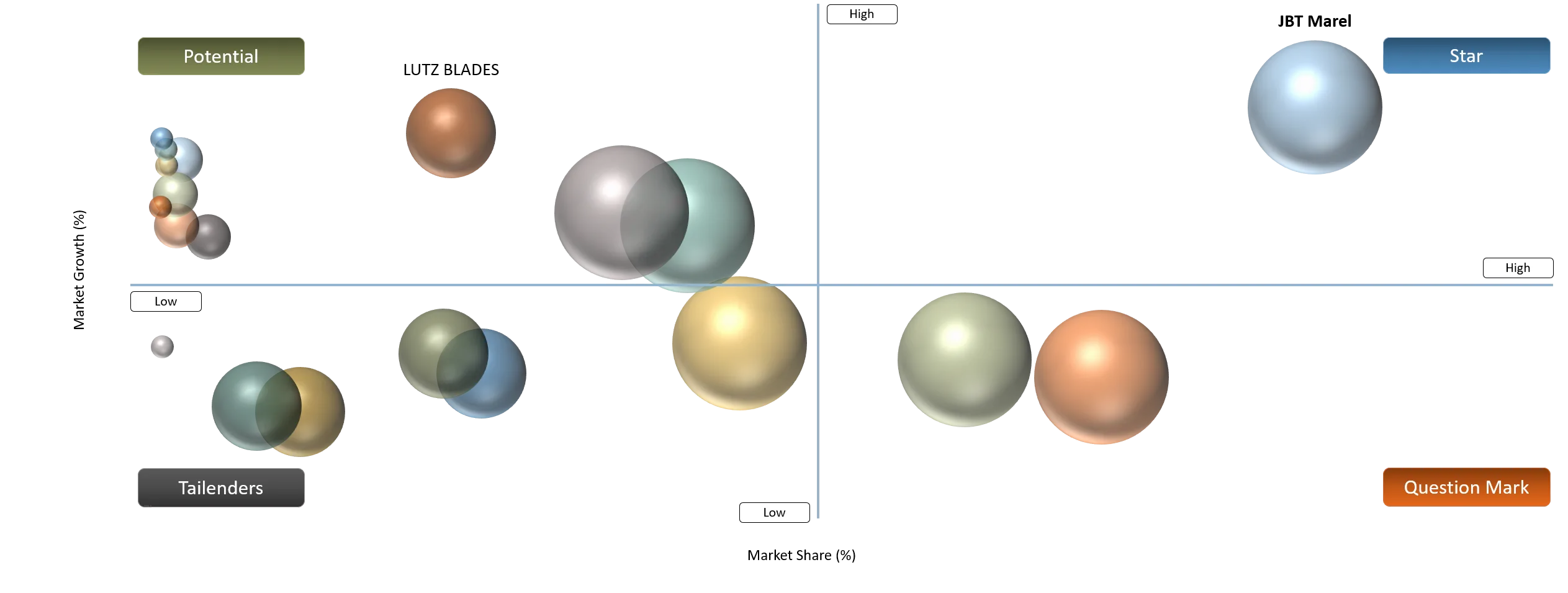
The Stars category comprises JBT Marel, Bettcher Industries, Grasselli, and Kasco, supported by established food-processing blade portfolios, strong equipment integration, and broad exposure to meat, poultry, seafood, and other high-throughput processing applications. The Potential Companies category includes LUTZ BLADES, Friedr. Dick, DIENES Werke, and Hyde Industrial Blade Solutions, with established industrial cutting capabilities and scope for deeper expansion across automated food-processing applications and specialized processing lines.
The Question Marks category comprises Cadence, Inc. and Fernite Machine Knives, where precision-engineered blade capabilities and customized cutting solutions provide entry into food-processing applications, but their exposure is more specialized than the leading food-processing-focused companies. The Tailenders category represents companies with comparatively narrower positioning in the food-processing blade landscape, where growth depends on expanding application coverage, strengthening OEM relationships, and increasing penetration of automated processing equipment.
Food Processing Blades Market Dynamics
Driver Impact Analysis
| Driver | Market Growth Impact (%) | Demand Concentration | Impacted Use Case | Strategic Impact |
High-speed slicers requiring tighter blade tolerances to maintain uniform product thickness | 22% | High demand among meat, poultry, seafood, cheese, and packaged-food processors operating high-speed slicing lines. | High-speed slicing, portion control, thickness-sensitive food production. | Accelerates demand for precision-ground blades, tighter tolerances, and application-specific blade geometries. |
Continuous meat processing increasing demand for wear-resistant blades between maintenance cycles | 21% | Concentrated among high-volume meat and poultry processors operating continuous production lines. | Meat cutting, trimming, deboning, portioning, continuous processing. | Increases demand for wear-resistant materials, extended blade life, and blades reducing production interruptions. |
Automated dicing lines requiring precision-ground blades for consistent cube dimensions | 20% | Strong demand among processors adopting automated dicing and portioning equipment for meat, vegetables, fruits, and processed foods. | Automated dicing, cubing, portioning, prepared-food production. | Drives adoption of precision-ground blades engineered for dimensional consistency and automated equipment compatibility. |
Corrosive washdown environments increasing demand for stainless steel processing blades | 19% | High demand across meat, poultry, seafood, dairy, and other facilities requiring frequent sanitation and washdown. | Hygienic cutting, slicing, trimming, deboning, food preparation. | Strengthens demand for corrosion-resistant stainless-steel blades and hygienically designed cutting components. |
High-volume potato processing increasing demand for specialized cutting grids and blades | 18% | Concentrated among industrial potato processors producing fries, chips, slices, and other processed potato products. | French-fry cutting, potato slicing, chipping, shredding, and specialty shapes. | Expands demand for specialized blade geometries, cutting grids, durable materials, and precision systems for consistent product dimensions. |
High-Speed Processing Is Increasing Demand for Precision and Durable Blades
Modern poultry-processing lines are operating at increasingly high speeds, raising requirements for blade consistency, edge retention, and cutting accuracy. The USDA's 2025 Poultry Processing Line Speed Evaluation Study examined establishments operating evisceration lines at 140–175 birds per minute, demonstrating the demanding production conditions under which processing blades operate. These operating speeds increase the importance of blades that maintain consistent cutting performance across continuous processing cycles.
Investment in processing capacity is also reinforcing this requirement. In July 2026, USDA opened $60 million in grants under Phase 4 of the Meat and Poultry Processing Expansion Program, including $10,000–$250,000 equipment-only grants and $50,000–$2 million processing-expansion grants. The funding supports equipment modernization and capacity expansion, increasing the addressable requirement for precision-ground, wear-resistant blades used in automated cutting, trimming, slicing, and portioning systems.
Restraint Impact Analysis
| Restraint | Drag on Market Growth (%) | Primary Impact Area | Impacted Use Case | Strategic Impact |
Precision blade manufacturing requiring tight tolerances, increasing production complexity and costs | 24% | Manufacturing cost, quality control, and production complexity | High-speed slicing, automated dicing, precision portioning | Raises manufacturing and inspection costs, particularly for blades requiring tight dimensional tolerances and consistent edge geometry. |
Application-specific blade geometries limiting interchangeability across processing equipment platforms | 22% | Equipment compatibility, inventory management, and replacement flexibility | Specialized slicing, cutting, deboning, dicing, and portioning | Increases SKU requirements and inventory complexity while limiting standardized blade replacement across equipment platforms. |
Abrasive food particles accelerating edge wear and increasing blade replacement frequency | 21% | Blade durability, maintenance frequency, and operating costs | Potato, frozen-food, grain, vegetable, and abrasive-product processing | Increases replacement and maintenance requirements, encouraging investment in wear-resistant materials and extended-life blade designs. |
Frequent sanitation cycles exposing carbon-steel blades to corrosion-related degradation | 18% | Material durability, hygiene, and maintenance | Meat, poultry, seafood, dairy, and wet-processing applications | Drives preference for stainless-steel and corrosion-resistant materials while increasing blade material costs. |
Abrasive Food Particles Accelerate Edge Wear and Increase Blade Replacement Frequency
Food-processing blades operating on products containing hard, abrasive, fibrous, or frozen material experience continuous edge degradation, increasing sharpening and replacement requirements. A 2026 industry analysis from Simmons Knife & Saw highlights the use of heat-treated tooth profiles and precise blade tolerances specifically to extend blade life and maintain even cuts in meat-processing applications.
The wear issue becomes more significant in continuous industrial processing, where frequent blade replacement can interrupt production and increase maintenance requirements. This creates a restraint through higher blade consumption, maintenance costs, and production downtime, particularly for processors operating multiple high-throughput cutting lines.
Food Processing Blades Market Segment Analysis
The global food processing blades market is segmented by product type, material, purpose, application, and region.
Circular Blades Dominate Through Expansion of Precision Slicer Blade Solutions
Circular blades remain the dominant blade type, with their use concentrated in high-speed slicing and continuous food-processing applications. The importance of this blade category is reflected in 2025 IFFA exhibitor data from Weber, which lists approximately 100 circular Durablade variants alongside 400 involute blades, covering different sizes, radii, serrated or smooth edges, and coatings.
The segment is also seeing direct commercial expansion around precision slicer blades. In May 2026, EDGE Industrial Technologies partnered with Thurne Middleby and became the exclusive North American provider of Thurne involute slicer blades and related maintenance services, including a five-day regrinding turnaround. The partnership demonstrates continued investment in specialized slicer-blade performance, OEM compatibility, maintenance, and yield-focused cutting solutions across high-speed food-processing operations.
Food Processing Blades Market Geographical Penetration
Expansion of Precision-Cutting Equipment Distribution Is Strengthening Asia-Pacific Demand
Asia-Pacific is both the dominant and fastest-growing regional market, with the region benefiting from expanding food-processing equipment deployment and greater access to precision cutting technologies. From January 2026, Urschel expanded its KRONEN portfolio throughout Asia through Urschel Asia Pacific, adding KRONEN washers, dicers, slicers, dryers, and conveyors to its regional offering. The partnership directly expands access to food-cutting and processing machinery across Asian markets, increasing the installed base of equipment requiring precision cutting components and replacement blades.
The expansion is particularly relevant because the KRONEN portfolio complements Urschel's precision cutting machinery, linking slicing and dicing equipment with a broader processing-line offering. This strengthens the regional ecosystem for automated cutting applications and increases opportunities for specialized blades used in high-throughput slicing, dicing, and food preparation equipment.
India Food Processing Blades Market Trends
India's food-processing equipment base is expanding through government-supported infrastructure investment. In April 2026, the Government of India reported that 165 applications covering 274 project locations had been approved under PLISFPI, with beneficiaries reporting ₹9,207 crore of investment and the creation of 34 lakh MT per year of additional processing and preservation capacity as of February 2026. The program has also facilitated adoption of advanced technologies and establishment of multiple production lines.
The expansion is directly relevant to food-processing blades because new and upgraded production lines require industrial cutting, slicing, dicing, trimming, and portioning equipment. The scale of supported capacity creation is therefore expanding the installed equipment base across India's processed-food industry, creating recurring requirements for precision blades and replacement cutting components.
Japan Food Processing Blades Market Trends
Japan is increasing its focus on automation and labor-saving technologies in food manufacturing in response to persistent workforce constraints. In 2026, Japan's Ministry of Agriculture, Forestry and Fisheries supported projects linking food manufacturers with machinery companies to develop and demonstrate labor-saving technologies, including AI and robotics-based equipment. The ministry also established a cross-industry technology development and demonstration program involving food companies and machinery manufacturers.
The shift is directly relevant to food-processing blades because automated slicing, cutting, dicing, and portioning systems require precisely engineered cutting components that can operate consistently within robotic and machine-controlled processes. Japan's FOOMA JAPAN 2026 further reflected this transition, with a record 1,025 exhibitors and an Innovation Hub focused on AI, robotics, digital technologies, and next-generation food manufacturing.
Food Processing Blades Market Competitive Landscape
- Key players include JBT Marel, Bettcher Industries, Kasco, LUTZ BLADES, Grasselli, Friedr. Dick GmbH & Co. KG, DIENES Werke für Maschinenteile GmbH & Co. KG, Hyde Industrial Blade Solutions, Cadence, Inc., Fernite Machine Knives.
Key Developments
May 2026: EDGE Industrial Technologies partnered with Thurne Middleby to become the exclusive North American provider of Thurne involute slicer blades and related maintenance services, directly expanding access to OEM food-processing slicer blades and blade regrinding services.
- February 2026: Permanent Corp acquired Rudolph Industries, a manufacturer of specialty knives, blades, and injector needles for the protein-processing industry. Rudolph serves meat, cheese, and pet-food processing plants and continues to operate independently under the acquisition.
- May 2026: Victorinox and JBS Foods Canada formed a strategic partnership involving direct purchasing and collaboration on new knife-product development tailored to meat-production operations, including plant-level supply and product-design support.
- March 2025: Hyde Industrial Blade Solutions completed its merger with Carolina Knife & Manufacturing, combining two U.S. cutting-tool manufacturers. Carolina Knife manufactures custom straight and circular cutting tools, while the combined business expanded its blade manufacturing capabilities and product portfolio.
Key Procurement Priorities and Buyer Evaluation Criteria
- Food processors increasingly prioritize blades that deliver consistent cutting precision, edge retention, corrosion resistance, and reliable performance across continuous processing and high-volume production environments.
- Procurement decisions are influenced by food type, processing operation, equipment configuration, sanitation requirements, production speed, product yield, and the need to maintain consistent slice, dice, trim, chop, or portion dimensions.
- Buyers evaluate suppliers based on blade material, geometry, hardness, wear resistance, corrosion resistance, dimensional tolerances, equipment compatibility, customization capabilities, food-contact suitability, replacement intervals, sharpening services, lead times, and total lifecycle cost.
Why Choose DataM?
Technological Innovations: Explores advancements in food-processing blade technologies, including precision-ground blades, specialized cutting geometries, carbide and ceramic materials, corrosion-resistant alloys, coated blades, involute blades, and application-specific blade designs for automated processing equipment.
Product Performance & Market Positioning: Evaluates food-processing blades based on cutting precision, edge retention, wear resistance, corrosion resistance, blade life, cutting speed, product yield, sanitation compatibility, and equipment compatibility, highlighting differentiation across meat, poultry, seafood, produce, bakery, dairy, and frozen-food applications.
Real-World Evidence: Highlights deployment of specialized blades across high-speed slicers, dicers, cutters, shredders, mincers, peeling systems, portioning equipment, potato-processing lines, meat-processing systems, and seafood-processing machinery, demonstrating blade requirements across commercial processing environments.
Market Updates & Industry Changes: Tracks blade launches, OEM partnerships, acquisitions, manufacturing expansions, food-grade requirements, processing-equipment developments, sharpening services, and material innovations shaping food-processing blade demand across North America, Europe, Asia-Pacific, and other major processing regions.
Competitive Strategies: Analyzes how leading blade manufacturers strengthen market positions through customized blade development, proprietary geometries, advanced materials, OEM partnerships, application-specific manufacturing, aftermarket sharpening, refurbishment services, acquisitions, and regional manufacturing expansion.
Pricing & Market Access: Explains pricing variations based on blade material, geometry, dimensions, precision requirements, coating, heat treatment, customization, production volume, equipment compatibility, and service life, alongside procurement through food processors, equipment OEMs, distributors, and industrial blade specialists.
Market Entry & Expansion: Identifies opportunities arising from automated food-processing lines, high-speed slicing and dicing, meat and poultry processing expansion, specialized potato-processing applications, localized blade manufacturing, aftermarket regrinding, and demand for longer-life blades in intensive processing environments.
Target Audience 2026
- Food Processing Equipment Manufacturers
- Meat and Poultry Processing Companies
- Seafood Processing Companies
- Fruit and Vegetable Processing Companies
- Bakery, Dairy, and Frozen Food Producers
- Industrial Blade Manufacturers and Distributor



























































