


Tungsten Carbide Market Size
The global Tungsten Carbide market reached an estimated US$ 1.98 billion in 2025 and is expected to reach approximately US$ 3.17 billion by 2035, growing at a CAGR of 4.8% during the forecast period 2026-2035. The market is supported by demand for high-wear cutting tools, mining inserts, drilling components, dies, punches, nozzles and engineered wear parts used in manufacturing and resource industries.
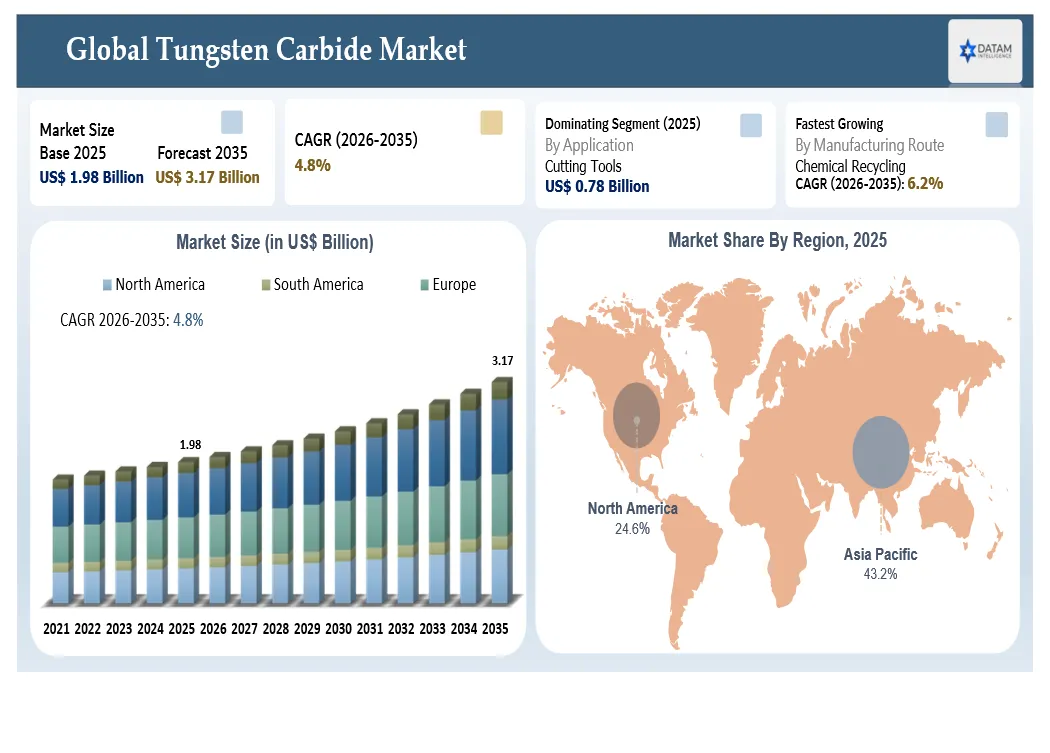
Cemented carbide remains the largest commercial product category because it converts tungsten carbide powder into high-value tools and components. Cutting tools represent the largest application due to the need for high-speed machining, tight tolerances and longer tool life. Mining and construction tools remain a major demand pool, while ultrafine grades, corrosion-resistant binders and recycled carbide are among the fastest-developing areas.
Asia-Pacific leads the market through tungsten availability, carbide powder production, cutting-tool manufacturing and heavy industrial demand. North America and Europe remain important for premium grades, recycling, aerospace tooling, oilfield wear components and high-precision applications. Supply concentration and export controls have increased the strategic value of recycling, non-Chinese feedstock and long-term procurement agreements.
| Metric | Details |
| 2025 Market Size | US$ 1.98 Billion |
| 2035 Projected Market Size | US$ 3.17 Billion |
| CAGR (2026-2035) | 4.8% |
| Largest Market | Asia-Pacific |
| Fastest Growing Market | Asia-Pacific |
| Dominating Application | Cutting Tools |
| Fastest Growing Theme | Recycled and Ultrafine Tungsten Carbide |
| Page Count | Approximately 260 pages in full report |
Tungsten Carbide Market Key Takeaways
- Cutting tools account for the largest demand share because tungsten carbide offers high hardness, compressive strength and tool-life advantages in metal removal.
- Asia-Pacific leads through China’s tungsten supply base, Japan and South Korea’s cutting-tool industries, and expanding manufacturing in India and Southeast Asia.
- Recycling is becoming strategically important as export controls and feedstock concentration raise supply-security concerns.
- Ultrafine and nano-grain grades are gaining adoption in micro-tools, electronics, medical-device machining and high-precision components.
- Mining and construction demand remains cyclical but structurally important due to infrastructure expansion and mineral development.
- Customers increasingly evaluate suppliers on grade consistency, binder chemistry, traceability, recycled content and reliable delivery.
Tungsten Carbide Industry Trends and Strategic Insights
- Closed-loop carbide recycling is moving from a cost-saving activity into a strategic supply model for tool producers and large industrial users.
- Export controls on tungsten intermediates and carbides are encouraging diversification toward allied-country mines, secondary feedstocks and regional processing.
- Producers are developing cobalt-reduced, nickel-bonded and corrosion-resistant grades for demanding oilfield, chemical and food-processing applications.
- Powder morphology, grain-size control and advanced sintering are increasingly important for differentiating tool performance.
- Acquisitions are expanding regional manufacturing footprints, especially in India and Asia-Pacific, where tool demand is growing rapidly.
Tungsten Carbide Market Scope
| Metrics | Details |
| By Product Type | Tungsten Carbide Powder, Cemented Carbide, Coated Carbide and Cast Tungsten Carbide |
| By Grade | General Purpose, Corrosion-Resistant, High-Temperature, Ultrafine and Nano-Grain |
| By Particle Size | Nano and Ultrafine, Fine, Medium and Coarse |
| By Manufacturing Route | Virgin Tungsten Route, Zinc Reclamation, Chemical Recycling, Hybrid and Other Routes |
| By Application | Cutting Tools, Mining and Construction Tools, Wear Parts, Dies and Punches, Oil and Gas Components, Coatings, Electronics and Other Specialty Uses |
| By End Use | Automotive, Mining and Construction, General Manufacturing, Aerospace and Defense, Oil and Gas, Electronics, Energy and Others |
| By Distribution Channel | Direct Sales, Authorized Distributors, Tool Integrators and OEM Channels, Online B2B Platforms |
| By Region | North America, Europe, Asia-Pacific, South America, Middle East and Africa |
| Report Insights Covered | Market Size, Share, Growth, Pricing, Capacity, Recycling, Trade, Competition and Country-Level Opportunity |
Why does this report matter in 2026?
The year 2026 is strategically important because tungsten supply security has moved to the center of industrial procurement. Export controls introduced in 2025 on tungsten intermediates, carbides and selected alloys tightened non-Chinese availability and increased the urgency of recycling, inventory planning and supplier diversification. At the same time, demand from defense, aerospace, mining, infrastructure and precision manufacturing remains resilient.
The report matters because the commercial market is highly fragmented by grade, particle size, binder system and end-use qualification. A powder suitable for general wear parts cannot automatically be substituted into aerospace cutting tools or high-pressure oilfield components. The study separates commodity volume from premium grades and evaluates where technical qualification, recycling access and regional manufacturing create defensible margins.
Tungsten Carbide Market White Space & Investment Opportunities
- Recycled carbide powder and closed-loop scrap programs offer the strongest near-term white space because they reduce exposure to primary tungsten supply and can improve carbon performance.
- India and Southeast Asia provide opportunities for regional carbide powder, blanks and wear-component production as manufacturing and mining activity expand.
- Ultrafine grades for micro-drills, printed circuit board tools, medical devices and precision molds provide higher-margin growth.
- Binder innovation using nickel, iron-nickel and cobalt-optimized formulations can address corrosion, cost and regulatory pressure.
- Digital traceability for recycled content, origin and lot-level quality can become a procurement differentiator in aerospace, defense and regulated industries.
Tungsten Carbide Future Market Transformation
The market will gradually shift from a linear virgin-material model toward a mixed system combining primary tungsten, hard scrap, soft scrap and chemical recovery. Large tool manufacturers are expected to secure scrap through take-back programs, customer contracts and partnerships with specialized recyclers. This will increase the value of collection networks and chemical conversion capacity.
Product differentiation will move further toward engineered microstructure. Grain-size distribution, binder chemistry, gradient structures, additive manufacturing and advanced coatings will determine performance. Producers that connect powder design with application engineering will capture more value than suppliers competing only on price.
Tungsten Carbide Market Buyer Decision-Making Criteria
Industrial buyers prioritize hardness, fracture toughness, transverse rupture strength, grain-size consistency, binder content and dimensional reliability. Tool users also assess machining speed, edge retention, thermal stability and predictable failure behavior. Mining and oilfield customers place additional weight on impact resistance, erosion resistance and field service life.
Supply reliability is now nearly as important as performance. Buyers increasingly ask for origin transparency, recycled content, dual sourcing, inventory support and long-term price mechanisms linked to tungsten feedstock benchmarks. Technical support and the ability to customize grades for specific workpiece materials or operating conditions influence vendor selection.
Tungsten Carbide Market Economic & Investment Analysis
The economics of tungsten carbide are shaped by APT and tungsten oxide prices, cobalt and nickel binder costs, energy use, recycling yields, machining losses and customer qualification. High-value tools can absorb higher powder costs when tool life and productivity improve, while commodity wear parts are more exposed to price competition.
Investment is moving toward recycling, powder classification, advanced sintering, automation and regional finishing capacity. Strategic value is highest where a company controls both feedstock and downstream application knowledge. Acquisitions that add local manufacturing or customer access can create more value than stand-alone capacity additions.
Tungsten Carbide Investment Trends in the Market
- Capital is moving into tungsten recycling, chemical recovery and urban mining projects.
- Tool producers are expanding manufacturing in India and Asia-Pacific to serve local metalworking, mining and oilfield demand.
- Investments in ultrafine powder, nano-grain control and coated carbide support premium tool applications.
- Defense and critical-mineral policy is encouraging domestic and allied-country tungsten projects.
- Digital production control and automated inspection are being adopted to improve consistency and reduce scrap.
Strategic Indicators For the Tungsten Carbide Market
High Regulation Impact
Chemical handling, worker exposure, conflict-mineral due diligence, mining permits and environmental requirements affect tungsten and cobalt supply. Defense procurement rules and critical-mineral policies increasingly influence approved sources.
High Investment Activity
Investment is concentrated in recycling, non-Chinese feedstock, regional processing, tool plants and advanced grades. Strategic acquisitions are being used to add capacity and customer access.
Supply Chain Disruption
The market is exposed to geographic concentration in tungsten mining and intermediate processing. Export controls, mine disruptions, shipping delays and energy shortages can rapidly affect availability.
Pricing Volatility
Tungsten carbide pricing follows APT, tungsten oxide, cobalt and energy costs. Premiums vary by grade, grain size, purity, recycled content and certification.
Procurement Pressure
Customers seek longer contracts, indexed pricing, scrap-return programs and dual sourcing. Qualification periods limit rapid supplier switching for critical applications.
New Technology Adoption
Ultrafine powders, gradient carbides, additive manufacturing, advanced PVD/CVD coatings and digital inspection are changing product performance and manufacturing efficiency.
Regional Expansion Opportunity
India, Southeast Asia, the Middle East and selected Latin American mining markets offer expansion opportunities for tools, wear parts and regional service.
Government Policy Support
Critical-mineral strategies in the U.S., Europe, Japan and allied countries support diversified tungsten supply, recycling and domestic processing.
Pricing Intelligence
General-purpose grades compete on cost and availability, while corrosion-resistant, ultrafine and aerospace-qualified grades command substantial premiums.
Disruption Analysis of Tungsten Carbide Market
The market is being disrupted by export controls, critical-mineral policy and rising concern over dependence on a concentrated supply base. These pressures are accelerating recycling, strategic stockpiling, supplier qualification and investment in non-Chinese tungsten projects. The effect is strongest in defense, aerospace and high-performance manufacturing where traceability and secure origin are becoming procurement requirements.
Technology disruption is also important. Coated carbides, ultrafine grains, additive manufacturing and digital process control are improving tool performance while reducing material use per part. This creates pressure on producers of conventional grades to move toward application-specific solutions and services.
Tungsten Carbide Market BCG Matrix: Company Evaluation
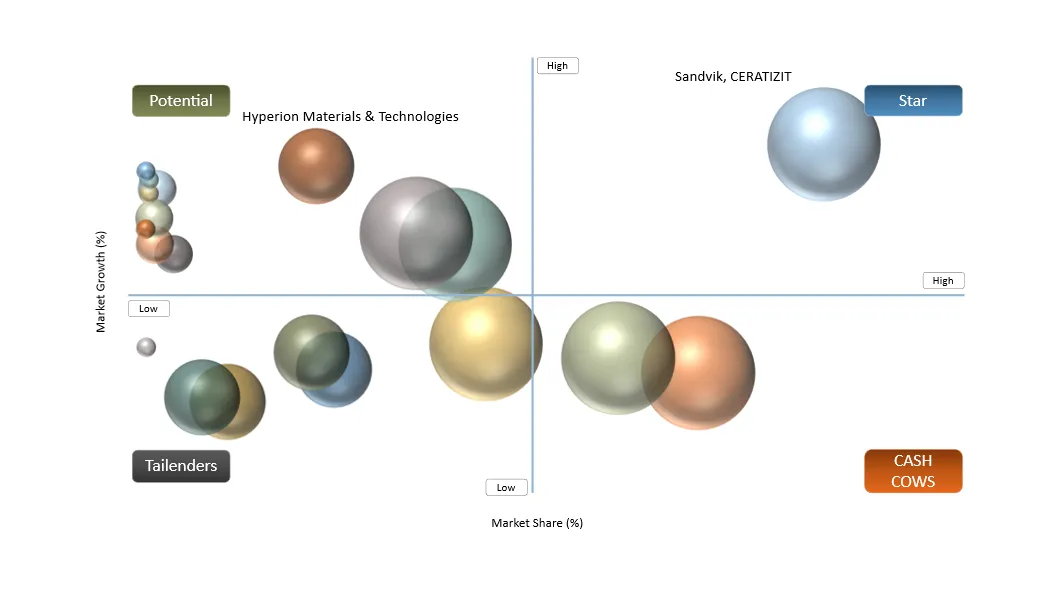
| Category | Representative Companies | Strategic Interpretation |
| STAR | Sandvik, CERATIZIT, Kennametal, Mitsubishi Materials, Sumitomo Electric | Global scale, broad application coverage, premium grades, strong tool channels and recycling capabilities. |
| POTENTIAL | Hyperion Materials & Technologies, Global Tungsten & Powders, Xiamen Tungsten, Chongyi Zhangyuan | Growth through regional expansion, powder specialization, recycling and customer-focused engineering. |
| CASH COW | Established regional carbide and wear-part producers | Strong positions in mature local markets with stable replacement demand. |
| TAILENDERS | Small commodity-grade suppliers | Vulnerable to feedstock volatility, price pressure and customer qualification requirements. |
Tungsten Carbide Market Dynamics
Driver Impact Analysis
| Driver | Market Growth Impact | Demand Concentration | Impacted Use Case | Strategic Impact |
| Rising demand for cutting tools | High | Automotive, general manufacturing, aerospace | Milling, turning, drilling | Supports premium grades and coated carbide. |
| Mining and infrastructure expansion | High | Asia-Pacific, Latin America, Middle East | Rock drilling and road tools | Raises demand for impact-resistant inserts. |
| Recycling and supply security | Medium-High | North America and Europe | Closed-loop powder and scrap recovery | Reduces import dependence and supports ESG goals. |
| Precision manufacturing growth | Medium-High | Electronics and medical devices | Micro-tools and precision dies | Accelerates ultrafine grade adoption. |
Driver: Rising Demand for Wear-Resistant Cutting and Mining Tools
The main growth driver is the need to improve productivity and reduce downtime in machining, mining and construction. Tungsten carbide tools can operate at higher cutting speeds and maintain dimensional accuracy longer than conventional tool steels. In mining and drilling, carbide inserts extend service life under abrasive and impact conditions. As labor and machine-hour costs rise, users increasingly evaluate tools on cost per part or cost per meter drilled rather than purchase price alone.
Restraint Impact Analysis
| Restraint | Drag on Market Growth | Primary Impact Area | Impacted Use Case | Strategic Impact |
| Feedstock concentration and export controls | High | Raw material availability | All carbide applications | Encourages recycling, stockpiling and supplier diversification. |
| High tungsten and binder cost | Medium-High | Manufacturing economics | Commodity tools and wear parts | Raises price sensitivity and substitution risk. |
| Cobalt exposure and compliance concerns | Medium | Binder systems | Cemented carbide production | Supports alternative binders and closed handling systems. |
| Qualification barriers | Medium | Supplier switching | Aerospace, defense and oilfield | Slows adoption of new suppliers despite shortages. |
Restraint: Tungsten Feedstock Concentration and Export Controls
Tungsten mining and intermediate processing remain geographically concentrated. Export restrictions can tighten availability of APT, oxides, carbides and selected alloys, creating price spikes and longer lead times. Producers without recycling capacity or diversified sourcing are more exposed. The market therefore requires higher working capital, strategic inventory and closer cooperation between miners, processors, recyclers and tool manufacturers.
Tungsten Carbide Market Segment Analysis
The global Tungsten Carbide market is segmented based on Product Type, Grade, Particle Size, Manufacturing Route, Application, End Use Industry, Distribution Channel and region.
By Product Type
Cemented Carbide Will Continue to Lead Commercial Value
Cemented carbide remains the largest segment because it is the dominant material platform for cutting inserts, drills, end mills, mining buttons, dies and wear parts. Tungsten carbide powder is strategically important as the upstream material, while coated carbide captures higher value in metal cutting through improved wear and heat resistance.
By Grade
Ultrafine and Nano-Grain Grades Will Record the Fastest Growth
Ultrafine grades provide high hardness and edge stability for micro-tools, precision molds, printed circuit board drilling and medical-device machining. General-purpose grades remain the largest by volume, while corrosion-resistant grades expand in oil and gas, chemical processing and food equipment.
By Particle Size
Fine and Ultrafine Powders Gain Share in Precision Applications
Fine powders support a broad balance of hardness and toughness. Ultrafine powders are growing faster in high-precision applications. Coarse grades remain important for mining and impact-heavy wear parts where fracture resistance is critical.
By Manufacturing Route
Virgin Tungsten Route Remains Largest While Recycling Grows Fastest
Virgin production remains essential for controlled chemistry and high-purity applications. Zinc reclamation and chemical recycling are gaining importance due to supply security, cost and sustainability. Chemical recovery can process mixed scrap and return material to powder production.
By Application
Cutting Tools Will Remain the Largest Application
Cutting tools lead because tungsten carbide is used across turning, milling, drilling and threading. Mining and construction tools form the second major demand pool. Wear parts, dies and oilfield components provide stable replacement demand.
By End Use Industry
General Manufacturing and Automotive Will Lead Demand
General manufacturing and automotive require large volumes of carbide tools for metal removal. Mining, aerospace and oil and gas consume lower volumes but often require premium grades and higher service value.
By Distribution Channel
Direct Sales Will Dominate Large Industrial Accounts
Large users prefer direct technical engagement, long-term contracts and customized grades. Distributors remain important for small and medium-sized manufacturers, replacement tools and regional inventory support.
Tungsten Carbide Market Geographical Penetration
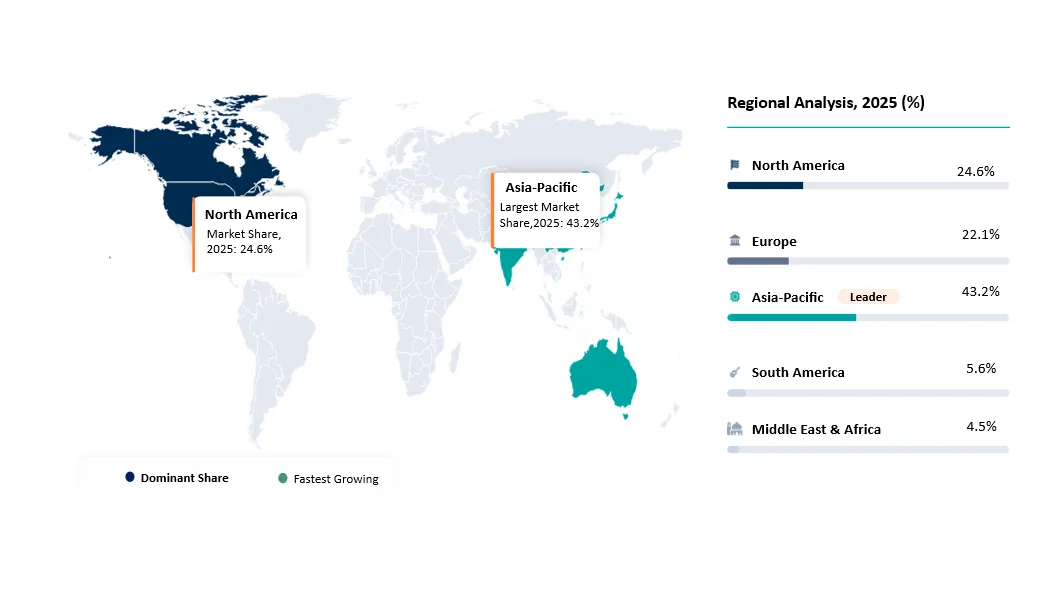
| Region | 2025 Share | Market Position | Key Drivers |
| Asia-Pacific | 43.2% | Largest and fastest growing | Tungsten supply, cutting-tool manufacturing, mining, automotive and infrastructure. |
| North America | 24.6% | Premium and secure-supply market | Aerospace, defense, oil and gas, mining, recycling and reshoring. |
| Europe | 22.1% | Technology and recycling leader | Automotive, precision engineering, tool manufacturing and circularity. |
| South America | 5.6% | Mining-driven growth | Copper, iron ore, construction and regional tool demand. |
| Middle East and Africa | 4.5% | Emerging industrial market | Mining, oil and gas, infrastructure and local manufacturing. |
U.S. Tungsten Carbide Market Landscape
The U.S. market is supported by aerospace, defense, oil and gas, mining and advanced manufacturing. Supply security is a central issue because domestic demand exceeds local tungsten processing capacity. Recycling and allied-country sourcing are expanding, while defense procurement policies increase the importance of origin traceability.
Germany Tungsten Carbide Market Outlook
Germany has a mature market built around automotive manufacturing, machine tools, precision engineering and recycling. Demand favors coated inserts, ultrafine grades and application engineering. Energy cost and automotive restructuring are challenges, but high-value manufacturing sustains premium demand.
Japan Tungsten Carbide Market Trends
Japan is a major producer and user of high-quality cemented carbide tools. The market benefits from automotive, electronics, robotics and precision machinery. Japanese companies compete through powder control, coating technology, edge preparation and long tool-life performance.
China Tungsten Carbide Market Trends
China dominates upstream tungsten supply and has extensive carbide powder, cemented carbide and cutting-tool production. Domestic demand comes from manufacturing, mining, infrastructure and exports. Environmental controls, export policy and movement toward higher-value tools are reshaping competition.
India Tungsten Carbide Market Outlook
India is a fast-growing market supported by automotive production, defense manufacturing, mining, rail, infrastructure and machine-tool investment. Regional manufacturing expansion and acquisitions are improving local availability of carbide products and wear solutions.
Brazil Tungsten Carbide Market Outlook
Brazil demand is closely linked to mining, oil and gas, construction and agricultural machinery. Mining tools and wear parts form a large opportunity. Import dependence creates a need for local inventory, repair, recycling and service partnerships.
Middle East and Africa Tungsten Carbide Market Outlook
The region offers growth through mining, oil and gas, construction and industrial localization. South Africa is important for mining applications, while Saudi Arabia and the UAE offer opportunities linked to industrial diversification and energy projects.
Tungsten Carbide Market Competitive Landscape
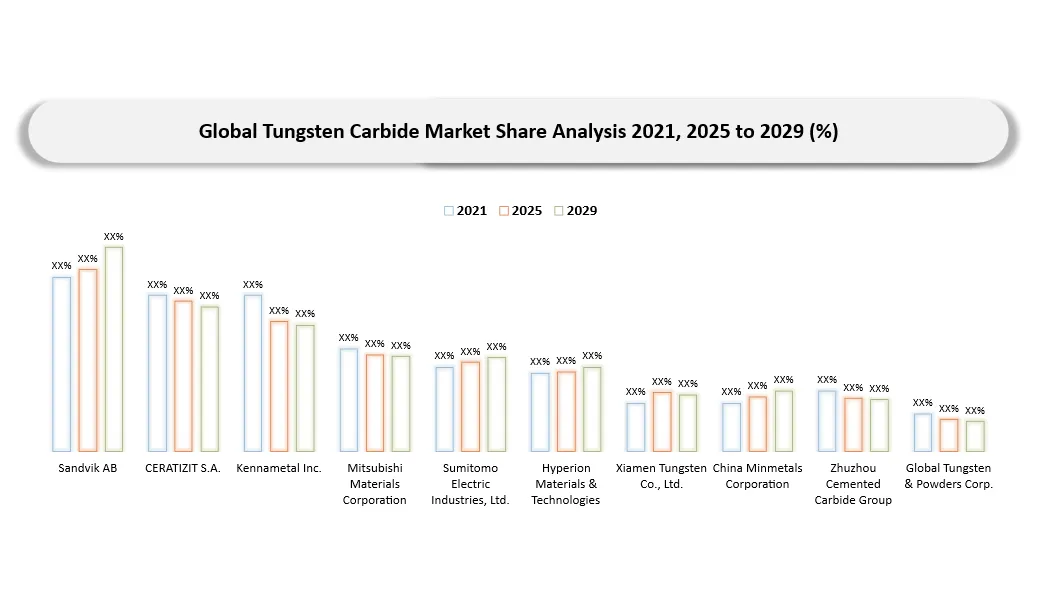
- Competition is divided between integrated tungsten and carbide groups, global cutting-tool companies, specialist powder producers, regional wear-part manufacturers and recyclers.
- Leading companies compete through powder quality, proprietary grades, coatings, application engineering, recycling access, tool channels and global customer service.
- Asia-Pacific has the largest production base, while Europe, Japan and the U.S. remain strong in premium tools, specialty powders and advanced wear solutions.
- Mergers and acquisitions are being used to add regional manufacturing and customer access, particularly in India and fast-growing industrial markets.
- Recycling capability is becoming a durable competitive advantage because it secures feedstock, supports sustainability targets and strengthens customer relationships.
Industry-Leading Players in Tungsten Carbide
- Sandvik AB
- CERATIZIT S.A.
- Kennametal Inc.
- Mitsubishi Materials Corporation
- Sumitomo Electric Industries, Ltd.
- Hyperion Materials & Technologies
- Global Tungsten & Powders Corp.
- Xiamen Tungsten Co., Ltd.
- Chongyi Zhangyuan Tungsten Co., Ltd.
- China Minmetals Corporation
- Zhuzhou Cemented Carbide Group
- Guangdong Xianglu Tungsten Co., Ltd.
- Buffalo Tungsten Inc.
- Japan New Metals Co., Ltd.
- Tungco Inc.
- Federal Carbide Company
- Extramet AG
- Eurotungstene
- Treibacher Industrie AG
- Electronica Tungsten Ltd.
Company Profiles
Sandvik AB
Sandvik is a global leader in metal cutting and mining solutions with extensive carbide grade, insert, tool and recycling capabilities. Its position is supported by broad customer coverage, digital machining solutions and control over application engineering.
CERATIZIT S.A.
CERATIZIT is an integrated hard-materials and cutting-tools group with strong tungsten recycling, powder metallurgy and engineered component capabilities. It competes across cutting tools, wear parts, wood and stone working, and specialized carbide components.
Kennametal Inc.
Kennametal serves metalworking, mining, aerospace, energy and infrastructure customers through cutting tools, wear solutions and engineered materials. Its competitive strength lies in application support, channel reach and premium tooling systems.
Mitsubishi Materials Corporation
Mitsubishi Materials is a major Japanese cutting-tool and materials company with broad carbide insert, drill, end mill and coated-tool portfolios. It benefits from advanced coating and substrate technology.
Sumitomo Electric Industries, Ltd.
Sumitomo Electric produces cemented carbide tools, CBN/PCD tools and precision machining solutions. Its market position is supported by Japanese manufacturing quality, automotive exposure and global technical service.
Hyperion Materials & Technologies
Hyperion specializes in hard and super-hard materials, carbide blanks, wear parts and engineered solutions. Its 2026 acquisition of Electronica Tungsten strengthens manufacturing capacity and customer access in India and Asia-Pacific.
Global Tungsten & Powders Corp.
Global Tungsten & Powders supplies tungsten powders, tungsten carbide powders and related materials. It is strategically relevant to non-Chinese supply, aerospace, defense and industrial customers requiring controlled quality and origin.
Xiamen Tungsten Co., Ltd.
Xiamen Tungsten is a major Chinese integrated tungsten company with upstream resources, intermediates, carbide powders and downstream hard-material products. Scale and vertical integration support cost competitiveness.
Tungco Inc.
Tungco focuses on tungsten carbide scrap, recycling and urban mining. Its Project 74 initiative expands domestic conversion of tungsten scrap into sodium tungstate, supporting U.S. circular supply.
Electronica Tungsten Ltd.
Electronica Tungsten manufactures carbide products for cutting, forming, mining, oil and gas and wear applications from India. Its acquisition by Hyperion expands its strategic role in regional supply.
Tungsten Carbide Market Major Pain Points
- Concentration of tungsten mining and intermediate processing in a limited number of countries.
- Export controls and geopolitical risk affecting availability and pricing.
- High tungsten, cobalt and energy costs.
- Long customer qualification periods for critical grades.
- Collection and sorting challenges for mixed carbide scrap.
- Environmental and worker-safety requirements in powder and binder handling.
- Price competition in commodity grades.
- Need for consistent grain size, chemistry and lot-to-lot performance.
Tungsten Carbide Market Recent Developments
- March 2026: Hyperion Materials & Technologies completed the acquisition of Electronica Tungsten Ltd., adding India-based carbide manufacturing for metal cutting, forming, mining, oil and gas and wear applications.
- April 2026: Tungco announced Project 74, an operational U.S. urban-mining partnership designed to convert domestic tungsten scrap into sodium tungstate for tungsten metals production and recycling.
- October 2025: Hyperion introduced DZ23, a lightweight carbide grade for can punch sleeves, targeting improved performance and reduced component weight.
- February 2025: China implemented new export controls covering selected tungsten intermediates, carbides and tungsten-containing alloys, tightening global supply and increasing diversification efforts.
- 2025-2026: Governments and industrial buyers increased focus on non-Chinese tungsten supply, recycling and traceability for defense and critical manufacturing.
Analyst View / Opinion on Tungsten Carbide Market
- The market will expand steadily as machining, mining and infrastructure activity sustain recurring tool and wear-part demand.
- Supply security will influence strategy more strongly than in the previous decade, raising the value of recycling, inventory and regional processing.
- Asia-Pacific will remain the largest market, while North America and Europe will emphasize secure supply and premium grades.
- Ultrafine powders, advanced coatings and corrosion-resistant binders will deliver faster growth than general-purpose commodity grades.
- Companies that combine feedstock access, recycling, powder expertise and application engineering will gain the strongest competitive position.
Tungsten Carbide Market Target Audience
| Industry | Who Should Buy This Report? | Reason to Buy This Report |
| Cutting Tools | Tool manufacturers, insert producers, machine-tool companies | Assess grade demand, application growth and competitive positioning. |
| Mining and Construction | Mining-tool suppliers, contractors, equipment OEMs | Evaluate demand for rock tools, wear parts and regional opportunities. |
| Automotive and Aerospace | OEMs, tier suppliers, machining operations | Understand tool consumption, qualification and productivity drivers. |
| Tungsten and Carbide Producers | Miners, processors, powder producers, recyclers | Analyze supply, pricing, capacity, trade and investment opportunities. |
| Oil and Gas | Drilling-tool and flow-control suppliers | Assess demand for erosion, corrosion and wear-resistant components. |
| Investors and Consulting | Private equity, corporate strategy, advisory firms | Support market entry, M&A, benchmarking and supply-chain strategy. |
Why Choose DATAM?
- Data-driven insights combining market sizing, trade, capacity, pricing and end-use demand.
- Post-purchase analyst consultations for sourcing, market entry, partnerships and competitive benchmarking.
- Annual updates covering export controls, capacity changes, product launches and acquisitions.
- Specialized focus on emerging markets and industrial supply chains.
- Actionable analysis linking tungsten feedstock to carbide powder, tools, wear parts and customer economics.
What DATAM Uniquely Provides
- Detailed value-chain analysis from tungsten concentrate and APT through carbide powder, cemented carbide and finished tools.
- Segmentation by product type, grade, particle size, manufacturing route, application, end use and distribution channel.
- Competitive benchmarking of integrated producers, tool companies, recyclers and regional specialists.
- Country-level analysis of demand, supply security, recycling and industrial growth.
- Strategic recommendations for feedstock diversification, partnerships, recycling and regional expansion.





























































