


U.S. Cutting Tools & Manufacturing Technology Perspective
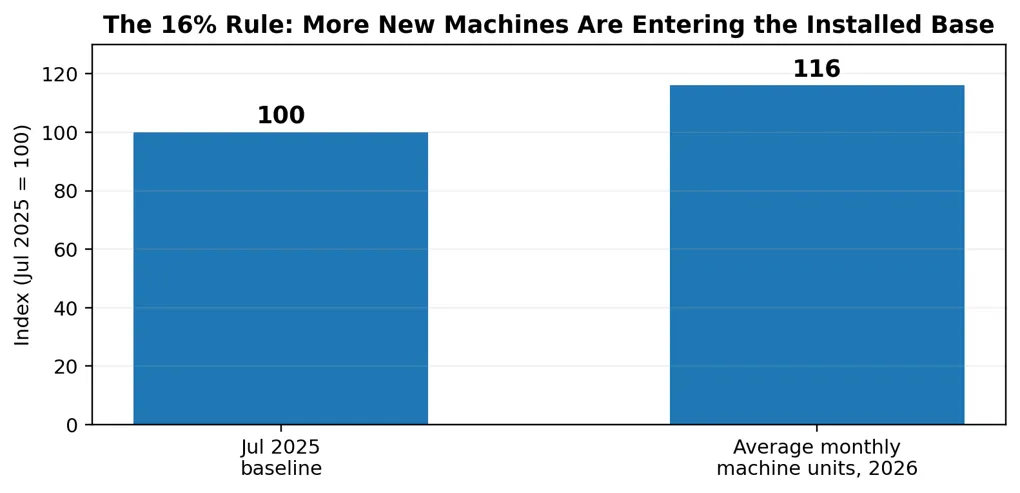
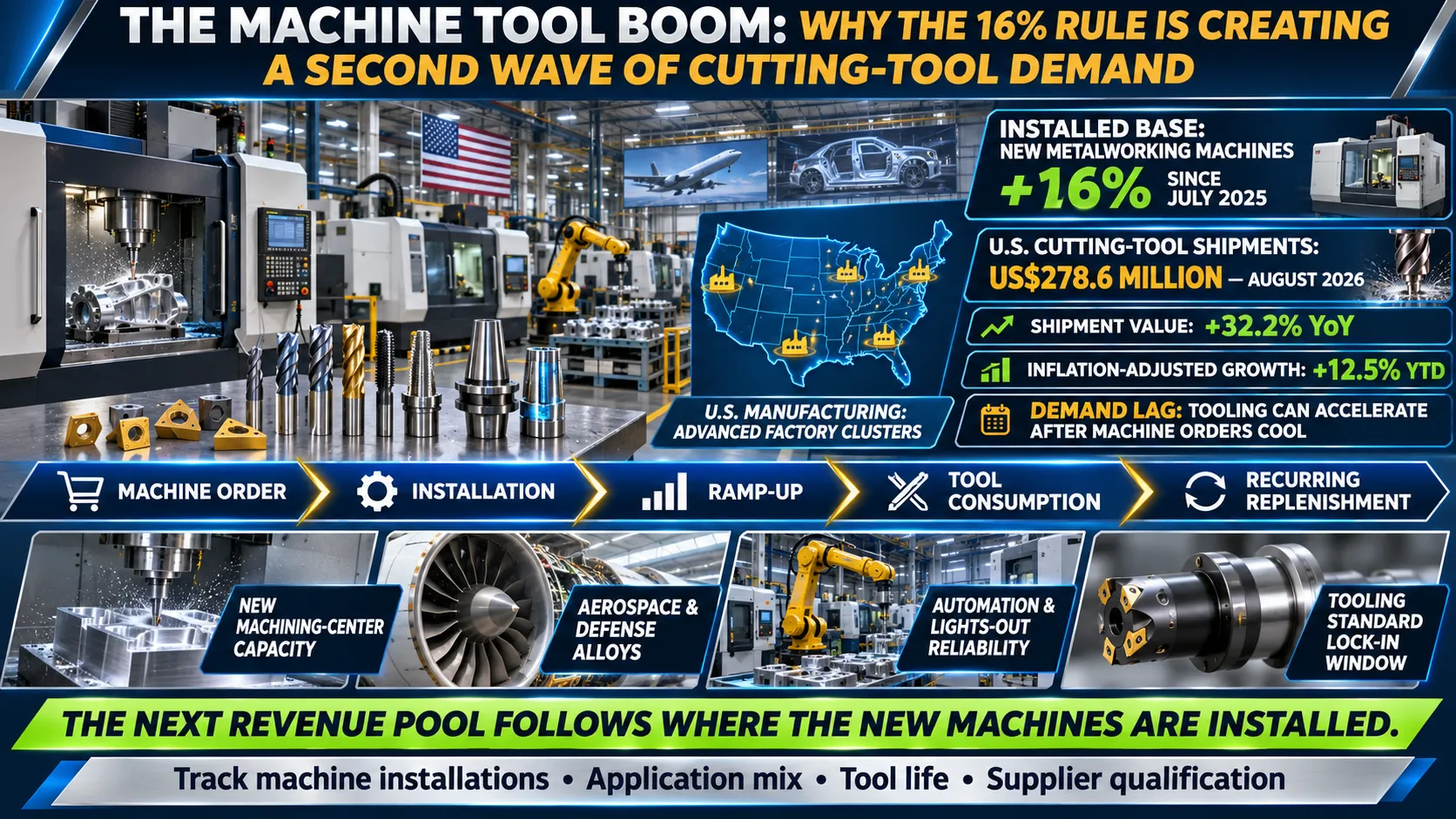
| INSTALLED-BASE SIGNAL | AMT says the average number of new metalworking machines ordered each month has increased 16% since July 2025, expanding the stock of machines that continuously consume cutting tools. |
| DEMAND SIGNAL | U.S. cutting-tool shipment value reached $278.6 million in August 2026, up 32.2% year over year. Even after removing price increases, YTD shipments were still up 12.5%. |
| COMMERCIAL QUESTION | Which industries and shop clusters are adding the most machine capacity now - and which tool categories will become recurring replenishment demand over the next 12-24 months? |
The Cutting Tool Cycle Is Catching Up With the Machine Tool Cycle
Cutting tools behave differently from capital equipment. A machining center, turning center or multi-axis system is purchased once, but the drills, end mills, inserts, taps, reamers and wear components running inside it are consumed repeatedly. That makes every new machine installation a potential multi-year stream of tooling demand.
The current U.S. manufacturing-technology expansion has now been running for roughly two years. AMT says the average number of new metalworking machines ordered each month has risen 16% since July 2025. That is the critical 16% rul”: even if machine-tool orders stop accelerating tomorrow, the installed base that needs fresh tooling is already larger.
Request Executive Sample: https://www.datamintelligence.com/download-sample/cutting-tools-and-inserts-market
Why the Installed Base Matters More Than One Month of Machine Orders
Machine-tool order headlines measure capital spending. Cutting-tool shipments measure actual consumption on the shop floor. The two cycles are linked, but they do not peak at the same time. AMT notes that during the previous cutting-tool expansion beginning in March 2021, tooling demand continued to accelerate for 27 months after machinery orders had already moved into contraction.
That lag matters because a machine ordered today typically enters production later, then begins a recurring cycle of insert indexing, edge replacement, drill wear, regrinding, tool-holder changes and application-specific optimization. The installed-machine base therefore acts like a demand reservoir that continues to pull tooling even after capital-equipment headlines cool.
The Demand Is Not Just Inflation
Raw-material inflation has clearly lifted cutting-tool shipment values in 2026. But the AMT/USCTI data still show substantial real demand after adjusting for those price increases. Through August, nominal shipment value was up 22.4% year to date, while inflation-adjusted growth was still 12.5%.
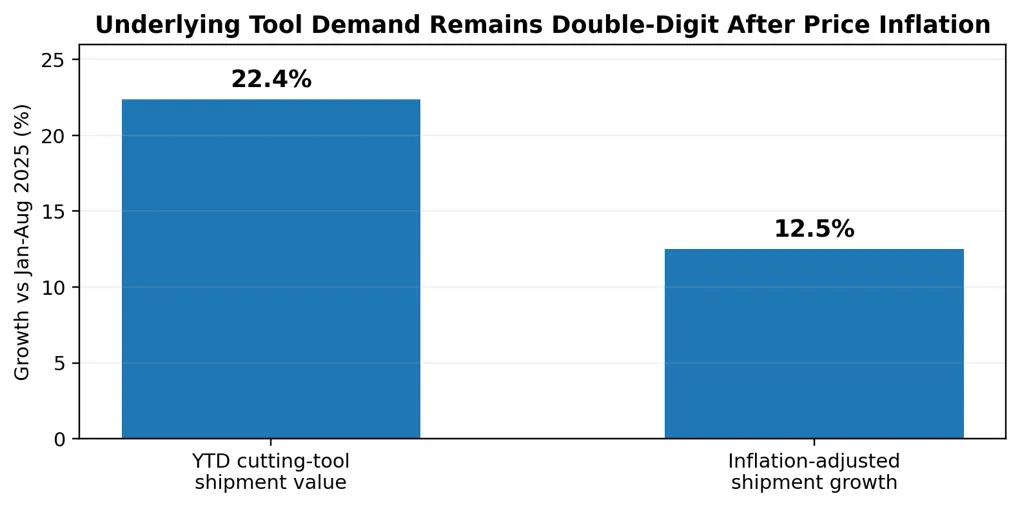
The difference between 22.4% and 12.5% is important. It shows that tungsten and carbide inflation are amplifying the market, but they are not creating the entire growth story. Shops are buying more tooling because more productive capacity is physically running.
Recurring Tool Demand Follows the Machine Into Production
| CAPEX ORDER | INSTALLATION | RAMP-UP | TOOL CONSUMPTION | REPLENISHMENT |
| Machine ordered | Commissioned and tooled | Programs stabilize and utilization rises | Inserts, drills, end mills and taps wear | Recurring monthly/quarterly purchasing |
Cutting-Tool Shipments Are Holding Near Record Levels
The monthly pattern supports the installed-base thesis. U.S. cutting-tool shipments increased from $239.8 million in May to $270.5 million in June, $278.1 million in July and $278.6 million in August. July and August were essentially flat month to month, but both remained dramatically above year-earlier levels.
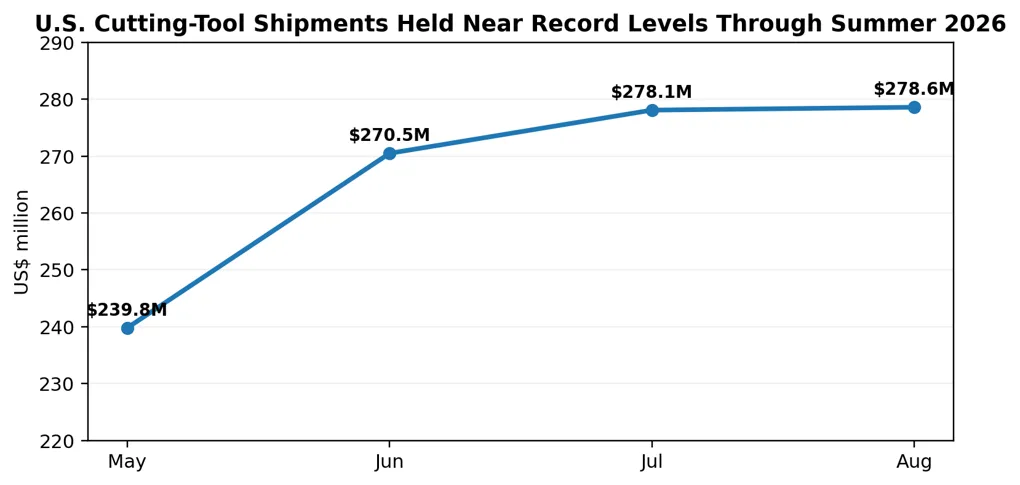
This is what a consumption cycle looks like after a machinery investment wave: tooling does not need machine orders to rise every month. It needs the installed equipment to run more shifts, machine more difficult materials and maintain higher spindle utilization.
The Machine-Tool Expansion Is Still Accelerating
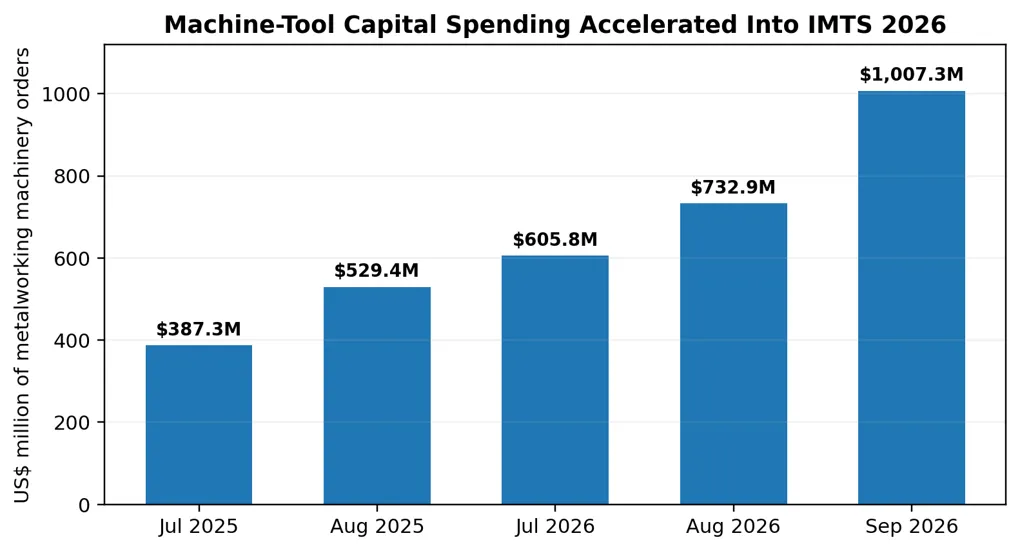
The upstream capital cycle has not disappeared either. U.S. metalworking machinery orders reached $605.8 million in July 2026, $732.9 million in August and then crossed $1 billion in September following IMTS. AMT described August as the third-highest monthly order total recorded, while September represented a 101.7% increase over September 2025.
Where the 16% Rule Converts Into Tooling Revenue
The commercial opportunity is not uniform across every tool family. The best demand pools are where machine additions overlap with high utilization, difficult-to-machine materials, automation and expensive downtime. Those conditions increase tool changes, tool-life optimization and willingness to pay for higher-performance geometries and coatings.
| Signal | What it reveals | Likely tooling impact | Commercial action |
New multi-axis / machining-center capacity | More spindle hours entering the installed base | End mills, drills, indexable cutters, holders | Map machine installations by shop and end market |
Aerospace / defense capacity expansion | High-value alloys and long cycle times increase wear sensitivity | Carbide drills, end mills, inserts, PCD/CBN where applicable | Prioritize applications where tool life has high economic value |
Automation / lights-out machining | Fewer operator interventions increase reliability requirements | Long-life inserts, monitoring-compatible tooling, preset systems | Sell cost per part and unattended reliability, not unit price |
Contract machining backlog growth | Utilization rises across mixed machine fleets | Broad replenishment across drills, taps, inserts and milling tools | Track backlog, spindle utilization and machine mix |
New machine commissioning | Tool package is still being standardized | Starter tooling, holders, presetting and application engineering | Engage before tooling standards are locked |
The Real Competitive Battle Is the Tooling Standard on the New Machine
A new machining center creates an unusually valuable commercial window. Before production stabilizes, the operator is still deciding which insert geometry, grade, coating, holder, drill family and tool-management process becomes standard. Winning that qualification can create recurring replenishment demand long after the original machine purchase disappears from the capital budget.
That is why machine-tool intelligence should sit beside cutting-tool market data. Knowing that the market is growing is not enough. Suppliers need to know which OEMs are shipping machines, which industries are adding capacity, which shops are expanding and when new equipment reaches production.
The 16% Rule Changes How Suppliers Should Read 2027
The headline risk is that analysts treat high cutting-tool shipment values as a temporary inflation spike. The data argue for a more balanced view. Material costs explain part of the 2026 increase, but the machinery base itself is expanding, and AMT still sees a two-year manufacturing-technology order cycle that accelerated into IMTS 2026.
For cutting-tool suppliers, the question is shifting from how fast tool shipments are growing to where did the new machines go, when will they reach full utilization and which consumable tooling standards will they lock in.
What Buyers Need to Track Beyond the Headline Shipment Data
A high-level shipment series tells you that tooling demand is strong. It does not tell you where the next recurring revenue pool is forming. A useful cutting-tools intelligence program needs to connect the capital-equipment cycle to the consumable cycle.
MACHINE INSTALLATIONS OEM, machine type, customer site, order timing and commissioning schedule | APPLICATION MIX Aerospace, automotive, defense, energy, general engineering and difficult-material exposure |
TOOLING ECONOMICS Tool life, coating/grade requirements, cost per part, regrind potential and substitution risk | SUPPLIER POSITIONING Incumbent tool brands, distributor relationships, application support and qualification windows |
Why This Makes the Cutting Tools Report More Valuable Now
The 2026 market is being shaped by two forces at the same time: a raw-material shock that is raising carbide tool prices and an installed-machine expansion that is increasing underlying consumption. Looking at either force alone can misread the opportunity.
The DataM Cutting Tools Market Report is designed to help manufacturers, distributors, investors and procurement teams separate price-driven growth from real consumption, identify the end-use sectors adding machining capacity, benchmark supplier positioning and understand where tooling demand is likely to persist after the current capital-investment cycle normalizes.
See which machine-tool investments are translating into recurring cutting-tool consumption - by application, geography, tool type and supplier. ACCESS THE
CUTTING TOOLS REPORT