


Cutting Tools & EV Manufacturing Perspective
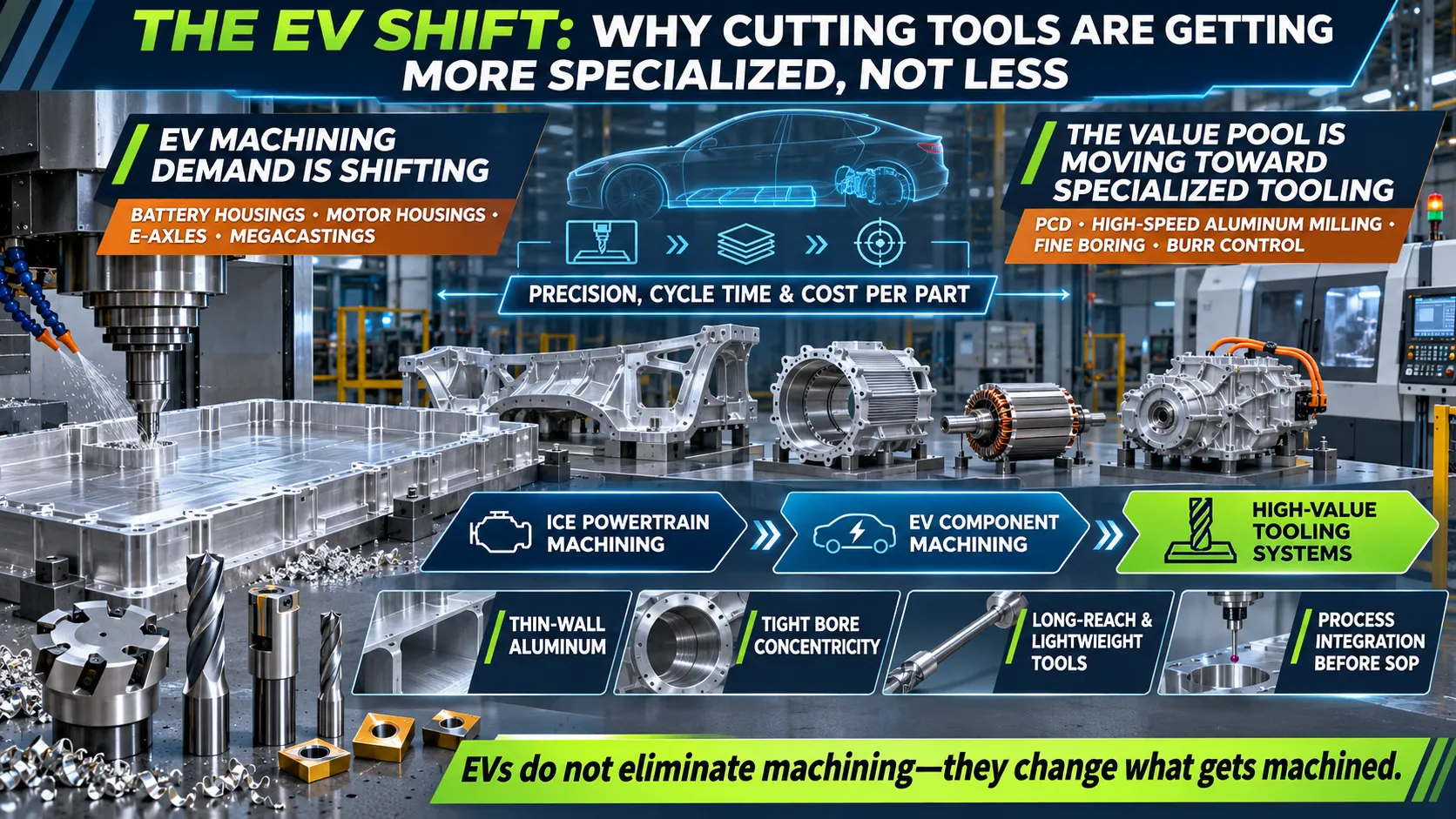
| DEMAND SHIFT | EVs remove some engine and transmission machining, but add large aluminum battery structures, motor housings, e-axles, power-electronics housings and precision rotor/shaft work. |
| TOOLING SHIFT | The value pool is moving toward PCD, high-speed aluminum milling, long-reach tools, fine boring, burr control, chip evacuation and integrated multi-operation tools. |
| COMMERCIAL QUESTION | Which EV platforms and Tier 1 programs are creating new high-value machining demand - and which tooling suppliers are getting specified before production ramps? |
EVs Do Not Eliminate Machining - They Change What Gets Machined
The transition from internal combustion to electric propulsion is often described as a negative for cutting tools because battery electric vehicles remove engine blocks, cylinder heads, crankshafts and parts of the conventional transmission. That view is incomplete. The machining burden is shifting into a different set of components with very different material, geometry and tolerance requirements.
ISCAR’s 2026 EV production guidance identifies large aluminum battery housings and structural frames, electric motor housings, stators, rotors, shafts and compact transmission components as core machining applications. The common thread is not simply “more aluminum.” It is thin walls, large workpieces, long overhangs, tight bore concentricity, aggressive material-removal rates and burr-free sealing surfaces. Those requirements favor application-specific tooling rather than commodity inserts.
Request Executive Sample: https://www.datamintelligence.com/download-sample/cutting-tools-and-inserts-market
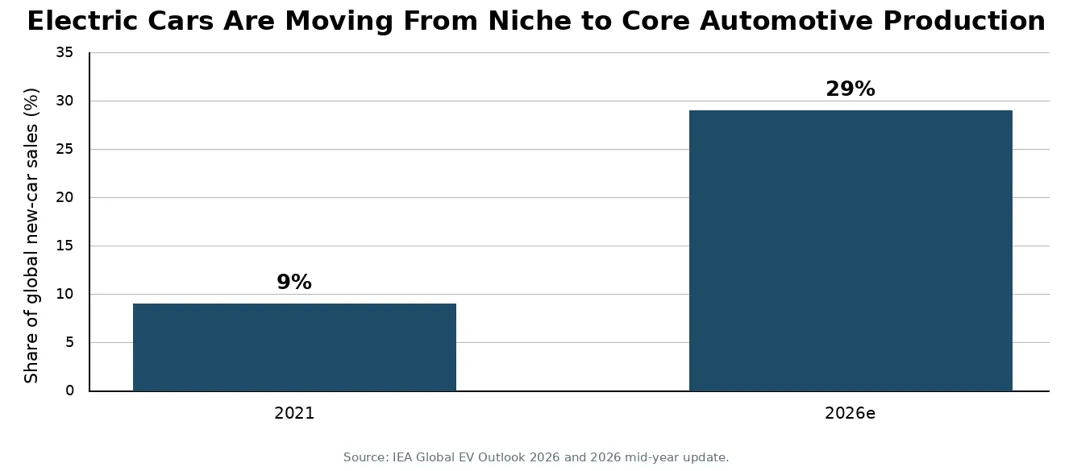
The addressable production base is also becoming too large to treat EV tooling as a niche program. The IEA says electric cars represented 25% of global new-car sales in 2025 and expects the share to approach 29% in 2026. The tooling implication is not a one-for-one increase in tool units. It is that more automotive plants and suppliers must qualify EV-specific machining processes alongside conventional programs.
The Value Pool Is Moving Toward Aluminum and Precision
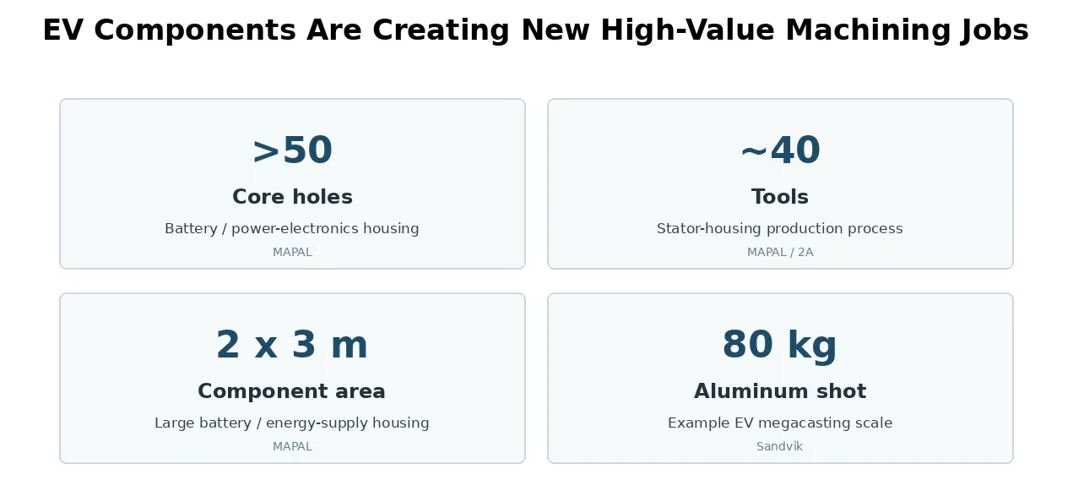
MAPAL’s electrified-mobility documentation shows how different the new machining jobs can be. Battery and power-electronics housings can reach roughly 2 x 3 metres, use thin-wall aluminum structures and require more than 50 core holes per component. In a separate stator-housing production example, around 40 different tools are used, with final boring performed to accuracy of only a few microns.
Sandvik makes the same commercial point from another angle: EVs may use fewer machined powertrain components, but the tools that remain can be more complex, more specialized and higher priced. It cites megacasting processes involving up to 80 kg of molten aluminum, where final machining can require long, lightweight overhanging tools and superhard PCD solutions.
Europe Shows How Quickly the Tooling Mix Can Change
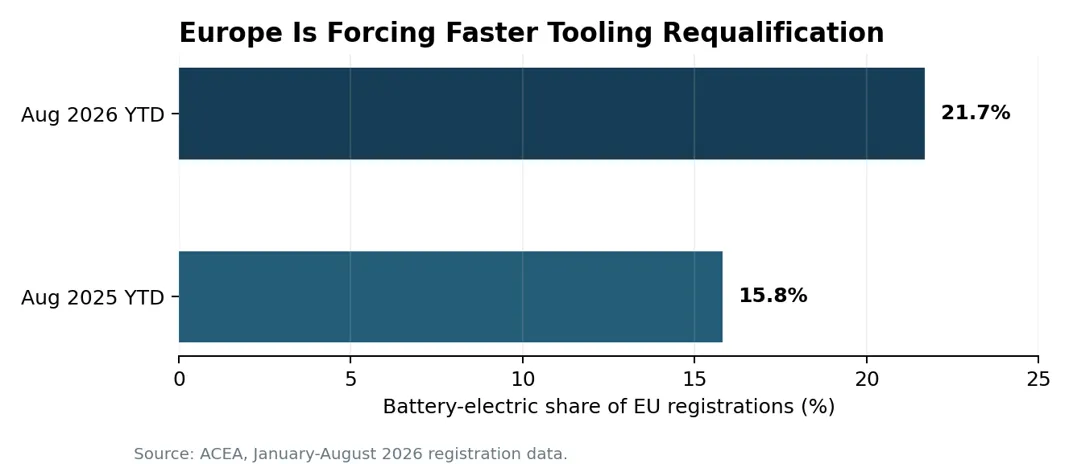
In the EU, battery-electric vehicles increased from 15.8% of registrations through August 2025 to 21.7% through August 2026. That change matters to cutting-tool suppliers because automotive programs do not transition uniformly. OEMs and Tier 1s must simultaneously support legacy ICE, hybrid and BEV production, creating a mixed tooling environment where standardized tool packages are harder to maintain.
The IEA expects the number of electric-car models available globally to exceed 1,100 in 2026, with around 150 new electric models announced for launch during the year. Each additional platform can create new battery-envelope dimensions, motor housings, thermal-management parts and structural designs that have to be tooled, validated and ramped.
Why Traditional Automotive Tooling Is Not Enough
Battery trays and housings are often large, thin and vibration-prone. They require high material-removal rates without distorting the component, plus reliable drilling, threading and sealing-surface finishing. Electric motor housings add a different problem: coaxial bores, bearing seats and stator interfaces must be finished with extremely tight concentricity because small geometric errors can affect motor efficiency, noise and assembly fit.
That is why dedicated EV tool systems are multiplying. ISCAR highlights polished aluminum geometries, modular drilling and integrated combination tools. MAPAL uses PCD-tipped boring and milling systems for motor housings. Kennametal markets dedicated EV solutions for aluminum alloys, hardened steels, battery housings, rotors and shafts. The competitive unit is increasingly the complete machining process rather than a standalone insert.
Specialized Tools Are Being Justified by Cost per Part
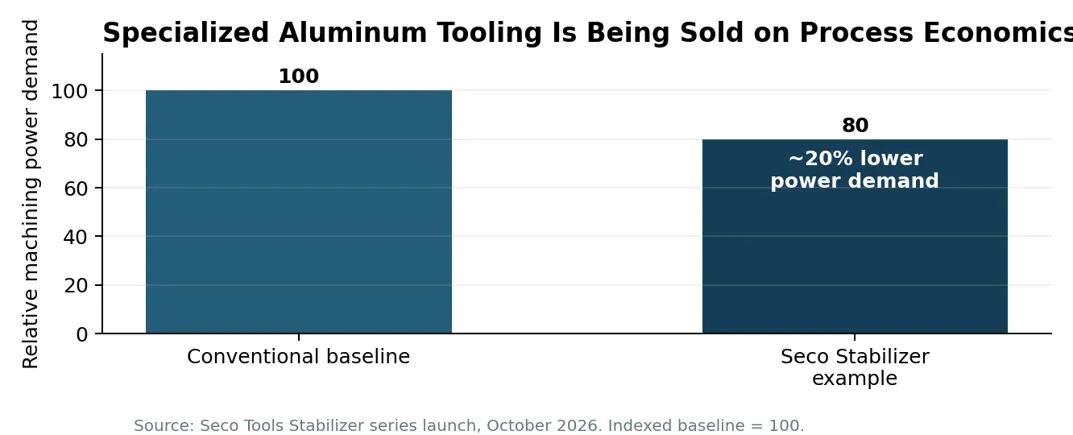
The shift is also changing how cutting tools are sold. Seco’s October 2026 Stabilizer series for aluminum machining is designed to reduce machining power demand by around 20% while maintaining productivity. That type of claim is increasingly important in EV programs, where OEMs and Tier 1s are evaluating tooling on cycle time, spindle load, burr control, scrap, energy use and tool-change frequency together.
For suppliers, this creates a higher-value selling opportunity. The winning tool is not necessarily the lowest-cost insert. It is the tool package that protects dimensional stability on a thin aluminum housing, avoids rework on a sealing surface, finishes a motor bore within tolerance and keeps a high-volume line running with fewer interventions.
Request a Customized Report According to Your Business Strategy: https://www.datamintelligence.com/customize/cutting-tools-and-inserts-market
Where the EV Shift Converts Into Cutting-Tool Revenue
| EV machining signal | What changes | Tooling opportunity | Commercial action |
Battery tray / housing award | Large thin-wall aluminum parts enter production | PCD milling, drilling, deburring, long-reach tools | Engage before process validation and tool standardization |
Motor / e-axle program ramp | Tighter bore, bearing-seat and concentricity requirements | Fine boring, reaming, combination tools, shaft tooling | Sell the complete process, not a single insert |
| Megacasting adoption | Fewer assembled parts but larger finishing jobs | Long lightweight tools, high-speed milling, PCD | Track casting line launches and downstream machining cells |
New EV platform / variant | Geometry and feature set change again | Modular tooling and flexible tool families | Target requalification windows before SOP |
Energy / cycle-time target | Cost per part becomes more important | Low-force geometries, fewer tool changes, process integration | Quantify power, scrap and cycle-time savings |
The Competitive Battle Is Moving Upstream Into Process Design
In conventional automotive programs, cutting-tool suppliers could often compete after the component and machining sequence were already mature. EV production creates more opportunities earlier in the process because OEMs and Tier 1s are still deciding how battery structures, motor housings and integrated castings will be machined at volume.
That makes process engineering, application support and machine-tool partnerships more commercially important. A supplier that helps define the cutter geometry, spindle strategy, chip evacuation, bore sequence and reconditioning plan during launch has a better chance of becoming the recurring standard once the line reaches volume production.
The EV Shift Is a Mix Shift, Not a Simple Volume Story
The risk for market analysis is to assume that every EV sold creates more cutting-tool consumption than an ICE vehicle. It does not. BEVs remove many conventional engine-machining operations. But the remaining and newly created machining jobs can carry higher tooling complexity, tighter tolerances and more demanding aluminum processes. That changes the revenue mix even when the number of machined components falls.
For cutting-tool companies, distributors and investors, the actionable question is therefore not “Will EVs increase or decrease total tooling demand?” It is “Which machining operations are disappearing, which high-value operations are replacing them, and which suppliers are being designed into those new processes?”
What Buyers Need to Track Beyond EV Sales
EV unit growth by itself does not identify the cutting-tool opportunity. A useful intelligence program needs to map vehicle platforms to battery architecture, casting strategy, motor and e-axle design, Tier 1 machining locations, material mix, production start dates and the tooling families used at each operation.
That is where the Cutting Tools Market Report becomes more valuable. It helps manufacturers, distributors, investors and procurement teams understand how automotive machining demand is migrating by component and material, where specialized tooling is gaining share, which suppliers are positioned for EV programs and how the shift affects drills, milling cutters, PCD tools, inserts, boring systems and other high-value tool categories.