


Cutting Tools Market Perspective
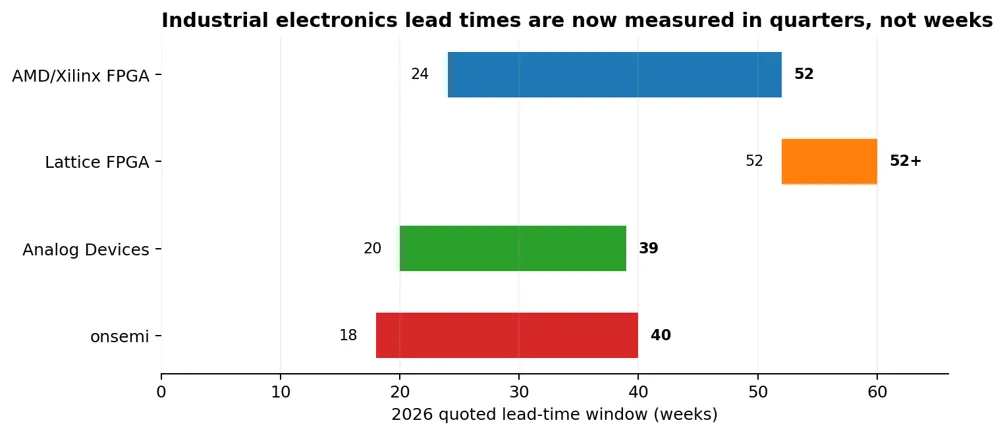
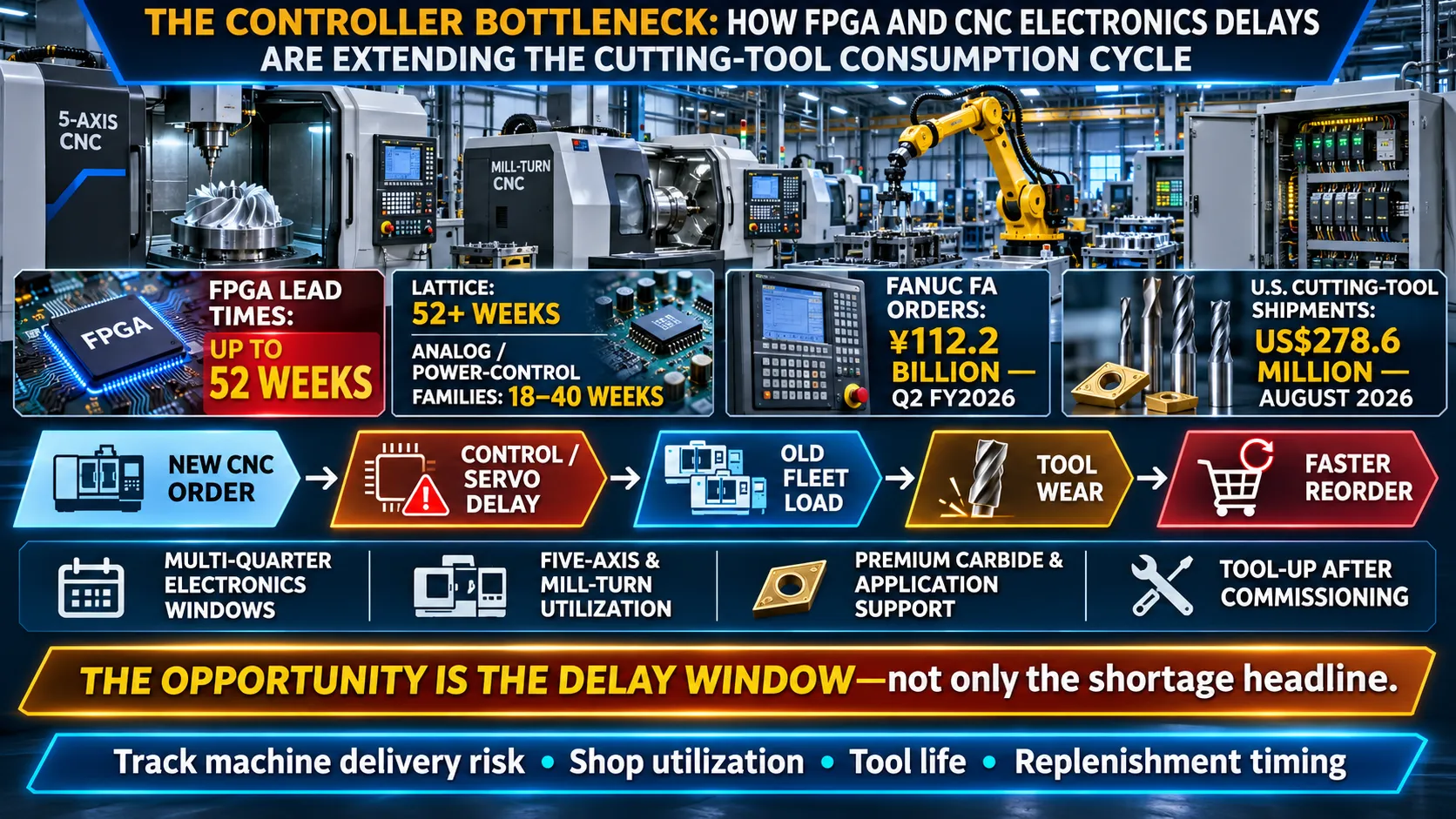
| CONTROL BOTTLENECK | Industrial electronics are again moving to long lead times. 2026 channel data show AMD/Xilinx FPGAs rising to as high as 52 weeks, Lattice at 52+ weeks and several analog/power-control families at 18-40 weeks. |
| OEM SIGNAL | FANUC says extended lead times for semiconductors, electrical/electronic components and mechanical parts are widening the gap between orders and sales. Customers are placing orders earlier to protect delivery slots. |
| TOOLING EFFECT | When new machine deliveries slip, production does not stop. Existing CNC assets carry more spindle hours, keeping inserts, drills, end mills and other consumables in an accelerated replenishment cycle. |
The Bottleneck Has Moved Inside the Control Cabinet
The cutting-tool demand story is no longer only about machine-tool capex or tungsten. A second constraint is emerging inside the electronics stack that controls high-end CNC equipment. Motion control, servo systems, signal processing, industrial I/O and safety architectures depend on semiconductors that are competing for constrained foundry and packaging capacity.
The user-provided “six-month FPGA delay” is directionally consistent with 2026 electronics conditions, but public evidence does not support treating six months as a universal lead time for every multi-axis CNC machine. The stronger, defensible conclusion is that FPGA and adjacent industrial-control components are frequently quoted in multi-quarter windows, while CNC OEMs themselves are confirming component-driven delivery pressure.
Request Executive Sample: https://www.datamintelligence.com/download-sample/cutting-tools-and-inserts-market
FANUC Confirms the Order-to-Delivery Gap Is a Supply-Chain Issue
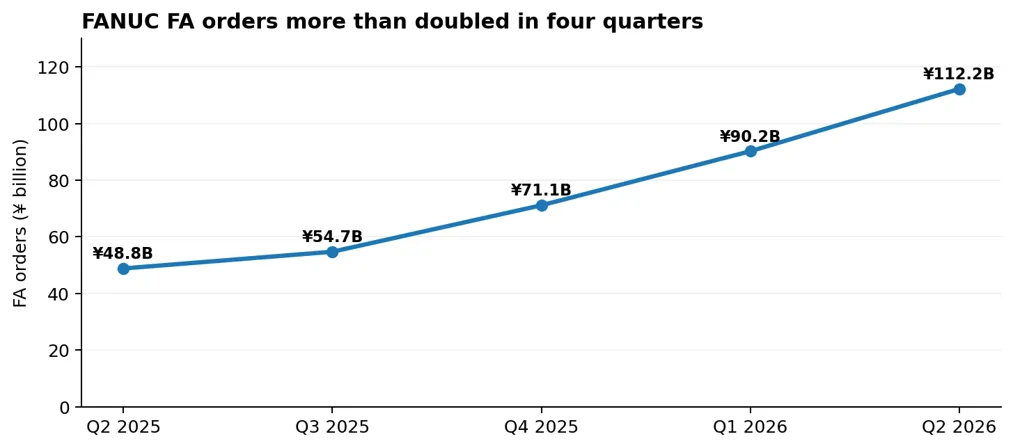
FANUC provides one of the clearest OEM-level signals. In its July 31, 2026 results call, the company said FA orders had surged since Q4 FY2025, but sales were not keeping pace because certain component lead times had extended. Management also said customers were ordering earlier than usual when delivery times lengthened.
By Q2 FY2026, FANUC FA orders had reached ¥112.2 billion, up 130.1% year over year and more than double the ¥48.8 billion recorded in Q2 FY2025. The result is important for cutting tools because a machine-order boom that cannot immediately convert into installed capacity does not eliminate production demand. It transfers more of that demand onto the installed fleet.
The AI Semiconductor Cycle Is Increasing Competition for Industrial Silicon
TrendForce says the average utilization rate at the top 10 eight-inch foundries is approaching 90% in 2026, while mature-node capacity is being reallocated toward higher-value power-related processes. Other 2026 electronics-supply reports show the same effect in industrial components: longer FPGA, MCU, analog and power-device lead times as AI infrastructure absorbs wafer, packaging and power-management capacity.
For machine-tool builders, this creates a procurement problem that is difficult to solve with simple inventory. High-axis CNC systems have long qualification cycles, safety requirements and tightly integrated control/servo architectures. Substituting a controller or semiconductor can require engineering validation rather than a simple part-number swap.
A Delayed New Machine Can Increase the Workload on the Old One
The commercial link to cutting tools is utilization. If a shop expected a new five-axis machining center, mill-turn or automated cell to absorb incremental jobs but the equipment arrives months late, the work must either be outsourced, delayed or pushed through existing machines. Where the shop keeps the work in-house, spindle hours rise on the installed base.
| NEW CNC ORDER | CONTROL DELAY | OLD FLEET LOAD | TOOL WEAR | REORDER |
| Capacity planned | Controller/electronics stretch delivery | More spindle hours on installed machines | More cutting cycles on existing tools | Consumables replenished sooner |
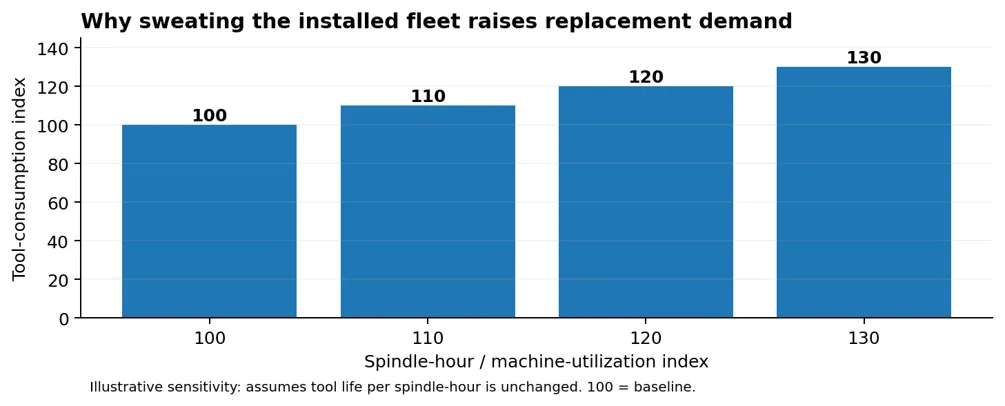
This mechanism is linear before any secondary effects are considered. If spindle hours rise 20% and tool life per spindle-hour is unchanged, tool consumption also rises about 20%. In practice, overtime, tougher jobs, less maintenance flexibility or more aggressive cutting parameters can push replacement demand higher, but those effects are shop-specific and should not be treated as a universal multiplier.
Why the Effect Is Stronger in High-Value Multi-Axis Applications
Five-axis and mill-turn machines are disproportionately used in aerospace, defense, medical, die & mould and other precision applications where tool quality, runout, coatings, geometry and process stability matter. These operations can use a broader mix of solid-carbide end mills, drills, indexable cutters, thread tools and application-specific tooling than simpler production work.
That makes a controller bottleneck commercially different from a normal machine-order slowdown. The shop still has work, the new spindle is simply late. Tool suppliers that can support the existing fleet with application engineering, regrinding, alternate grades and rapid replenishment become part of the capacity solution.
Cutting-Tool Demand Is Already Holding Near Record Levels
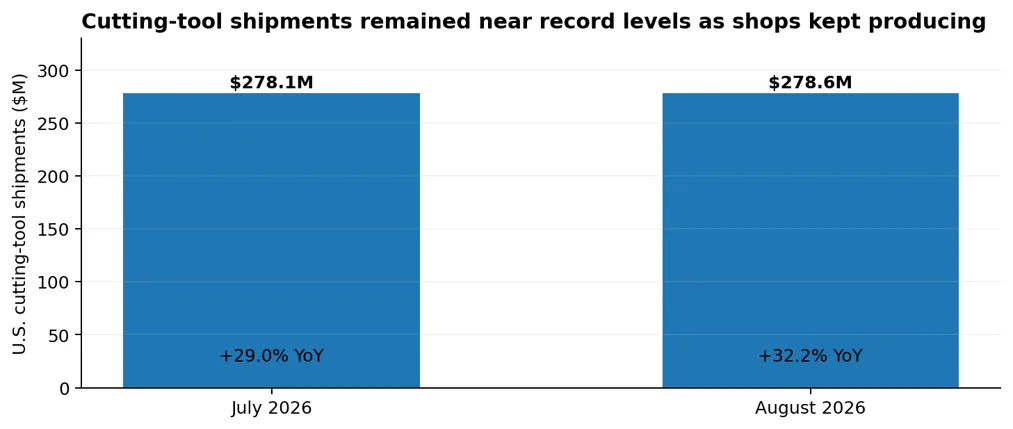
The utilization thesis is consistent with the 2026 cutting-tool shipment data. U.S. cutting-tool shipments reached $278.1 million in July and $278.6 million in August. July was 29.0% above July 2025, while August was 32.2% above the prior year. Raw-material inflation explains part of the increase, but AMT and USCTI still reported double-digit growth after adjusting for price effects earlier in the year.
Request a Customized Report According to Your Business Strategy: https://www.datamintelligence.com/customize/cutting-tools-and-inserts-market
Five Signals Cutting-Tool Suppliers Should Track
| Signal | What it reveals | Likely tooling impact | Commercial action |
| CNC delivery pushed out | Planned spindle capacity is late | Higher utilization of installed machines | Target shops with delayed equipment and active order books |
| Controller / servo substitution | OEM is redesigning around constrained electronics | Commissioning can slip again | Track OEM controller changes and revised delivery windows |
| Overtime / extra shifts | Shop is protecting throughput with existing assets | Faster wear and replenishment | Increase local inventory and application support |
| High-axis backlog | Complex jobs cannot easily move to simpler machines | Premium carbide and application-specific demand | Prioritize aerospace, defense and precision clusters |
| Machine finally commissioned | Deferred capacity enters production | Initial tool-up plus recurring replenishment | Win the tooling package before production ramp |
The Commercial Opportunity Is the Delay Window - Not the Shortage Headline
The most valuable intelligence is not simply that FPGAs are tight. Cutting-tool suppliers need to know which machine OEMs are exposed, which customer installations are slipping, what work is being retained on the existing fleet and when the delayed machine will finally enter production. That timing determines whether the opportunity is immediate replenishment, alternate tooling, regrinding support or a future full tool-up package.
MACHINE & CONTROL PIPELINE order date, expected delivery, revised delivery and commissioning risk. | SHOP UTILIZATION SIGNALS Backlog, overtime, shifts, spindle loading, outsourcing and maintenance pressure on the installed fleet. |
TOOLING ECONOMICS coating/grade requirements and alternate-tool qualification. | SUPPLIER POSITIONING Incumbent tool brands, distributor stock, application engineering capability and rapid-response alternatives. |
What the Cutting Tools Report Helps Buyers Answer
The DataM Cutting Tools Market Report connects cutting-tool demand with machine installations, end-use production cycles, raw-material risks, technology shifts and competitive positioning. For this specific disruption, the decision value comes from separating temporary electronics delays from structural changes in machining capacity and identifying where higher utilization is creating a near-term consumables opportunity.
See which machine-tool bottlenecks are extending utilization of the installed fleet - and where that is translating into faster cutting-tool replenishment. ACCESS THE
CUTTING TOOLS MARKET REPORT