


Renewable Energy Certificate Market Overview
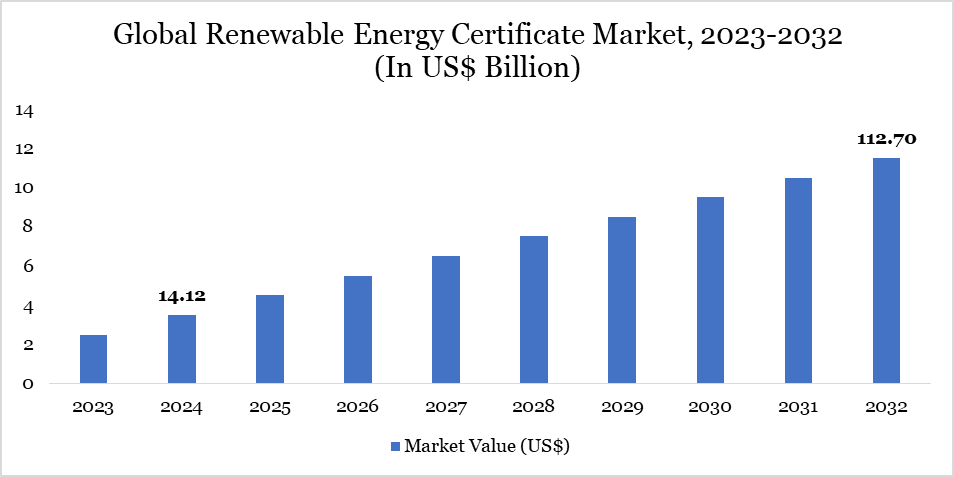
The global Renewable Energy Certificate Market landscape is changing dramatically, driven by the need to mitigate climate change and reduce greenhouse gas (GHG) emissions. Renewable energy certificates (RECs) have emerged as a vital instrument in this shift, providing a market-based solution to encourage renewable energy supply while tracking usage. This thorough analysis investigates the characteristics of the global REC market, including its evolution, segmentation, regulatory frameworks, main competitors, regional insights, market challenges and future trends.
Renewable energy certificates (RECs), sometimes known as green tags, represent the environmental and social benefits of producing one megawatt-hour (MWh) of electricity from renewable energy sources. RECs are distinct from the physical power generated, allowing for independent sale, trade, or consumption. This distinction provides a flexible framework for enterprises to demonstrate their commitment to sustainable energy use, even if they cannot directly supply it.
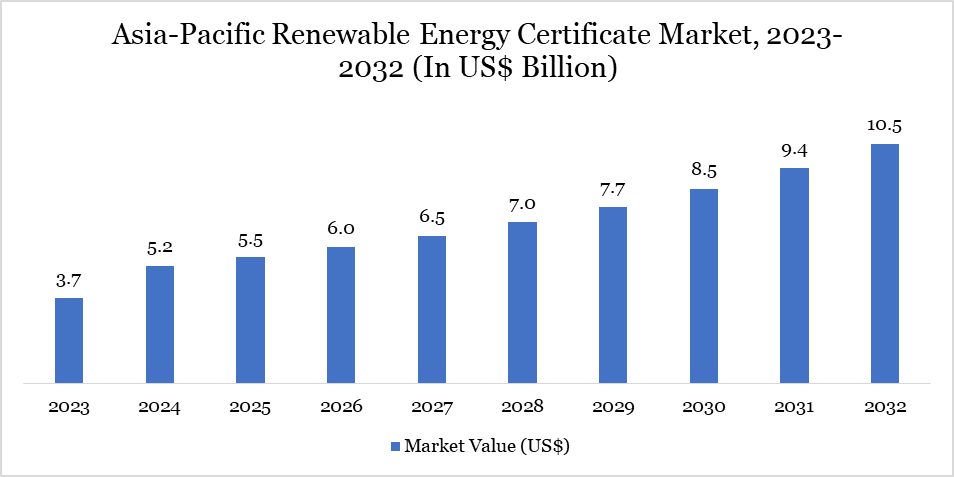
While Asia-Pacific's emerging markets are leading the way in REC adoption, several countries are still in the early stages. However, countries like India and China are making considerable gains in incorporating RECs into their renewable energy targets. The region, particularly India, is seeing an increase in REC trade volumes. India's commitment to renewable energy is obvious, as evidenced by record-breaking transactions of 1.52 million RECs on the Indian Energy Exchange (IEX) in January 2024, which align with its expanding energy needs.
For more details on this report, Request for Sample
Key Takeaways
- North America accounted for approximately 38.6% of the Renewable Energy Certificate (REC) market share in 2025, supported by mature voluntary and compliance renewable energy programs across the United States and Canada. Corporate sustainability commitments, net-zero targets, and utility procurement strategies continue to drive REC demand across commercial and industrial sectors.
- Asia-Pacific is projected to register the fastest CAGR through the forecast period, driven by rapid renewable energy deployment in China, India, Japan, South Korea, and Australia. Governments are strengthening clean energy mandates and introducing renewable energy trading mechanisms to accelerate decarbonization and attract private investment.
- Corporate renewable procurement is becoming a major growth engine for the REC market. Global technology companies, manufacturing firms, data center operators, and financial institutions increasingly utilize RECs to meet ESG objectives, carbon neutrality goals, and Scope 2 emissions reduction commitments.
- Digitalization is transforming REC trading and certificate management. Blockchain-based renewable energy tracking platforms, automated verification systems, and digital registries are improving transparency, reducing transaction costs, and enhancing confidence among market participants.
- Voluntary REC markets are expanding faster than compliance-driven markets in several regions. Organizations seeking sustainability leadership are purchasing certificates beyond regulatory requirements to demonstrate environmental responsibility and strengthen brand positioning.
- Green hydrogen, electric vehicle infrastructure, and data center expansion are creating new REC demand streams. As electricity consumption rises across these sectors, companies are increasingly purchasing renewable energy certificates to offset grid-related emissions and support renewable energy claims.
- Policy harmonization and cross-border renewable energy trading are gaining momentum. Regional initiatives in Europe and Asia-Pacific are improving interoperability between certificate systems, creating opportunities for broader market participation and international renewable energy procurement.
- Price volatility remains a key challenge across REC markets. Certificate values vary significantly depending on renewable technology type, geographic location, regulatory framework, and supply-demand dynamics, creating both opportunities and risks for buyers and sellers.
- Artificial intelligence and advanced analytics are improving renewable energy portfolio management. Utilities, energy traders, and corporate buyers are leveraging predictive tools to optimize REC procurement strategies, manage compliance obligations, and forecast certificate pricing trends.
Renewable Energy Certificate Market Scope
| Metrics | Details |
| CAGR | 26.32% |
| Size Available for Years | 2024-2032 |
| Forecast Period | 2026-2033 |
| Data Availability | Value (US$) |
| Segments Covered | Type, Certificate, Energy Source, End-User and Region |
| Regions Covered | North America, Europe, Asia-Pacific, South America and Middle East & Africa |
| Fastest Growing Region | Asia-Pacific |
| Largest Region | North America |
| Report Insights Covered | Competitive Landscape Analysis, Company Profile Analysis, Market Size, Share, Growth, Demand, Recent Developments, Mergers and Acquisitions, New Product Launches, Growth Strategies, Revenue Analysis, Porter’s Analysis, Pricing Analysis, Regulatory Analysis, Supply-Chain Analysis and Other key Insights. |
Renewable Energy Certificate Market Dynamics
Rising Government Regulations
Governments around the world have put in place policies requiring the use of renewable energy and carbon offsets. Policies such as the EU Renewable Energy Directive and US Clean Power Plan have played an important role in increasing demand for RECs. The restrictions compel energy producers to certify they're reaching renewable energy targets by issuing RECs. In Asia-Pacific, the International Renewable Energy Certificate (I-REC) and the Tradable Instrument for Global Renewables (TIGR) are significant examples.
The International Renewable Energy Certificate (I-REC) Standard is overseen by the I-REC Standard Foundation, based in the Netherlands. The I-REC Standard provides a global framework for certifying renewable energy production and consumption. It contributes to ensuring that renewable energy claims are consistently checked and validated under local regulations and market requirements.
Growing Energy Transition
As the world's energy shift to cleaner, renewable sources continue, the demand for RECs naturally increases. This is especially true in markets switching from fossil fuels to renewable energy, as RECs serve as verification that energy was generated sustainably. For instance, China's renewable energy sector, particularly PV technology, is making substantial progress. China is solidly on track to achieve its carbon neutrality goals by 2060.
Google has announced a cooperation with renewable energy company Intersect Power and investment firm TPG Rise Climate to create enough renewable energy to power several gigawatt-scale data centers. The total investment in renewable energy is projected at US$ 20 billion, with Intersect having already funded the first project. As part of the strategic three-party collaboration, Intersect Power will create new renewable energy infrastructure, with Google ensuring power offtake as the anchor tenant for newly built data centre campuses in co-located industrial parks. This ambitious project seeks to provide renewable energy for gigawatts of data centre capacity across the US and will be carried out in phases. The initial phase is planned to become operational by 2026, with full completion by 2027.
Complexity and Market Volatility
One of the most significant issues for the RECs business is a lack of uniformity and standardization between regions. For example, the I-REC system utilized worldwide does not always correspond to national certification systems, causing difficulties in cross-border business.
The lack of harmonization raises transaction costs and administrative load. REC prices can be highly volatile, based on factors such as demand fluctuations, policy changes and the availability of renewable energy. This uncertainty can make long-term planning difficult for businesses and dissuade potential buyers.
Renewable Energy Certificate Market Segment Analysis
The global renewable energy certificate market is segmented based on type, certificate, energy source, end-user and region.
Corporate Sustainability Commitments Drive Voluntary REC Segment
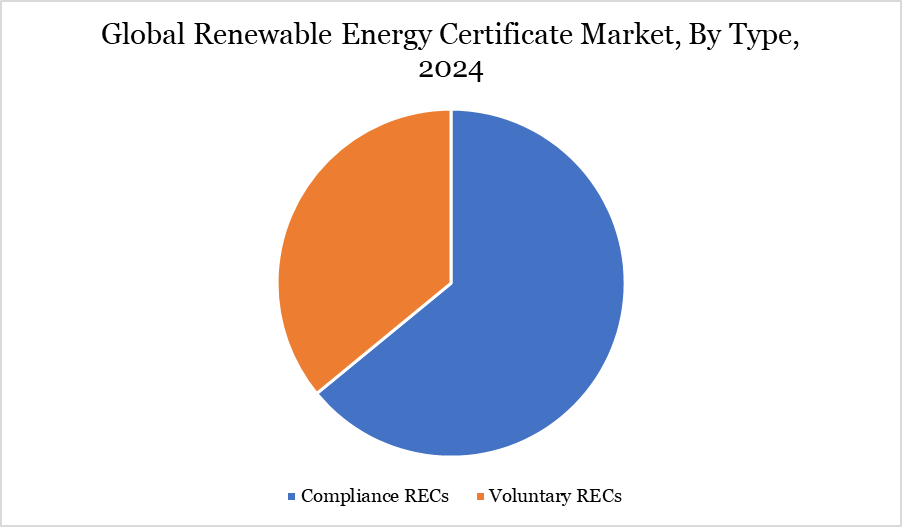
The voluntary REC segment is expected to dominate the global market in 2024. The voluntary REC industry is expanding rapidly, driven by corporate sustainability commitments and net-zero ambitions. Companies like Google, Microsoft and Amazon have established high renewable energy objectives, driving REC purchases in this sector.
In 2022, around 240 million RECs retired in voluntary markets, vs approximately 390 million RECs in compliance markets. The voluntary market encompasses a wide range of items, buyers and market situations. Different products package RECs and power differently, catering to different types of clients, ranging from residential families making relatively small buys to non-residential buyers making huge purchases.
Why Renewable Energy Certificate (REC) Market Matters in 2026
The global energy sector is undergoing a significant transition toward decarbonization and sustainable electricity generation.
Renewable Energy Certificates (RECs) are becoming a critical market-based mechanism that enables organizations to demonstrate renewable electricity consumption, meet sustainability goals, and support clean energy development without direct ownership of renewable assets.
Several macroeconomic and regulatory factors are driving market growth:
- Increasing corporate net-zero commitments worldwide
- Growing demand for renewable electricity procurement
- Expansion of voluntary carbon and sustainability programs
- Rising government renewable energy targets
- Strengthening ESG reporting requirements
- Increasing investments in solar, wind, and hydro power projects
- Growing participation of commercial and industrial energy consumers
- Digitalization of renewable energy tracking and verification systems
- Rising demand for transparent green energy sourcing
- Cross-border renewable energy trading initiatives
Analyst View
DataM Intelligence Analyst Perspective
The Renewable Energy Certificate market is evolving from a compliance-focused mechanism into a strategic sustainability and energy procurement tool.
The long-term success of the REC market will depend on:
- Regulatory framework development
- Renewable energy capacity expansion
- Standardization of certificate tracking systems
- Corporate sustainability commitments
- Transparency and verification mechanisms
- Grid decarbonization initiatives
- Integration with carbon reduction strategies
- International renewable energy market cooperation
The United States continues to lead REC market maturity through established renewable energy programs and strong corporate participation. Europe is advancing renewable energy procurement through ambitious climate policies and sustainability regulations. China is rapidly expanding renewable energy generation capacity, creating significant opportunities for certificate-based energy tracking. India is emerging as a high-growth market supported by renewable purchase obligations (RPOs), expanding solar and wind capacity, and increasing corporate demand for green electricity procurement.
Renewable Energy Certificate Market Geographical Share
Production and Consumer Trends in North America
North America particularly plays a dominant role in the global renewable energy certificate market, driven by both production and consumption factors. The region is primarily driven by a robust regulatory framework and government requirements for renewable energy. The US and Canada are the market leaders in terms of both issuance and acquisition of RECs.
Voluntary RECs are increasing in popularity in the US due to business sustainability goals and tax incentives, such as the Inflation Reduction Act of 2022. This trend is especially noticeable in the data centre industry, where corporations are aggressively pursuing green Power Purchase Agreements (PPAs). Mexico's REC market is stable, with regulators aiming to entice smaller generators with standard changes and rate reductions. This program is projected to promote the development of International Renewable Energy Certificates (I-RECs), especially in sectors like retail and industry that want to certify their renewable energy use.
Growing Energy Transition in Asia-Pacific
Asia-Pacific is expected to be the fastest-growing region in the global REC market. The Asia-Pacific region has experienced a significant transformation in its energy landscape over the past decade, marked by a robust shift towards renewable energy sources. This transition is not only altering the region's energy mix but also propelling the development and adoption of Renewable Energy Certificates (RECs) as mechanisms to certify and trade renewable energy generation.
The Philippines exemplifies this commitment. According to the Department of Energy, the country ascended to the 2nd spot in BloombergNEF's 2024 Climatescope Report, a significant rise from 20th place in 2021. This leap reflects the global community's growing confidence in the Philippines' dedication to clean energy transition and sustainable growth.
Vietnam has also made notable strides in renewable energy development. As of recent reports, hydropower accounts for approximately 44% of the country's energy generation, followed by oil and gas at 34% and coal at 19%. This distribution highlights Vietnam's substantial reliance on renewable sources, particularly hydropower, in its energy mix.
Renewable Energy Certificate Market Major Players
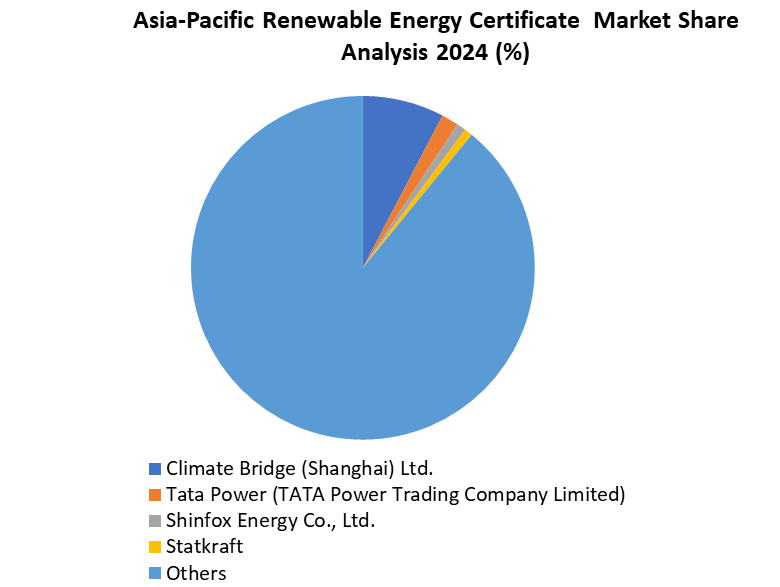
The major global players in the market include ECOHZ, Green-e Energy, Green-e Energy, APX Inc., ENGIE, I-REC standard, RECS International, Statkraft, The Green Certificate Company Limited, Eneco Energy Trade, Shell Energy, Climate Bridge (Shanghai) Ltd., Tata Power Renewable Energy Ltd., Adani Green Energy, INDIAN ENERGY EXCHANGE LIMITED and National Renewable Energy Certification (T-REC) Center.
Asia-Pacific Renewable Energy Certificate (REC) market is growing rapidly, driven by increasing corporate demand for clean energy and supportive government policies. Countries across the region are expanding their REC frameworks to encourage renewable energy adoption and carbon reduction.
Advanced digital platforms are enhancing transparency and efficiency in REC trading, making it easier for businesses to meet sustainability goals. The market is also seeing increased participation from energy producers, utilities and large corporations seeking to offset emissions. With rising awareness and regulatory support, the REC market in Asia-Pacific is poised for continued expansion and integration into global sustainability initiatives.
Renewable Energy Certificate Market Pricing Analysis
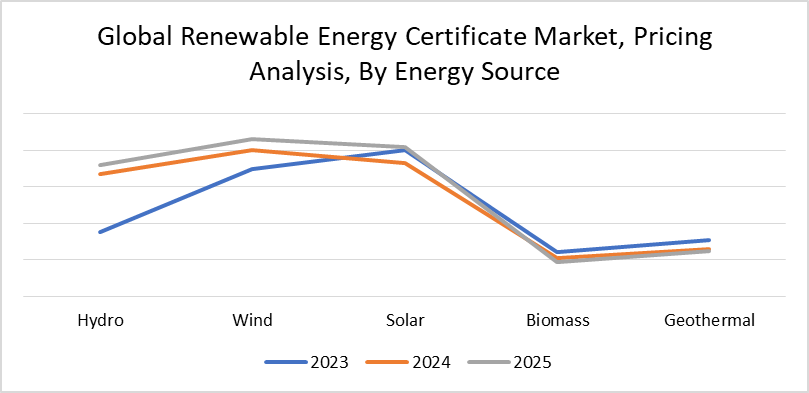
The pricing of renewable energy certificates (RECs) in the global market is influenced by factors such as supply-demand dynamics, regulatory frameworks and the distinction between compliance and voluntary markets. In compliance markets like the US RPS program and the EU’s Guarantees of Origin (GO) system, prices are more stable but fluctuate based on mandated targets and market liquidity.
In voluntary markets, such as I-RECs in Asia and Latin America, prices vary significantly depending on corporate sustainability commitments and regional policy changes. Additionally, vintage-based pricing plays a role, with older RECs often trading at a discount compared to newer ones. The growing demand for RECs, driven by corporate net-zero goals and Scope 2 emissions reduction, continues to impact pricing, while factors like renewable project financing and geopolitical shifts also contribute to price volatility.
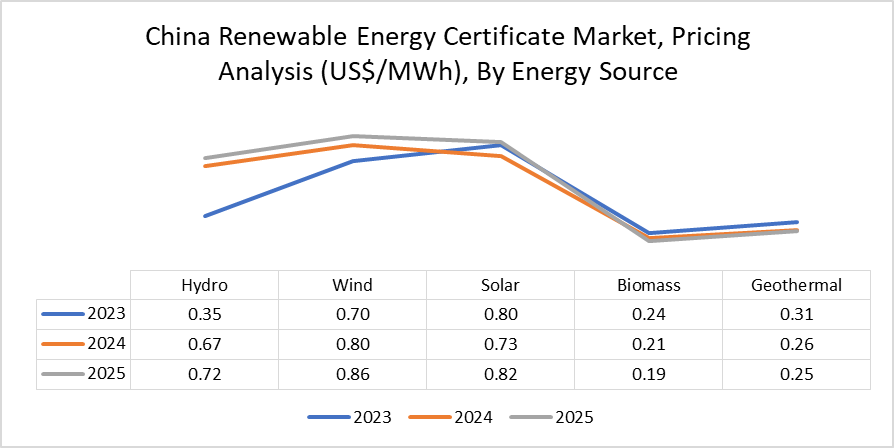
China: The pricing of renewable energy certificates (RECs) in China is influenced by several factors, including government policies, supply-demand dynamics, corporate sustainability commitments and the dominance of state-owned enterprises in the renewable energy sector. The price of China’s RECs fluctuates based on the type of renewable energy source, with wind and solar RECs generally priced higher than hydropower RECs due to differences in generation costs and technology maturity. China’s hydro RECs were priced at US$ 0.30/MWh, while solar RECs were priced at US$ 0.80/MWh in 2023.
The increasing demand from multinational corporations looking to meet renewable energy targets under initiatives like RE100 has contributed to price adjustments, but concerns over double-counting, lack of transparency and limited third-party verification have kept some buyers hesitant, preventing price surges seen in more mature REC markets.
Renewable Energy Certificate Market Sustainability Analysis
The renewable energy certificate (REC) market plays a vital role in driving sustainability efforts globally by incentivizing renewable energy production, reducing carbon emissions and facilitating the energy transition. By purchasing RECs, organizations directly fund renewable energy projects like wind, solar, hydro and biomass, increasing global renewable energy capacity.
Regulatory mandates like Renewable Portfolio Standards (RPS) drive demand in compliance REC markets, ensuring a stable framework. Voluntary markets grow as more corporations commit to sustainability goals and adopt Science-Based Targets or net-zero pledges. Emerging platforms simplify REC purchasing for small businesses and individuals, expanding market participation.
The government and private entities' significant investment in renewable energy, notably large-scale solar power facilities, is propelling industry expansion. For example, in April 2023, US Department of Energy (DOE) announced a US$ 52 million financial commitment for a carefully selected collection of 19 projects. This includes US$ 10 million supplied from the Bipartisan Infrastructure Law, aimed at strengthening the domestic solar supply chain in US.
Blockchain and Transparency in REC Trading
The use of blockchain technology in conjunction with AI can increase the transparency and security of REC transactions. Blockchain technology can generate a decentralized and unchangeable record of all REC purchases and sales, lowering fraud and increasing trust in the certification process. This will also boost the transparency of renewable energy projects and assist track the actual production of renewable energy in real-time.
According to Silke Mooldijk, the corporate climate responsibility expert at the NewClimate Institute, if tech businesses do not disclose transparent information, consumers may be unable to understand the climatic impact of AI and move their behavior towards different models. Google recognizes that unbundled renewable energy certificates do not cut emissions and has begun replacing them with clean energy.
Key Developments of the Renewable Energy Certificate Market
May 2026: I-TRACK Foundation and Global Gas Tracking launched the I-TRACK(G) Product Code and Registry for Biogas and Biomethane, introducing a standardized framework for issuing, transferring, and redeeming renewable-gas attribute certificates. The system extends high-integrity energy attribute tracking across jurisdictions through registries operated by Instituto Totum and Evident.
April 2026: Xpansiv and Granular Energy launched an integrated clean-energy matching solution that connects granular certificate-matching technology with registry infrastructure. The advancement streamlines green energy certificate matching for power producers, utilities, traders, brokers, and corporate buyers while supporting more precise clean-electricity procurement.
- October 2025: Constellation and Xpansiv announced a new clean-energy certificate trading initiative supported by Xpansiv’s North American Renewables Registry. The development introduced full-lifecycle traceability for zero-emission certificates, extending certificate-market infrastructure and digital tracking capabilities alongside established renewable energy certificate systems.
Renewable Energy Certificate Market Investment & Funding Analysis
Global investments in renewable energy and sustainability initiatives continue to increase significantly.
Major funding areas include:
- Renewable energy generation projects
- Green power certification platforms
- Carbon reduction and net-zero programs
- Energy attribute tracking systems
- Blockchain-based REC trading solutions
- Corporate renewable procurement initiatives
- Digital energy management platforms
Mergers, acquisitions, and strategic partnerships are expected to accelerate as organizations strengthen their clean energy portfolios and sustainability commitments.
Strategic Recommendations
For Renewable Energy Developers
- Expand renewable generation capacity
- Increase REC certification coverage
- Strengthen corporate power purchase agreements
- Invest in digital tracking technologies
For Investors
- Focus on scalable clean energy assets
- Monitor renewable policy developments
- Evaluate REC demand from corporate buyers
- Assess long-term sustainability investment opportunities
For Governments
- Strengthen renewable energy targets
- Enhance REC market transparency
- Support clean energy infrastructure development
- Encourage corporate renewable energy adoption
Why Buy This Renewable Energy Certificate Report?
This report helps organizations:
- Understand evolving renewable energy trends
- Identify high-growth investment opportunities
- Benchmark industry participants effectively
- Analyze regulatory and policy developments
- Optimize market entry and expansion strategies
- Evaluate sustainability-driven demand patterns
- Assess regional market opportunities
- Track clean energy procurement developments
What's Included in the Renewable Energy Certificate Report?
The report provides:
- Market size & forecast analysis
- Regional growth outlook
- Competitive intelligence
- Policy and regulatory assessment
- Pricing trend analysis
- Supply chain insights
- Market share analysis
- Investment landscape analysis
- Strategic recommendations
- Emerging trend analysis
- Corporate procurement assessment
- Company profiling
Who Should Buy This Report?
This Renewable Energy Certificate report is ideal for:
- Renewable energy developers
- Utility companies
- Energy retailers
- Corporate sustainability teams
- Renewable energy investors
- Financial institutions
- REC trading platform providers
- Government agencies
- Environmental consulting firms
- Energy procurement organizations
- Market intelligence teams
- Clean energy technology companies
Key Benefits for Stakeholders
Gain actionable market intelligence:
- Understand future renewable energy market dynamics
- Analyze global clean energy procurement strategies
- Evaluate sustainability and decarbonization trends
- Identify strategic growth opportunities
- Benchmark market participants
- Improve investment and business decisions
- Track regulatory and compliance developments
- Assess emerging REC trading opportunities
- Strengthen long-term sustainability planning
- Enhance competitive positioning in renewable energy markets



























































