


Global Oncology Companion Diagnostics Market Size
The Oncology Companion Diagnostics Market will reach US$ 5.98 billion in 2026, up from US$ 5.48 billion in 2025, and is projected to reach US$ 13.09 billion by 2035, registering strong growth at a CAGR of 9.1% during the forecast period from 2026 to 2035.
Global Oncology Companion Diagnostics Market Overview
The oncology companion diagnostics market is experiencing robust growth, driven by the rising global cancer burden, advancements in personalized medicine, and increasing regulatory approvals for targeted therapies. These diagnostics are critical for identifying patients most likely to benefit from specific cancer treatments, especially in areas like non-small cell lung cancer (NSCLC), breast cancer, and colorectal cancer. As pharmaceutical companies increasingly collaborate with diagnostic firms to co-develop drug-diagnostic pairs, the demand for companion diagnostics is expected to surge. Major market players such as Roche, Thermo Fisher Scientific, QIAGEN, and Agilent Technologies are leading innovation through next-generation sequencing (NGS), PCR, and immunohistochemistry (IHC)-based platforms.
Global Oncology Companion Diagnostics Market Executive Summary
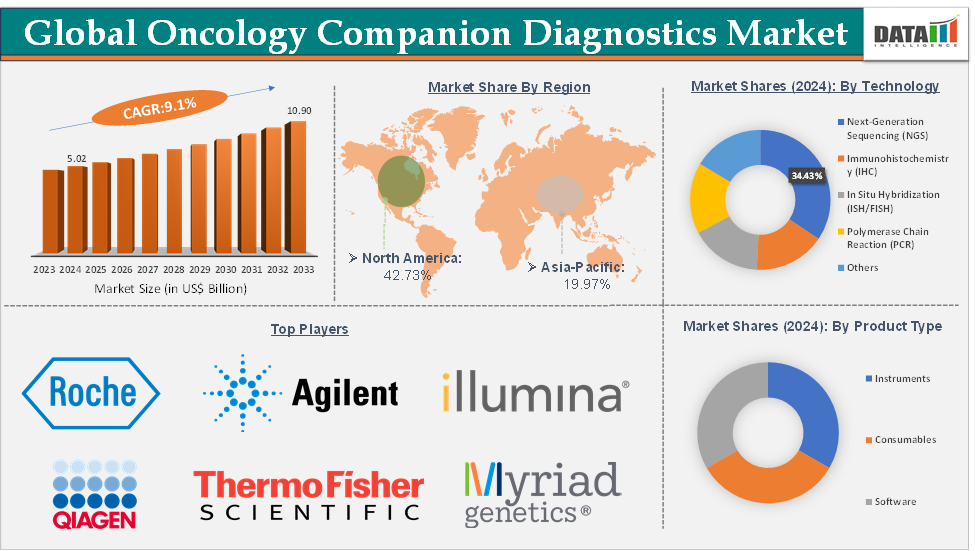
Global Oncology Companion Diagnostics Market Scope
| Metrics | Details | |
| CAGR | 9.1% | |
| Market Size Available for Years | 2022-2035 | |
| Estimation Forecast Period | 2025-2035 | |
| Revenue Units | Value (US$ Bn) | |
| Segments Covered | Product Type | Instruments, Consumables and Software |
| Technology | Polymerase Chain Reaction (PCR), Next‑Generation Sequencing (NGS), Immunohistochemistry (IHC), In Situ Hybridization (ISH/FISH), Liquid Biopsy and Others | |
| Application | Non‑Small Cell Lung Cancer (NSCLC), Breast Cancer, Prostate Cancer, Colorectal Cancer and Others | |
| End-User | Hospitals, Diagnostic Laboratories, Academic and Research Institutions and Others | |
| Regions Covered | North America, Europe, Asia-Pacific, South America and the Middle East & Africa | |
Oncology Companion Diagnostics Market Key Takeaways
- North America accounts for approximately 42-45% of the global market share, driven by the rapid adoption of precision oncology, increasing regulatory approvals for companion diagnostic assays, and growing investments in biomarker-driven cancer therapeutics.
- Next-Generation Sequencing (NGS)-based companion diagnostics contribute over 35% of total market revenue, owing to their ability to simultaneously analyze multiple genomic biomarkers and support personalized treatment decisions across various cancer types.
- Non-Small Cell Lung Cancer (NSCLC) applications account for nearly 30% of total market demand, supported by the increasing use of biomarker testing for EGFR, ALK, ROS1, and KRAS-targeted therapies.
- Hospitals and diagnostic laboratories collectively represent more than 65% of end-user adoption, leveraging advanced molecular diagnostic technologies to improve treatment selection and patient outcomes.
- Liquid biopsy-based companion diagnostics are witnessing annual adoption growth exceeding 18%, driven by their minimally invasive nature and increasing utilization in treatment monitoring and disease progression assessment.
- Asia-Pacific is projected to register the fastest market growth, with a CAGR exceeding 10%, supported by expanding cancer screening programs, increasing healthcare investments, and growing adoption of precision medicine technologies.
- AI-enabled biomarker discovery and companion diagnostic platforms are increasingly accelerating clinical development timelines, improving predictive analytics, genomic interpretation, and personalized treatment strategies.
- Strategic collaborations among pharmaceutical companies, diagnostic manufacturers, and biotechnology firms are accelerating regulatory approvals and commercialization of companion diagnostic solutions globally.
- Growing investments in molecular diagnostics, precision oncology, liquid biopsy technologies, and advanced genomic sequencing platforms are expected to drive long-term market expansion.
Global Oncology Companion Diagnostics Market Dynamics
Drivers:
The rising prevalence of cancer is significantly driving the oncology companion diagnostics market growth
The rising global prevalence of cancer is a primary catalyst driving growth in the oncology companion diagnostics (CDx) market, as it amplifies the demand for precision diagnostics that can guide targeted treatments. For instance, according to the National Institutes of Health, by 2040, the number of new cancer cases per year is expected to rise to 29.9 million and the number of cancer-related deaths to 15.3 million. Additionally, according to the International Agency for Research on Cancer, in 2025, cancer incidence cases are projected to reach 21.3 million, and in 2030, the cases are estimated to reach 24.1 million.
As incidence rates soar, particularly for types like non-small cell lung cancer (NSCLC), breast, colorectal, and prostate cancers, there is an urgent need for more personalized and effective treatment strategies. Companion diagnostics play a critical role by identifying specific genetic mutations, biomarkers, or protein expressions that determine a patient’s likelihood to respond to a targeted therapy.
The surge in personalized medicine, combined with aging populations and lifestyle risk factors, further intensifies cancer prevalence. This trend not only increases the number of patients eligible for biomarker-driven therapies but also encourages pharmaceutical companies to co-develop diagnostic tools with therapeutics. Consequently, the market for oncology companion diagnostics is expanding rapidly, as it directly aligns with the need for safer, smarter, and more cost-effective cancer treatment pathways tailored to individual patient profiles.
Restraints:
Limited biomarker access & heterogeneity are hampering the growth of the oncology companion diagnostics market
Limited biomarker access and tumor heterogeneity significantly hamper the growth of the oncology companion diagnostics (CDx) market by reducing the effectiveness and scalability of these tests. Intra-tumor and inter-patient heterogeneity complicate diagnosis and treatment selection. A single biopsy may not accurately represent the genetic profile of the entire tumor, especially in cancers with high mutation rates or those that evolve under treatment pressure. For instance, a lung cancer patient might test negative for a biomarker in one part of the tumor but positive in another, leading to potential misclassification and suboptimal treatment.
Additionally, accessing high-quality tumor samples is a challenge in late-stage or hard-to-biopsy cancers, which can limit biomarker detection altogether. These limitations reduce the clinical reliability and utility of companion diagnostics, discouraging adoption among clinicians and slowing market expansion. As a result, the full potential of personalized oncology remains constrained by biomarker and tumor complexity.
For more details on this report - Request for Sample
Oncology Companion Diagnostics Market Trends and Insights
Expansion of NGS-Based Companion Diagnostics
NGS is becoming increasingly important in oncology because a single assay can evaluate multiple genes and biomarkers simultaneously. This is particularly valuable for tumors with several actionable mutations, helping clinicians match patients with targeted therapies more efficiently.
The increasing availability of comprehensive genomic profiling is also encouraging pharmaceutical companies and diagnostic developers to collaborate on broader biomarker-testing strategies.
Growing Adoption of Liquid Biopsy
Liquid biopsy is one of the most important emerging trends in oncology diagnostics. Blood-based testing can identify circulating tumor DNA and other cancer-related biomarkers without requiring repeated tissue biopsies.
Applications are expanding beyond treatment selection toward therapy monitoring, recurrence assessment, resistance detection, and minimal residual disease evaluation. Liquid biopsy technologies are also attracting substantial investment as diagnostic developers seek less-invasive approaches to precision oncology.
Increasing Drug–Diagnostic Co-Development
Pharmaceutical and diagnostic companies are increasingly developing therapies and companion diagnostics together rather than treating diagnostic development as a separate process.
This approach allows biomarker identification, clinical-trial patient selection, assay validation, regulatory submission, and commercialization planning to be coordinated more closely. It is becoming particularly important for targeted oncology drugs where treatment effectiveness depends on a specific molecular profile.
AI and Digital Interpretation of Biomarker Data
Artificial intelligence is increasingly being incorporated into oncology diagnostic workflows to interpret complex genomic, pathological, and clinical datasets.
AI-enabled platforms can assist with variant interpretation, biomarker classification, digital pathology, treatment matching, and clinical decision support. The integration of AI with NGS and pathology is expected to become increasingly relevant as the volume of oncology data continues to expand.
Shift Toward Multiplex and Comprehensive Testing
Instead of testing individual biomarkers separately, laboratories are increasingly adopting multi-gene panels and comprehensive molecular profiling.
This approach can reduce the number of separate tests required for patients and provide broader information for treatment selection. The trend is particularly relevant for cancers such as NSCLC, where multiple actionable biomarkers may influence therapeutic decisions.
Oncology Companion Diagnostics Market Future Market Trends (2026-2035)
The Oncology Companion Diagnostics Market is expected to witness substantial growth throughout the forecast period driven by increasing adoption across precision oncology initiatives, intelligent diagnostic innovations, personalized therapeutic developments, and biomarker-based healthcare programs worldwide. Future market expansion will be supported by next-generation sequencing technologies, liquid biopsy capabilities, advanced bioinformatics platforms, and intelligent clinical decision support innovations across major global economies.
Increasing investments supporting oncology diagnostic infrastructures, precision medicine ecosystems, and advanced therapeutic platforms are anticipated to substantially strengthen commercialization opportunities globally. Furthermore, growing demand for highly targeted and clinically effective diagnostic solutions capable of improving patient outcomes while simultaneously addressing unmet oncology needs is expected to significantly influence future market dynamics through 2035.
Global Oncology Companion Diagnostics Market Segment Analysis
The global oncology companion diagnostics market is segmented based on product type, technology, application, end-user, and region.
The next‑generation sequencing (NGS) from the technology segment is dominating the oncology companion diagnostics market with a 34.43% share in 2024
Next-generation sequencing (NGS) is dominating the oncology companion diagnostics (CDx) market due to its unparalleled ability to analyze multiple genes and biomarkers simultaneously, offering a comprehensive and efficient approach to precision oncology. Unlike traditional single-gene tests like PCR or IHC, NGS enables high-throughput, multiplexed analysis of entire cancer-related gene panels or even whole exomes, making it ideal for identifying complex mutational profiles across various tumor types.
This technological advantage is especially critical in cancers like non-small cell lung cancer (NSCLC) or melanoma, where multiple genetic alterations such as EGFR, ALK, ROS1, BRAF, and MET may guide treatment decisions. NGS panels can detect all of these mutations in one test, reducing the time and tissue required while providing actionable insights for therapies. Furthermore, NGS is essential in assessing tumor mutational burden and microsatellite instability, two emerging biomarkers critical for predicting response to immune checkpoint inhibitors like pembrolizumab.
Companies like Roche, QIAGEN, Thermo Fisher Scientific, and Illumina have developed FDA-approved NGS-based CDx platforms, which are now standard tools in advanced oncology care. For instance, in June 2025, QIAGEN N.V. and Incyte announced a new global collaboration to develop a novel diagnostic panel to support Incyte’s extensive portfolio of investigational therapies for patients with myeloproliferative neoplasms, a group of rare blood cancers, including Incyte’s monoclonal antibody INCA033989, targeting mutant calreticulin (mutCALR), which is being developed in myelofibrosis (MF) and essential thrombocythemia (ET). The panel will be validated using the next-generation sequencing (NGS) technology and the Illumina NextSeq 550Dx platform as part of QIAGEN’s partnership with Illumina to leverage its NGS diagnostic platforms for patient testing by laboratories worldwide.
Global Oncology Companion Diagnostics Market Geographical Shares
North America is expected to dominate the global oncology companion diagnostics market with a 42.73% in 2024
North America dominates the global oncology companion diagnostics (CDx) market due to its advanced healthcare infrastructure, strong pharmaceutical and biotechnology ecosystem, and supportive regulatory environment. The United States, in particular, accounts for the largest market share, driven by the widespread adoption of precision medicine, high cancer prevalence, and substantial investment in biomarker research and targeted therapies.
The U.S. Food and Drug Administration (FDA) has played a key role by establishing clear regulatory guidelines for companion diagnostics and offering expedited pathways like Breakthrough Device Designation, which encourages innovation and rapid market entry. For instance, the FDA’s approval of FoundationOne CDx, an NGS-based test developed by Foundation Medicine (a Roche subsidiary), is now widely used for comprehensive genomic profiling in solid tumors.
Additionally, the presence of major diagnostic and life sciences companies such as Thermo Fisher Scientific, Illumina, Agilent Technologies, and QIAGEN North America supports local production, co-development with pharma companies, and clinical trial activity. The region is also home to a large number of leading cancer centers, which routinely incorporate CDx into clinical decision-making.
Global Oncology Companion Diagnostics Market Regulatory Landscape
Companion diagnostics operate under a highly regulated environment because their results can directly influence the selection of cancer treatments.
Key regulatory considerations include:
- Analytical validity
- Clinical validity
- Clinical utility
- Assay performance
- Biomarker validation
- Patient safety
- Quality management systems
- Laboratory accreditation
- Manufacturing controls
- Diagnostic labeling
- Data integrity
- Post-market monitoring
In the United States, the FDA plays a central role in regulating companion diagnostics and evaluating whether a diagnostic test adequately identifies patients appropriate for a corresponding therapeutic product.
In Europe, in-vitro diagnostic products are subject to the EU In Vitro Diagnostic Medical Devices Regulation (IVDR), which has increased requirements for clinical evidence, quality systems, performance evaluation, and conformity assessment.
As drug–diagnostic co-development expands, regulatory agencies are increasingly focused on ensuring that the diagnostic accurately identifies the biomarker-defined population used in clinical development and treatment decisions.
Global Oncology Companion Diagnostics Market Value Chain Analysis
The Oncology Companion Diagnostics value chain begins with biomarker discovery and technology development, where pharmaceutical companies, biotechnology firms, academic institutions, and diagnostic developers identify biomarkers associated with treatment response or resistance.
The next stage involves assay development and analytical validation, including PCR, NGS, IHC, ISH/FISH, and liquid-biopsy technologies.
Diagnostic companies then conduct clinical validation and work with pharmaceutical partners to integrate testing into clinical trials. Successful assays proceed through regulatory review, manufacturing, commercialization, laboratory implementation, and reimbursement assessment.
Downstream participants include hospitals, pathology laboratories, molecular diagnostic laboratories, cancer centers, oncologists, and healthcare systems.
The final value is generated by enabling clinicians to identify appropriate patients for targeted therapies, potentially reducing ineffective treatment exposure and improving treatment-selection efficiency.
The value chain is increasingly shaped by pharmaceutical-diagnostic partnerships, biomarker discovery, NGS adoption, liquid biopsy development, AI-powered interpretation, reimbursement policies, and regulatory requirements.
Global Oncology Companion Diagnostics Market Competitive Landscape
Top companies in the oncology companion diagnostics market include F. Hoffmann-La Roche Ltd, Agilent Technologies, Inc., Illumina, Inc., QIAGEN, Thermo Fisher Scientific Inc., Myriad Genetics, Inc., Guardant Health, Labcorp, Quest Diagnostics and Invivoscribe, Inc., among others.
Why Choose DataM?
Technological Innovations: DataM evaluates advances in NGS-based companion diagnostics, multiplex PCR, digital pathology, IHC, FISH, liquid biopsy, AI-assisted biomarker interpretation, genomic data analysis, and integrated diagnostic platforms supporting precision oncology.
Product Performance & Market Positioning: The report evaluates diagnostic solutions based on analytical sensitivity, specificity, turnaround time, multiplexing capability, biomarker coverage, sample requirements, workflow integration, automation, cost efficiency, and compatibility with targeted cancer therapies.
Real-World Evidence: DataM connects market developments with clinical applications across NSCLC, breast cancer, colorectal cancer, prostate cancer, and other cancers where biomarker testing influences treatment selection. The report also evaluates the growing use of NGS and liquid biopsy for treatment monitoring and molecular profiling.
Market Updates & Industry Changes: The report tracks companion-diagnostic approvals, pharmaceutical-diagnostic collaborations, biomarker discoveries, NGS adoption, liquid-biopsy developments, AI integration, clinical-trial activity, reimbursement changes, and regulatory developments shaping precision oncology.
Competitive Strategies: DataM analyzes how leading companies strengthen their positions through drug–diagnostic partnerships, proprietary assay development, NGS platforms, laboratory networks, strategic acquisitions, clinical collaborations, and expansion into emerging oncology indications.
Pricing & Market Access: The report evaluates pricing based on testing technology, biomarker coverage, assay complexity, sample type, laboratory infrastructure, sequencing requirements, reimbursement conditions, and testing volume while assessing access through hospitals, diagnostic laboratories, cancer centers, and pharmaceutical partnerships.
Market Entry & Expansion: DataM identifies opportunities created by the expansion of targeted cancer therapies, increasing genomic testing, liquid biopsy adoption, precision oncology programs, and emerging healthcare infrastructure. The report outlines strategies involving pharmaceutical partnerships, local laboratory networks, regulatory alignment, technology licensing, and expansion into high-growth Asia-Pacific markets.
Target Audience
The Oncology Companion Diagnostics Market Report is designed for companion diagnostic developers, pharmaceutical and biotechnology companies, molecular diagnostic manufacturers, NGS companies, pathology laboratories, hospitals, cancer centers, and genomic testing providers evaluating opportunities in precision oncology.
The report is particularly useful for R&D teams, clinical-development professionals, regulatory specialists, product managers, business development executives, investors, and corporate strategists assessing biomarker technologies, drug–diagnostic partnerships, competitive positioning, and commercialization strategies.
Healthcare regulators, academic institutions, CROs, reimbursement stakeholders, and healthcare consultants can use the report to evaluate regulatory developments, clinical adoption, technology trends, and emerging opportunities across the oncology companion diagnostics ecosystem.
The global oncology companion diagnostics market report delivers a detailed analysis with 70 key tables, more than 68 visually impactful figures, and 167 pages of expert insights, providing a complete view of the market landscape.
Suggestions for Related Report
For more clinical diagnostics-related reports, please click here



























































