


Global Industrial Sensor Market Overview
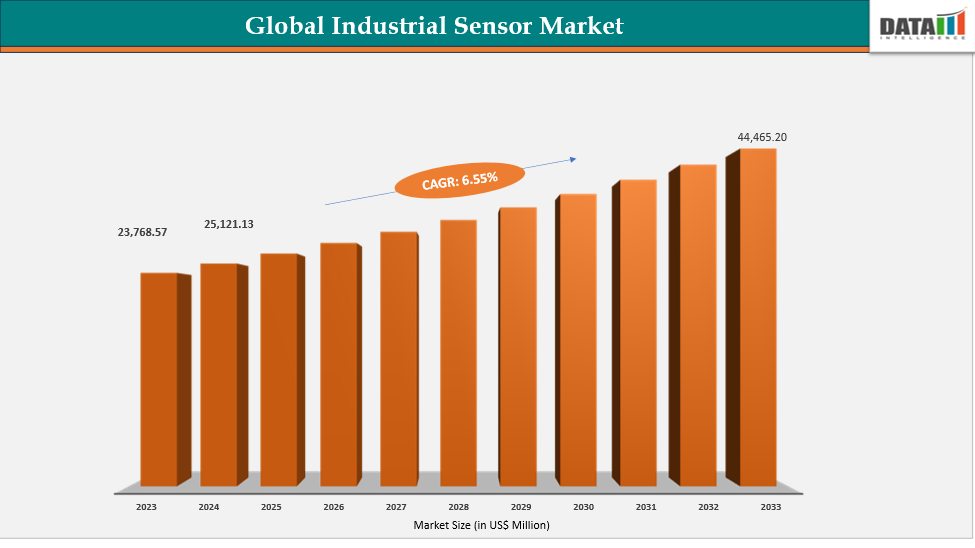
The global industrial sensor market reached US$ 26,766.6 million in 2025 and is expected to reach US$ 44,465.20 million by 2033, growing at a CAGR of 6.55% during the forecast period 2026-2033.
The market growth is driven by increasing demand for automation, predictive maintenance, and real-time data analytics across various industries such as manufacturing, oil and gas, and pharmaceuticals. Technological advancements in sensor technologies, such as MEMS sensors and CMOS, are enabling precise monitoring and control in complex industrial environments, boosting demand for sensors in manufacturing and energy sectors. The integration of sensors with digital platforms is transforming traditional manufacturing processes, leading to smarter and more efficient production systems.
A unique trend in the global industrial sensor market is the growing integration of sensors with digital platforms, enabling manufacturers to optimize efficiency, enhance predictive maintenance, and improve safety across operations. Advancements in sensor technologies, including MEMS and CMOS, are enabling precise monitoring and control in complex industrial environments. This integration is transforming traditional manufacturing processes, leading to smarter and more efficient production systems. As industries continue to embrace digital transformation, the demand for advanced industrial sensors to support these IoT applications is expected to rise accordingly.
Key Market Trends & Insights
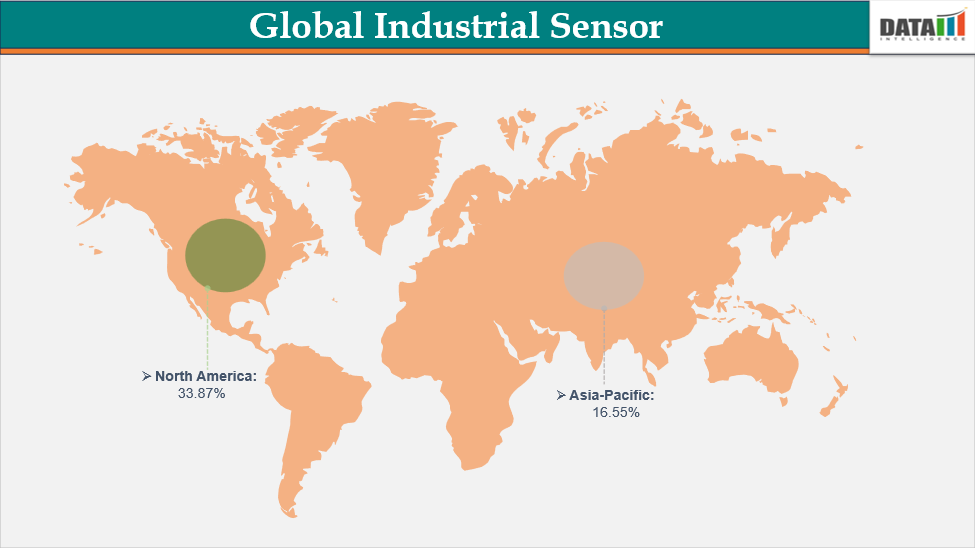
- North America leads 33.87% global industrial sensor market due to its mature manufacturing base, high adoption of Industry 4.0 practices, and investments in automation across key sectors such as oil & gas and pharmaceuticals.
- Asia-Pacific is 16.55% witnessing rapid growth, driven by government-backed industrialization programs, expansion of electronics and automotive manufacturing, and initiatives to implement smart factories across China, India, and Southeast Asia.
- Innovations in MEMS, CMOS, and wireless sensors, combined with IoT integration, are increasing the adoption of industrial sensors for predictive maintenance, energy efficiency, and real-time process monitoring.
Industrial Sensor Market Size & Forecast
- 2025 Market Size: US$ 26,766.6 million
- 2033 Projected Market Size: US$ 44,465.20 million
- CAGR (2025–2033): 6.55%
- Asia Pacific: Fastest growing market in 2025
- North America: Largest market
Industrial Sensor Market Dynamics: Drivers, Restraints, Opportunities
Driver: Rising Adoption of IoT-Enabled Smart Manufacturing
The rising adoption of IoT-enabled smart manufacturing is significantly driving the global industrial sensor market. In India and other industrial hubs, manufacturers are increasingly deploying sensors to monitor machine performance, detect faults, and optimize production processes. Integration of sensors with digital twins and robotics is enhancing operational efficiency and reducing downtime across factories.
Cloud connectivity and real-time data analytics are further accelerating sensor adoption, allowing industries to make informed decisions and improve overall productivity. As digital transformation continues, the demand for advanced industrial sensors to support IoT applications and smart manufacturing initiatives is expected to grow rapidly across multiple sectors.
Restraint: High Implementation and Integration Costs
High implementation and integration costs are significant barriers to the growth of the global industrial sensor market. Upgrading traditional industrial processes to include smart sensors necessitates substantial investment in new hardware, software, and infrastructure. Companies must also invest in integrating these sensors into existing systems, which may include extensive retrofitting and the creation of suitable platforms.
While major corporations in industrialized countries may have the capacity to absorb these expenditures, firms in emerging markets or industries with weaker profit margins may be more unwilling to make these investments. This financial barrier may hinder the overall growth of the industrial smart sensors market, especially in countries or industries that are slow to implement digital transformation initiatives.
For more details on this report, Request for Sample
Industrial Sensor Market Segmentation
The global industrial sensor market is segmented based on sensor type, technology, end-user, application, and region.
Sensor Type: Pressure Sensors segment is estimated to have 22.7% of the industrial sensor market share.
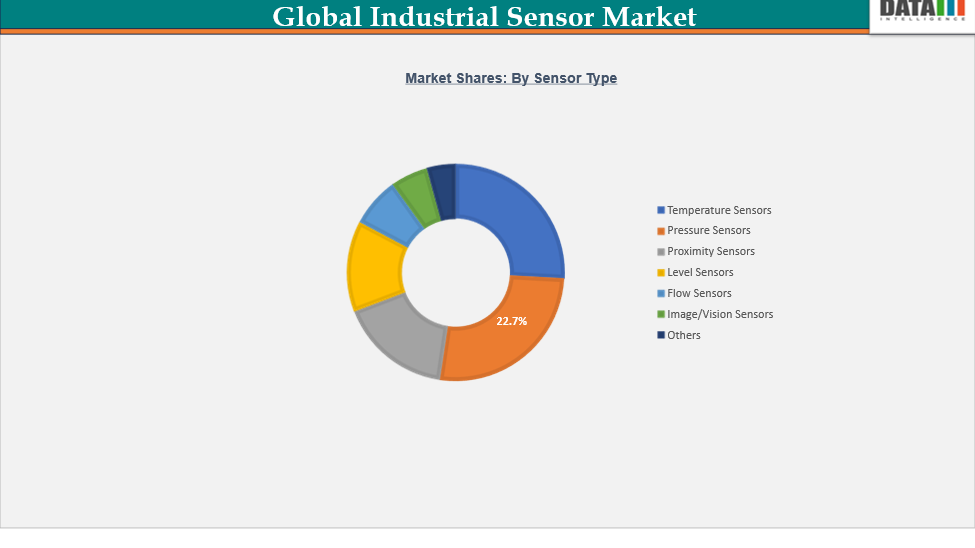
The pressure sensor segment is a key driver of the global industrial sensor market, supported by rising industrial automation and smart manufacturing initiatives. Demand is particularly strong in sectors such as automotive, healthcare, and energy, where precise pressure monitoring is critical for safety and efficiency. Technological advancements, including miniaturized and wireless pressure sensors, are expanding their industrial applications. Additionally, the integration of pressure sensors with IoT and predictive maintenance systems is boosting adoption across factories worldwide.
Why Industrial Sensor Market Matters in 2026-2033
The global industrial sector is undergoing a major digital transformation driven by automation, smart manufacturing, and Industry 4.0 initiatives.
Industrial sensors are becoming the backbone of connected factories by enabling real-time monitoring, predictive maintenance, process optimization, and improved operational efficiency across manufacturing, energy, automotive, healthcare, and logistics industries.
Several macroeconomic and technological factors are driving market growth:
- Rapid adoption of Industry 4.0 and smart factories
- Increasing demand for industrial automation
- Growing implementation of Industrial Internet of Things (IIoT)
- Rising investments in predictive maintenance solutions
- Expansion of robotics and autonomous manufacturing systems
- Advancements in MEMS and smart sensor technologies
- Increasing focus on workplace safety and regulatory compliance
- Growing demand for energy-efficient industrial operations
- Government support for digital manufacturing initiatives
- Rising need for real-time data analytics and remote asset monitoring
Analyst View
DataM Intelligence Analyst Perspective
The industrial sensor market is rapidly evolving from traditional monitoring devices into intelligent sensing ecosystems that enable autonomous industrial operations and data-driven decision-making.
The long-term success of the industrial sensor market will depend on:
- Expansion of smart manufacturing ecosystems
- Wider adoption of IIoT platforms
- AI-powered predictive analytics integration
- High-precision and miniaturized sensor development
- Industrial cybersecurity advancements
- Energy-efficient sensing technologies
- Seamless cloud and edge computing integration
- Strategic partnerships across automation and semiconductor industries
North America continues to lead in industrial automation innovation and advanced manufacturing technologies, while Asia-Pacific dominates production capacity, supported by large-scale manufacturing hubs in China, Japan, South Korea, and India. Europe remains a key market driven by Industry 4.0 adoption, sustainability initiatives, and stringent industrial safety standards. India is emerging as a high-growth market, fueled by smart manufacturing programs, expanding industrial infrastructure, government initiatives such as Make in India, and increasing investments in factory automation.
Industrial Sensor Market Regional Analysis
North America Holds the Largest Industrial Sensor Market Share
North America holds the largest Industrial Sensor market share, supported by advanced industrial automation, widespread adoption of Industry 4.0 technologies, strong manufacturing investments, and the presence of leading sensor manufacturers and automation solution providers. Growing demand from automotive, aerospace, energy, and semiconductor industries continues to strengthen regional market growth.
United States
The U.S. is a leading market for industrial sensors due to rapid deployment of smart factories, industrial IoT (IIoT), robotics, and predictive maintenance solutions across manufacturing facilities.
Proximity, pressure, temperature, position, flow, vibration, and vision sensors are widely deployed to improve production efficiency, equipment reliability, and worker safety in highly automated industrial environments.
Automotive manufacturers increasingly rely on advanced sensors for robotic assembly, quality inspection, automated material handling, and EV battery manufacturing.
Federal investments in semiconductor manufacturing, clean energy projects, and domestic industrial modernization are creating additional demand for high-performance industrial sensing technologies.
U.S. Industrial Sensor Market in Manufacturing
The expansion of smart manufacturing and digital factories is significantly increasing demand for industrial sensors capable of delivering real-time operational data.
Manufacturers require highly accurate sensors that support predictive maintenance, machine condition monitoring, process automation, and energy optimization while minimizing production downtime.
AI-powered analytics, edge computing, and industrial IoT platforms are increasing the commercial value of intelligent sensors that enable continuous monitoring and automated decision-making.
Suppliers offering reliable products, industrial certifications, cybersecurity-ready connectivity, and long-term technical support are well positioned to secure large industrial automation contracts.
Demand extends beyond new production facilities as existing factories continue upgrading legacy equipment with smart sensing technologies to improve operational efficiency and regulatory compliance.
Asia-Pacific is the Fastest-Growing Region
Asia-Pacific is expected to register the fastest CAGR in the Industrial Sensor market, driven by rapid industrialization, expanding electronics manufacturing, increasing adoption of smart factories, and strong government support for industrial digital transformation.
China, Japan, South Korea, and India remain key growth markets. China leads global industrial automation and electronics manufacturing, while Japan and South Korea continue investing in robotics, precision manufacturing, and factory automation. India is rapidly expanding industrial production through smart manufacturing initiatives and infrastructure development.
The region's strong manufacturing ecosystem supports growing demand for proximity sensors, pressure sensors, temperature sensors, vision sensors, motion sensors, flow sensors, and wireless industrial sensing solutions.
Europe Shows Strong Growth Through Smart Manufacturing
Europe continues to experience strong market growth driven by Industry 4.0 adoption, industrial automation investments, energy-efficient manufacturing, and stringent workplace safety regulations.
Germany, France, Italy, the United Kingdom, and other European manufacturing hubs are increasing deployment of industrial sensors across automotive production, pharmaceuticals, food processing, chemicals, and industrial machinery.
European manufacturers are placing greater emphasis on precision sensing, predictive maintenance, digital twins, sustainability, and intelligent production systems, creating sustained demand for advanced industrial sensing technologies.
Latin America Industrial Sensor Market Outlook
Latin America is steadily expanding with increasing investments in manufacturing modernization, mining automation, oil & gas operations, and food processing industries.
Brazil, Mexico, Chile, and Argentina are adopting industrial sensors to improve operational efficiency, equipment monitoring, worker safety, and process automation across industrial facilities.
Middle East & Africa Industrial Sensor Market Outlook
The Middle East & Africa region is witnessing growing demand driven by industrial diversification, smart manufacturing initiatives, energy infrastructure expansion, and large-scale automation projects.
Saudi Arabia, the UAE, and South Africa are investing in Industry 4.0 technologies, industrial robotics, and digital manufacturing, while emerging African economies are gradually adopting industrial sensors to enhance productivity, safety, and operational efficiency across manufacturing, mining, and utilities.
Industrial Sensor Market Competitive Landscape & Key Players
Honeywell International Inc., Texas Instruments Incorporated, STMicroelectronics N.V., TE Connectivity Ltd., Siemens AG, ABB Ltd., Rockwell Automation, Inc., Bosch Sensortec GmbH, First Sensor AG, and Pepperl+Fuchs SE. among others.
Siemens AG: It is a major player in the industrial sensor market, offering a wide range of automation and sensor technologies that support smart factories and Industry 4.0 initiatives. Its portfolio includes process instrumentation, proximity sensors, and condition monitoring solutions tailored for multiple industries. Siemens leverages its global presence and strong R&D capabilities to integrate sensors with digital platforms such as MindSphere, its industrial IoT ecosystem. This enables manufacturers to optimize efficiency, enhance predictive maintenance, and improve safety across operations.
Recent Developments in the Industrial Sensor Market (2026)
- In June 2026, Siemens AG expanded its industrial sensor portfolio with next-generation AI-enabled condition monitoring sensors designed for predictive maintenance, helping manufacturers improve equipment reliability, reduce downtime, and support Industry 4.0 initiatives.
- April 2026 – Honeywell expands AI-enabled industrial sensing and automation technologies
Honeywell International Inc. introduced advanced industrial sensor platforms integrated with AI analytics and predictive maintenance capabilities to improve operational efficiency and asset monitoring in manufacturing environments. - April 2026 – Siemens advances smart factory sensor integration for industrial automation
Siemens AG expanded deployment of intelligent industrial sensors and edge-connected monitoring systems supporting digital twins, real-time process optimization, and Industry 4.0 manufacturing operations. - March 2026 – STMicroelectronics launches next-generation MEMS industrial sensor portfolio
STMicroelectronics N.V. introduced upgraded MEMS-based environmental and motion sensors designed for industrial automation, robotics, and predictive maintenance applications. ( - March 2026 – ABB strengthens industrial sensing capabilities for smart manufacturing infrastructure
ABB Ltd. expanded its industrial automation portfolio with connected sensors and AI-powered monitoring systems aimed at improving energy efficiency, process reliability, and factory safety. - February 2026 – Bosch Sensortec advances compact sensor technologies for industrial IoT systems
Bosch Sensortec GmbH introduced high-performance environmental and motion sensing solutions optimized for industrial IoT, condition monitoring, and autonomous machine applications. - February 2026 – Rockwell Automation enhances connected industrial monitoring platforms
Rockwell Automation, Inc. launched upgraded industrial sensing and control solutions integrated with cloud analytics and digital manufacturing software for predictive maintenance and operational visibility. - January 2026 – TE Connectivity expands sensor technologies for harsh industrial environments
TE Connectivity Ltd. introduced rugged industrial sensors engineered for extreme temperature, pressure, and vibration conditions across energy, manufacturing, and transportation sectors.
Industrial Sensor Market Investment & Funding Analysis
Global investments in industrial automation and smart manufacturing continue to accelerate as industries embrace Industry 4.0, IIoT, AI-driven monitoring, and predictive maintenance technologies.
Major funding areas include:
- Smart sensor technologies
- Industrial IoT (IIoT) platforms
- AI-powered predictive maintenance
- Wireless sensor networks
- Factory automation solutions
- Edge computing and industrial connectivity
Strategic Recommendations
For Industrial Sensor Manufacturers
- Invest in AI-enabled smart sensor development
- Expand IIoT-compatible product portfolios
- Strengthen partnerships with automation providers
For Investors
- Focus on high-growth industrial automation technologies
- Monitor Industry 4.0 adoption across manufacturing sectors
- Evaluate companies with advanced sensing and analytics capabilities
For Governments
- Support smart manufacturing initiatives
- Promote industrial digital transformation programs
- Encourage adoption of energy-efficient automation technologies
Why Buy This Industrial Sensor Market Report?
This report helps organizations:
- Understand future industrial automation trends
- Identify high-growth investment opportunities
- Benchmark competitors effectively
- Analyze emerging technology developments
- Optimize market expansion strategies
- Evaluate digital transformation opportunities
- Assess regional market potential
- Track next-generation industrial sensing innovations
What's Included in the Industrial Sensor Market Report?
The report provides:
- Market size & forecast analysis
- Regional growth outlook
- Competitive intelligence
- Technology benchmarking
- Pricing analysis
- Supply chain insights
- Market share analysis
- Investment landscape analysis
- Strategic recommendations
- Emerging trends analysis
- Company profiling
Who Should Buy This Report?
This Industrial Sensor Market report is ideal for:
- Industrial sensor manufacturers
- Industrial automation companies
- Manufacturing enterprises
- IIoT solution providers
- Semiconductor manufacturers
- Robotics companies
- Process automation providers
- System integrators
- Venture capital firms
- Market intelligence teams
- Government organizations
- Industrial equipment OEMs
Key Benefits for Stakeholders
Gain actionable market intelligence:
- Understand future industrial automation trends
- Analyze global smart manufacturing strategies
- Evaluate sensor technology innovations
- Identify strategic growth opportunities
- Benchmark leading market participants
- Improve investment and business decision-making
Industrial Sensor Market Scope
| Metrics | Details | |
| CAGR | 6.55% | |
| Market Size Available for Years | 2025-2032 | |
| Estimation Forecast Period | 2026-2033 | |
| Revenue Units | Value (US$ Mn) | |
| Segments Covered | Sensor Type | Temperature Sensors, Pressure Sensors, Proximity Sensors, Level Sensors, Flow Sensors, Image/Vision Sensors, and Others. |
| Technology | Wired Sensors, Wireless Sensors, MEMS-based Sensors, Optoelectronic Sensors | |
| Application | Condition Monitoring & Predictive Maintenance, Process Control & Automation, Quality Inspection & Testing, Safety & Security Systems, Environmental Monitoring, and Others. | |
| End-User | Chemicals & Petrochemicals, Energy & Power, Food & Beverage, Pharmaceuticals & Life Sciences, Metals & Mining, Water & Wastewater Treatment, Automotive & Transportation, Semiconductors & Electronics, and Others. | |
| Regions Covered | North America, Europe, Asia-Pacific, South America, and the Middle East & Africa | |
The global industrial sensor market report delivers a detailed analysis with 70 key tables, more than 76 visually impactful figures, and 230 pages of expert insights, providing a complete view of the market landscape.
Target Audience
- Industrial Sensor Manufacturers
- Industrial Automation and Smart Factory Companies
- Manufacturing Companies (Discrete & Process Industries)
- Automotive OEMs and Tier-1/Tier-2 Suppliers
- Industrial IoT (IIoT) Solution Providers
- Robotics and Machine Automation Companies
- Process Control and Instrumentation Companies
- Semiconductor and Electronics Manufacturers
- Oil & Gas and Petrochemical Companies
- Power Generation and Utility Companies
- Food & Beverage Processing Companies
- Pharmaceutical and Life Sciences Manufacturers
- Chemical Manufacturing Companies
- Aerospace & Defense Equipment Manufacturers
- Mining and Metals Companies
- Building Automation and HVAC System Providers
- Logistics and Warehouse Automation Companies
- Engineering, Procurement & Construction (EPC) Companies
- Industrial Equipment and Machinery Manufacturers
- System Integrators and Industrial Control Solution Providers
Suggestions for Related Report




























































