


Nanosensors Market Size
The global Nanosensors market reached an estimated US$ 1.02 billion in 2025 and is expected to reach approximately US$ 2.06 billion by 2035, growing with a CAGR of 7.3% during the forecast period 2026-2035. The market is expanding as nanoscale materials and structures move into diagnostics, wearables, environmental monitoring, industrial automation, semiconductor inspection and defense systems. Commercial value is created by ultra-low detection limits, rapid response, miniaturized form factors and the ability to combine sensors with wireless connectivity, edge processing and artificial intelligence.
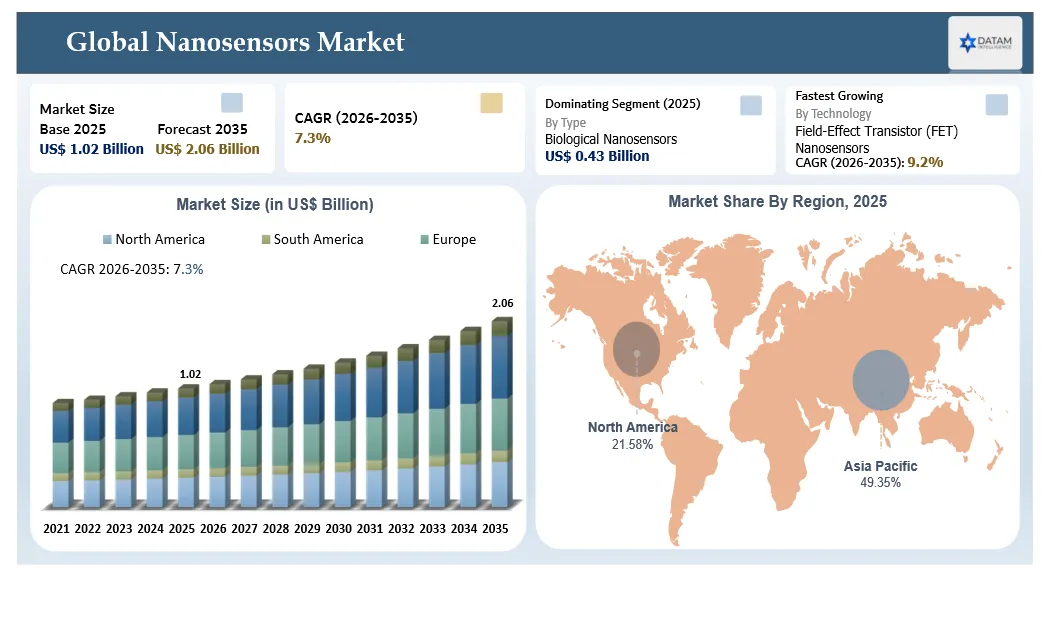
Healthcare and life sciences represent the most visible growth engine. Nano-enabled biosensors can detect biomarkers, metabolites, gases and mechanical signals at concentrations or spatial scales that are difficult for conventional devices. At the same time, industrial and environmental users are adopting nano-enabled gas, chemical, strain and optical sensors for predictive maintenance, leak detection, process optimization and pollution control. Research instrumentation remains an important base market through atomic-force microscopy probes, nanomechanical sensors and specialized measurement systems.
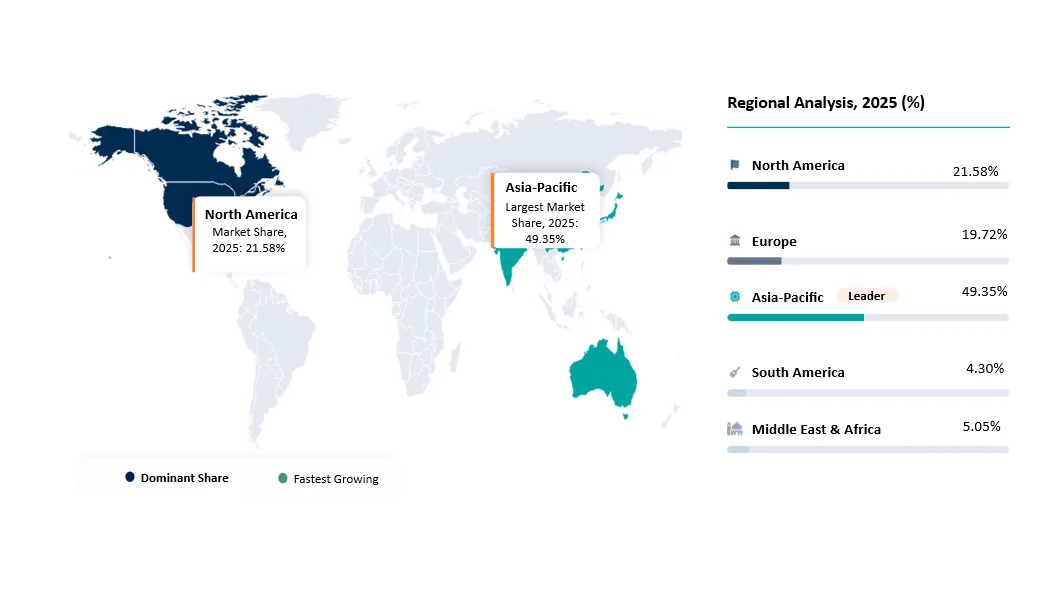
North America leads through research funding, semiconductor and biomedical innovation, defense applications and early adoption of connected health technologies. Asia-Pacific is expected to grow fastest because of electronics manufacturing, expanding healthcare infrastructure, environmental monitoring requirements and investment in graphene, nanowire and MEMS/NEMS fabrication. Commercialization will depend on reproducibility, scalable packaging, calibration, biocompatibility and the ability to demonstrate value beyond conventional microsensors.
| Metric | Details |
| 2025 Market Size | US$ 1.02 Billion |
| 2035 Projected Market Size | US$ 2.06 Billion |
| CAGR (2026-2035) | 7.3% |
| Largest Market | North America |
| Fastest Growing Market | Asia-Pacific |
| Dominating Segment | Biological Nanosensors |
| Fastest-Growing Technology | Field-Effect Transistor and Optical Nanosensors |
| Report Page Count | Approximately 250-300 pages in full study |
Nanosensors Market Key Takeaways
- Biological nanosensors lead commercial value because molecular diagnostics, wearable monitoring and precision medicine require high sensitivity and miniaturized form factors.
- North America held the largest share in 2025, supported by biomedical research, semiconductor design, defense spending and early adoption of advanced diagnostic platforms.
- Asia-Pacific is expected to record the fastest growth as China, Japan, South Korea, India and Singapore expand electronics, healthcare, industrial automation and nanotechnology investment.
- Graphene and nanowire platforms are gaining strategic relevance because their electrical properties support label-free, low-power and highly sensitive detection.
- Packaging, calibration and manufacturing reproducibility remain greater commercialization barriers than laboratory sensitivity alone.
- Artificial intelligence is increasing the value of nanosensor data by improving signal processing, anomaly detection, sensor fusion and predictive maintenance.
- Healthcare, environmental monitoring and industrial process control are expected to generate the strongest near-term adoption.
- Future market leadership will depend on scalable manufacturing, validated performance, application-specific integration and trusted data governance.
Nanosensors Industry Trends and Strategic Insights
- The industry is moving from isolated nanosensor elements toward integrated modules that combine nanomaterials, microfluidics, readout electronics, wireless communication and analytics.
- Commercial differentiation is shifting from record laboratory detection limits to repeatability, shelf life, selectivity, calibration stability and cost per test.
- Wearable and implantable platforms are increasing demand for flexible substrates, biocompatible coatings, low-power readout and continuous monitoring.
- Environmental and industrial customers are adopting distributed sensor networks that combine nano-enabled sensitivity with edge computing and remote maintenance.
- Partnerships between nanomaterial specialists, semiconductor foundries, diagnostics firms and system integrators are becoming essential for scale-up.
- Standardized reference materials and validation protocols are emerging as prerequisites for procurement and regulation.
Nanosensors Market Scope
| Metrics | Details |
| By Type | Biological, Chemical and Physical Nanosensors |
| By Technology | Electrochemical, Optical, Electromechanical, Field-Effect Transistor, Piezoelectric and Others |
| By Nanomaterial | Carbon Nanotubes, Graphene, Nanowires, Quantum Dots, Metal/Metal Oxide Nanoparticles, Polymeric and Hybrid Nanomaterials |
| By Sensing Parameter | Chemical/Gas, Biological/Molecular, Temperature, Pressure/Force, Motion/Strain, Optical/Radiation and Others |
| By Deployment Mode | Standalone, Integrated Modules, Wearable/Implantable and Distributed/Networked |
| By Application | Medical Diagnostics, Environmental Monitoring, Industrial Control, Food Safety, Consumer Electronics, Automotive, Aerospace/Defense and Research |
| By End Use Industry | Healthcare, Electronics, Chemicals/Manufacturing, Energy, Automotive, Aerospace/Defense, Food/Agriculture and Research |
| By Distribution Channel | Direct Sales, Specialized Distributors, OEM/System Integrator Partnerships and Online/Catalog |
| Report Insights Covered | Market Size, Share, Growth, Technology Landscape, Competitive Analysis, Company Profiles and Country-Level Opportunity |
Why does this report matter in 2026?
The year 2026 is an important commercialization point for nanosensors. Research programs are moving beyond proof-of-concept sensitivity toward manufacturable devices, while healthcare, environmental and industrial customers are seeking smaller, faster and more connected sensing systems. New all-optical force-sensing approaches, biohybrid nanosensor laboratories and AI-enabled connected detectors illustrate how the field is broadening from academic nanotechnology into practical measurement platforms.
The report matters because nanosensors are not one homogeneous product category. Commercial requirements differ sharply between implantable biosensors, AFM probes, industrial gas sensors, graphene transistors, optical nanoparticles and distributed environmental nodes. The study separates these markets by technology, nanomaterial, sensing parameter, deployment mode and end-user requirements, allowing companies to distinguish scalable near-term opportunities from research-intensive longer-term concepts.
Decisions made in 2026 on foundry partnerships, packaging, regulatory strategy, reference methods, data architecture and customer co-development will shape competitive position through 2035. The market is sufficiently mature to support commercial revenue but still fragmented enough for new entrants and specialized suppliers to create defensible positions.
Nanosensors Market White Space & Investment Opportunities
- Scalable graphene and nanowire field-effect transistor platforms for label-free diagnostics and gas detection.
- Flexible and biocompatible nanosensors for continuous wearable or implantable monitoring.
- Optical nanosensors for intracellular oxygen, pH, force and metabolite measurement.
- Low-power distributed nanosensor networks for air quality, water monitoring, industrial safety and smart infrastructure.
- Standardized functionalization, calibration and reference materials that reduce customer validation burden.
- Packaging and readout platforms that convert high-performance nanomaterials into robust, manufacturable sensor modules.
Nanosensors Future Market Transformation
The market will transform from component-led innovation into application-specific sensing ecosystems. Successful products will combine nano-enabled recognition with microfluidics, low-noise electronics, wireless communication, edge AI and cloud analytics. Healthcare products will increasingly be sold as monitored-care solutions rather than as isolated sensors, while industrial products will connect directly to maintenance, quality and safety workflows.
Manufacturing will become more standardized through wafer-scale fabrication, printed electronics, roll-to-roll processing and modular functionalization. This shift will reduce unit cost and improve lot-to-lot consistency. At the same time, data quality and cybersecurity will become part of sensor qualification because connected nanosensors can influence clinical, operational and safety decisions.
By 2035, competitive advantage is expected to depend on validated end-to-end performance rather than nanomaterial novelty alone. Companies that control application data, packaging, calibration and customer integration will capture more value than suppliers of raw nanomaterials without a clear device pathway.
Nanosensors Market Buyer Decision-Making Criteria
Buyers evaluate detection limit, selectivity, response time, repeatability, drift, operating range and resistance to interference. For regulated or safety-critical applications, validation, calibration traceability, biocompatibility, sterilization tolerance and false-alarm performance are decisive. Customers also examine packaging, shelf life, power consumption, readout compatibility and the ability to integrate with existing software and communication standards.
Procurement decisions increasingly include total cost of ownership rather than unit price. Buyers compare calibration frequency, sensor replacement, data processing, maintenance, training and downtime reduction. Suppliers that provide application engineering, validation documentation, secure data interfaces and lifecycle support are better positioned than component-only vendors.
Nanosensors Market Economic & Investment Analysis
The economics of nanosensors differ by application. Research probes and specialized laboratory devices can support high margins at low volume, while consumer and environmental applications require scalable fabrication and aggressive cost reduction. Medical diagnostics can support premium pricing when a nanosensor improves sensitivity, speed or decentralization, but regulatory evidence and clinical workflow integration increase development cost.
Investment is concentrated in graphene and nanowire electronics, wearable biosensing, optical nanoparticles, gas detection, microfluidic integration and AI-enabled analytics. Capital requirements rise sharply when a project moves from material discovery to packaging, pilot manufacturing and qualification. Investors should therefore distinguish scientific sensitivity from commercial readiness and assess yield, stability, supply chain and customer validation milestones.
Strategic value is highest for platforms that can serve multiple analytes or applications using a common fabrication and readout architecture. Such platforms can reuse manufacturing, software and regulatory capabilities and create a portfolio rather than a single sensor. Partnerships with foundries, diagnostics companies, industrial OEMs and research institutions can reduce time to market and improve credibility.
Nanosensors Investment Trends in the Market
- Capital is moving toward integrated sensing platforms that combine nanomaterials with microfluidics, electronics and analytics.
- Healthcare investment favors continuous monitoring, non-invasive testing and biomarker detection at low concentrations.
- Industrial investment is focused on predictive maintenance, leak detection, air quality and process optimization.
- Public research funding continues to support graphene, quantum materials, optical nanosensors and biohybrid systems.
- Manufacturing investment is increasingly directed toward wafer-scale processes, automated functionalization and robust packaging.
- Partnerships and licensing are preferred when start-ups lack semiconductor, regulatory or commercial infrastructure.
Strategic Indicators For Nanosensors Market
High Regulation Impact
Medical, environmental and defense nanosensors face significant validation and compliance requirements. Biocompatibility, toxicology, electrical safety, cybersecurity, analytical performance and quality-system controls can determine commercialization timelines. Regulations differ by intended use, and a research sensor may require substantial redesign before clinical or industrial deployment.
High Investment Activity
Investment remains high because nanosensors sit at the intersection of nanotechnology, diagnostics, semiconductors, AI and connected devices. Funding is selective and increasingly tied to manufacturability, validation and customer pilots rather than sensitivity claims alone.
Supply Chain Disruption
Specialty nanomaterials, high-purity substrates, lithography, functionalization chemicals, packaging and calibration equipment can be concentrated among limited suppliers. Semiconductor constraints, export controls or quality failures can delay scale-up.
Pricing Volatility
Pricing varies from low-cost disposable sensor elements to premium research probes and regulated medical devices. Yield, packaging, functionalization, calibration and certification have greater influence on price than raw nanomaterial content alone.
Procurement Pressure
Large buyers demand reproducibility, secure supply, documentation and application support. Suppliers must often complete lengthy qualification and field testing before receiving volume orders.
New Technology Adoption
Graphene FETs, optical nanocrystals, nanoelectromechanical sensors, flexible electronics and AI-based sensor fusion are expanding use cases. Adoption depends on measurable improvement over conventional sensors.
Regional Expansion Opportunity
Asia-Pacific offers strong expansion potential through electronics manufacturing, smart-city investment, environmental monitoring and healthcare modernization. North America and Europe remain attractive for high-value diagnostics, research and industrial applications.
Government Policy Support
Nanotechnology programs, semiconductor incentives, environmental monitoring mandates and digital health initiatives support R&D and commercialization. Public procurement and standards can accelerate adoption.
Pricing Intelligence
Research-grade nanosensors command high prices, while OEM volumes require cost-down roadmaps. Buyers increasingly prefer transparent cost models that separate sensor element, packaging, electronics, software and service.
Disruption Analysis of Nanosensors Market
Nanosensors are disrupting conventional sensing by enabling molecular-scale detection, smaller sample volumes, faster response and continuous monitoring. In healthcare, this can shift diagnostics from centralized laboratories toward point-of-care, wearable and implantable systems. In industrial and environmental applications, it supports distributed monitoring at locations that were previously too costly or inaccessible.
The disruption is gradual because performance at the nanoscale must survive packaging, contamination, temperature, humidity, mechanical stress and long operating periods. Conventional sensors remain competitive when they are cheaper, sufficiently sensitive and easier to qualify. The strongest displacement will occur where nanosensors deliver a clear step-change in detection, size, power or multiplexing.
Nanosensors Market BCG Matrix: Company Evaluation
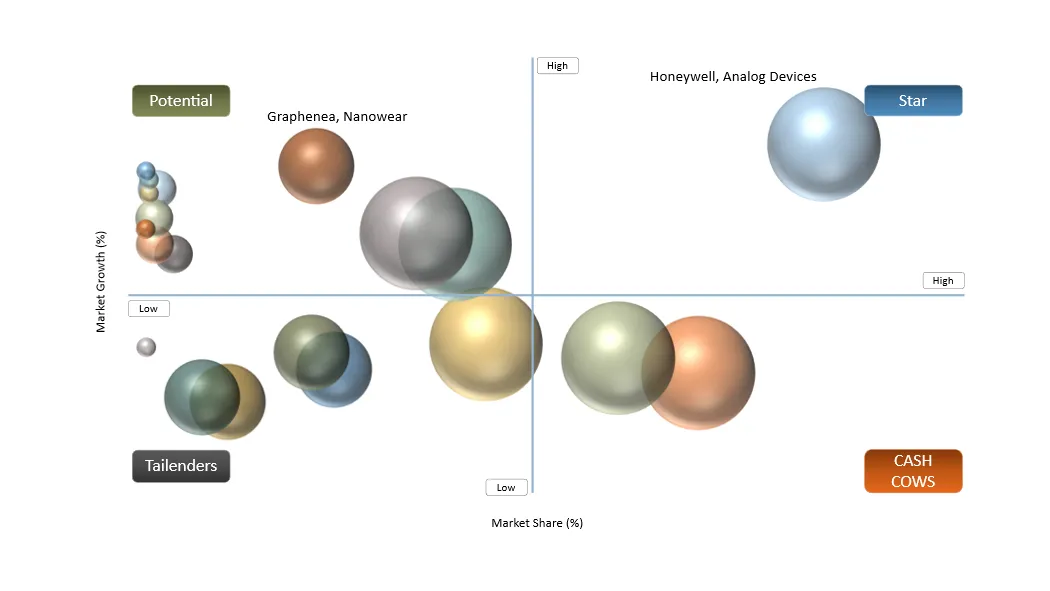
STAR
Honeywell, Analog Devices, Texas Instruments, OMRON and Bruker are positioned as Stars because they combine sensor, electronics, instrumentation or industrial commercialization capabilities with large customer bases. Their advantage comes from system integration, manufacturing quality and the ability to embed nano-enabled sensing into broader product platforms.
POTENTIAL
Graphenea, Nanowear, Tracense Systems, Applied Nanodetectors, LamdaGen, NANOSENSORS and Nano Sensorics represent Potential players. These companies and specialists have differentiated materials, products or application focus but require continued scale-up, validation, partnerships and market expansion to achieve broader share.
Nanosensors Market Dynamics
Driver Impact Analysis
| Driver | Market Growth Impact | Demand Concentration | Impacted Use Case | Strategic Impact |
Precision diagnostics and continuous health monitoring | High | Healthcare and wearables | Biomarker, physiological and metabolic sensing | Expands premium medical and consumer applications. |
Environmental and industrial monitoring mandates | High | Utilities, manufacturing and smart cities | Gas, chemical and pollution detection | Supports distributed sensing and recurring service models. |
Advances in graphene, nanowires and optical nanomaterials | Medium-High | Cross-industry | High-sensitivity and low-power devices | Improves performance and creates new form factors. |
AI, edge computing and wireless integration | Medium-High | Connected devices | Sensor fusion and predictive analytics | Increases data value and reduces false alarms. |
Driver: Rising Demand for Ultra-Sensitive Diagnostics and Real-Time Monitoring
The strongest growth driver is demand for earlier and more continuous measurement. Nanosensors can detect biomarkers, gases, mechanical changes and metabolites at low concentrations and in small sample volumes. This supports point-of-care testing, wearable monitoring, personalized treatment and remote patient management. Similar needs exist in industrial safety and environmental monitoring, where early detection can reduce downtime, contamination and risk.
Restraint Impact Analysis
| Restraint | Drag on Market Growth | Primary Impact Area | Impacted Use Case | Strategic Impact |
| Manufacturing reproducibility and yield | High | Scale-up | All commercial devices | Raises cost and delays qualification. |
| Packaging, drift and calibration | High | Field reliability | Industrial, environmental and healthcare | Limits long-term accuracy. |
| Regulatory and biocompatibility requirements | Medium-High | Medical commercialization | Wearables, implants and diagnostics | Extends evidence and approval timelines. |
| Competition from mature microsensors | Medium | Cost-sensitive applications | Consumer and industrial sensing | Requires clear performance advantage. |
Restraint: Scale-Up, Reproducibility and Packaging Challenges
Many nanosensors demonstrate excellent performance in controlled laboratories but experience variability when fabricated at larger scale. Surface chemistry, nanomaterial defects, contamination and packaging can change sensitivity and selectivity. Companies must invest in process control, automated functionalization, reference standards and environmental protection. Without repeatable performance, customers cannot validate devices or integrate them into regulated and safety-critical workflows.
Nanosensors Market Segment Analysis
The global Nanosensors market is segmented based on Type, Technology, Nanomaterial, Sensing Parameter, Deployment Mode, Application, end-use industry, distribution channel, and region.
By Type
Biological Nanosensors Will Continue to Lead Commercial Value
Biological nanosensors are expected to remain the largest type because healthcare diagnostics, molecular research, food safety and wearable monitoring require detection of proteins, nucleic acids, metabolites, pathogens and physiological signals. Chemical nanosensors also have strong demand in gas detection, environmental analysis and process control. Physical nanosensors serve force, pressure, temperature, strain, motion and radiation applications, including research instrumentation and advanced manufacturing.
By Technology
Electrochemical Technology Will Lead While FET and Optical Platforms Grow Fastest
Electrochemical nanosensors lead because they are compatible with compact electronics, low sample volumes and disposable test formats. Field-effect transistor sensors are gaining value through label-free electrical detection, while optical nanosensors support remote, multiplexed and intracellular measurement. Electromechanical and piezoelectric technologies remain important for force, mass, pressure and vibration sensing.
By Nanomaterial
Graphene and Nanowires Will Gain Strategic Share
Carbon nanotubes have established use in high-surface-area sensing, but graphene and nanowires are expected to gain share because they support high carrier mobility, tunable surface functionalization and integration with semiconductor processes. Quantum dots and plasmonic nanoparticles are important for optical detection. Metal oxides remain competitive in gas sensing because of established chemistry and scalable processing.
By Sensing Parameter
Biological and Molecular Detection Will Be the Largest Parameter
Biological and molecular sensing leads through diagnostics, drug development and life-science research. Chemical and gas sensing is also substantial in industrial safety, emissions and air quality. Force and strain nanosensors are gaining importance in robotics, structural monitoring and cellular biophysics, while optical and radiation nanosensors address imaging, photonics and defense.
By Deployment Mode
Integrated Sensor Modules Will Capture the Largest Commercial Share
Integrated modules combine the nanosensor element with packaging, signal conditioning, calibration and communication. They offer greater value and easier adoption than standalone elements. Wearable and implantable deployments are expected to grow fastest from a smaller base, while distributed networked sensors expand in environmental and industrial monitoring.
By Application
Medical Diagnostics and Monitoring Will Remain the Largest Application
Medical diagnostics and monitoring benefit from the ability to detect low-concentration biomarkers and support continuous measurement. Environmental monitoring is growing through air, water and contaminant detection. Industrial process control uses nanosensors for gases, corrosion, pressure and predictive maintenance. Consumer, automotive and defense applications grow where miniaturization and sensitivity provide clear system value.
By End Use Industry
Healthcare and Life Sciences Will Lead End-Use Demand
Healthcare and life sciences lead because premium pricing and high unmet need support investment. Electronics and semiconductor companies use nanosensors in inspection, device integration and connected products. Manufacturing, energy and automotive users prioritize reliability and total cost of ownership. Academic and research institutes remain important early adopters and validation partners.
By Distribution Channel
Direct Sales and OEM Partnerships Will Dominate
Direct sales dominate complex and high-value projects because customers require technical support, validation and customization. OEM and system-integrator partnerships are increasingly important for embedding nanosensors into diagnostics, industrial equipment and connected devices. Specialized distributors support research and regional coverage, while online channels serve catalog products and replacement probes.
Nanosensors Market Geographical Penetration
U.S. Nanosensors Market Landscape
The U.S. is the largest national market because it combines nanotechnology research, biomedical innovation, semiconductor design, defense spending and venture investment. Demand is strong for diagnostic biosensors, wearable monitoring, industrial gas detection and research instrumentation. The market benefits from university-industry collaboration and federal funding, but medical products face demanding validation and reimbursement requirements.
Germany Nanosensors Market Outlook
Germany has strong demand from industrial automation, automotive engineering, chemicals, medical technology and research institutes. Customers emphasize reliability, standards and integration with manufacturing systems. Opportunity is strongest in process monitoring, predictive maintenance, environmental sensing and high-value instrumentation.
Japan Nanosensors Market Trends
Japan combines advanced electronics, precision instrumentation, automotive manufacturing and healthcare technology. The market favors high-quality optical, electrochemical and nanomechanical sensors. Aging demographics support health-monitoring applications, while established materials and semiconductor companies strengthen domestic R&D.
China Nanosensors Market Outlook
China is a major growth market through electronics manufacturing, environmental monitoring, healthcare modernization and public investment in nanotechnology. Domestic companies are expanding graphene, metal-oxide and connected-sensor capabilities. Commercial growth will depend on quality consistency, intellectual-property protection and movement from research output to validated products.
India Nanosensors Market Outlook
India offers growth in diagnostics, food safety, water monitoring, agriculture and industrial sensing. Academic and government research capabilities are expanding, while domestic healthcare demand supports low-cost point-of-care formats. Scale-up infrastructure and commercialization partnerships remain key constraints.
Brazil Nanosensors Market Outlook
Brazil has opportunities in agriculture, food safety, mining, environmental monitoring and healthcare. Adoption is concentrated in research institutions and larger industrial users. Local partnerships, import support and cost-effective platforms are important for market development.
Middle East and Africa Nanosensors Market Outlook
The region offers opportunities in water quality, oil and gas, environmental monitoring, smart infrastructure and healthcare. Gulf countries can support advanced deployments through investment capacity, while wider adoption in Africa depends on rugged, affordable and low-maintenance systems.
Nanosensors Market Competitive Landscape
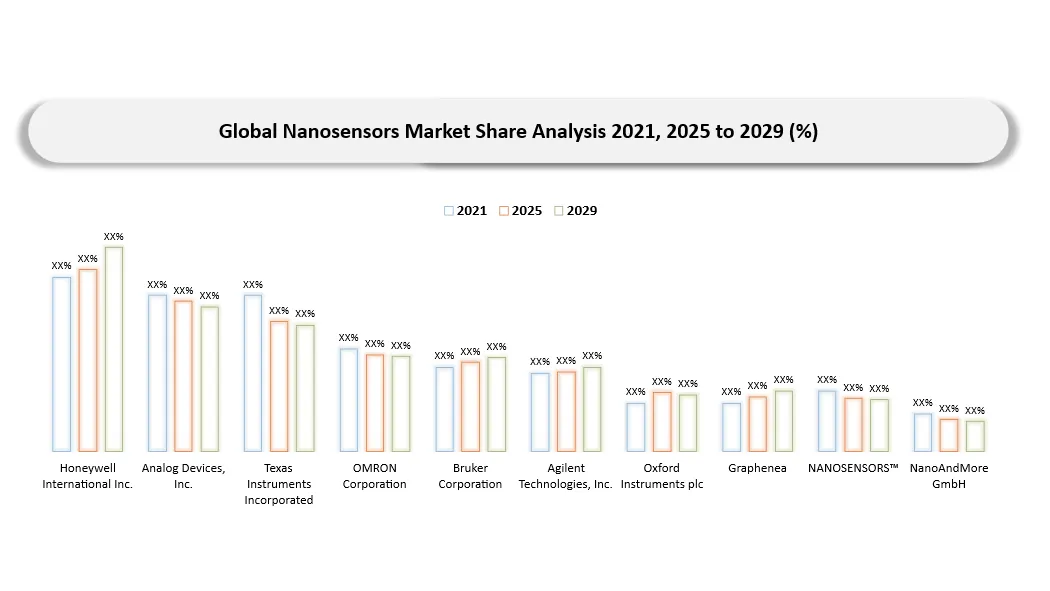
- Competition spans diversified sensor and semiconductor companies, research-instrument providers, nanomaterial specialists and application-focused start-ups.
- Large companies compete through manufacturing quality, customer relationships, electronics integration and global support, while specialists compete through sensitivity, material know-how and application focus.
- Healthcare and environmental markets require partnerships with diagnostics companies, laboratories, hospitals, utilities and regulators.
- Graphene, nanowire and optical nanosensor developers increasingly use licensing, foundry and co-development models rather than building full manufacturing stacks.
- Competitive differentiation depends on reproducibility, packaging, validation, signal processing, cybersecurity and customer integration.
- Patent portfolios and access to application data are becoming more important as core nanomaterial concepts become widely available.
Key Companies
- Honeywell International Inc.
- Analog Devices, Inc.
- Texas Instruments Incorporated
- OMRON Corporation
- Bruker Corporation
- Agilent Technologies, Inc.
- Oxford Instruments plc
- NanoAndMore GmbH
- NANOSENSORS
- Graphenea
- Nanowear, Inc.
- Tracense Systems Ltd.
- Applied Nanodetectors Ltd.
- LamdaGen Corporation
- Nano Sensorics
Company Profiles
Honeywell International Inc.
Honeywell is relevant through industrial sensing, connected safety, aerospace and automation platforms. Its competitive advantage is the ability to integrate advanced sensor elements with control systems, software, certification and global service. Nano-enabled gas, chemical and physical sensing can strengthen offerings in industrial safety, air quality and aerospace monitoring.
Competitive priorities include product validation, repeatable manufacturing, application partnerships, secure data integration and expansion through OEM or distributor relationships.
Analog Devices, Inc.
Analog Devices provides signal conditioning, data conversion, edge processing and sensor-interface technologies that are essential for converting nanoscale signals into reliable system data. The company is positioned to benefit as nanosensors require low-noise electronics, power management and embedded intelligence.
Competitive priorities include product validation, repeatable manufacturing, application partnerships, secure data integration and expansion through OEM or distributor relationships.
Texas Instruments Incorporated
Texas Instruments supports the market through analog front ends, microcontrollers, connectivity and power devices used in compact sensor systems. Its scale, reference designs and OEM relationships make it an important enabling company for integrated nanosensor modules.
Competitive priorities include product validation, repeatable manufacturing, application partnerships, secure data integration and expansion through OEM or distributor relationships.
OMRON Corporation
OMRON combines sensing, automation and healthcare capabilities. It is positioned for nano-enabled industrial, environmental and physiological monitoring where sensor data can be connected to control, inspection or health-management systems.
Competitive priorities include product validation, repeatable manufacturing, application partnerships, secure data integration and expansion through OEM or distributor relationships.
Bruker Corporation
Bruker is a leading research-instrument company with atomic-force microscopy and nanoscale characterization capabilities. It serves universities, semiconductor companies, materials laboratories and life-science researchers. Its installed base and application expertise support premium research and metrology demand.
Competitive priorities include product validation, repeatable manufacturing, application partnerships, secure data integration and expansion through OEM or distributor relationships.
Agilent Technologies, Inc.
Agilent provides analytical instruments, diagnostics and laboratory platforms. Nanosensor relevance comes from integration with chemical and biological analysis, microfluidics and high-sensitivity measurement workflows.
Competitive priorities include product validation, repeatable manufacturing, application partnerships, secure data integration and expansion through OEM or distributor relationships.
Oxford Instruments plc
Oxford Instruments supplies advanced research and semiconductor tools used in nanofabrication and characterization. It benefits from demand for nanosensor development, process control and materials research.
Competitive priorities include product validation, repeatable manufacturing, application partnerships, secure data integration and expansion through OEM or distributor relationships.
NanoAndMore GmbH
NanoAndMore distributes AFM probes and nanotechnology products. Its catalog, application support and regional reach make it important in research and instrumentation channels.
Competitive priorities include product validation, repeatable manufacturing, application partnerships, secure data integration and expansion through OEM or distributor relationships.
NANOSENSORS
NANOSENSORS is a specialist brand in atomic-force microscopy probes. Its market position is based on high-quality probe designs, application-specific coatings and long-standing relationships with research users and instrument manufacturers.
Competitive priorities include product validation, repeatable manufacturing, application partnerships, secure data integration and expansion through OEM or distributor relationships.
Graphenea
Graphenea supplies graphene materials and devices for research and commercial development. Its graphene wafers, films and transistor structures support biosensor, gas-sensor and electronic-sensor development.
Competitive priorities include product validation, repeatable manufacturing, application partnerships, secure data integration and expansion through OEM or distributor relationships.
Nanowear, Inc.
Nanowear develops wearable medical technology using nano-enabled textile sensing and analytics. Its strategic position is based on combining sensor-rich garments with software and clinical monitoring workflows.
Competitive priorities include product validation, repeatable manufacturing, application partnerships, secure data integration and expansion through OEM or distributor relationships.
Tracense Systems Ltd.
Tracense develops nano-enabled chemical sensing platforms for security and hazardous-material detection. Commercial opportunity depends on selectivity, ruggedization, field validation and integration into security systems.
Competitive priorities include product validation, repeatable manufacturing, application partnerships, secure data integration and expansion through OEM or distributor relationships.
Applied Nanodetectors Ltd.
Applied Nanodetectors focuses on nanomaterial-based gas and air-quality sensing. The company targets compact, low-power monitoring for environmental, indoor-air and industrial applications.
Competitive priorities include product validation, repeatable manufacturing, application partnerships, secure data integration and expansion through OEM or distributor relationships.
LamdaGen Corporation
LamdaGen develops electrochemical and nano-enabled sensing concepts for advanced diagnostics and measurement. Its opportunity lies in platform partnerships and application-specific commercialization.
Competitive priorities include product validation, repeatable manufacturing, application partnerships, secure data integration and expansion through OEM or distributor relationships.
Nano Sensorics
Nano Sensorics develops connected environmental and safety sensors, including intelligent indoor monitoring. Its positioning combines sensor hardware, connectivity and analytics for public buildings, schools and smart infrastructure.
Competitive priorities include product validation, repeatable manufacturing, application partnerships, secure data integration and expansion through OEM or distributor relationships.
Nanosensors Market Major Pain Points
- Difficulty reproducing laboratory sensitivity at manufacturing scale.
- Signal drift, fouling, humidity and temperature interference.
- Packaging that protects the sensor without blocking the target analyte.
- High qualification and regulatory cost for medical and safety-critical uses.
- Lack of standardized reference methods across emerging nanomaterial platforms.
- Dependence on specialized nanomaterials, fabrication tools and skilled personnel.
- Customer reluctance when conventional sensors are adequate and cheaper.
- Cybersecurity and data-governance risks in connected sensing systems.
Nanosensors Market Recent Developments
- November 2025: Fraunhofer IMS completed the insituBIOS project and established laboratory infrastructure for biohybrid nanosensors targeting biomedical, environmental and process applications.
- January 2025: Columbia Engineering researchers reported all-optical nanoscale force sensors based on photon-avalanching nanocrystals, with potential across cellular biophysics, robotics and remote measurement.
- April 2025: Research published in ACS Sensors reviewed advances in oxygen-sensitive optical nanosensors and highlighted the need for standardized protocols, scalable production and broader application access.
- 2025: Nano Sensorics expanded connected detector offerings for indoor air, safety and smart-building applications, demonstrating the integration of sensing, wireless connectivity and analytics.
- 2025: NANOSENSORS continued to expand application content and scientific use cases for specialized AFM probes, reinforcing demand from nanomaterials, photovoltaics and life-science research.
Analyst View / Opinion on Nanosensors Market
- The Nanosensors market is entering a durable commercialization phase as healthcare, environmental and industrial users seek greater sensitivity, miniaturization and continuous measurement.
- Healthcare will remain the largest value opportunity, but near-term revenue will also come from research instrumentation, gas sensing and industrial monitoring where regulatory barriers are lower.
- Graphene, nanowire and optical platforms have strong technical potential, yet commercial leadership will depend on packaging, reproducibility and integration rather than material novelty.
- Asia-Pacific will gain share through electronics manufacturing and public investment, while North America will retain leadership in high-value biomedical and defense applications.
- Companies should build application-specific partnerships early because customer validation and data access are essential for product design and procurement.
- Long-term winners will combine sensors, electronics, analytics, calibration and lifecycle support into complete solutions.
Nanosensors Market Target Audience
| Industry | Who Should Buy This Report? | Reason to Buy This Report |
| Healthcare & Diagnostics | Diagnostic developers, medtech firms, hospitals and digital-health teams | Assess biomarker, wearable and point-of-care opportunities. |
| Semiconductor & Electronics | Sensor designers, foundries, analog and connectivity companies | Evaluate integration, materials and manufacturing requirements. |
| Industrial Automation | OEMs, plant operators and predictive-maintenance providers | Identify gas, chemical, force and condition-monitoring applications. |
| Environmental & Utilities | Air, water and emissions monitoring organizations | Assess distributed monitoring and regulatory demand. |
| Automotive & Aerospace | OEMs, Tier suppliers and defense contractors | Evaluate miniaturized sensing, structural monitoring and safety use cases. |
| Nanomaterials | Graphene, nanotube, nanowire and nanoparticle suppliers | Understand device pathways and partner opportunities. |
| Research & Academia | Universities, laboratories and instrument providers | Track emerging technologies, validation needs and funding directions. |
| Investment & Consulting | Investors, strategy teams and advisors | Support market entry, partnership, funding and acquisition decisions. |
Why Choose DATAM?
- Data-driven insights combining market sizing, technology readiness, application economics and country-level adoption.
- Post-purchase analyst consultations for portfolio prioritization, partnerships, commercialization and custom modeling.
- Annual report updates covering product launches, research milestones, regulation, funding and competitive developments.
- Specialized focus on emerging markets, manufacturing ecosystems and commercialization barriers.
- Actionable analysis connecting nanomaterial performance with packaging, electronics, validation and buyer requirements.
What DATAM Uniquely Provides
- Ten-year forecasts across type, technology, nanomaterial, sensing parameter, deployment, application, end use and region.
- Commercial-readiness analysis separating research prototypes from scalable products.
- Competitive benchmarking across diversified sensor companies, instrument providers, nanomaterial suppliers and start-ups.
- Buyer-focused analysis of sensitivity, selectivity, calibration, packaging, regulation and total cost of ownership.
- Country-level views linking research strength, semiconductor capacity, healthcare adoption and environmental policy.
- Strategic recommendations for foundry partnerships, system integration, validation and market entry.
Questions This Report Answers
- How will the global Nanosensors market evolve from 2025 through 2035?
- Which technologies, nanomaterials and applications offer the strongest commercial opportunity?
- How will healthcare, environmental and industrial demand shape adoption?
- What manufacturing, packaging and validation barriers constrain scale-up?
- Which companies are best positioned across components, instruments and integrated solutions?
- How should companies build foundry, OEM, research and regulatory partnerships?
- Which regions offer the best balance of innovation, manufacturing and customer demand?




























































