


Flexible Sensors Market Size and Overview
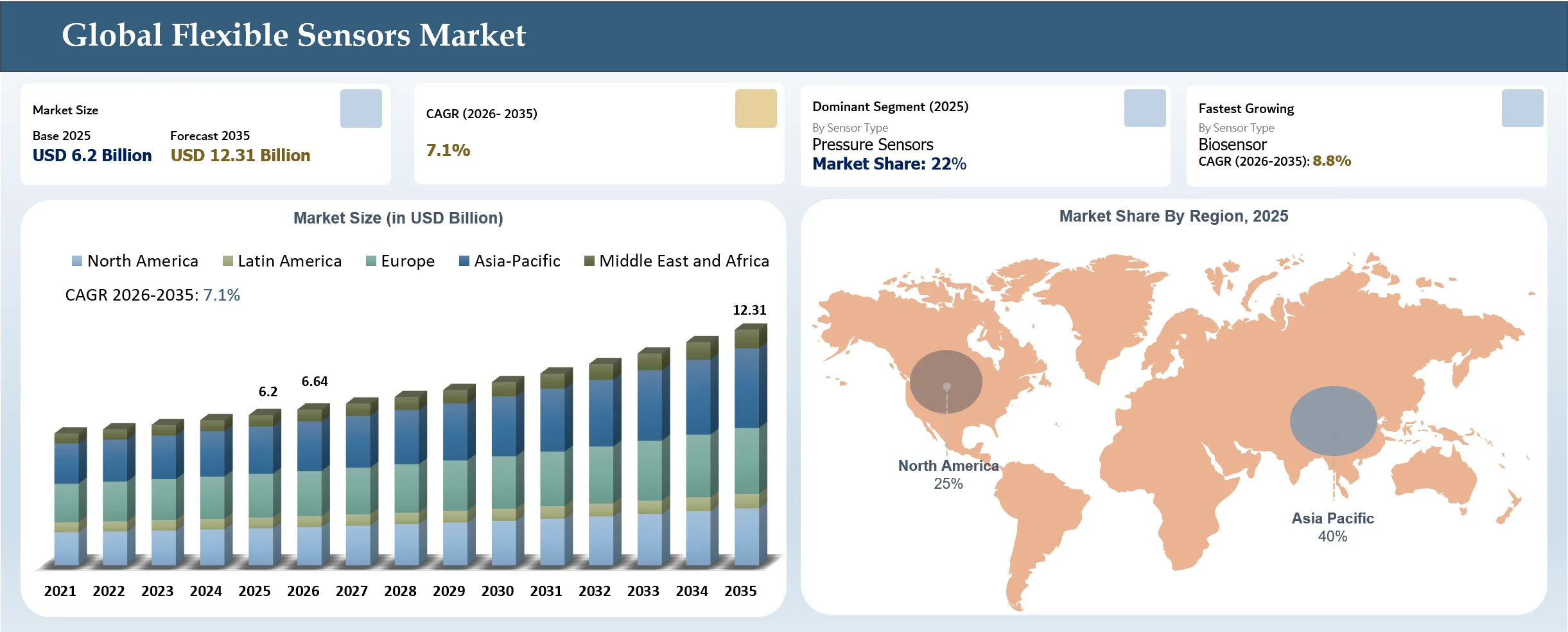
The global flexible sensors market reached USD 6.2 billion in 2025 and is expected to reach USD 12.31 billion by 2035, growing with a CAGR of 7.1% during the forecast period 2026-2035. The market is being shaped by company investment in flexible tactile sensing for automotive and robotics applications. In 2025, Xiaomi invested in Shanghai-based Yaole Technology, a developer of flexible pressure and fabric tactile sensors, to advance its technology and mass-production capabilities. The company targets automotive, medical, furniture, sports, and robotics applications.
In 2026, Brighter Signals secured additional funding for its tactile-sensing technology for cars and robots, with its platform designed to detect human touch and pressure through flexible sensor structures. The company is developing applications across automotive seats, robotics, healthcare, and industrial environments, indicating continued commercialization of conformable pressure-sensing systems.
White-Space Opportunities for Flexible Pressure Sensors in Automotive Safety and Humanoid Robotics
The €1.6 million funding secured by Brighter Signals in May 2026 demonstrates increasing investment in flexible, fabric-based pressure sensing for automotive and robotics applications. The financing included Wake Up Capital, ELOKON Ventures, Innovatiefonds Noord-Holland, and a Eurostars grant co-funded by the Dutch Enterprise Agency (RVO). Brighter Signals is using the funding to advance its flexible pressure and tactile-sensing technology, strengthen its data-interpretation algorithms, and expand pilot programs with automotive OEMs, Tier 1 suppliers, and robotics companies. The company states that its sensors are designed to detect pressure, presence, and proximity for automotive safety systems and industrial and humanoid robotics.
The funding activity indicates white space for flexible pressure sensors that combine conformable sensing surfaces with real-time data interpretation and application-specific electronics. In January 2026, Brighter Signals also received a €328,000 convertible loan from Innovatiefonds Noord-Holland to develop its fabric-based sensors for detecting human touch and pressure. The financing supports projects with car manufacturers, Tier 1 automotive suppliers, and robotics developers, including technical and commercial validation of its flexible textile sensor platform.
Flexible Sensors Market Key Takeaways
- Asia-Pacific accounted for approximately 40% of the flexible sensors market in 2025, driven by strong electronics manufacturing and adoption of wearable, healthcare, and automotive sensors. North America held approximately 25%, supported by advanced healthcare, automotive, and robotics applications.
- Pressure Sensors dominated by sensor type with approximately 22% market share in 2025, supported by applications in wearables, healthcare, automotive, and robotics. Biosensors recorded an 8.8% CAGR, driven by growing use in wearable and point-of-care devices.
- Flexible pressure sensors are gaining adoption in automotive, healthcare, robotics, and wearable devices, particularly for tactile and pressure detection on curved surfaces.
- Flexible sensor development is shifting toward multifunctional platforms, integrating pressure, tactile, proximity, and other sensing capabilities for advanced human-machine interfaces.
Flexible Sensors Market Industry Trends and Strategic Insight
- Flexible pressure sensors are gaining traction in wearable healthcare, automotive interiors, robotics, and smart textiles, where conventional rigid sensors face integration limitations.
- Automotive manufacturers and robotics companies are emerging as key adoption areas, particularly for seat occupancy, tactile interfaces, robotic gripping, and human-machine interaction.
- The industry is shifting toward thin, conformable, and high-resolution sensor arrays, enabling pressure detection across larger and irregular surfaces.
- Integration of sensing with data processing and software is becoming important, allowing flexible pressure sensors to provide real-time tactile and pressure mapping rather than simple point measurements.
- Increasing investment in fabric-based and printed sensor technologies is supporting development of lightweight, scalable solutions for next-generation wearable and robotic applications.
Flexible Sensors Market Scope
| Metrics | Details | |
| 2025 Market Size | USD 6.2 Billion | |
| 2035 Projected Market Size | USD 12.31 Billion | |
| CAGR (2026-2035) | 7.1% | |
| Largest Market | Asia-Pacific | |
| Fastest Growing Market | North America | |
| By Sensor Type | Touch Sensors, Pressure Sensors, Strain Sensors, Temperature Sensors, Biosensors, Image Sensors, Gas & Chemical Sensors, Photodetectors, Others | |
| By Technology | Capacitive, Piezoresistive, Piezoelectric, Fiber Optic, Others | |
| By Application | Healthcare & Medical, Consumer Electronics, Automotive, Robotics, Industrial & IoT, Others | |
| By Resistance Range | 1KΩ–20KΩ, 21KΩ–100KΩ, 100KΩ–200KΩ, More than 200KΩ | |
| By Region | North America | U.S., Canada, Mexico |
| Europe | Germany, United Kingdom, France, Italy, Spain, Netherlands, Switzerland, Sweden, Norway, Denmark, Belgium, Poland, Austria, Ireland, Portugal, Greece, Finland, Rest of Europe | |
| Asia-Pacific | China, Japan, India, South Korea, Australia, New Zealand, Singapore, Malaysia, Thailand, Indonesia, Vietnam, Philippines, Taiwan, Rest of Asia Pacific | |
| Latin America | Brazil, Argentina, Chile, Colombia, Peru, Rest of Latin America | |
| Middle East and Africa | Saudi Arabia, United Arab Emirates, Qatar, Kuwait, Oman, Bahrain, South Africa, Egypt, Nigeria, Morocco, Rest of Middle East & Africa | |
| Report Insights Covered | Competitive Landscape Analysis, Company Profile Analysis, Market Size, Share, Growth | |
Flexible Sensors Market Disruption Analysis
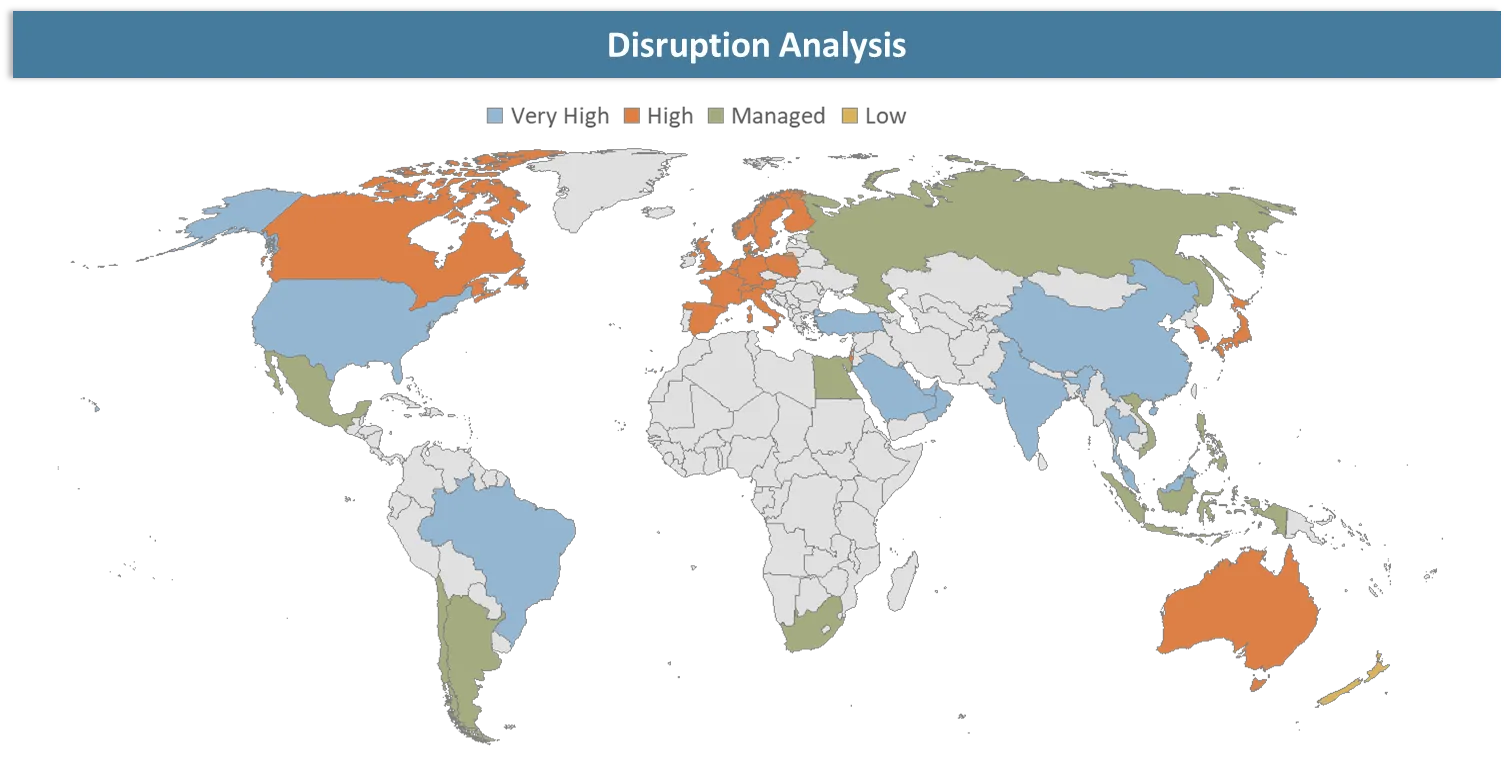
Shift Toward Flexible Tactile Sensing for Robotics and Physical AI
The Flexible Sensors Market is shifting from conventional point pressure measurement toward flexible tactile sensing for robots and physical AI. In July 2026, LG Innotek and TDK announced a strategic partnership to develop a tactile sensing module with ultra-thin and flexible structures for robotic hands, arms, and bodies, with launch planned for 2027.
This shift is also being reinforced by new investment in flexible sensing. In April 2026, Lingdong Jiaxin raised nearly RMB 100 million to develop PVDF-based flexible tactile sensors for embodied AI, including robotic hands and grippers. The development indicates a move toward distributed, high-density pressure sensing as a core perception layer rather than standalone pressure measurement.
Flexible Sensors Market BCG Matrix: Company Evaluation
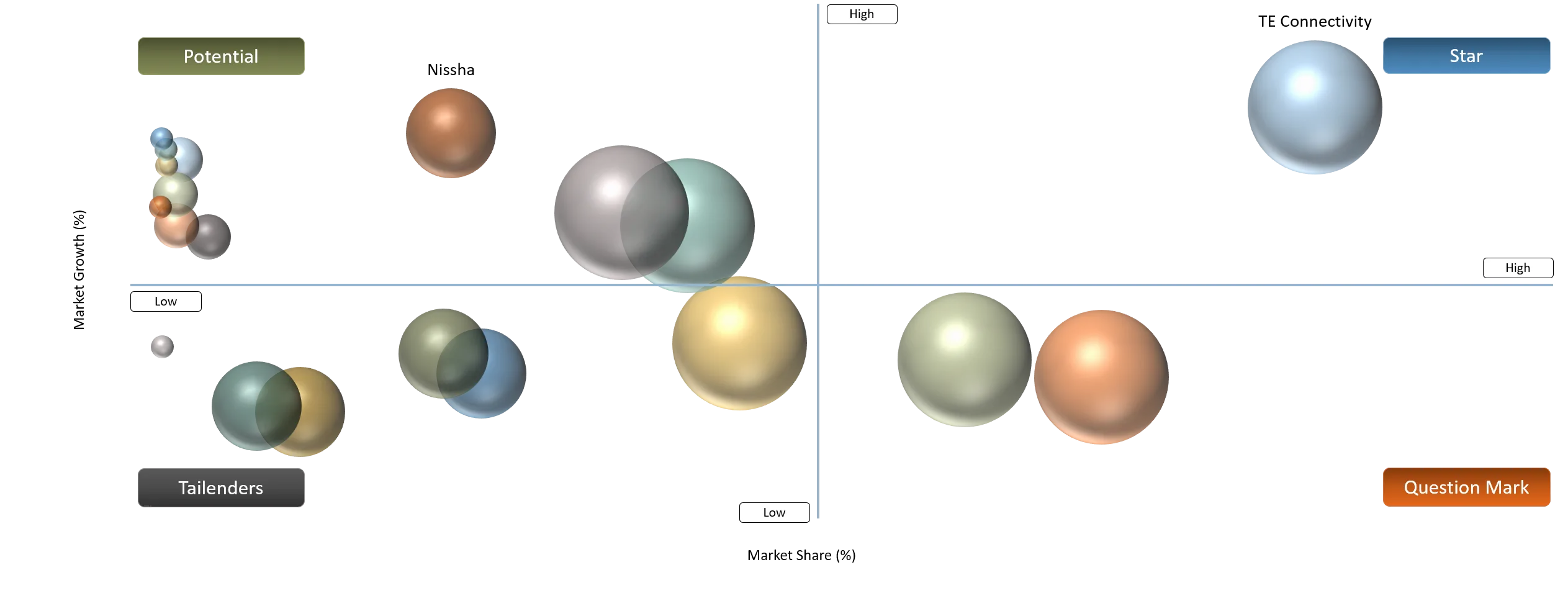
The stars position is led by TE Connectivity, Tekscan, Interlink Electronics, and Canatu, supported by established flexible pressure-sensing technologies, broad application exposure, and strong capabilities across automotive, healthcare, robotics, and wearable applications. The potential companies include Nissha, Sensitronics, and Flexpoint Sensor Systems, with specialized flexible and printed sensing technologies and scope for broader application adoption.
The question marks comprise PolyIC, ElastiSense Sensor Technology, and FlexEnable, where flexible and printed sensor technologies provide differentiation across smart surfaces, tactile sensing, and human-machine interfaces, while commercial exposure remains more specialized
Flexible Sensors Market Dynamics
Driver Impact Analysis
| Driver | Market Growth Impact (%) | Demand Concentration | Impacted Use Case | Strategic Impact |
Wearable healthcare adoption increasing demand for lightweight, conformable sensing devices | 24% | High demand across wearable healthcare and remote monitoring applications requiring comfortable, body-conforming sensors. | Wearable health monitoring, patient monitoring, fitness tracking. | Drives adoption of thin, lightweight, and conformable pressure and biosensing solutions. |
Flexible sensors enabling continuous monitoring across body contours and moving surfaces | 21% | Concentrated in healthcare, wearables, sports, and human-machine interface applications. | Continuous pressure monitoring, motion tracking, rehabilitation, prosthetics. | Increases demand for stretchable and conformable sensor architectures capable of maintaining performance during movement. |
Printed electronics enabling scalable production of lightweight sensor architectures | 19% | Strong demand among sensor manufacturers and electronics companies pursuing high-volume flexible-device production. | Smart textiles, wearable electronics, flexible medical devices. | Encourages development of printed, thin-film, and scalable manufacturing processes for flexible sensors. |
Robotics increasing demand for tactile and deformation sensing across irregular surfaces | 20% | Concentrated among robotics manufacturers developing robotic hands, grippers, and humanoid systems. | Robotic tactile sensing, gripping, human-robot interaction. | Accelerates development of flexible pressure arrays and distributed tactile sensing platforms. |
Flexible substrates enabling sensor integration into compact and non-planar electronic systems | 16% | Broad demand across automotive, consumer electronics, medical devices, and industrial systems. | Smart interiors, curved displays, compact electronic devices, wearable systems. | Expands opportunities for sensors that integrate directly onto curved, space-constrained, and non-planar surfaces. |
Wearable Healthcare Adoption Increasing Demand for Conformable Pressure Sensing
The adoption of flexible sensing in medical technology is increasing demand for pressure sensors that can conform to body surfaces and movement. In September 2025, WACKER began serial production of NEXIPAL® Sense flexible sensor laminates, manufactured through an automated roll-to-roll process and designed for pressure and movement sensing in medical technology, robotics, automotive, and sports applications.
The development demonstrates a shift toward scalable production of stretchable pressure-sensing structures for applications requiring flexibility and continuous surface contact. The use of automated roll-to-roll manufacturing also addresses the need for consistent production of flexible sensor laminates as adoption expands across medical and wearable applications.
Restraint Impact Analysis
| Restraint | Drag on Market Growth (%) | Primary Impact Area | Impacted Use Case | Strategic Impact |
Manufacturing consistency remains challenging across flexible sensor materials and structures | 22% | Production consistency, yield, and quality control | Wearable devices, automotive sensors, medical devices | Increases production complexity and limits consistent performance during large-scale manufacturing. |
Flexible materials face thermal, mechanical, and environmental stability limitations | 21% | Sensor durability, reliability, and material performance | Automotive interiors, industrial systems, outdoor wearables | Raises material-development and qualification requirements for sensors exposed to repeated bending, heat, moisture, and mechanical stress. |
Healthcare applications require extensive validation, biocompatibility, and regulatory compliance | 19% | Clinical validation, safety, and regulatory approval | Wearable healthcare, patient monitoring, medical interfaces | Extends commercialization timelines and increases testing and compliance costs for medical-grade flexible sensors. |
Integration with power sources and wireless electronics remains technically challenging | 18% | Power management, electronics integration, and connectivity | Wireless wearables, smart textiles, remote monitoring devices | Adds design complexity for compact systems requiring flexible sensing, power, processing, and wireless communication. |
Manufacturing Consistency Limiting Large-Scale Flexible Sensor Production
Flexible sensors use thin films, printed materials, conductive inks, polymers, and multilayer structures that require tight control over material properties, layer thickness, alignment, and electrical characteristics. Variations during fabrication can affect sensitivity, repeatability, durability, and calibration, making consistent performance more difficult to achieve compared with conventional rigid sensors.
The challenge becomes more significant as manufacturers move from prototype production toward high-volume manufacturing for wearables, automotive systems, medical devices, and robotics. Differences in substrate properties, printing conditions, curing, and assembly can increase yield losses and quality-control requirements. These manufacturing dependencies can raise production costs and slow commercialization, making process standardization, automated inspection, and scalable fabrication techniques important for wider adoption of flexible pressure sensors.
Flexible Sensors Market Segmentation Analysis
The global flexible sensors market is segmented by sensor type, technology, application, resistance range, and region.
Pressure Sensor Technology Is Expanding Through Sensor Portfolio Acquisitions and Broader Industrial Integration
Pressure sensor suppliers are strengthening their portfolios through acquisitions and business expansion, particularly across automotive, industrial, aerospace, and medical pressure-sensing applications. In July 2025, STMicroelectronics announced the acquisition of part of NXP Semiconductors' MEMS sensor business for up to US$950 million. The transaction includes MEMS-based sensors used in vehicle safety, industrial monitoring, and industrial pressure applications, expanding STMicroelectronics' position in electromechanical sensing. The transaction was expected to close in the first half of 2026.
The competitive landscape is also being reshaped through consolidation of dedicated pressure-sensing businesses. In June 2025, Crane announced the US$1.15 billion acquisition of Baker Hughes' Precision Sensors and Instrumentation business, which includes Druck, Reuter-Stokes, and Panametrics. Druck's portfolio includes pressure sensing technologies for aerospace and industrial applications, with the acquisition intended to strengthen Crane's engineered-products portfolio and expand its pressure-sensing capabilities, including ground testing and calibration..
Flexible Sensors Market Geographical Penetration
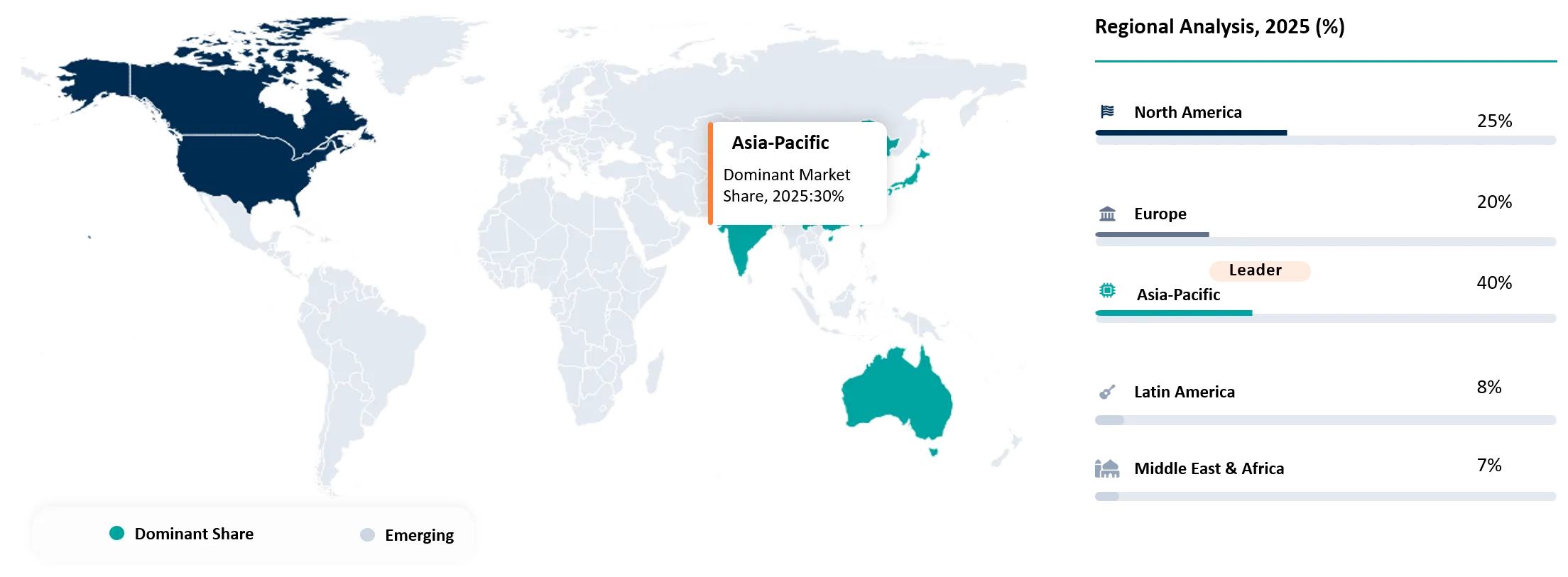
North America Strengthening Flexible Sensor Commercialization Through Advanced Pressure, Force, and Imaging Sensor Development
North America is the fastest-growing region in the flexible sensors market, supported by established sensor manufacturers, medical-device development, robotics, automotive electronics, and advanced semiconductor and imaging capabilities. The region also has a strong base of companies developing thin-film, force, pressure, and flexible sensing technologies.
In November 2025, Uneo completed its acquisition of Tekscan, combining Uneo's printed flexible sensor technologies with Tekscan's thin-film pressure and force sensing systems. The combined portfolio covers medical, industrial, robotics, consumer electronics, and smart manufacturing applications. The acquisition strengthens the regional flexible-sensor ecosystem by combining flexible printed sensor manufacturing with established pressure-mapping and force-sensing technologies. It also expands the scope for OEM integration across healthcare, robotics, industrial equipment, and consumer electronics, while providing a larger technology base for prototype-to-production sensor development.
U.S. Flexible Sensors Market Trends
The U.S. represents the largest market within North America, supported by established flexible pressure-sensing manufacturers and demand from healthcare, industrial automation, robotics, automotive and consumer electronics applications.
In April 2025, Tekscan introduced a real-time temperature mapping system designed for industrial applications. The system uses thin and flexible sensing technology to measure temperature distribution between surfaces and complements the company's existing pressure and force mapping portfolio. The introduction expands flexible sensing from conventional force and pressure measurement toward combined surface-condition monitoring. This increases the relevance of thin, conformable sensor systems for industrial inspection, equipment characterization, thermal analysis and OEM applications.
Canada Flexible Sensors Market Outlook
Canada is developing its sensor manufacturing base through investment in specialized imaging and semiconductor technologies. In March 2025, the Government of Canada announced an CAD 8 million Strategic Innovation Fund contribution toward Teledyne's CAD 42 million project to upgrade equipment at its Bromont, Quebec facility.
The project includes development of the next generation of image sensors and a new 200 mm wafer manufacturing line, while also expanding access to specialized imaging infrastructure for Canadian businesses and research organizations. The investment strengthens Canada's position in advanced sensor manufacturing and image-sensor development. For flexible sensors, the development is relevant to the broader transition toward miniaturized and advanced sensor architectures, particularly imaging and specialized sensing components used in electronics, automotive systems and industrial applications.
Asia-Pacific Expanding Flexible Sensor Manufacturing Through Tactile Sensing, Printed Electronics, and Advanced Sensor Production
Asia-Pacific is the dominant regional market for flexible sensors, supported by its concentration of electronics manufacturing, automotive production, robotics development, semiconductor manufacturing and flexible-electronics research. China and Japan represent two important technology and manufacturing centers within the region.
In China, Fulai New Materials publicly introduced its second-generation tactile sensing products in June 2025, featuring curved-surface sensing and three-dimensional force detection. The company applies flexible sensing technologies across robotics, medical applications, new-energy batteries and industrial inspection. The development demonstrates the movement of flexible sensors from individual sensing components toward integrated tactile systems for humanoid robots, industrial inspection, healthcare and battery monitoring. The emphasis on curved surfaces and multidimensional force detection is particularly relevant to electronic-skin and robotic tactile applications..
China Flexible Sensors Market Trends
China represents the largest flexible-sensor market within Asia-Pacific, supported by domestic electronics manufacturing, robotics, new-energy equipment and sensor-component development. In 2025, Modu Technology completed seed and angel financing rounds, developed a robotic tactile sensor module and launched an industrial-grade product line.
In March 2026, the company completed Pre-A and Pre-A+ financing and reported mass delivery across four product lines covering flexible polymer and fabric sensing technologies among its broader sensor portfolio. It indicates increasing commercialization of flexible and tactile sensing for robotics, new-energy systems, industrial manufacturing and automotive applications. The transition from R&D toward mass delivery also indicates movement toward volume deployment of flexible sensing modules rather than limited laboratory demonstrations.
Japan Flexible Sensors Market Trends
Japan has a strong position in advanced sensor manufacturing, flexible electronics, automotive electronics and precision industrial sensing. In December 2025, Nikon launched S3S LAB at its Sagamihara Plant in Kanagawa, establishing a co-creation platform equipped with a roll-to-roll maskless lithography system and related film-deposition and multilayer-wiring equipment for flexible-device manufacturing. Nikon positioned the facility to accelerate flexible-electronics commercialization from R&D through production.
The facility strengthens Japan's flexible-electronics manufacturing infrastructure and creates an environment for developing thin, lightweight and conformable electronic devices. The roll-to-roll manufacturing capability is particularly relevant to flexible sensor production because it enables processing on film substrates and facilitates scalable device fabrication. In June 2026, TDK announced the establishment of a new sensor factory in Niigata, with operations scheduled to begin in the first half of 2029. The facility will produce TDK sensor products and expand its custom sensing solutions, with applications spanning robotics, smart infrastructure and automation.
Flexible Sensors Market Competitive Landscape
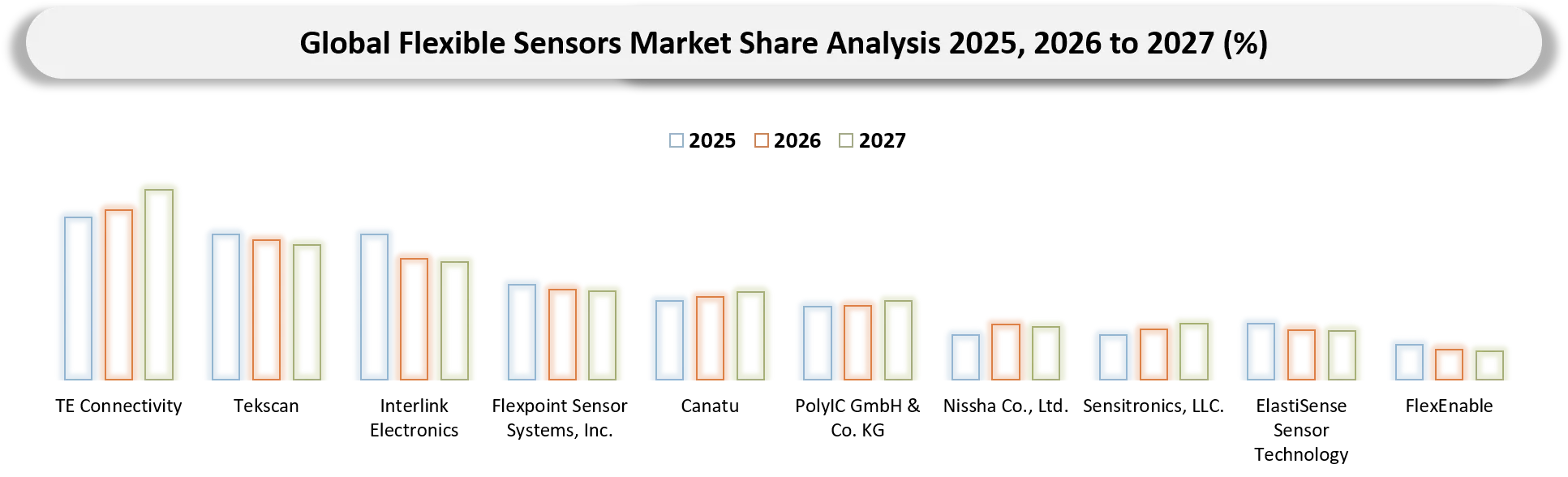
- Key players include TE Connectivity, Tekscan, Interlink Electronics, Flexpoint Sensor Systems, Inc., Canatu, PolyIC GmbH & Co. KG, Nissha Co., Ltd., Sensitronics, LLC., ElastiSense Sensor Technology, FlexEnable.
Key Developments
- February 2025: Tekscan, a U.S.-based tactile sensing manufacturer, entered a strategic partnership with FLEXOO to expand printed sensor capabilities and combine Tekscan's sensing technologies with FLEXOO's printed-electronics manufacturing expertise. The collaboration targets applications across energy, automotive, and electronics.
- March 2025: Forciot, a Finland-based stretchable electronics and sensor technology company, added Chimet S.p.A. as a new investor and announced a development collaboration focused on advanced sensor and heater inks. The companies are developing materials for Forciot's flexible sensor and heater solutions used in automotive steering wheels and seating.
- April 2025: Tekscan unveiled a real-time temperature mapping system for industrial applications, expanding its thin and flexible sensing portfolio beyond pressure and force measurement. The company described the system as a new temperature-mapping solution for industrial applications.
- October 2025: Uneo announced its planned acquisition of Tekscan, a U.S.-based manufacturer of applied surface sensing technologies. The transaction was positioned to combine Uneo's printed flexible sensor capabilities with Tekscan's pressure and force sensing technologies and expand manufacturing across multiple continents.
- November 2025: Uneo completed its acquisition of Tekscan, creating a broader portfolio covering printed flexible sensors, pressure sensing, force sensing, tactile sensing, and related applications across medical, industrial, robotics, consumer electronics, and smart manufacturing.
- September 2025: WACKER Chemie AG announced the start of serial production of NEXIPAL® Sense flexible sensor laminates, using a fully automated roll-to-roll manufacturing process. The stretchable silicone-based laminates are designed for pressure and movement sensing in medical technology, robotics, automotive, and sports applications.
- February 2026: The Tekscan Group was formally established following Uneo's acquisition of Tekscan, combining Tekscan's pressure and force-mapping expertise with Uneo's printed flexible sensor and high-volume cleanroom manufacturing capabilities. The group stated that the structure is intended to help OEMs move from prototyping to production and expand global manufacturing capacity.
- June 2026: Tekscan introduced the ErGO-Scan Pressure Mapping System for clinical seating assessments, representing a new application of its pressure-mapping and flexible sensing technology in clinical assessment
Key Procurement Priorities and Buyer Evaluation Criteria
- Buyers evaluate sensing accuracy, sensitivity, response time, detection range, resolution, repeatability, and signal stability across different operating conditions.
- Procurement decisions consider bending radius, stretchability, conformability, durability under repeated deformation, and retention of sensing performance after mechanical stress.
- Buyers assess substrate compatibility, conductive materials, encapsulation, thickness, weight, biocompatibility, and resistance to moisture, temperature, chemicals, and abrasion.
- Sensor dimensions, electrical interfaces, operating voltage, signal-conditioning requirements, communication interfaces, and compatibility with existing electronic systems influence supplier selection.
- Buyers prioritize operational lifetime, fatigue resistance, calibration stability, environmental durability, quality consistency, and availability of technical support.
- For high-volume applications, buyers evaluate manufacturing capacity, printing compatibility, customization capabilities, yield, production consistency, and ability to maintain specifications at scale.
- Unit price, customization costs, minimum order quantities, lead times, tooling requirements, and long-term supply commitments influence procurement decisions.
Why Choose DataM?
- Technological Innovations: Explores developments in flexible, stretchable, printed, piezoresistive, capacitive, piezoelectric, optical, and multifunctional sensing technologies, including electronic skin, smart textiles, and conformable sensing platforms.
- Product Performance & Market Positioning: Evaluates flexible sensor solutions based on sensitivity, accuracy, response time, flexibility, stretchability, durability, integration capability, form factor, and application suitability, highlighting differentiation among leading manufacturers.
- Real-World Evidence: Tracks commercial deployment of flexible sensors across wearable healthcare devices, patient monitoring systems, consumer electronics, automotive interfaces, robotics, industrial automation, smart textiles, and human-machine interfaces.
- Market Updates & Industry Changes: Monitors sensor launches, printed-electronics developments, manufacturing expansions, technology partnerships, commercialization activities, and investments shaping flexible sensor adoption across healthcare, electronics, automotive, robotics, and industrial applications.
- Competitive Strategies: Analyzes how manufacturers strengthen their positions through proprietary sensing technologies, material innovation, product customization, strategic partnerships, application-specific development, manufacturing scale-up, and expansion into emerging applications.
- Pricing & Market Access: Examines pricing differences according to sensor type, sensing technology, materials, dimensions, customization, production volume, performance specifications, and application requirements, alongside purchasing through OEMs, electronics manufacturers, medical-device companies, and system integrators.
- Market Entry & Expansion: Identifies opportunities associated with wearable healthcare, electronic skin, smart textiles, robotics, automotive interiors, industrial monitoring, and flexible consumer electronics while assessing technology partnerships, localization, manufacturing capabilities, and application-specific product development.
Target Audience 2026
- Flexible Sensor Manufacturers
- Printed Electronics Manufacturers
- Sensor Technology Companies
- Healthcare and Medical Device Manufacturers
- Consumer Electronics Manufacturers
- Automotive OEMs and Tier Suppliers
- Robotics and Industrial Automation Companies



























































