


Robotic Sensors Market Overview
The Robotic Sensors market is expected to witness strong growth driven by the expansion of industrial robots, collaborative robots, autonomous mobile robots, humanoids, warehouse robots and AI-enabled service robots. The DataM Report identifies the market as a high growth segment and covers pressure sensors, force and torque sensors, proximity sensors, position sensors, velocity sensors, safety sensors, vision sensors and collision detection sensors across robot types and end-user industries.
Buyer interest is increasingly tied to actionable outcomes rather than component availability alone. Procurement teams want sensors that improve uptime, reduce programming time, enable safer human-robot collaboration, support predictive maintenance and create better dexterity for picking, assembly, inspection and mobile navigation. The market is moving from single-function sensing toward multimodal sensor stacks combining 3D vision, force feedback, proximity sensing, joint encoders, tactile skins and edge AI.
Backend industry signals support this shift. The World Robotics 2025 statistics reported 542,000 industrial robots installed in factories and an operational stock of 4.664 million industrial robots worldwide. Asia accounted for 74% of new deployments, while China installed 295,000 industrial robots and exceeded 2 million operational robots. These robot installations directly increase the attach rate for vision systems, force sensors, proximity systems, safety sensors and position feedback modules.
Service and medical robotics also create allied demand. The World Robotics 2025 service robotics data reported close to 20 million consumer service robots sold, more than 25,000 professional cleaning robots sold and around 16,700 medical robots sold, with medical robot sales rising 91%. These categories require sensor packages for navigation, obstacle detection, contact safety, localization, object recognition and human interaction. As robots move from cages into dynamic environments, sensor intensity per robot is increasing.
Robotic Sensors Market Key Takeaways
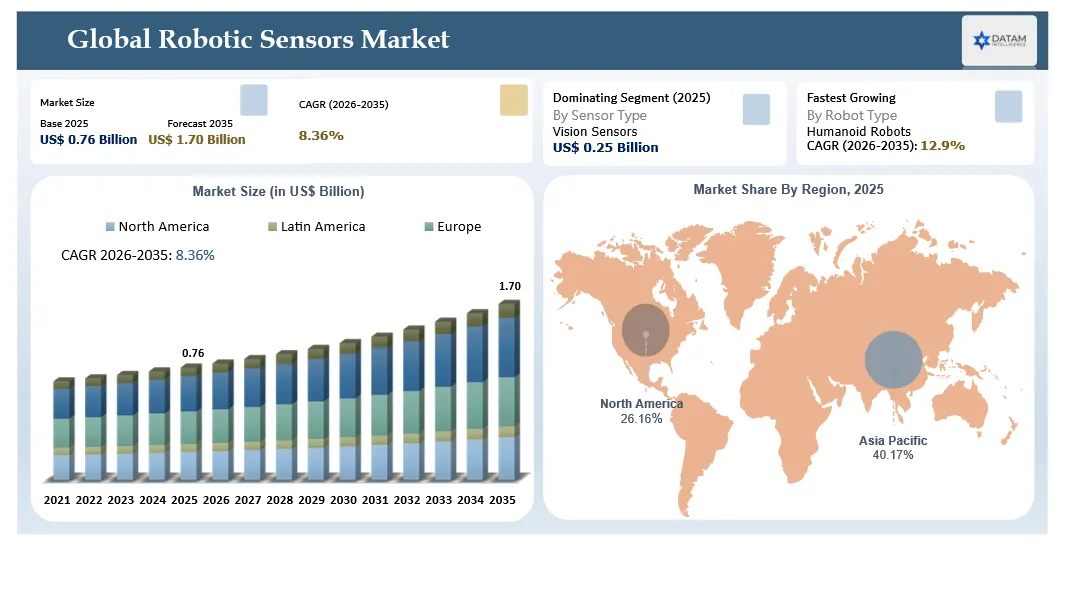
- Overall market size is estimated at US$ 0.76 billion in 2025 and US$ 0.83 billion in 2026, reaching US$ 1.24 billion by 2031 and an indicative US$ 1.70 billion by 2035 under the same CAGR extension.
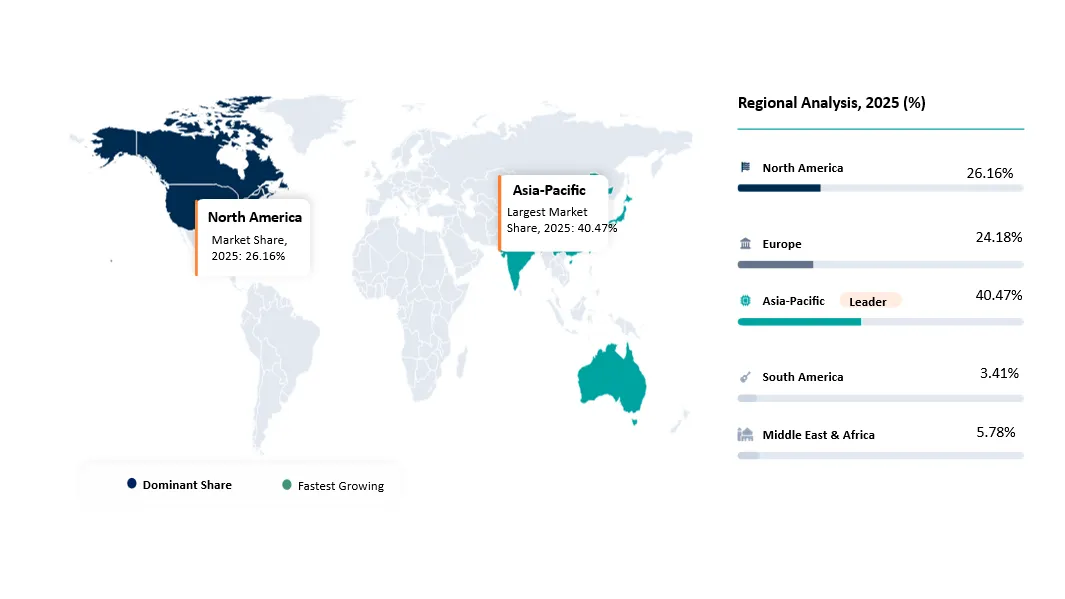
- The DataM Report identifies North America as the largest regional market, supported by advanced automation adoption, strong sensor suppliers, system integrators and high use of industrial and warehouse robotics.
- Asia-Pacific is the fastest-growing region in the DataM Report, supported by China, Japan, South Korea and India. IFR reported that Asia accounted for 74% of new industrial robot deployments in the latest World Robotics 2025 release.
- Vision sensors are the largest segment because 2D and 3D vision, depth cameras and AI vision are central to navigation, bin picking, inspection, object recognition and human-robot interaction.
- Force, torque and tactile sensors are the fastest growing segment because humanoids, collaborative robots and dexterous end-effectors need real-time contact feedback for safe and adaptive manipulation.
- Industrial platforms remain the largest robot type, while humanoid and autonomous mobile robots are high growth categories because their sensor stack is richer and more perception-intensive than traditional fixed robots.
- Automotive and EV production is the strongest industrial demand base, but logistics, healthcare, electronics and food packaging are increasing adoption as robots move into more variable task environments.
- The strongest buyer intent is around reducing downtime, improving quality control, lowering integration risk, meeting safety compliance and enabling robots to work in less structured real-world conditions.
Robotic Sensors Market Report Scope
| Metric | Details |
| 2025 Estimated Market Size | US$ 0.76 Billion |
| 2026 Estimated Market Size | US$ 0.83 Billion |
| 2031 Projected Market Size | US$ 1.24 Billion |
| 2035 Indicative Market Size | US$ 1.70 Billion, based on 8.36% CAGR extension |
| CAGR | 8.36% during 2026-2031, extended for long-range scenario modeling |
| Largest Market | North America in the DataM Report public preview. Asia-Pacific is the largest in some current third-party 2026 benchmark estimates due to robotics installation concentration. |
| Fastest Growing Region | Asia-Pacific in the DataM Report public preview. Middle East shows high growth in some recent third-party benchmarks because of new automation investments. |
| Largest Segment | Vision Sensors, supported by 3D vision, AI-native depth cameras and machine vision in AMRs, cobots and inspection robots. |
| Fastest Growing Segment | Force, torque and tactile sensors, supported by humanoid robots, collaborative robots and dexterous manipulation. |
| Report Insights Covered | Competitive landscape analysis, company benchmarking, market size, share, growth, demand, recent developments, product launches, investment activity and buyer decision criteria. |
Robotic Sensors Industry Trends and Strategic Insights
- Robot OEMs are increasing sensor attach rates as robots move from repeatable motion to adaptive perception, safety-rated collaboration and AI-enabled manipulation.
- Vision sensor demand is expanding from machine guarding and barcode reading into 3D bin picking, depth perception, defect inspection, warehouse navigation and physical AI perception.
- Force and torque sensors are becoming central to battery assembly, electronics assembly, surface finishing, screwdriving, welding, therapy robots and dexterous humanoid hands.
- Tactile sensing is moving from research into commercialization as humanoids, industrial grippers and warehouse robots require better handling of fragile, deformable or irregular objects.
- Sensor suppliers are bundling hardware with edge analytics, calibration tools, safety certification support and robot controller integration to reduce customer engineering effort.
- Procurement teams are demanding second-source availability, rugged packaging, cybersecurity, long lifecycle support and compatibility with leading robot ecosystems.
Why does this report matter in 2026?
In 2026, robotic sensors are becoming one of the most strategic component categories in automation because the next wave of robotics depends on perception rather than motion alone. Industrial robots already rely on encoders, force sensing, machine vision and safety systems, but new growth is coming from robots that must perceive objects, humans, surfaces, pressure, slips, collisions and spatial constraints in real time. This changes buyer requirements from basic component sourcing to full sensor stack strategy.
The report delivers actionable intelligence on market size, fast growing sensor types, robot platform demand, regional adoption, buyer pain points, product launches and investment opportunities. It helps sensor suppliers identify where to compete, robot OEMs benchmark technology roadmaps, manufacturers evaluate automation readiness and investors understand which sensor categories will benefit from physical AI, humanoid robots, AMRs, EV factories and smart manufacturing.
Robotic Sensors Market White Space & Investment Opportunities
- Tactile sensor skins and robotic fingertips for humanoid hands, adaptive grippers, warehouse picking robots and delicate handling applications.
- Low-cost six-axis force and torque sensors for collaborative robots, humanoid joints and end-effectors where cost has historically limited deployment.
- AI-native depth cameras and 3D vision modules optimized for navigation, object manipulation, inspection and human-robot interaction.
- Safety-rated proximity sensing for cobots and mobile manipulation in factories, hospitals, warehouses and public environments.
- Sensor fusion software that integrates vision, force, torque, tactile, inertial and proximity data into actionable robot perception.
- Localized sensor manufacturing and second-source MEMS supply to reduce procurement risk for robot OEMs and automation integrators.
Robotic Sensors Future Market Transformation
The robotic sensors market is expected to transform from a hardware-led component market into an integrated perception ecosystem. Robots will increasingly use synchronized sensor stacks that combine machine vision, force feedback, proximity detection, tactile sensing, inertial measurement and controller-level analytics. The value will shift from sensor output alone to the ability to translate data into safe motion, adaptive manipulation and predictive maintenance.
During the forecast period, sensor suppliers will rely more heavily on embedded intelligence, calibration software, diagnostic analytics, digital twins, pre-trained AI models and standard robot interfaces. As physical AI matures, the sensor becomes a data gateway for robot learning and real-time decision making. Suppliers that provide validated integration with FANUC, ABB, Universal Robots, Kawasaki, KUKA, Yaskawa, Omron, Staubli and mobile robot platforms will gain stronger buyer preference.
Robotic Sensors Market Buyer Decision-Making Criteria
Buyers evaluate robotic sensors based on accuracy, repeatability, latency, durability, IP rating, temperature tolerance, signal stability, calibration requirements, controller compatibility and ease of integration. For industrial buyers, the sensor must reduce cycle time, improve quality, avoid downtime and meet safety requirements. For humanoid and service robot developers, sensor density, weight, power consumption and real-time data usability are critical. For warehouse and logistics operators, vision and proximity sensors must operate reliably under changing light, packaging variation and traffic congestion.
Long-term decisions increasingly depend on total cost of integration rather than unit price. Sensors with strong documentation, SDKs, ROS support, robot controller compatibility, reference applications and local engineering support can command premium pricing. Buyers also want suppliers that can support lifecycle availability because robotic systems may remain in production for years.
Robotic Sensors Market Economic & Investment Analysis
Robotic sensors are attractive from an investment perspective because they participate in multiple growth curves at once: industrial automation, warehouse automation, humanoid robotics, medical robotics, semiconductor manufacturing, EV production and physical AI. IFR data shows more than 500,000 industrial robot installations for four consecutive years and 4.664 million operational industrial robots worldwide. Every incremental robot requires a sensor stack, while new robot types typically require more sensors per unit than legacy robots.
Investment is moving toward tactile sensing, AI-native vision, force torque systems, capacitive proximity sensing and sensor fusion platforms. RealSense securing US$ 50 million in Series A funding after spinning out from Intel and XELA Robotics introducing tactile sensor upgrades in 2026 are examples of the market shifting toward perception modules that enable robots to operate in less predictable environments.
Robotic Sensors Investment Trends in the Market
- Increasing funding for AI-native vision platforms that combine depth sensing, edge AI and software-defined perception for robotics.
- Growth in tactile and force feedback startups targeting humanoid robots, robotic hands, grippers and physical AI data acquisition.
- Strategic partnerships between robotics OEMs and sensor providers to improve safe proximity sensing and human-robot interaction.
- Investment in sensor fusion and edge processing to reduce latency and move perception closer to the robot controller.
- Rising demand for low-cost MEMS force, torque and inertial sensors to support volume robotics, drones and service robots.
- Increasing procurement focus on secure, localized and second-source sensor supply due to semiconductor supply chain risk.
Strategic Indicators for Robotic Sensors Market
High Automation Impact
The robotic sensors market has high exposure to factory automation because sensors are needed for robot localization, end-effector control, quality inspection and safety. With 542,000 industrial robot installations reported in World Robotics 2025 statistics and more than 4.6 million industrial robots in operation, sensor demand is structurally tied to the installed base as well as new robot sales. Replacement, upgrade and retrofit cycles create recurring demand.
High Investment Activity
Investment is increasing in perception technologies that allow robots to handle more variable work. AI-native depth cameras, tactile skins, six-axis force sensors, capacitive safety sensing and edge AI modules are attracting attention because they unlock broader applications beyond fixed repetitive tasks. Automate 2026 highlighted physical AI, sensors and adaptive automation as central themes, with more than 50,000 attendees and over 1,000 exhibitors expected.
Supply Chain Disruption
The market is exposed to MEMS, CMOS image sensor, PCB, embedded processor and precision electronics supply risk. Robot OEMs and tier suppliers are asking for second-source agreements, long-term availability, traceable component sourcing and local support. Sensors used in safety-rated robots also face longer qualification cycles, making supplier continuity critical.
Pricing Volatility
Pricing differs sharply by sensor type. Basic proximity and position sensors are cost competitive, while six-axis force torque sensors, 3D depth cameras, safety-rated scanners and tactile sensor arrays command premium pricing due to calibration, accuracy, firmware and integration support. Buyers increasingly compare total integration cost, not just component price.
Procurement Pressure
Automation buyers are under pressure to justify ROI through reduced downtime, less scrap, higher throughput and improved worker safety. This pressure increases demand for sensors with proven application data, easy robot controller integration and reliable documentation. Suppliers that provide reference designs and application engineering can shorten procurement cycles.
New Technology Adoption
Robotics is adopting AI-enabled perception, tactile sensing, 3D vision, sensor fusion and embedded analytics. XELA Robotics and PaXini demonstrate the move toward tactile intelligence, while RealSense’s 2026 D585 Pro launch shows depth cameras moving toward AI-native edge sensing. These technologies raise the performance ceiling for robots in manufacturing, logistics and service environments.
Regional Expansion Opportunity
Asia-Pacific has the strongest robot deployment base, while North America leads the DataM Report public preview for the robotic sensors market. Europe remains important for high-quality industrial automation and safety compliance. Middle East demand is growing as logistics, smart manufacturing and industrial diversification programs adopt automation.
Government Policy Support
Manufacturing reshoring, EV production incentives, smart factory programs, semiconductor investment and industrial modernization policies indirectly support robotic sensor demand. Policies that encourage advanced manufacturing raise adoption of robots, machine vision, inspection systems and safety-rated automation.
Pricing Intelligence
Premium pricing is available where sensors directly improve production quality, safety certification or robot dexterity. Vision sensors and force torque systems often support higher margins when sold with software, calibration tools, field support and application packages. Commodity pressure is strongest in basic proximity, pressure and position sensing.
AI Impact Analysis
AI improves robotic sensors by enabling local interpretation of images, depth maps, tactile signals, vibration patterns and force feedback. Edge AI reduces latency and helps robots detect objects, avoid collisions, monitor grasp stability and adjust motion dynamically. The strongest commercial impact is expected in AMRs, humanoids, bin picking, quality inspection and collaborative workcells.
Disruption Analysis
The market is being disrupted by physical AI and humanoid robotics. Traditional robots relied on deterministic paths and limited sensing, while new robots require perception-rich stacks to operate in changing environments. This creates opportunities for new suppliers that offer tactile sensing, sensor fusion and AI-native perception, even against established sensor incumbents.
Robotic Sensors Market Dynamics
Driver Impact Analysis
| Driver | Market Growth Impact (%) | Demand Concentration | Impacted Use Case | Strategic Impact |
Industrial robot installations and operational stock expansion | 25% | Asia-Pacific, North America | Vision, position and safety sensing | Expands sensor attach rates across new robots and installed base upgrades. |
Growth of AI, physical AI and adaptive automation | 22% | Global | 3D vision, tactile and sensor fusion | Raises demand for sensors that feed real-time perception and decision-making. |
Warehouse automation and AMR adoption | 18% | North America, Europe, Asia-Pacific | Navigation and obstacle sensing | Increases demand for depth cameras, LiDAR, proximity and IMU systems. |
Collaborative robots and human-robot safety | 15% | Europe, North America, Japan | Force, torque and proximity sensing | Drives adoption of safety-rated sensing and contact feedback. |
Driver: Rising Industrial Robot Installations and Factory Automation Demand
Industrial robot installations are a primary growth driver because each robot depends on sensors for motion feedback, safety, end-effector control and quality monitoring. IFR reported 542,000 industrial robots installed in factories and 4.664 million industrial robots in operational use in its World Robotics 2025 statistics. As factories automate welding, assembly, material handling, packaging, inspection and EV battery production, the required sensor stack expands from basic position feedback to machine vision, force torque, proximity, vibration and safety sensors. This creates an actionable opportunity for suppliers that can bundle sensors with application-specific integration support.
Restraint Impact Analysis
| Restraint | Drag on Market Growth (%) | Primary Impact Area | Impacted Use Case | Strategic Impact |
High sensor and integration cost | 19% | Robot BOM and project ROI | Cobots, humanoids, AMRs | Delays adoption where automation payback is uncertain or engineering cost is high. |
Calibration and accuracy drift | 16% | Quality and uptime | Force, torque and tactile sensing | Increases maintenance burden and weakens trust in automated decisions. |
Safety certification complexity | 13% | Compliance and deployment | Human-robot collaboration | Extends validation timelines for sensors used near humans. |
Semiconductor and component supply risk | 11% | Procurement and lifecycle support | Vision, MEMS and edge AI sensors | Pushes buyers toward suppliers with second-source and long-term availability. |
Restraint: Sensor Cost, Calibration Complexity and Integration Barriers
High performance robotic sensors can raise robot bill of materials and integration cost. Force torque sensors need calibration and mechanical protection, vision sensors require lighting, calibration and software tuning, while tactile systems need custom integration into hands or grippers. For buyers, the challenge is not only the sensor price but also engineering time, commissioning risk and production validation. Small and mid-sized manufacturers may delay deployment when payback is unclear. Suppliers that provide ready-to-use kits, reference applications, calibration software and robot controller compatibility can reduce adoption friction.
Robotic Sensors Market Segment Analysis
The global Robotic Sensors market is segmented based on sensor type, robot type, industry, sensing technology and region. Each segmentation reflects a different buyer decision pathway. Sensor type identifies product demand, robot type identifies platform-specific attach rates, industry identifies procurement budgets and sensing technology identifies innovation direction.
By Sensor Type: Vision Sensors Will Lead Value Creation
Vision sensors hold the strongest value creation role because robots increasingly need to perceive objects, spaces and workers rather than simply repeat programmed movements. 2D cameras, 3D depth cameras, stereo vision, structured light, time-of-flight and AI-native vision modules are used in bin picking, inspection, navigation, palletizing, depalletizing, weld inspection and human-robot interaction. RealSense’s 2026 D585 Pro launch, with AI-native depth sensing and Perception Studio software, illustrates how vision sensors are evolving into software-defined perception platforms. Buyer intent in this segment centers on faster integration, better depth quality, lower latency and fewer failed picks or inspection escapes.
By Robot Type: Industrial Robots Remain the Largest Installed Base
Industrial robots remain the largest demand base for sensors because they account for the highest installed robot stock in factories. IFR reported 4.664 million industrial robots in operational use worldwide in the World Robotics 2025 release. These robots require encoders, position sensors, force feedback, vision systems and safety sensors across welding, painting, assembly, machine tending, battery manufacturing and electronics production. The buyer need is no longer only precision motion. Manufacturers want robots that can detect process deviations, adapt to part variation and reduce downtime. This creates opportunities for retrofit sensors and digital monitoring tools.
By Industry: Automotive and EV Manufacturing Remain the Core Procurement Base
Automotive and EV manufacturing remain core demand drivers because these plants use high volumes of robots in welding, painting, battery assembly, inspection, sealing, material handling and final assembly. The transition to EV platforms increases demand for precision force sensing in battery cell and module assembly, vision inspection for welds and coatings and safety sensing in flexible automation cells. IFR reported India’s industrial robot installations reached a record 9,100 units, with automotive holding a 45% share of installations, indicating the continued role of automotive automation in emerging markets. Buyers in this vertical prioritize uptime, traceability, quality control and compatibility with existing robot controllers.
By Sensing Technology: Optical and AI-Enabled Sensing Are Becoming the Fastest Decision Layer
Optical sensing is expanding because machine vision has become the practical interface between AI and physical automation. Depth cameras, stereo vision, 3D scanners and AI vision software help robots understand object position, orientation, surfaces and workspace safety. The value is highest when vision reduces fixturing, allows mixed SKU handling or enables automated quality inspection. The market is moving from standalone cameras toward AI-enabled sensing stacks with edge processing, SDKs and perceptionsoftware. Buyers are increasingly evaluating whether a sensor can reduce programming complexity and support changing product mixes rather than only checking resolution and frame rate.
By Application Scenario: Human-Robot Collaboration Drives Safety and Proximity Sensing
Human-robot collaboration is a high-intent application scenario because manufacturers want automation that can work safely near people without large cages or rigid layouts. This drives demand for force torque sensors, capacitive proximity systems, safety scanners, collision detection and tactile surfaces. ABB Robotics’ 2026 Automate demo with Aura Sensae proximity-sensing technology shows how proximity perception is moving into collaborative automation. Buyers in this area focus on worker safety, cycle time, regulatory compliance and the ability to dynamically respond to human presence.
By Technology Maturity: Tactile Sensing Is Moving from Research to Commercial Adoption
Tactile sensing is one of the most important emerging segments because robots need touch to handle fragile, irregular or deformable objects. XELA Robotics’ 2026 uSkin demonstrations and PaXini’s 2026 tactile infrastructure show how robotic touch is moving into commercial hands, grippers and embodied AI systems. PaXini showcased multidimensional tactile products including 12 models and a dexterous hand with 1,140 tactile processing units. Buyer interest is strongest among humanoid developers, warehouse automation firms, food handling robotics, medical robotics and electronics assembly users that need reliable grasp control.
By Procurement Model: Integrated Sensor Kits Are Reducing Adoption Barriers
Integrated sensor kits are gaining demand because buyers want faster commissioning and lower engineering effort. Robot OEMs and integrators prefer sensors that include mounts, cables, drivers, SDKs, calibration tools and verified compatibility with robot brands. XELA’s integrations for robot hands and grippers from several companies show how sensor suppliers are shifting toward platform compatibility. This segment is commercially attractive because it increases supplier stickiness and reduces price competition. The strongest opportunity is in packaged solutions for bin picking, force-controlled assembly, safe cobot deployment and AMR navigation.
By Installed Base OpportunityRetrofit and Upgrade Demand Creates Recurring Revenue
Retrofit demand is important because millions of existing industrial robots can be upgraded with vision, force sensing, safety systems and predictive monitoring without replacing the robot arm. Older robots often operate in fixed cells with limited perception, but manufacturers increasingly need flexibility for smaller batch sizes and changing products. Retrofitting sensors can improve quality inspection, process monitoring and safety. The opportunity is strongest in automotive, electronics, metalworking, packaging and logistics facilities with high robot utilization. Suppliers that provide easy integration and field service can capture recurring revenue from installed base modernization.
By Safety Criticality: Safety-Rated Sensors Command Premium Value
Safety-rated robotic sensors are commercially important because robots operating near humans require validated detection, fail-safe behavior and compliance support. Proximity sensors, safety scanners, collision sensors and force monitoring help reduce incident risk. Safety-rated components often command higher margins because they require certification, redundancy and documentation. Buyers are willing to pay more where safety certification reduces deployment risk and insurance concerns. The market will favor suppliers that combine hardware reliability with application guidance for ISO and regional safety requirements.
By Edge Intelligence: Edge AI Sensors Shift Value from Hardware to Data
Edge AI sensors are changing the value proposition because perception decisions can be made closer to the robot. Depth cameras with onboard AI, smart tactile modules, vibration analytics and condition monitoring sensors reduce latency and bandwidth requirements. They also help robots respond to object variation, workspace changes and predictive maintenance indicators. RealSense’s 2026 AI-native depth camera positioning reflects this shift. Buyers want actionable perception outputs rather than raw sensor streams, which creates premium opportunities for sensor suppliers that embed analytics and software updates.
By Integration Channel: System Integrators Shape Final Sensor Selection
System integrators are critical because many end users rely on integrators to select sensor packages, design end-effectors, validate safety and commission robot cells. A sensor may have strong technical specifications but fail commercially if it is difficult for integrators to deploy. Suppliers therefore need training, application demos, integration kits and strong technical support. Integrator influence is highest in mid-market manufacturing, packaging, warehousing and food processing. Sensor companies that build trusted integrator channels can increase adoption faster than those selling components directly without application support.
By White Space Opportunity: Dexterous Manipulation Is the Highest-Value White Space
Dexterous manipulation is the highest-value white space because robots still struggle with irregular, soft, transparent, reflective or fragile objects. This creates demand for sensor fusion across tactile, force, vision and proximity data. Warehouse picking, food handling, laboratory automation, electronics assembly and humanoid service tasks all need better dexterity. The market opportunity is not limited to one sensor type. It requires full perception stacks, contact intelligence, slip detection, material recognition and real-time control. Suppliers that solve manipulation reliability can unlock new automation budgets across industries where robots have historically underperformed.
Robotic Sensors Market Geographical Penetration
North America Robotic Sensors Market Landscape
North America leads the DataM Report public preview for robotic sensors and remains a high-value market because of strong manufacturing automation, warehouse automation, medical robotics, defense robotics and sensor supplier presence. The United States accounted for 68% of robot installations in the Americas in the latest IFR World Robotics 2025 release, with 34,200 industrial robots installed. The region also benefits from companies developing AI-native perception and robotics components, including RealSense, Honeywell, TE Connectivity, ATI Industrial Automation and emerging tactile sensing firms. Buyer intent is focused on labor substitution, reshoring, warehouse throughput, safety compliance and faster payback from robotic workcells.
Europe Robotic Sensors Market Outlook
Europe is a critical market for robotic sensors because it combines strong industrial robotics know-how, strict machine safety requirements and high-value manufacturing. IFR reported 85,000 industrial robot installations in Europe in the latest World Robotics 2025 release, with the European Union accounting for 67,800 units. Germany remains the largest European robotics market with 26,982 installations and a 32% share of the annual European total. Sensor demand in Europe is strongly linked to automotive, machine tools, electronics, packaging, healthcare and collaborative automation. Buyers prioritize safety certification, precision, durability and energy-efficient automation.
Asia-Pacific Robotic Sensors Market Trends
Asia-Pacific is the fastest growing region in the DataM Report and is the strongest region for robot installation concentration. IFR reported that Asia accounted for 74% of new industrial robot deployments in its World Robotics 2025 release. China installed 295,000 industrial robots and its operational stock exceeded 2 million units. Japan installed 44,500 units, South Korea installed 30,600 units and India reached a record 9,100 units. This creates large sensor demand across vision, position, force torque, proximity and safety categories. China and Japan also host major robotic OEMs and component suppliers, increasing regional integration depth.
South America Robotic Sensors Market Trends
South America is a developing robotic sensors market where demand is concentrated in automotive, food and beverage, mining, packaging and agricultural processing. Brazil is the primary market because of its manufacturing base and automotive supply chain, while Argentina offers selective demand in food processing, packaging and industrial automation. Buyer intent is generally ROI-driven, with strong focus on reducing labor dependency, improving quality and extending equipment life. Sensor demand tends to start with vision inspection, proximity sensing, safety and basic position feedback before expanding into higher-end force and torque systems.
Middle East and Africa Robotic Sensors Market Outlook
Middle East and Africa is an emerging opportunity for robotic sensors, driven by industrial diversification, logistics automation, oil and gas automation, smart city projects, warehouse robotics and security robotics. The UAE and Saudi Arabia are early adopters of automation within logistics, airports, industrial zones and service robotics. South Africa has demand in mining, automotive and manufacturing automation. The region has fewer installed industrial robots than Asia or Europe, but new automation projects can adopt modern sensor-rich platforms from the start. Buyer intent is focused on operational reliability, labor efficiency, safety and modernization of strategic industries.
China Robotic Sensors Market Trends
China is the single most important country-level demand signal for robotic sensors because it installed 295,000 industrial robots and exceeded 2 million operational robots in the latest IFR World Robotics 2025 release. Domestic robot manufacturers captured a rising share of China’s home market, creating opportunities for local sensor suppliers and integrated perception modules. Demand spans automotive, electronics, batteries, solar manufacturing, logistics and humanoid robotics. Buyers increasingly evaluate sensor performance, domestic supply security, cost and software integration. China’s humanoid and embodied AI ecosystem is also increasing demand for tactile, force torque and multimodal sensing.
U.S. Robotic Sensors Market Landscape
The U.S. is the largest market in the Americas, with 34,200 industrial robots installed according to the latest IFR World Robotics 2025 release. Demand is supported by warehouse automation, reshoring, EV and battery manufacturing, medical devices, defense robotics and AI-driven automation startups. U.S. buyers are especially focused on labor availability, production resilience and safety. RealSense’s 2025 spin-out with US$ 50 million Series A funding from Intel Capital and MediaTek Investment Fund demonstrates investor interest in depth sensing and AI-native perception for robotics. Sensor suppliers that can support integrators and OEMs with fast deployment have strong growth potential.
India Robotic Sensors Market Trends
India is a fast-growing robotics adoption market, with IFR reporting a record 9,100 industrial robot installations and automotive accounting for 45% of installations. India’s sensor demand is driven by automotive, EV components, electronics manufacturing, food processing, packaging and warehouse automation. Buyers are increasingly looking for cost-effective sensors that can withstand industrial conditions and integrate with imported robot platforms. Sensor suppliers can benefit from local application support, training and bundled solutions for mid-market manufacturers. India’s automation expansion creates strong opportunities for vision inspection, proximity sensing, force-controlled assembly and safety sensors.
Japan and South Korea Robotic Sensors Market Outlook
Japan and South Korea are advanced robotics markets with strong demand for high precision sensors. Japan installed 44,500 industrial robots and had 450,500 operational robots in the latest IFR data. South Korea installed 30,600 units and remains one of the largest robot markets by annual installations. Demand is linked to electronics, automotive, semiconductors, machine tools, healthcare and service robotics. Buyers prioritize accuracy, reliability, compact design and long lifecycle supply. Japan also has strong tactile sensing innovation through companies such as XELA Robotics, while South Korea supports demand through electronics and robotics manufacturing ecosystems.
Germany Robotic Sensors Market Outlook
Germany is Europe’s largest robotics market, with 26,982 robot installations reported in the latest IFR World Robotics 2025 release. Demand is anchored in automotive, machinery, electronics, logistics and precision manufacturing. German buyers typically require high reliability, detailed documentation, safety compliance and compatibility with established automation systems. Force torque sensors, machine vision, safety scanners, encoders and proximity systems are important categories. The market rewards suppliers that can support demanding applications such as battery cell assembly, PCB placement, force-controlled joining and flexible automation cells.
Robotic Sensors Market Competitive Landscape
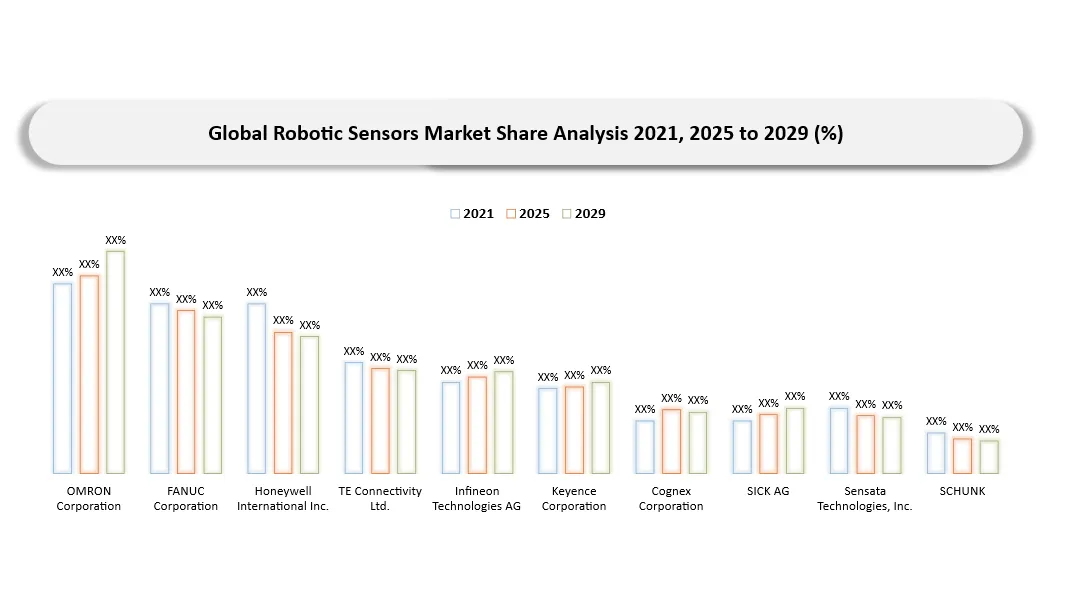
- Competition is shifting from single-sensor hardware toward integrated perception modules, edge AI, calibration software and robot-ready sensor kits.
- Established industrial sensor companies compete through reliability, catalog breadth, safety certification and global support, while startups compete through tactile sensing, AI-native vision and humanoid-ready sensing.
- Robot OEMs and integrators increasingly influence sensor selection because end users want validated application packages rather than component experimentation.
- Competition is intensifying in six-axis force torque sensors as cobots, humanoids and precision assembly applications require lower cost and higher availability.
- Vision sensor suppliers are differentiating through AI models, depth quality, close-range performance, SDK support and compatibility with warehouse and manufacturing use cases.
- Tactile sensor providers are entering a high-growth window as physical AI and humanoids require contact data for dexterity, grasp stability and safe manipulation.
Key Companies of Robotic Sensors Market
- OMRON Corporation
- FANUC Corporation
- Sensata Technologies, Inc.
- TE Connectivity Ltd.
- Tekscan, Inc.
- FUTEK Advanced Sensor Technology, Inc.
- Infineon Technologies AG
- Baumer Group
- Honeywell International Inc.
- ATI Industrial Automation
- Novanta Inc.
- Bota Systems AG
- RealSense
- XELA Robotics
- PaXini Tech
- SCHUNK
- SICK AG
- Keyence Corporation
- Cognex Corporation
- ifm electronic
Robotic Sensors Market Major Pain Points
- High cost of advanced force torque sensors, depth cameras and tactile sensor arrays for cost-sensitive robot platforms.
- Calibration drift, mounting variation and environmental noise can reduce measurement reliability in production conditions.
- Robot controller integration remains complex when sensors lack proven drivers, SDKs or reference applications.
- Safety-rated applications require longer validation cycles and stronger documentation than general automation sensors.
- Vision sensors can struggle with reflective, transparent, deformable or low-contrast objects without lighting and AI tuning.
- Tactile sensors are still emerging and must prove durability under repeated industrial contact, contamination and cleaning cycles.
- Supply chain risk around CMOS image sensors, MEMS components and embedded processors can affect robot OEM production planning.
- Buyers face difficulty comparing total cost of ownership because sensor price, integration effort and maintenance burden vary widely.
Robotic Sensors Market Recent Developments
- January, 2026: XELA Robotics demonstrated its uSkin 3D tactile sensor technology at CES 2026, with working integrations in robot hands and grippers for humanoid and industrial robots. The company also highlighted integrations for several robot hand and gripper platforms, supporting easier adoption by OEMs and automation users.
- January, 2026: PaXini unveiled its tactile infrastructure for embodied AI at CES 2026, including multidimensional tactile sensors, a commercial Hall-effect 6D force torque sensor and a dexterous hand with 1,140 tactile processing units. The launch signaled rising demand for full-body force perception and tactile data infrastructure in humanoid robots.
- April, 2026: SCHUNK’s FTS six-axis force torque sensor was awarded first place in the Robotics, Handling and Assembly Technology category at the INDUSTRIAL Production Products of the Year 2026 competition. The sensor measures forces and torques across six degrees of freedom and supports robot-assisted tasks including battery cell assembly, PCB placement and therapy robots.
- June, 2026: RealSense unveiled the D585 Pro and Perception Studio at Automate 2026. The AI-native depth camera combines depth sensing, edge AI acceleration and a software-defined platform, with reported improvements in depth quality and close-range performance for navigation, manipulation, inspection and human-robot interaction.
- June, 2026: XELA Robotics announced new uSkin tactile sensor capabilities for Automate 2026, including enhanced delicate grasping, high durability fingertip covers and automatic weight and hardness detection. The upgrades target humanoid robot hands, grippers and industrial manipulation tasks involving fragile or irregular objects.
- June, 2026: ABB Robotics showcased its PoWa cobot family and collaboration with Aura Sensae at Automate 2026, integrating intelligent capacitive sensing to improve human-robot interaction and dynamic response to human presence in collaborative applications.
Analyst View / Opinion on Robotic Sensors Market
- The robotic sensors market is moving from component-led procurement toward application-led perception systems that directly influence robot autonomy, quality, safety and ROI.
- Vision sensors will remain the largest commercial segment because 3D perception and AI vision are required for navigation, inspection and flexible handling.
- Force torque and tactile sensing will show the strongest strategic upside because humanoids, cobots and dexterous robots need real-time contact feedback to expand beyond repetitive tasks.
- Sensor suppliers that provide software, calibration, AI models and robot-ready integration kits will gain stronger pricing power than vendors selling hardware alone.
- Asia-Pacific robot deployment concentration will continue to drive volume demand, while North America and Europe will remain high-value markets for advanced automation, safety compliance and AI-enabled sensing.
- Long-term leadership will be shaped by sensor fusion, edge AI, safety certification, semiconductor supply resilience and partnerships with robot OEMs and system integrators.
Robotic Sensors Market Target Audience
| Industry | Who Should Buy This Report? | Reason to Buy This Report |
| Robotic Sensor Manufacturers | Product managers, strategy teams, sales leaders | To identify high-growth sensor types, customer applications, pricing trends and competitive positioning. |
| Robot OEMs | Engineering leaders, platform managers, product planners | To benchmark sensor stack requirements across industrial robots, cobots, AMRs and humanoids. |
| System Integrators | Automation engineers, application teams, business development teams | To understand buyer needs, integration pain points and sensor categories with strong deployment potential. |
| Automotive and EV Manufacturers | Manufacturing leaders, quality managers, procurement teams | To evaluate sensor technologies that improve assembly accuracy, safety and production uptime. |
| Logistics and Warehousing | Operations heads, automation managers, fulfillment leaders | To assess vision, proximity, navigation and tactile sensing for AMRs and robotic picking. |
| Healthcare and Medical Robotics | R&D teams, medical device developers, surgical robot companies | To evaluate force feedback, haptics, safety and precision sensing opportunities. |
| Semiconductor and Electronics Manufacturing | Process engineers, automation teams, quality teams | To identify sensors for precise placement, inspection, handling and contamination-sensitive automation. |
| Investors and Consulting Firms | Private equity, venture capital, strategy consultants | To identify high-growth segments, white space opportunities and acquisition targets in sensor-enabled robotics. |
Why Choose DATAM?
- Data-Driven Insights: Detailed analyses with granular insights such as pricing, segment opportunity, regional penetration, buyer criteria and value chain evaluation, enriched by industry interviews and secondary validation.
- Post-Purchase Support and Expert Analyst Consultations: Direct access to expert analysts for tailored advice and strategic guidance specific to your sensor, robot platform, region or end-user focus.
- White Papers and Case Studies: Quarterly studies related to purchased titles, tailored to refine product strategy, sales targeting and market entry planning.
- Annual Updates on Purchased Reports: Existing customers can receive annual updates to stay aligned with market developments, product launches, technology shifts and competitive changes.
- Specialized Focus on Emerging Markets: DataM differentiates itself by delivering in-depth insights for emerging and high-growth regional markets rather than generic geographic overviews.
- Value of DataM Reports: Our reports offer specialized insights tailored to the latest trends and specific business inquiries, giving clients the precise information needed to make informed decisions.
What DATAM Uniquely Provides
- Detailed 10-year market predictions by sensor type, robot type, industry, sensing technology and region, underpinned by strong market sizing and forecasting techniques.
- Thorough competitive analysis across robotic sensor suppliers, robot OEMs, AI vision companies, tactile sensing startups and industrial automation providers.
- Comprehensive evaluation of technology trends covering force torque sensors, tactile sensing, 3D vision, proximity sensing, position feedback, sensor fusion and edge AI.
- Strategic market insights through AI impact evaluation, disruption assessment, BCG Matrix analysis, pricing intelligence, trade flow evaluation and investment trend analysis.
- Tangible white-space and investment opportunity analysis identifying high-growth applications, unmet sensor needs, regional expansion opportunities and buyer decision criteria.
- Country-level recommendations that help sensor suppliers, robot OEMs, integrators, investors and automation buyers make informed strategic decisions.




























































