


The probiotics supplements industry is moving far beyond basic digestive health capsules. In 2026, the market is being reshaped by science-backed strains, personalized nutrition, women’s health formulations, shelf-stable technologies, advanced packaging, stricter regulations and stronger investment in microbiome research. What was once a niche gut health category has now become a mainstream wellness, preventive health, and functional nutrition opportunity.
At the center of this shift is a more informed consumer. People are no longer buying probiotic supplements only because the label says “good bacteria.” They want to know which strain is used, what clinical evidence supports it, whether the product survives storage, how it supports immunity or digestion, and whether the brand is transparent about CFU count, formulation, and testing. This is pushing probiotic supplement companies, manufacturers, ingredient suppliers, and private label brands to compete on quality, science, and trust rather than simple marketing claims.
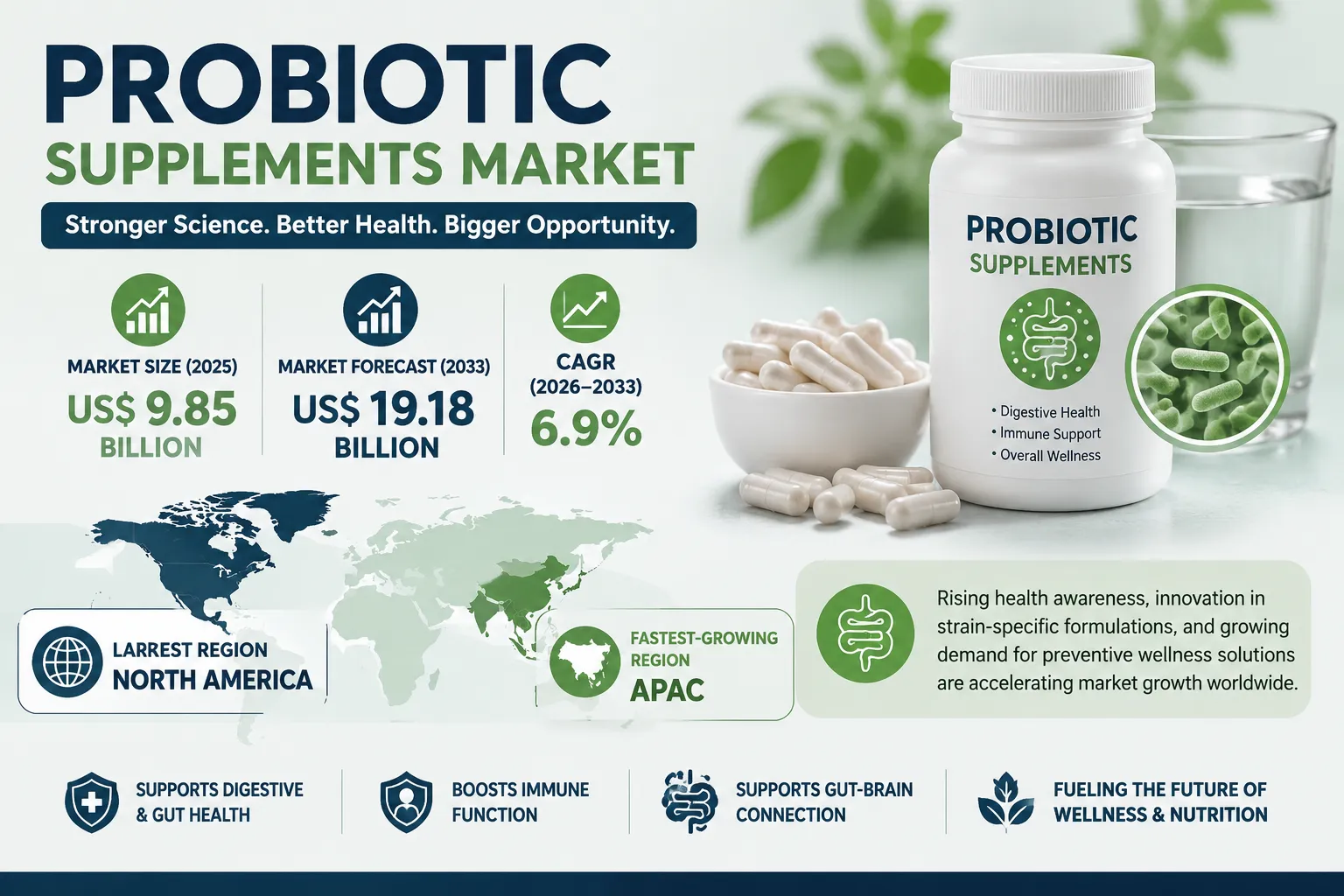
The global probiotic supplements market was valued at around USD US$ 9.85 billion in 2025 and is projected to reach USD 19.18 billion by 2033, showing steady demand across capsules, powders, gummies and targeted health formulations. Asia-Pacific held the largest revenue share in 2025, while demand in North America and Europe continues to grow through premium supplements, personalized nutrition and clinically positioned products.
Request For Exclusive Sample: https://www.datamintelligence.com/download-sample/probiotic-supplements-market
1. Science-Backed Strains Are Becoming the New Market Standard
The biggest transformation in the probiotics supplements industry is the move from generic probiotics to strain-specific solutions. Earlier, many brands promoted probiotics using broad terms such as Lactobacillus, Bifidobacterium, or “multi-strain blend.” Today, serious buyers, healthcare professionals, and informed consumers want to know the exact strain and the clinical evidence behind it.
This matters because probiotic benefits are not the same across all strains. The NIH Office of Dietary Supplements notes that probiotic effects can be strain-specific, meaning clinical recommendations should be linked to the exact strain, dosage, and use case.
This trend is changing product development. Brands are now building formulations around clinically validated strains for specific outcomes such as digestive comfort, immune support, women’s health, oral health, children’s health, mental wellness and antibiotic-associated digestive imbalance. Ingredient suppliers with documented strain libraries, stability data, and published studies are gaining stronger value in the B2B supply chain.
For manufacturers, this means formulation is becoming more technical. A successful probiotic supplement is no longer just about adding live bacteria into a capsule. It requires strain selection, compatibility testing, moisture control, shelf-life validation, delivery technology, and evidence-based positioning.
2. Digestive Health Is Still the Core, but the Category Is Expanding
Digestive health remains the foundation of the probiotics supplements market. Consumers continue to associate probiotics with gut balance, bloating support, bowel regularity, and recovery after antibiotic use. However, the industry is expanding into several high-growth health areas.
The strongest emerging categories include:
Women’s health probiotics: Products targeting vaginal microbiome balance, urinary tract support and hormonal life stages are gaining attention. However, this category also faces higher scrutiny because some claims are ahead of the science. Brands that invest in targeted strains and responsible communication will have a stronger long-term advantage.
Immune health probiotics: Post-pandemic consumer behavior continues to support preventive wellness. Probiotics positioned for immune balance, gut barrier support, and daily wellness are becoming part of broader immune supplement stacks.
Oral health probiotics: Probiotic supplements for gums, breath, plaque balance, and oral microbiome support are emerging as a premium niche. These products are especially attractive because they create a bridge between supplements, dental care, and preventive health.
Mental wellness and gut-brain axis: The connection between the gut and brain is becoming a major innovation area. Probiotic brands are exploring formulations for stress, mood, and cognitive wellness, although the market still requires careful clinical substantiation.
Kids, seniors, and sports nutrition: Age-specific and lifestyle-specific probiotics are gaining shelf space. Kids’ probiotics are moving into gummies and powders, senior-focused products are being linked with digestion and immunity, while sports nutrition brands are exploring gut recovery and inflammation-related positioning.
The next phase of category growth will come from precise consumer segmentation. The winning brands will not sell “one probiotic for everyone.” They will sell targeted probiotic solutions for clearly defined health needs.
3. Personalized Nutrition Is Reshaping Product Innovation
Personalized nutrition is one of the most powerful trends influencing the future of probiotic supplements. Consumers are increasingly aware that every person’s microbiome is different. This is creating demand for products that match lifestyle, diet, age, gender, symptoms, and health goals.
The market is seeing the rise of microbiome testing, subscription-based supplement plans, and customized probiotic recommendations. Some brands are using digital questionnaires, gut health assessments, and data-driven formulation logic to recommend specific probiotic, prebiotic, or synbiotic combinations.
This does not mean every consumer will buy a fully customized probiotic. However, personalization is changing how brands communicate. Even mass-market products are becoming more targeted, with labels such as “for women,” “for travelers,” “for antibiotic use,” “for daily immunity,” “for kids,” “for bloating,” or “for mood support.”
AI is also entering this space. Companies can use AI to analyze consumer feedback, clinical literature, strain databases, formulation stability data, and market demand patterns. Over time, AI may help brands identify new strain combinations, predict product stability, improve customer segmentation, and reduce formulation development time.
4. AI and Genomics Are Entering Probiotic Formulation
AI in probiotics is moving from a marketing concept to a practical R&D tool. The probiotic industry generates large volumes of data from clinical trials, strain sequencing, fermentation performance, consumer reviews, stability studies and microbiome research. AI can help companies convert this data into more useful formulation decisions.
Genomics is also becoming more important. DNA-based strain identification helps confirm the identity, safety, and consistency of probiotic strains. This is especially important for premium brands and ingredient suppliers because product credibility depends on proving that the strain on the label is actually present in the finished product.
In the future, AI and genomics may support:
- Faster screening of probiotic strains
- Better prediction of strain compatibility
- Improved formulation for targeted benefits
- Personalized probiotic recommendations
- Quality control across manufacturing batches
- Stronger traceability in the supply chain
This trend will favor companies that combine microbiology, bioinformatics, clinical research and commercial formulation expertise.
5. Manufacturing Quality Is Becoming a Competitive Advantage
Probiotic supplement manufacturing is technically more difficult than many other supplement categories because probiotics are live microorganisms. They can lose potency during fermentation, drying, blending, encapsulation, packaging, shipping and storage.
This makes manufacturing quality one of the most important competitive factors in the industry. Brands are paying closer attention to GMP compliance, stability testing, moisture control, oxygen exposure, temperature sensitivity and CFU count at the end of shelf life.
In the United States, dietary supplement manufacturers must follow current Good Manufacturing Practice requirements under 21 CFR Part 111, which covers manufacturing, packaging, labeling and holding operations for dietary supplements.
For probiotic products, strong manufacturing practices include:
Fermentation control: The strain must be grown under controlled conditions to maintain purity and potency.
Freeze-drying or stabilization: Many probiotics are freeze-dried to preserve viability.
Blending precision: Probiotic powders must be blended without damaging live cultures.
Encapsulation technology: Capsules must protect probiotics from moisture, acid and oxygen.
Stability testing: Brands must confirm that the product remains potent throughout its shelf life.
Batch testing: Finished products need microbial testing, potency verification and contamination checks.
Manufacturers that can deliver stable, clinically aligned and regulatory-compliant probiotic supplements will attract more private label, contract manufacturing and premium brand partnerships.
| Company Name | Strong Region | Probiotic / Supplement Products List | Growth Strategy |
| Novonesis | Europe, North America, Asia-Pacific | Clinically documented probiotics, prebiotics, postbiotics, HMOs, enzymes and protein ingredients for dietary supplements and infant nutrition. Key areas include digestive health, women’s health, immune health, infants & children, mental wellness and healthy longevity. | Drive above-market growth in probiotics through innovation, customization, expansion into new health categories, HMO opportunities and global scale. Its Strategy 2030 highlights probiotic supplement growth across mental health, women’s health, infants & children, gastrointestinal and immune categories. |
IFF Health Sciences | North America, Europe, Asia-Pacific | HOWARU probiotics, HOWARU Signature Strains, HOWARU NCFM, HOWARU HN001, HOWARU HN019, HOWARU Bi-07, HOWARU Bl-04, HOWARU GI Complete and HOWARU Restore. | Focus on strain genetics, clinical science, long-term stability, R&D strength and health-specific probiotic solutions. IFF states its Global Probiotic Health Research Center is supported by decades of work, 600+ research papers and 70+ human clinical studies. |
Lallemand Health Solutions | North America, Europe, Asia-Pacific | Bacteria- and yeast-based probiotic supplements for gut health, natural defenses, mental health, women’s health, skin health, oral health, sports, metabolic health, babies and postbiotics. Includes CEREBIOME psychobiotic solutions. | Vertically integrated model covering R&D, production and marketing. Growth is driven by custom formulations, protective technologies, global accreditations, stakeholder education and emerging microbiome health areas. |
| Probi AB | EMEA, Americas, Asia-Pacific | Probi LiveBac, Probi Osteo, BLIS by Probi, BLIS K12, BLIS M18, LP299V and broad probiotic strains for dietary supplements and functional foods. | Strategy focuses on commercial execution, science and innovation, differentiated products and organizational strength. Probi also highlights supply chain control and in-house production as advantages. |
| dsm-firmenich | Europe, North America, Asia-Pacific | Humiome probiotics, Humiome biotics, postbiotics, multi-ingredient custom solutions and gut-health supplement solutions using Microbiome Targeted Technology. | Growth strategy is centered on “health from the gut,” microbiome research, custom supplement solutions, probiotics + postbiotics, technical services and purpose-led digestive health innovation. |
ADM / Deerland Probiotics & Enzymes | North America, Europe, Asia-Pacific | ADM probiotics, Deerland Probiotics & Enzymes portfolio, DE111 spore-forming probiotic, prebiotics, enzymes, capsules, tablets, stick packs, gummies, bulk powder blends and food & beverage formats. | ADM’s strategy is to expand microbiome and wellness solutions through science-backed ingredients, precision fermentation, customer formulation support and its Deerland acquisition, which expanded its probiotic and dietary supplement capabilities. |
Morinaga Milk Industry | Japan, Asia-Pacific, Brazil, China, global ingredient markets | Bifidobacterium longum BB536, BB536 supplement products, B. longum subsp. infantis M-63, probiotic/postbiotic ingredients and functional foods. BB536 is used in foods and supplements and has a long history of global commercial use. | Growth strategy focuses on proprietary bifidobacteria research, overseas expansion, regulatory approvals and strengthening probiotics/postbiotics business in markets with future growth potential. |
| BioGaia | Europe, North America, Asia-Pacific, practitioner channels | Lactobacillus reuteri-based probiotic supplements, BioGaia Protectis, Gastrus, Prodentis oral health probiotic, baby drops, child health, adult health and oral health products. | Strategy is built on L. reuteri strain science, healthcare professional trust, clinical research transparency and life-stage probiotic products from newborns to adults. |
Nestlé Health Science | North America, Europe, global consumer health markets | Consumer care supplement brands including Nature’s Bounty probiotics, Pure Encapsulations supplements and broader vitamins, minerals and active lifestyle nutrition solutions. | Growth strategy focuses on consumer care, premium science-backed supplements, trusted ingredient sourcing, quality testing and global health science brand expansion. Nestlé’s annual report also positions Health Science within its broader nutrition and wellness strategy. |
| Yakult Honsha | Japan, Asia-Pacific, Europe, Americas | Probiotic products based on Lacticaseibacillus paracasei strain Shirota, including Yakult fermented milk products and related microbiome-focused health products. | Growth strategy is based on microorganism research, global health positioning, international expansion and strengthening brand trust through life-science-based products. Its integrated report emphasizes medium- to long-term growth and sustainability management. |
Request For Exclusive Sample: https://www.datamintelligence.com/download-sample/probiotic-supplements-market
6. Shelf-Stable and Spore-Based Probiotics Are Gaining Momentum
One of the major challenges in probiotic supplements is maintaining live culture viability without refrigeration. This has created growing interest in shelf-stable probiotics, spore-forming probiotics and advanced encapsulation technologies.
Spore-based probiotics such as Bacillus coagulans are attractive because they are more resistant to heat, moisture and stomach acid compared with many traditional probiotic strains. This makes them suitable for capsules, gummies, powders, functional foods and beverages.
Shelf-stable innovation is especially important for e-commerce and global distribution. Products sold through Amazon, pharmacies, health stores and international markets may face long shipping times and varied temperature conditions. If potency drops before the product reaches the consumer, brand trust is damaged.
This is why packaging, delivery systems and stability data are now central to product differentiation.
7. Packaging Is Moving Toward Protection, Convenience and Sustainability
Packaging is no longer just a branding tool in the probiotics supplements industry. It directly affects product quality. Since probiotics are sensitive to moisture, oxygen, light and heat, packaging must protect the live cultures until the end of shelf life.
Popular packaging formats include blister packs, desiccant bottles, stick packs, sachets, moisture-resistant capsules and high-barrier containers. For powders and children’s probiotics, single-serve sachets are gaining popularity because they improve dosing convenience and reduce repeated exposure to air.
At the same time, sustainability is becoming a stronger requirement. Brands are under pressure to reduce plastic use, improve recyclability and adopt responsible packaging materials. The challenge is that probiotic packaging must balance sustainability with product protection. A poorly protected probiotic in eco-friendly packaging can still fail if live cultures degrade before consumption.
Future packaging innovation will focus on high-barrier recyclable materials, lightweight formats, reduced plastic bottles and smart packaging that supports traceability or freshness communication.
8. Regulations Are Getting More Important for Global Expansion
Regulation is one of the most important areas for probiotic supplement companies, especially those selling across the United States, Europe, Asia-Pacific and the Middle East.
In the United States, probiotic supplements are generally regulated as dietary supplements when they are marketed for supplement use. Brands must comply with dietary supplement labeling, manufacturing and claims rules. FDA guidance covers dietary supplement regulatory requirements, while label claims may fall under health claims, nutrient content claims or structure/function claims depending on how they are written.
In the European Union, probiotic claims are more complex. The EU Register lists authorized and non-authorized health claims, and EFSA has historically required strong scientific evidence for health claim approval.
This creates a major strategic issue for global brands. A claim that works in the United States may not be acceptable in the EU. A product label that uses the word “probiotic” in one country may need adjustment in another. Export-focused brands must build a regulatory strategy early rather than treating compliance as a final packaging step.
The companies that win globally will be those that combine clinical evidence, compliant claims, transparent labeling, and region-specific market entry planning.
9. Ingredient Suppliers Are Becoming Strategic Partners
Probiotic ingredient suppliers are no longer simple raw material vendors. They are becoming strategic partners for brands, manufacturers, and formulation teams.
Leading suppliers provide clinically studied strains, stability data, technical documentation, regulatory support, formulation guidance, and sometimes ready-to-market concepts. IFF, for example, promotes clinically studied HOWARU probiotics and microbiome solutions, while Novonesis highlights science-backed biosolutions across health and nutrition.
For supplement brands, choosing the right ingredient supplier can influence product claims, market positioning, cost, stability and consumer trust. This is especially important for private label probiotic brands that may not have in-house microbiology or clinical research teams.
Procurement teams are increasingly evaluating probiotic ingredients based on:
- Strain documentation
- Clinical evidence
- CFU stability
- Allergen status
- Regulatory support
- Country-of-origin requirements
- Manufacturing capacity
- Cost per effective dose
- Compatibility with capsules, powders or gummies
Ingredient intelligence will become a major SEO and B2B content opportunity because buyers are actively searching for strain suppliers, private label options and high-quality probiotic raw materials.
10. Synbiotics, Postbiotics and Next-Generation Biotics Are Expanding the Market
The probiotics industry is no longer limited to live bacteria alone. Synbiotics, postbiotics and next-generation biotics are expanding the category.
Synbiotics
Combine probiotics with prebiotics, giving beneficial bacteria a food source that may support their activity.
Postbiotics
Use beneficial compounds produced by microorganisms, rather than relying on live organisms. This can offer stability advantages and easier formulation in some applications.
Next-generation probiotics
May include more advanced microbial strains linked to specific health pathways, but these products require stronger safety, regulatory and clinical validation.
This shift is important because not every product needs to depend on live culture survival. Postbiotics and heat-stable ingredients may open opportunities in gummies, beverages, bars and functional foods where traditional live probiotics can be difficult to maintain.
11. Consumer Trust Is Becoming the Real Brand Differentiator
The probiotic supplements market is crowded. Consumers see hundreds of products claiming digestive support, immune support, gut balance and microbiome benefits. In this environment, trust is becoming the strongest differentiator.
Consumers are asking sharper questions:
Does the product show CFU count through the end of shelf life?
Are the strains clearly listed?
Is the product third-party tested?
Does the brand explain what the strain does?
Are claims realistic or exaggerated?
Does the product need refrigeration?
Is the packaging protecting the live cultures?
The NIH notes that probiotics have shown promise for several health purposes, but many questions remain about which probiotics are helpful for which people and conditions. This makes responsible communication essential.
Brands that overpromise may generate short-term sales, but brands that educate consumers will build long-term authority.
12. Distribution Channels Are Shifting Toward Omnichannel Growth
The probiotics supplements industry is expanding across multiple distribution channels. Pharmacies, supermarkets, health food stores, practitioner channels, Amazon, direct-to-consumer websites and subscription models all play important roles.
E-commerce has changed the category by making it easier for emerging brands to launch quickly. However, it has also increased competition and price pressure. Online shoppers compare reviews, claims, strain details, ingredient panels and pricing within seconds.
Premium probiotic brands are using DTC models to build stronger customer relationships through subscriptions, educational content, quizzes and personalized recommendations. Retail brands, meanwhile, are competing through trust, convenience and shelf visibility.
The future will be omnichannel. Brands need strong digital education, credible product pages, marketplace optimization, retail packaging and practitioner trust.
13. M&A and Investment Activity Are Increasing
Probiotics sit inside the broader wellness, microbiome and preventive health investment theme. Large consumer health companies, food companies and private equity investors are watching the category closely because probiotics connect multiple growth areas: gut health, immunity, women’s health, personalized nutrition and functional wellness.
Recent activity shows growing interest in science-backed supplements and microbiome-related assets. For example, Eris Lifesciences acquired the prescription probiotics business of Velbiom Probiotics for Rs 50 crore to strengthen its position in metabolic wellness and women’s healthcare. In the broader supplement industry, Unilever has reportedly explored a bid for Thorne, a science-backed supplement company valued at up to USD 4 billion, showing how major consumer companies are looking at premium wellness platforms.
M&A in probiotics will likely focus on:
- Clinically validated strain portfolios
- Women’s health and digestive health brands
- Private label manufacturing capacity
- Microbiome testing platforms
- Shelf-stable delivery technologies
- Regional brands with strong retail distribution
- Premium supplement companies with subscription models
Investors will prefer companies with defensible science, strong margins, recurring customers and clear regulatory discipline.
14. Regional Markets Are Growing Differently
The probiotics supplements industry is global, but each region has a different growth pattern.
North America is driven by premium supplements, DTC brands, practitioner recommendations, women’s health products, immunity support and personalized nutrition. Consumers are willing to pay more for clinically positioned products.
Europe has strong consumer interest in Gut Health Supplements, but stricter health claim rules make compliance and label language more important. Brands must be careful with claims and regulatory interpretation.
Asia-Pacific is one of the strongest probiotic regions due to high acceptance of fermented foods, digestive health awareness, large consumer populations and growing middle-class wellness spending. The region also has strong opportunities in Japan, China, India, South Korea and Southeast Asia.
Japan is highly mature in probiotics and functional foods, with strong consumer familiarity and innovation in digestive health.
India is emerging as a strong opportunity due to rising supplement adoption, pharmacy access, digestive health awareness and growth in women’s health and immunity products.
Regional growth will depend on regulatory fit, price positioning, local consumer education, distribution partnerships and product format preferences.
15. Competitive Landscape Is Moving Toward Premiumization
The competitive landscape includes global ingredient suppliers, large consumer health companies, supplement brands, private label manufacturers, startups and regional probiotic specialists.
Major players in the broader probiotics ecosystem include companies such as Novonesis, IFF, Danone, Yakult, BioGaia, Nestlé Health Science, Procter & Gamble, Garden of Life, Culturelle, Align, Seed Health, NOW Foods, Thorne and several private label manufacturers.
Competition is shifting from “who has the highest CFU count” to “who has the strongest evidence, best delivery system and clearest consumer positioning.” This is a healthy development for the industry because higher CFU numbers do not automatically mean better outcomes. The future belongs to brands that combine science, stability, usability and trust.
16. Sustainability Will Influence Manufacturing and Packaging Decisions
Sustainability is becoming more important in probiotic supplements, especially among premium and younger consumers. The sustainability conversation includes responsible sourcing, energy-efficient fermentation, reduced waste, recyclable packaging, lighter logistics and better cold-chain efficiency.
However, probiotics create a special challenge. Some products require temperature control or protective packaging, which can increase environmental impact. This is why shelf-stable probiotics and improved packaging materials are gaining strategic value. A probiotic product that maintains potency at room temperature can reduce cold-chain dependence and support wider distribution.
Sustainability will not replace efficacy, but it will increasingly influence supplier selection, packaging design and brand reputation.
Future Outlook: The Probiotics Industry Is Becoming More Scientific, Targeted and Competitive
The future of the probiotics supplements industry will be shaped by precision, proof and performance. Generic probiotic products will continue to exist, but premium growth will come from targeted formulations supported by strain-level science, stability data, compliant claims and strong consumer education.
The most important trends transforming the industry are clear: personalized nutrition, women’s health, immune support, oral health, AI-led formulation, genomics, shelf-stable strains, advanced packaging, regulatory discipline, private label manufacturing, regional expansion and M&A activity.
For brands, the opportunity is strong but the market is becoming harder to win. Launching a probiotic supplement now requires more than a label and a high CFU count. It requires the right strain, the right dose, the right delivery system, the right claims, the right packaging and the right distribution strategy.
For manufacturers, the opportunity lies in quality, stability, compliance and flexible production capabilities. For ingredient suppliers, the advantage lies in clinical evidence and technical support. For investors, the most attractive companies will be those that combine science-backed products with scalable channels and strong consumer trust.
The probiotics supplements industry is entering a new phase where microbiome science, wellness behavior and commercial strategy are converging. Companies that understand this shift early will be better positioned to lead the next decade of growth.