


How AI Is Transforming the Pharmaceutical Industry
Artificial intelligence is moving from an experimental technology to an increasingly important component of pharmaceutical research, development and commercialization. From identifying potential drug targets and screening molecules to optimizing clinical trials and supporting pharmacovigilance, AI is changing how pharmaceutical companies analyze data, prioritize research and make development decisions.
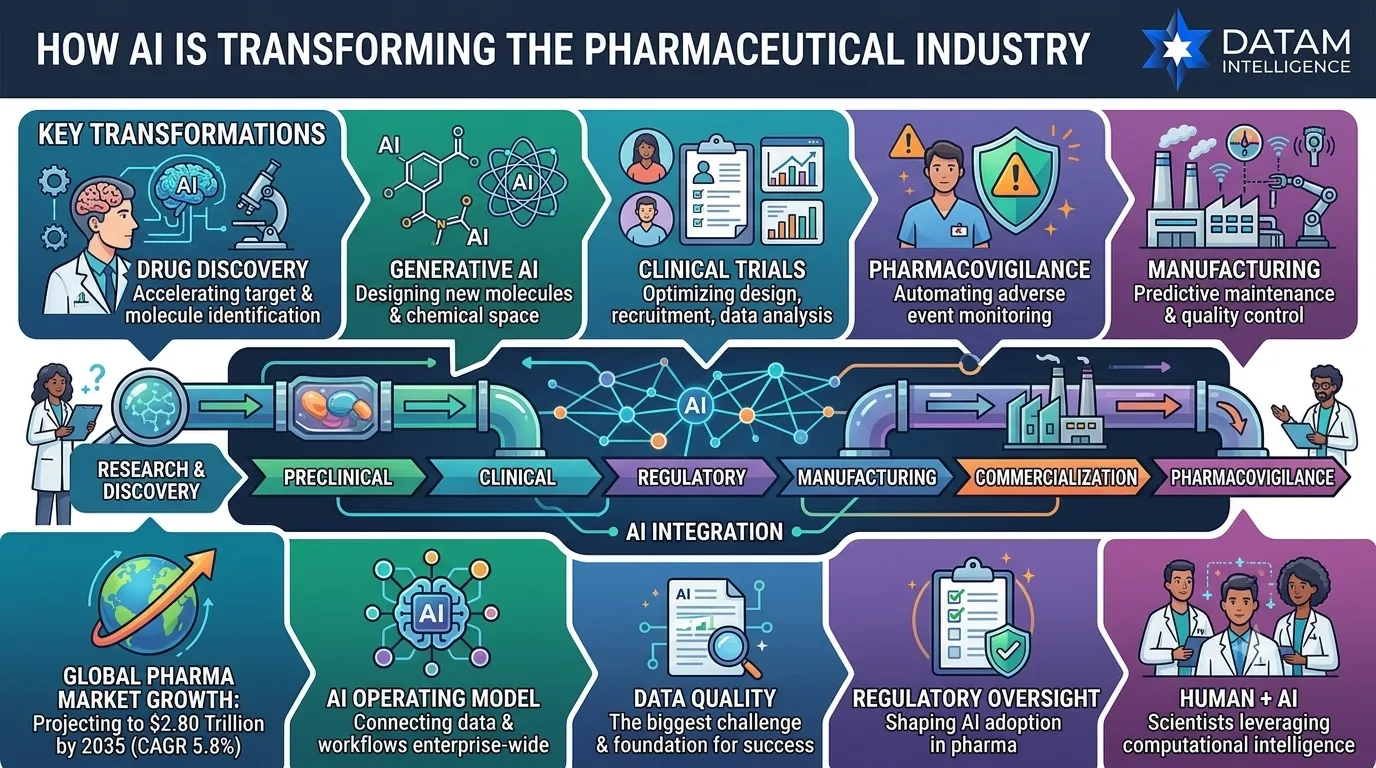
The transformation is occurring alongside continued expansion of the global pharmaceutical industry. According to DataM Intelligence, the global Pharmaceuticals Market is projected to grow from approximately US$1.69 trillion in 2026 to US$2.80 trillion by 2035, representing a CAGR of 5.8% during 2026 - 2035. AI-powered drug discovery is identified as one of the industry's emerging investment opportunities.
Explore the Pharmaceuticals Market: Data, Trends & Strategic Insights
Get a comprehensive view of the global Pharmaceuticals Market with market size forecasts, growth trends, segmentation, regional analysis, competitive landscape, key industry developments, and emerging investment opportunities. The report also examines high-growth areas including biologics, advanced therapies, personalized medicine, AI-powered drug discovery, and digital pharmaceutical manufacturing. Request a Sample Report Today!
The key question is no longer whether pharmaceutical companies will use AI, but where AI can generate measurable improvements without compromising scientific validity, patient safety, data quality or regulatory compliance.
How Is AI Changing the Pharmaceutical Industry?
AI is transforming the pharmaceutical value chain in several interconnected areas:
- Drug target identification
- Molecular discovery and screening
- Drug design and optimization
- Preclinical research
- Clinical trial design and recruitment
- Clinical data analysis
- Pharmacovigilance
- Manufacturing and quality control
- Supply-chain forecasting
- Commercial and market intelligence
Rather than replacing scientists, AI is increasingly being positioned as a research and decision-support capability that allows teams to process complex datasets faster and investigate a larger number of hypotheses.
1. AI Is Accelerating Drug Discovery
Traditional drug discovery requires researchers to evaluate enormous numbers of biological and chemical possibilities. AI can help narrow this search by analyzing molecular structures, genomic information, disease mechanisms and historical research data.
Machine-learning models can be used to predict properties such as molecular activity, toxicity, binding affinity and other characteristics before candidates progress through expensive laboratory experiments.
This creates a potential shift from:
Test large numbers of candidates → identify promising candidates
toward:
Use computational intelligence → prioritize candidates → validate experimentally.
The distinction is important. AI does not eliminate laboratory validation. Instead, its greatest near-term value is helping researchers determine which experiments are most worth conducting.
Recent industry activity illustrates the direction of travel. In July 2026, GSK entered a research collaboration with Relation Therapeutics worth up to $110 million focused on AI-enabled drug discovery, including human cellular datasets and AI models for identifying novel drug targets.
2. Generative AI Is Expanding the Role of Computational Drug Design
Generative AI introduces another layer of pharmaceutical innovation.
Instead of only predicting the properties of existing molecules, generative models can assist researchers in exploring potential molecular structures according to desired characteristics.
Potential applications include:
- Designing candidate molecules
- Optimizing molecular properties
- Exploring chemical space
- Generating research hypotheses
- Summarizing scientific literature
- Supporting experimental planning
- Accelerating knowledge discovery
The commercial opportunity is significant, but pharmaceutical companies must distinguish between generating a promising computational candidate and demonstrating that the candidate is safe, effective and manufacturable.
That distinction will remain central to the adoption of generative AI in pharma.
3. AI Is Reshaping Clinical Trials
Clinical trials are another area where AI can have a significant operational impact.
Pharmaceutical companies manage large volumes of patient, laboratory, clinical and operational data during trials. AI can help identify suitable patients, improve trial-site selection, analyze clinical data and automate parts of documentation and monitoring.
AI is also being explored for predictive approaches that could help researchers identify patients more likely to meet trial criteria.
One emerging concept is the use of synthetic or virtual control approaches. Industry executives are increasingly discussing whether computational models and external data can reduce reliance on traditional placebo-control approaches in certain trial designs.
However, these approaches require rigorous validation and regulatory acceptance before becoming standard practice.
4. AI Can Improve Pharmacovigilance
After a medicine reaches the market, pharmaceutical companies continue monitoring adverse events and safety signals.
AI can help process large volumes of safety information from sources such as:
- Adverse-event reports
- Clinical databases
- Medical literature
- Electronic health records
- Regulatory submissions
- Patient-generated information
Automating repetitive data-processing activities can allow safety teams to focus more heavily on signal assessment and scientific judgment.
This is particularly relevant as pharmaceutical companies face increasing data volumes and complex global regulatory requirements.
5. AI Is Moving Into Pharmaceutical Manufacturing
AI's influence is not limited to research laboratories.
Pharmaceutical manufacturers can apply AI and advanced analytics to:
- Predictive maintenance
- Production optimization
- Quality monitoring
- Process control
- Demand forecasting
- Inventory management
- Supply-chain planning
- Deviation detection
For manufacturers, the value proposition is particularly strong when AI can improve operational efficiency while maintaining strict quality and compliance standards.
The next phase of pharmaceutical digital transformation is therefore likely to involve greater integration between AI models, manufacturing systems, laboratory information and enterprise data platforms.
6. AI Is Becoming an Enterprise Capability
The pharmaceutical industry's AI transformation is moving beyond individual pilot projects.
Companies increasingly need AI strategies covering the entire development lifecycle.
A mature pharmaceutical AI operating model can connect:
Research → Discovery → Preclinical → Clinical → Regulatory → Manufacturing → Commercialization → Pharmacovigilance
This creates a larger opportunity than simply deploying an AI model for one scientific task.
The strategic advantage comes from connecting high-quality data, specialized AI systems, domain expertise and human decision-making across the pharmaceutical value chain.
7. The Biggest Challenge Is Not the AI Model - It Is the Data
AI performance depends heavily on the quality and consistency of the underlying data.
Pharmaceutical data can be fragmented across laboratories, hospitals, clinical-trial systems, research databases and manufacturing environments.
Recent industry discussions have highlighted inconsistent data storage and a lack of universal data standards as important barriers to scaling AI across drug development.
For pharmaceutical companies, this means AI investment must be accompanied by investment in:
- Data governance
- Data interoperability
- Data quality
- Secure data infrastructure
- Model validation
- Metadata management
- Access controls
- Auditability
Without these foundations, sophisticated AI models may produce outputs that are difficult to reproduce, validate or operationalize.
8. Regulatory Oversight Will Shape AI Adoption
Pharmaceutical AI operates in a highly regulated environment.
AI systems used in drug development, clinical research and healthcare must be evaluated according to their intended use, reliability, transparency and potential risks.
Regulators are therefore examining how conventional regulatory frameworks should adapt to AI-enabled technologies.
In August 2026, the U.S. FDA was reported to be considering a competency-based approach for evaluating generative-AI-enabled medical devices, reflecting the challenge of assessing systems whose outputs can evolve and vary depending on context.
For pharmaceutical companies, regulatory readiness will become an important component of AI strategy.
9. Human + AI Is Likely to Define the Next Phase
The most realistic future for pharmaceutical AI is not AI replacing scientists.
It is scientists working with increasingly capable AI systems.
AI can process datasets, identify patterns, generate hypotheses and prioritize possibilities. Scientists and clinicians remain responsible for interpreting evidence, designing experiments, assessing uncertainty and making high-impact decisions.
This human-AI model is particularly important in pharmaceutical development because biological systems are extraordinarily complex and computational predictions still require experimental and clinical validation.
Recent research on agentic AI in medicine similarly highlights the importance of human oversight, auditability, uncertainty assessment and prospective validation before broad clinical translation.
10. What Will AI Mean for the Future of the Pharmaceuticals Market?
AI is unlikely to become a standalone pharmaceutical market segment. Instead, its impact will increasingly be embedded across the broader pharmaceutical value chain.
The most important future opportunities are likely to include:
- AI-powered drug discovery
- AI-assisted precision medicine
- Generative molecular design
- AI-enabled clinical trials
- Predictive pharmacovigilance
- Digital pharmaceutical manufacturing
- AI-powered supply-chain optimization
- Multimodal biological data analysis
- Agentic AI for scientific workflows
- AI-enabled commercialization and market intelligence
This aligns with the broader growth trajectory of the pharmaceuticals industry. DataM Intelligence identifies AI-driven drug discovery alongside biologics, cell and gene therapies, mRNA technologies and digital pharmaceutical manufacturing as important investment areas.
What Pharmaceutical Companies Should Watch Next
The next competitive advantage will not necessarily belong to companies that simply deploy the largest AI models.
Instead, pharmaceutical leaders will increasingly need to evaluate five factors:
1. Data readiness
Can high-quality scientific and clinical data be accessed, standardized and governed?
2. Scientific validation
Can AI-generated predictions be reproduced experimentally?
3. Regulatory readiness
Can AI-supported decisions be explained, validated and audited?
4. Workflow integration
Can AI move beyond isolated pilots and become part of real pharmaceutical workflows?
5. Economic impact
Does AI improve development speed, probability of success, operational efficiency or commercial outcomes?
Conclusion
AI is changing the pharmaceutical landscape by moving computational intelligence deeper into drug discovery, clinical development, safety monitoring, manufacturing and commercial decision-making.
The transformation is still developing. AI has not eliminated the scientific complexity or high failure rates associated with pharmaceutical development. Instead, its immediate value lies in helping researchers and organizations process more information, prioritize opportunities and improve selected workflows.
As pharmaceutical companies increase investment in AI-enabled research and development, the competitive landscape will increasingly depend on the combination of AI capabilities, proprietary data, scientific expertise, regulatory confidence and execution.
For pharmaceutical businesses and investors, the strategic opportunity is therefore broader than AI drug discovery alone: AI is becoming an enabling layer across the pharmaceutical value chain.