


Radiopharmaceuticals Market Size
The global radiopharmaceuticals market size reached US$ 8.76 billion in 2025 and is expected to reach US$ 24.17 billion by 2035, growing at a CAGR of 10.8% during the forecast period 2026-2035.
Radiopharmaceuticals Market Overview
The global radiopharmaceuticals market is experiencing rapid expansion, driven by a surge in demand for precision diagnostics and targeted radioligand therapies. Key industry players such as Novartis, Bayer, and Eli Lilly are capitalizing on this growth through strategic acquisitions, R&D investments, and integrated product development. Geographically, North America leads the market in terms of revenue and innovation, while Asia-Pacific is registering the fastest growth, fueled by expanding healthcare access and regulatory support. Looking ahead, the continued convergence of diagnostic and therapeutic agents, alongside improvements in isotope generation, regulatory pathways, and combination regimens, is poised to further propel the market.
Radiopharmaceuticals Market Key Takeaways
- Prostate cancer held a 21.03% market share in 2025, making it the leading indication, supported by growing adoption of PSMA-targeted imaging and radioligand therapies.
- North America accounted for 42.39% of the global market in 2025, supported by advanced nuclear medicine infrastructure, strong clinical research activity, regulatory support, and established radiopharmacy networks.
- Asia-Pacific is the fastest-growing regional market, driven by expanding healthcare access, increasing nuclear medicine capabilities, and supportive regulatory conditions.
- Diagnostic and therapeutic radiopharmaceuticals are gaining commercial importance as theranostic approaches connect molecular imaging with targeted radionuclide treatment.
- Lutetium-177, Gallium-68, Fluorine-18, Technetium-99m, Iodine-131, and Yttrium-90 remain important radioisotopes across diagnostic imaging and targeted therapeutic applications.
- Major companies including Novartis Pharmaceuticals Corporation, Bayer Corporation, Jubilant DraxImage Inc., Eckert & Ziegler, Telix Pharmaceuticals Limited, and Eli Lilly and Company are strengthening their positions through product development, R&D, acquisitions, and broader radiopharmaceutical strategies.
Radiopharmaceuticals Market Scope
| Metric | Details |
| Market Size, 2025 | US$ 8.76 billion |
| Market Size, 2035 | US$ 24.17 billion |
| CAGR | 10.80% |
| Historic Years | 2023-2024 |
| Base Year | 2025 |
| Forecast Period | 2026-2035 |
| 2023 Market Size | US$ 7.20 billion |
| 2024 Market Size | US$ 7.91 billion |
| 2026 Market Size | US$ 9.71 billion |
| Source Forecast | US$ 19.69 billion by 2033 |
| Leading Region | North America |
| Fastest Growing Region | Asia-Pacific |
Radiopharmaceuticals Market Dynamics
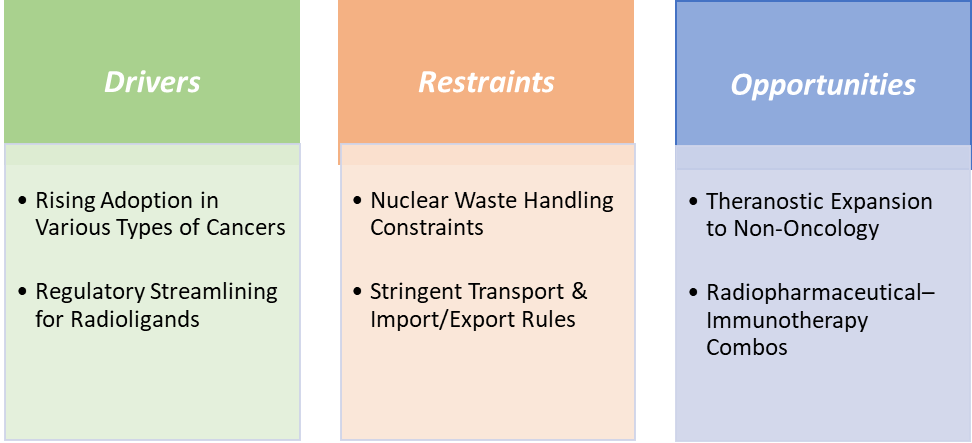
Drivers:
Rising adoption in various types of cancers is significantly driving the radiopharmaceuticals market growth
The rising adoption of radiopharmaceuticals in multiple cancer types is a significant driver of market growth, as these agents uniquely combine high diagnostic accuracy with targeted therapeutic potential. In prostate cancer, PSMA-targeted PET tracers such as ^68Ga-PSMA-11 and ^18F-DCFPyL have become pivotal in staging and recurrence detection, while the paired therapy ^177Lu-PSMA-617 (Pluvicto) has demonstrated significant survival benefits in metastatic castration-resistant cases.
Neuroendocrine tumors (NETs) similarly benefit from the theranostic pairing of ^68Ga-DOTATATE for imaging and ^177Lu-DOTATATE (Lutathera) for peptide receptor radionuclide therapy (PRRT), offering both precise localization and effective tumor control. In thyroid cancer, ^131I remains a gold-standard therapy, especially in differentiated subtypes, providing a decades-long proof of clinical and commercial viability. Liver cancers have seen growing use of ^90Y microspheres for selective internal radiation therapy (SIRT), which delivers high-dose beta radiation directly to hepatic tumors while sparing healthy tissue.
Additionally, radiopharmaceutical use is expanding into breast cancer, where agents such as ^89Zr-trastuzumab are in trials for HER2-positive tumor imaging, and into glioblastoma, with iodine- and lutetium-labeled agents targeting LAT1 transporters. The broadening spectrum of cancer applications is not only increasing patient volumes eligible for radiopharmaceutical-based management but also encouraging oncologists to integrate these agents earlier in treatment algorithms.
Combined with precision medicine trends, this multi-cancer adoption is catalyzing sustained demand, prompting pharmaceutical majors and isotope suppliers to expand capacity, diversify pipelines, and accelerate R&D collaborations ultimately propelling the global radiopharmaceuticals market toward robust growth in the coming years.
Restraints:
Nuclear waste handling constraints is hampering the growth of the radiopharmaceuticals market
Nuclear waste handling constraints are a significant barrier to radiopharmaceutical market growth because every stage of production, transport, and clinical use generates radioactive byproducts that require specialized disposal. For instance, spent generator columns from ^99Mo/^99mTc systems, unused doses of short-lived isotopes, and contaminated consumables (syringes, vials, shielding) must be treated as radioactive waste. This necessitates licensed storage facilities, trained radiation safety personnel, and compliance with stringent national regulations, which can be costly and time-consuming.
Smaller hospitals and imaging centers, especially in emerging markets, often lack the infrastructure for proper waste containment and decay storage, forcing them to rely on centralized facilities, slowing turnaround times and limiting access to time-sensitive tracers like ^18F and ^68Ga. These challenges can discourage new entrants, restrict the number of approved radiopharmacy sites, and increase overhead costs for existing providers. Ultimately, inefficient or costly nuclear waste handling systems reduce scalability, limit geographical reach, and dampen investment in new radiopharmaceutical production facilities, thereby constraining overall market expansion.
For more details on this report – Request for Sample
Radiopharmaceuticals Market Segmentation Analysis
The global radiopharmaceuticals market is segmented based on type, radioisotope, indication, end-user, and region.
The prostate cancer segment from the indication is dominating the radiopharmaceuticals market with a 21.03% share in 2025
The prostate cancer segment is the dominant indication in the radiopharmaceuticals market due to the rapid global adoption of PSMA-targeted theranostic approaches. Imaging agents like ^68Ga-PSMA-11 and ^18F-DCFPyL have revolutionized disease staging and recurrence detection by offering superior sensitivity compared to conventional imaging, enabling earlier and more precise treatment planning. On the therapeutic side, ^177Lu-PSMA-617 (Pluvicto) has gained regulatory approvals in multiple regions after demonstrating significant improvements in overall survival and quality of life for patients with metastatic castration-resistant prostate cancer in the VISION trial. This success has prompted its integration into standard oncology workflows, leading to high prescription volumes in the U.S., Europe, and Australia.
Moreover, prostate cancer’s high global prevalence over 1.6 million cases expected to occur in 2025 according to the World Health Organization, which creates a large and recurring patient pool, especially in aging male populations. The strong clinical evidence, large addressable market, and increasing reimbursement coverage have solidified prostate cancer’s position as the largest revenue-generating segment in the radiopharmaceuticals industry, outpacing other cancer indications such as neuroendocrine tumors and thyroid cancer.
Radiopharmaceuticals Market Geographical Share Analysis
North America is expected to dominate the global radiopharmaceuticals market with a 42.39% in 2025
North America is the dominant region in the radiopharmaceuticals market due to its advanced healthcare infrastructure, strong research ecosystem, and early adoption of cutting-edge nuclear medicine technologies. The U.S. hosts a dense network of cyclotrons, PET/SPECT facilities, and radiopharmacies, enabling efficient production and distribution of short-lived isotopes like ^18F, ^68Ga, and ^99mTc.
Regulatory support from the FDA, including accelerated approval pathways for theranostic agents such as ^177Lu-PSMA-617 (Pluvicto) and ^177Lu-DOTATATE (Lutathera), has fast-tracked commercialization. Leading companies like Novartis, Bayer and Eli Lilly have significant operational bases in the region, ensuring robust supply chains. High per-capita healthcare spending and broad insurance reimbursement encourage adoption of costly but effective radiopharmaceutical therapies, particularly in oncology.
Additionally, a large and growing patient pool for prostate cancer, neuroendocrine tumors, and cardiovascular conditions sustains demand. The presence of top-tier academic and research institutions such as the Mayo Clinic supports continuous clinical trial activity, further driving innovation. Combined with a mature regulatory framework, strong investment climate, and widespread clinical expertise, these factors solidify North America’s leadership in global radiopharmaceuticals market share.
Radiopharmaceuticals Market Competitive Landscape
Top companies in the radiopharmaceuticals market include Novartis Pharmaceuticals Corporation, Bayer Corporation, Jubilant DraxImage Inc., Eckert & Ziegler, Telix Pharmaceuticals Limited, and Eli Lilly and Company, among others.
Radiopharmaceuticals Market Recent Developments
August 2026: Globally, radiopharmaceutical development accelerated across both diagnostic imaging and targeted radioligand therapies. Curium completed the acquisition of Abscint SA, adding ABS-011, an investigational gallium-68 PET radiodiagnostic tracer targeting HER2, to its oncology pipeline and strengthening its capabilities in breast and gastric cancer imaging.
July 2026: In Europe, ITM Radiopharma expanded its focus on next-generation radiotherapeutics and isotope supply. The company introduced Lumara Bio as its new oncology therapeutics division and announced progress in sustainable radium-226 recycling to support reliable commercial-scale production of actinium-225 (Ac-225) for global radiopharmaceutical programs.
June 2026: Globally, clinical development of radioligand therapies continued advancing, particularly in oncology. ITM reported Phase 3 COMPETE results for ¹⁷⁷Lu-edotreotide (ITM-11) in patients with advanced gastroenteropancreatic neuroendocrine tumors, highlighting the increasing focus on lutetium-177-based targeted radiopharmaceutical treatments.
May 2026: In North America, radiopharmaceutical companies increasingly expanded their diagnostic pipelines alongside therapeutic programs. Lantheus continued advancing its radiopharmaceutical portfolio, including prostate cancer imaging and new diagnostic candidates, amid growing industry interest in theranostics and targeted nuclear medicine.
April 2026: Globally, the industry increasingly focused on securing isotope supply chains, expanding manufacturing capacity, and developing integrated diagnostic-and-therapeutic platforms. Investments in isotopes such as lutetium-177, actinium-225, gallium-68, and radium-226 are becoming increasingly important as radiopharmaceutical developers scale clinical and commercial programs.
Target Audience
This radiopharmaceuticals market analysis is relevant to:
- Radiopharmaceutical manufacturers and developers
- Pharmaceutical and biotechnology companies
- Radioisotope producers and suppliers
- Radiopharmacy operators
- Hospitals and diagnostic imaging centers
- Nuclear medicine departments
- Oncology treatment providers
- Medical technology companies
- Healthcare investors and private equity firms
- Procurement and sourcing teams
- Corporate strategy and business development teams
- Academic and clinical research organizations
- Regulatory and healthcare policy stakeholders
The global radiopharmaceuticals market report delivers a detailed analysis with 58 key tables, more than 70 visually impactful figures, and 167 pages of expert insights, providing a complete view of the market landscape.
Suggestions for Related Report
For more pharmaceuticals-related reports, please click here





























































