


Why the Critical Minerals Market Matters
The critical minerals market has moved from a specialist mining topic to the center of global industrial strategy. Lithium, rare earths, copper, graphite, cobalt, nickel, and manganese are no longer just raw materials. They are the foundation of electric vehicles, battery storage, wind turbines, solar infrastructure, AI data centers, defense systems, semiconductors, and advanced manufacturing.
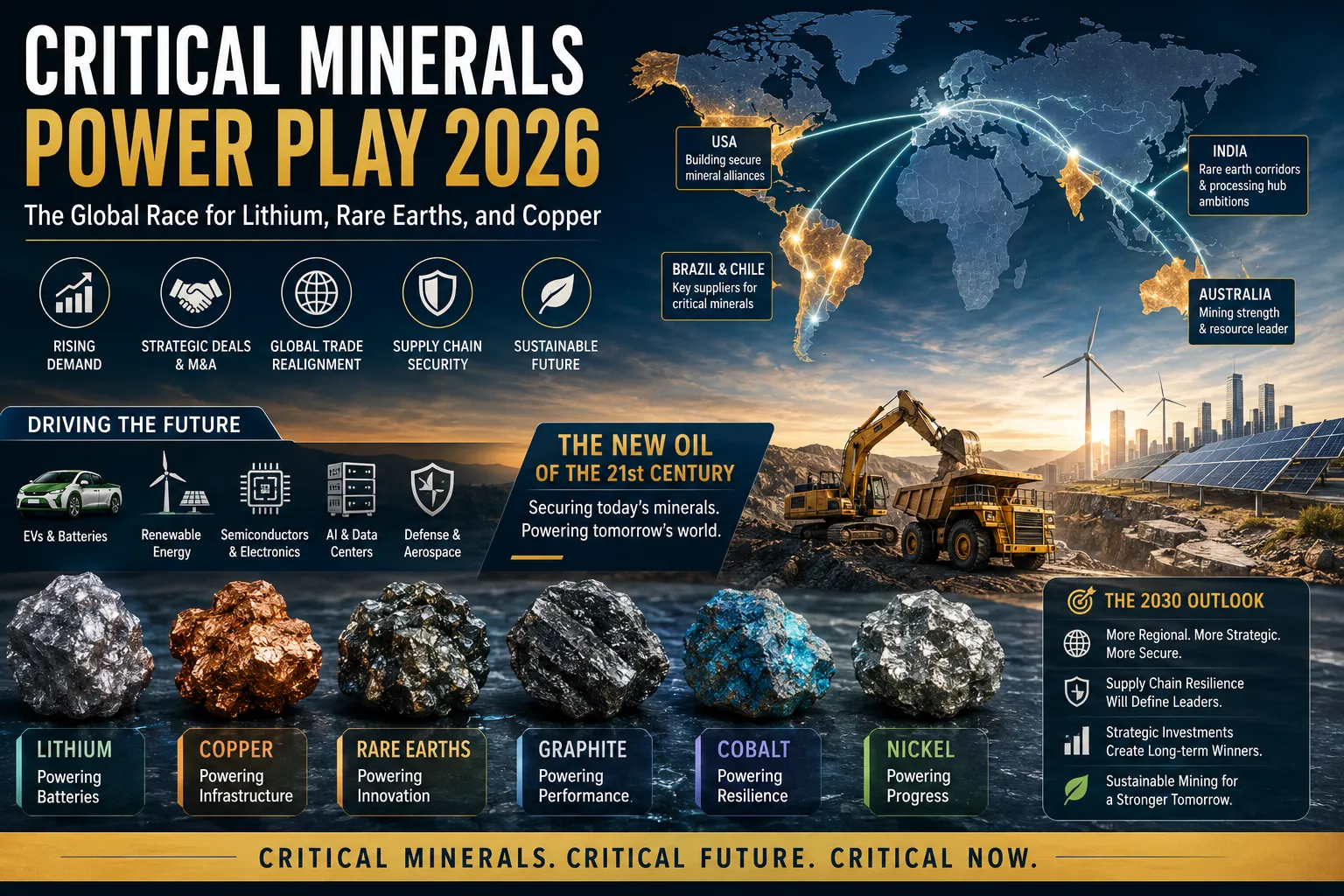
In 2026, the global race for critical minerals is becoming a power play between governments, miners, investors, and industrial buyers. The biggest developments include rising mining M&A, new trade partnerships, government-backed mineral funds, rare earth processing investments, and a rapid push to reduce dependence on China-dominated supply chains.
The story is not only about who owns the mines. The real battle is over refining, processing, magnet manufacturing, battery materials, recycling, and long-term supply agreements. Countries that control these midstream and downstream stages will shape the next phase of the energy transition.
Why Critical Minerals Are Becoming the New Oil
For most of the 20th century, oil shaped geopolitics. In the 21st century, critical minerals are taking on a similar role. The reason is simple: every major growth industry now depends on minerals that are difficult to mine, complex to process, and often concentrated in a small number of countries.
Electric vehicles need lithium, graphite, nickel, cobalt, manganese, and copper. Wind turbines and EV motors require rare earth magnets made from elements such as neodymium, praseodymium, dysprosium, and terbium. AI data centers require huge amounts of copper for power systems, cooling infrastructure, grid connections, and transformers. Defense applications depend on rare earths, titanium, gallium, germanium, and other strategic minerals.
Demand is rising fast. UNCTAD’s 2026 trade update notes that lithium demand could increase by more than 350% by 2040, while graphite demand could rise by more than 130%. That kind of growth explains why governments are treating minerals as a national security issue, not just a commodity market.
The critical minerals industry is also different from oil because the bottleneck is not always the mine. In many cases, mining capacity exists or can be expanded, but processing and refining remain limited. This is especially true for rare earths, where separation, refining, alloying, and magnet production require technical expertise, environmental controls, and long-term capital.
Request Exclusive Sample Report for Critical Minerals Market
The M&A Wave Reshaping Global Mineral Supply
Mining M&A in 2026 is being driven by one question: who can secure future supply before prices spike and geopolitical risk increases?
Global mining M&A reached around $21.6 billion in Q1 2026, the strongest first quarter since 2023. The trend shows that major miners, private equity groups, sovereign-backed funds, and strategic investors are willing to pay for assets linked to electrification, defense, and supply chain security.
One major example is the Orion Critical Mineral Consortium’s reported interest in French miner Eramet. Orion, backed by U.S. and Abu Dhabi-linked capital, is exploring a stake in Eramet, which has exposure to lithium, nickel, manganese, and other strategic materials. This type of transaction shows how critical mineral investments are increasingly being shaped by geopolitical alignment.
Another important deal is Critical Metals Corp’s planned acquisition of European Lithium, valued at approximately $835 million. The transaction is designed to consolidate ownership and strengthen control over strategic rare earth and lithium-linked assets, including exposure to Greenland’s Tanbreez rare earth project.
These transactions show that investors are not waiting for shortages to become obvious. They are moving early to control assets, simplify ownership structures, and position themselves for future supply agreements with governments and manufacturers.
Recent Critical Mineral M&A Deals and Investment Signals
| Deal / Development | Mineral Focus | Strategic Meaning |
| Orion CMC interest in Eramet | Lithium, nickel, manganese | Allied capital moving into strategic mining assets |
| Critical Metals Corp–European Lithium deal | Lithium, rare earths | Consolidation of Western rare earth and battery mineral exposure |
| Q1 2026 global mining M&A | Copper, lithium, gold, critical minerals | Mining consolidation returns as supply security becomes urgent |
| Strategic investment in rare earth processing | Rare earths, magnets | Midstream capacity becomes as important as mining |
Trade Deals Reshaping Critical Mineral Supply Chains
The critical minerals supply chain is being redrawn through trade agreements as much as through mining deals.
India and Brazil have moved closer through a rare earth and critical minerals partnership. Brazil is emerging as an important supplier for India because it has major reserves of rare earths, graphite, niobium, nickel, lithium, and copper. For India, this partnership supports electric mobility, renewable energy, defense manufacturing, and semiconductor ambitions.
India is also advancing CEPA negotiations with Chile, one of the world’s most important copper and lithium producers. Access to Chilean lithium, copper, and cobalt resources could support India’s battery, grid, and manufacturing strategy.
The United States is pushing a wider critical minerals trading bloc concept with partners such as Japan and the European Union. The goal is to reduce exposure to China-controlled processing, create more predictable pricing mechanisms, and support trusted supply chains.
The Quad Critical Minerals Initiative among India, Australia, Japan, and the United States adds another layer. Australia brings mining strength, Japan brings processing and advanced manufacturing capabilities, India brings demand and industrial scale, and the United States brings financing, defense demand, and policy support.
Together, these deals show a clear shift from globalization to friend-shoring. The question is no longer “Where is the cheapest supply?” It is now “Where is the most secure, reliable, and politically aligned supply?”
The India Opportunity: Can India Become a Critical Minerals Hub?
India is one of the most important emerging players in the critical minerals market. The country has rising demand from electric vehicles, renewable energy, electronics, semiconductors, defense systems, and industrial manufacturing. At the same time, it wants to reduce dependence on imported critical minerals and China-linked rare earth supply chains.
A major development is India’s rare earth corridor strategy. The Union Budget 2026–27 announced dedicated rare earth corridors in Odisha, Kerala, Andhra Pradesh, and Tamil Nadu. These corridors are designed to support mining, processing, research, and rare earth permanent magnet manufacturing.
Andhra Pradesh is attracting particular attention because of its beach sand mineral resources and potential rare earth processing ecosystem. Indian conglomerates such as Reliance, Vedanta, and Adani have reportedly shown interest in rare earth processing facilities in the state. This is a major signal that India’s private sector is beginning to treat rare earths as a strategic manufacturing opportunity.
India also has policy support through the Rare Earth Permanent Magnet manufacturing scheme and the National Critical Mineral Mission. If these initiatives succeed, India could become a key alternative processing and manufacturing hub for rare earth magnets, battery materials, and mineral-based components.
However, the challenge is execution. Building processing capacity requires technology, environmental approvals, skilled talent, stable feedstock, and long-term offtake agreements. India has the demand and policy direction, but it must now build industrial depth.
Top 10 Critical Minerals and Their Applications
| Critical Mineral | Key Applications |
| Lithium | EV batteries, grid storage, consumer electronics |
| Copper | Power grids, data centers, EVs, renewable energy systems |
| Rare Earth Elements | EV motors, wind turbines, defense systems, electronics |
| Graphite | Battery anodes, steelmaking, fuel cells |
| Cobalt | Batteries, aerospace alloys, defense applications |
| Nickel | EV batteries, stainless steel, energy storage |
| Manganese | Batteries, steelmaking, grid storage |
| Gallium | Semiconductors, LEDs, defense electronics |
| Germanium | Fiber optics, infrared systems, solar cells |
| Titanium | Aerospace, defense, medical devices, advanced manufacturing |
Winners and Losers in the New Resource Nationalism Era
The winners in this new era will be companies and countries that control strategic assets across the full value chain. Rare earth miners with scalable deposits, copper producers with low-cost operations, lithium refiners, graphite processors, battery material suppliers, and magnet manufacturers are all well positioned.
Processing companies may become even more valuable than miners. The world does not only need more ore; it needs more refined lithium chemicals, separated rare earth oxides, battery-grade graphite, copper smelting capacity, and magnet production.
Countries with mineral resources and clear policy frameworks are also winners. Australia, Chile, Argentina, Brazil, Canada, India, and parts of Africa could attract new capital if they provide stable regulation, infrastructure, and transparent permitting.
The losers will be companies that rely on fragile supply chains without diversification. Manufacturers dependent on a single country for rare earth magnets, graphite anodes, or battery metals face rising procurement risk. Smaller miners without funding may also struggle as ESG rules, permitting delays, and processing gaps increase costs.
China remains the dominant force in many parts of the critical minerals supply chain, especially processing. But the U.S., EU, India, Japan, Australia, and others are now building policies to reduce that dependence. The EU’s Critical Raw Materials Act, for example, sets 2030 benchmarks for domestic extraction, processing, and recycling.
Critical Mineral Corridors to Watch
A useful interactive map for this topic would highlight the world’s most important critical mineral corridors:
- Australia: lithium, rare earths, nickel, and critical mineral mining expertise
- Chile: copper and lithium supply for batteries and grids
- Argentina: lithium brine projects in the Lithium Triangle
- Brazil: rare earths, graphite, niobium, nickel, lithium, and copper
- India: rare earth corridors, magnet manufacturing, processing ambitions
- Canada: nickel, cobalt, lithium, graphite, and allied supply chain development
These corridors will attract investment because they combine resource potential with geopolitical relevance.
Expert Commentary: Will Critical Minerals Become the New Oil?
Critical minerals are already becoming the “new oil” in one important sense: they are turning industrial supply into strategic power. But there is one big difference. Oil is consumed once it is burned. Minerals can be reused, recycled, and redesigned into circular supply chains.
That means the future will not only belong to countries with large reserves. It will also belong to companies that master recycling, substitution, cleaner processing, traceability, and long-term offtake contracts.
By 2030, the critical minerals market will likely be more regional, more political, and more vertically integrated. Governments will keep funding domestic projects. Automakers and battery makers will sign more direct supply deals. Mining M&A will continue as companies chase copper, lithium, graphite, rare earths, and nickel assets.
The biggest opportunity is clear: whoever controls secure supply chains for lithium, rare earths, copper, graphite, and cobalt will control the backbone of the next industrial economy.
2030 Outlook: What Comes Next?
By 2030, copper demand will be driven by electrification, grid upgrades, AI data centers, and renewable power. Lithium demand will continue to rise as EV adoption and battery storage expand. Rare earth demand will grow with electric motors, wind turbines, robotics, defense systems, and advanced electronics.
Government intervention will remain intense. Strategic stockpiles, trade blocs, tax incentives, export controls, and public-private partnerships will become normal features of the critical minerals industry.
For investors and industrial buyers, the key lesson is simple: critical minerals are not a short-term commodity trend. They are a long-term restructuring of global supply chains. The race for lithium, rare earths, copper, graphite, and cobalt is already underway - and by 2030, the winners will be those who secured supply before the rest of the world realized how tight the market had become.