


Wearable Asthma Monitoring Devices Market Size - Industry Trends & Outlook
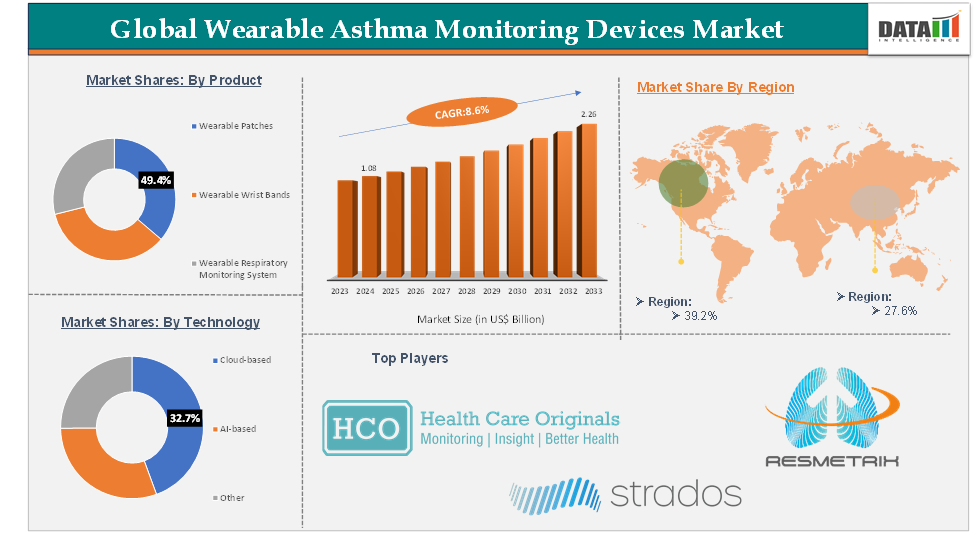
The wearable asthma monitoring devices market size reached US$1.17 billion in 2025 and is expected to reach US$3.00 billion by 2035, growing at a CAGR of 8.6% during the forecast period 2026-2035.
The global wearable asthma monitoring devices market is experiencing significant growth, driven by the increasing prevalence of asthma, advancements in wearable technology, and a rising demand for real-time health monitoring solutions.
The market is propelled by strong support from healthcare systems, growing investment in digital health, and the increasing use of telehealth and remote patient monitoring. North America currently dominates the market due to its advanced healthcare infrastructure and high adoption rate of wearable technologies, while Asia-Pacific is expected to witness the fastest growth owing to rising healthcare awareness and smartphone penetration.
Despite growth opportunities, challenges such as data privacy concerns, high device costs, and regulatory hurdles may impede adoption. However, with continuous R&D and supportive government initiatives, the market is poised to expand significantly over the next five to ten years.
Wearable Asthma Monitoring Devices Market Key Takeaways
- The market is projected to grow from US$ 1.17 billion in 2025 to US$ 3.00 billion by 2035 at a CAGR of 8.6%.
- Wearable patches lead the market with an expected 49.4% share due to continuous, non-invasive monitoring.
- North America dominates with a 39.2% market share, supported by advanced digital healthcare adoption.
- Rising global asthma prevalence and increasing demand for remote patient monitoring are key growth drivers.
- AI-based and cloud-connected wearable devices are improving early detection and personalized asthma management.
- High device costs and data privacy concerns remain major challenges to broader market adoption.
Wearable Asthma Monitoring Devices Market Scope
| Metrics | Details |
| Market Size (2025) | US$ 1.17 Billion |
| Market Size (2035) | US$ 3.00 Billion |
| CAGR | 8.6% (2025-2035) |
| Historic Years | 2023-2024 |
| Base Year | 2025 |
| Forecast Period | 2026-2035 |
| Segments Covered | Product, Technology, Application, Region |
| Leading Region | North America |
| Fastest Growing Region | Asia-Pacific |
| Fastest Growing Region | Asia-Pacific |
Executive Summary
For more details on this report – Request for Sample
Wearable Asthma Monitoring Devices Market Dynamics: Drivers & Restraints
Rising global prevalence of asthma is expected to drive the wearable asthma monitoring devices market
The rising global prevalence of asthma is a key driver expected to significantly boost the wearable asthma monitoring devices market. For instance, according to the American Lung Association, in 2022, approximately 44.2 million Americans reported having been diagnosed with asthma at some point in their lives by a healthcare professional. This reflects a significant increase of 48% from 1999, when the lifetime prevalence was 9.1%.
Adults between the ages of 18 and 55 experienced the highest rates of lifetime asthma prevalence, with 16.8% reporting a diagnosis in 2022. The condition is becoming more common due to increasing air pollution, urbanization, changing lifestyles, and heightened exposure to allergens.
Recent data from the Global Burden of Disease Study highlights a notable increase in asthma cases in emerging economies like India and China, where rapid urban growth has worsened air quality. In the United States, the CDC reported a steady rise in asthma diagnoses among children and adults, with around 25 million Americans now affected. These trends underscore the urgent need for continuous monitoring and proactive management tools.
Wearable asthma devices, which offer real-time tracking of respiratory parameters and early detection of potential exacerbations, are uniquely positioned to meet this growing healthcare demand. As more healthcare systems emphasize preventive care and remote patient monitoring, the increasing asthma burden will continue to drive the adoption of wearable solutions.
High cost of wearable devices
The high cost of wearable asthma monitoring devices is a major barrier to widespread adoption and is expected to hinder market growth, particularly in price-sensitive and developing regions. These devices often incorporate advanced technologies such as real-time respiratory monitoring, wireless connectivity, and AI-driven analytics, which significantly increase their production and retail costs. As a result, many patients, especially those with mild to moderate asthma or limited financial resources, may be unwilling or unable to invest in such devices.
Wearable Asthma Monitoring Devices Market Segment Analysis
The global wearable asthma monitoring devices market is segmented based on product, technology, end user, and region.
Product:
The wearable patches segment is expected to hold 49.4% of the global wearable asthma monitoring devices market
Wearable patches are poised to dominate the wearable asthma monitoring devices market due to their discreet design, continuous monitoring capabilities, and non-invasive nature. These patches can detect respiratory patterns such as wheezing and coughing, providing real-time data to both patients and healthcare providers.
For instance, researchers found that a wearable patch, when used with a deep learning model, was more effective at detecting wheezing than traditional digital stethoscopes. The system demonstrated high performance, with an accuracy of 95%, a sensitivity of 96%, and a specificity of 93%. These results suggest that wearable technology could be a more reliable tool for monitoring respiratory conditions like asthma. This high level of precision makes wearable patches invaluable for early detection and management of asthma and chronic obstructive pulmonary disease (COPD).
Additionally, developing wireless versions of these patches aims to facilitate long-term home monitoring, enabling data transmission to physicians for timely interventions. Such advancements underscore the potential of wearable patches to transform asthma management by providing continuous, real-time insights into respiratory health.
The integration of artificial intelligence and machine learning into these devices further enhances their predictive capabilities, allowing for personalized asthma management plans. As the healthcare industry increasingly shifts towards remote monitoring and personalized care, wearable patches are well-positioned to lead the market in wearable asthma monitoring devices.
Wearable Asthma Monitoring Devices Market Geographical Analysis
North America is expected to hold 39.2% of the global wearable asthma monitoring devices market
North America is projected to maintain a dominant position in the wearable asthma monitoring devices market, driven by several key factors. The increasing adoption of smart inhalers and wearable devices, supported by favorable reimbursement policies and widespread insurance coverage, further propels market growth.
The integration of smart inhalers and wearable devices into asthma management is on the rise. These technologies enable real-time monitoring of medication usage and respiratory health, leading to improved patient outcomes. For instance, in June 2024, Intermountain Health expanded its partnership with CareCentra to include remote monitoring of asthma patients, utilizing digital devices and patient-reported information to detect symptom exacerbations and enable earlier interventions.
Additionally, government initiatives and public health programs aimed at enhancing chronic disease management contribute to the region's market leadership. Thus, North America is expected to continue its dominance in the wearable asthma monitoring devices market.
Wearable Asthma Monitoring Devices Market Competitive Landscape
The wearable asthma monitoring devices market remains innovation-driven, with companies focusing on sensor accuracy, artificial intelligence integration, wireless connectivity, and remote patient monitoring capabilities.
Leading participants include:
- Strados Labs
- Resmetrix
- Health Care Originals
Competitive differentiation increasingly depends on clinical validation, AI-powered respiratory analytics, patient comfort, cloud integration, and healthcare provider interoperability. Companies investing in continuous monitoring technologies and physician-focused digital platforms are strengthening their competitive positioning as healthcare systems transition toward preventive respiratory care.
Wearable Asthma Monitoring Devices Market Key Developments
June 2026: Philips expanded its connected respiratory monitoring portfolio by introducing AI-enabled wearable solutions that provide continuous tracking of respiratory parameters, helping clinicians detect early signs of asthma exacerbations and improve remote patient management.
May 2026: Medtronic enhanced its digital respiratory care ecosystem through the integration of wearable monitoring technologies with cloud-based analytics, enabling real-time patient monitoring and personalized asthma management.
April 2026: Propeller Health (ResMed) strengthened its digital asthma platform by expanding smart inhaler and wearable monitoring capabilities, offering improved medication adherence tracking and predictive insights for asthma control.
March 2026: VitalConnect advanced its wearable biosensor platform with enhanced continuous respiratory monitoring features, supporting remote monitoring of asthma patients in hospital and home healthcare settings.
February 2026: Biofourmis expanded its AI-powered wearable health monitoring solutions by integrating advanced respiratory analytics, enabling early detection of worsening asthma symptoms and improving clinical decision-making through remote patient monitoring.
Market Impact Analysis
Healthcare systems are increasingly shifting from reactive asthma treatment toward continuous disease management supported by connected monitoring technologies. This transition is encouraging greater investment in wearable respiratory monitoring devices capable of delivering real-time clinical insights.
However, regulatory approval requirements, cybersecurity expectations, patient data privacy considerations, and premium device pricing continue influencing commercialization strategies across global markets.
How This Report Supports Business Decisions
This report assists:
- Medical device manufacturers evaluating product development strategies.
- Investors assessing long-term digital respiratory healthcare opportunities.
- Technology companies developing AI-enabled remote monitoring platforms.
- Healthcare providers expanding remote patient monitoring services.
- Procurement teams evaluating connected respiratory monitoring technologies.
- Strategy teams monitoring competitive positioning and regional expansion opportunities.
Target Audience
- Medical Device Manufacturers
- Digital Health Companies
- Healthcare Providers
- Hospitals and Health Systems
- Respiratory Care Specialists
- Investors and Venture Capital Firms
- Healthcare Technology Companies
- Procurement Organizations
- Research Institutions
- Healthcare Strategy and Business Development Teams
Conclusion
The wearable asthma monitoring devices market is positioned for sustained expansion as healthcare delivery increasingly emphasizes continuous monitoring, preventive intervention, and digitally connected patient care. Rising asthma prevalence, broader adoption of telehealth services, and advances in artificial intelligence-enabled respiratory monitoring are strengthening long-term commercial prospects.
Wearable patches continue to demonstrate strong competitive advantages through high diagnostic performance and patient convenience, while North America maintains leadership supported by advanced healthcare infrastructure and digital adoption. Asia-Pacific presents attractive long-term growth potential as healthcare modernization accelerates across developing economies.
Organizations capable of combining clinically validated monitoring technologies with cost-effective deployment models, secure cloud connectivity, and intelligent respiratory analytics are likely to strengthen their competitive position as wearable asthma management becomes an increasingly important component of modern respiratory healthcare.




























































