


Remote Patient Monitoring Market Size
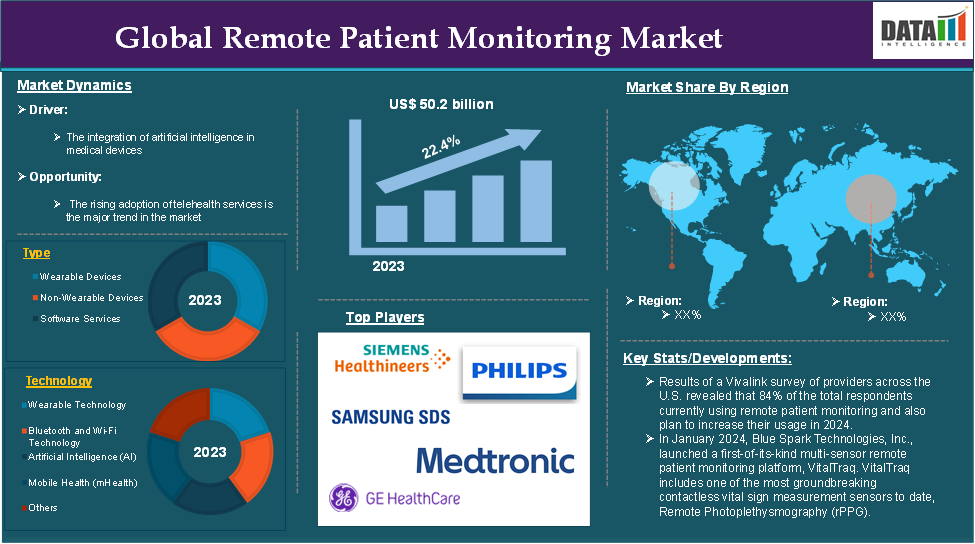
The Global Remote Patient Monitoring Market reached US$ 75.20 billion in 2025 and is expected to reach US$ 380.00 billion by 2033, growing at a CAGR of 22.4% during the forecast period 2026-2033, according to DataM Intelligence report.
Remote patient monitoring refers to the use of digital technologies, medical devices and telecommunication systems to monitor and manage a patient's health outside of traditional clinical settings, such as at home or in a community setting. Remote patient monitoring involves the continuous or periodic collection of patient data related to vital signs, symptoms, or chronic conditions, which is then transmitted to healthcare providers for review, analysis, and follow-up care. The data collected by the monitoring devices is transmitted via secure, wireless communication technologies to healthcare providers or monitoring platforms. The data can include metrics like heart rate, blood pressure, blood glucose levels, oxygen saturation, and more.
The demand for remote patient monitoring is rapidly growing, driven by the need for efficient chronic disease management, the global shift toward more patient-centric care models and the rising adoption of remote patient monitoring. For instance, results of a Vivalink survey of providers across the U.S. revealed that 84% of the total respondents currently using remote patient monitoring and also plan to increase their usage in 2024. Additionally, according to Medscape, it is estimated that more than 60 million people in the U.S. will have used remote patient monitoring in 2024.
Executive Summary
For more details on this report – Request for Sample
Remote Patient Monitoring Market Dynamics: Drivers & Restraints
Rising prevalence of chronic diseases
The rising prevalence of chronic diseases is significantly driving the growth of the remote patient monitoring market and is expected to drive the market over the forecast period. Chronic diseases often require regular monitoring of key vital signs, such as blood pressure, blood glucose levels, heart rate, and oxygen saturation. Remote patient monitoring solutions enable patients to continuously track their health at home and transmit the data to healthcare providers for ongoing assessment.
For instance, with over 463 million adults worldwide living with diabetes, according to the International Diabetes Federation (IDF), the demand for continuous glucose monitoring (CGM) devices is soaring. Companies like Dexcom and Abbott have introduced products such as the Dexcom G6 and the Freestyle Libre, which are widely used for remote monitoring of glucose levels. These systems allow patients to receive real-time glucose readings and share data with healthcare providers, enabling more effective diabetes management.
According to the Pan American Health Organization, hypertension affects more than 30% of the adult population worldwide, more than one billion people around the world. Monitoring blood pressure remotely has become increasingly common with devices like Omron’s Blood Pressure Monitor. Remote patient monitoring solutions allow for continuous tracking, which helps patients and providers manage the disease more effectively, avoiding complications like stroke or heart failure.
Cardiovascular diseases are the leading cause of death globally. According to the CDC, one person dies every 33 seconds from cardiovascular disease. In 2022, 702,880 people died from heart disease. That's the equivalent of 1 in every 5 deaths. Remote patient monitoring devices such as Medtronic's MiniMed insulin pumps and iRhythm's Zio Patch for continuous ECG monitoring help reduce hospital visits by tracking critical metrics and ensuring early intervention when needed.
Lack of patient acceptance and engagement
The lack of patient acceptance and engagement is a significant barrier to the growth of the remote patient monitoring market. While remote patient monitoring offers numerous benefits, such as improved chronic disease management and reduced healthcare costs, many patients still struggle to fully embrace these technologies. The key challenges related to this issue include technological barriers, lack of understanding or awareness, and privacy concerns, all of which impact patient adoption and engagement.
Many patients, particularly older adults, find remote patient monitoring devices and health platforms difficult to use. These technologies often require a certain level of digital literacy, and for those who are not familiar with digital tools, the setup process or ongoing usage may seem complex or frustrating.
For instance, while remote health monitoring is gaining traction, older patients, who are a key demographic for remote patient monitoring, may struggle with adopting new technologies. This lack of comfort and technological familiarity among seniors hampers the widespread adoption, especially for managing chronic conditions like heart disease and diabetes.
Patients may be hesitant to adopt remote patient monitoring solutions due to concerns about data privacy and security. The transmission of sensitive health data over the internet raises issues related to data breaches, unauthorized access, or misuse of personal health information. These concerns can undermine trust and discourage patients from fully engaging with remote patient monitoring technologies.
For instance, according to the HIPAA Journal, in August 2023, 23 million breached healthcare records are noticed. Over the past 12 months, an average of 9,989,003 healthcare records were breached each month. In the year to August 31, 2024, there have been 491 data breaches of 500 or more records, and at least 58,668,002 records are known to have been breached. The average breach size in 2024 is currently 119,487 records and the median breach size is 4,109 records.
Remote Patient Monitoring Market Segment Analysis
The global remote patient monitoring market is segmented based on type, technology, application, end-user, and region.
Type:
Wearable devices segment is expected to dominate the remote patient monitoring market share
The wearable devices segment is expected to dominate the global remote patient monitoring market due to their convenience, real-time data collection and continuous monitoring capabilities. Wearable devices are often the most user-friendly remote patient monitoring solutions, enabling patients to manage their health proactively while providing healthcare providers with consistent data for timely intervention.
Wearable devices are typically non-intrusive and easy to use, which makes them highly accessible to a wide range of patients. They allow for continuous monitoring of vital signs, such as heart rate, blood pressure, blood oxygen levels, and physical activity without the need for frequent hospital visits. For instance, Fitbit and Apple Watch are two widely used wearable devices that continuously track heart rate, steps and sleep patterns. These devices are designed to be worn throughout the day, giving users consistent feedback on their health while being minimally disruptive to their daily routine.
Wearables also help patients track their health, which motivates them to engage with their treatment plans. These devices often provide users with feedback, reminders and goals, fostering better self-management of chronic conditions and encouraging healthier behaviors. Thus, the market players are focusing on the development of remote patient monitoring devices with enhanced features.
For instance, in July 2024, Georgia-based KORE and Australian company mCare Digital launched a smartwatch for virtual patient monitoring called mCareWatch 241. The watch features an SOS setting that enables wearers to obtain emergency assistance, call capabilities, GPS tracking, reminders, a heart rate monitor, speed dialing, fall detection, a pedometer, a geo-fence alarm, non-movement detection and a mobile app and web dashboard.
Remote Patient Monitoring Market Geographical Analysis
North America is expected to hold a significant position in the remote patient monitoring market share
North America is expected to hold the largest market share in the global remote patient monitoring market. North America, especially the United States, has a significant burden of chronic diseases such as diabetes, hypertension, heart disease and obesity, which drives the demand for remote monitoring solutions.
For instance, according to the CDC, an estimated 129 million people in the US have at least 1 major chronic disease (e.g., heart disease, cancer, diabetes, obesity, hypertension) as defined by the US Department of Health and Human Services. Remote patient monitoring helps manage these conditions by providing continuous monitoring, reducing hospital visits and enabling early interventions.
North America is a leader in digital health innovation, with widespread adoption of wearable devices, telehealth platforms and smart health technologies. This creates a favorable environment for remote patient monitoring solutions to thrive, as patients are increasingly willing to use technology to manage their health. For instance, the Apple Watch and Fitbit have become mainstream devices in North America, with features like heart rate monitoring, ECG and sleep tracking that are often used in conjunction with remote patient monitoring applications.
Asia-Pacific is growing at the fastest pace in the remote patient monitoring market
The Asia-Pacific region is experiencing the fastest growth in the remote patient monitoring market, owing to the strong presence of market players and innovative product launches, technological advancements and rising chronic disease prevalence. Asia Pacific especially India, Japan and China witnessed rapid growth in smartphone adoption, which has created a favorable environment for the use of wearables and mobile health applications. These technologies allow manufacturers to develop innovative wearable devices for remote patient monitoring.
For instance, Mindray launched the mWear system, an all-new wearable patient monitoring solution that enables an efficient workflow to continually monitor patient conditions and deliver advanced patient-centric care. mWearTM supports comprehensive and precise measurements of vital signs including ECG, oxygen saturation, noninvasive blood pressure, respiration rate, pulse rate and temperature.
Remote Patient Monitoring Market Competitive Landscape
The major global players in the remote patient monitoring market include Apple Inc., Koninklijke Philips N.V., Samsung SDS America, Inc., Humworld Inc., Medtronic plc, Siemens Healthineers AG, GE HealthCare, Fitbit (Google), Abbott Laboratories, Qardio, Inc. and among others.
Remote Patient Monitoring Market Scope
| Metrics | Details | |
| CAGR | 22.4% | |
| Market Size Available for Years | 2025-2033 | |
| Estimation Forecast Period | 2026-2033 | |
| Revenue Units | Value (US$ Bn) | |
| Segments Covered | Type | Wearable Devices, Non-Wearable Devices and software services |
| Technology | Wearable Technology, Bluetooth and Wi-Fi Technology, Artificial Intelligence (AI), Mobile Health (mHealth), Others | |
| Application | Chronic Disease Management, Post-Operative Care, Maternal Health, Mental Health, Emergency Care, General Health and Wellness, Others | |
| End-User | Hospitals, Specialty Clinics, Homecare Settings, Others | |
| Regions Covered | North America, Europe, Asia-Pacific, South America, and Middle East & Africa | |
Remote Patient Monitoring Market Recent Developments
August 2026: In North America, RPM adoption continued expanding across chronic-disease management and home-based care, with Philips, Medtronic, Abbott, GE HealthCare, and Masimo remaining key players.
July 2026: In Asia-Pacific, adoption accelerated, particularly in India and Japan, as healthcare providers expanded connected monitoring for chronic conditions and elderly patients. OMRON Healthcare, Nihon Kohden, and Mindray are prominent regional participants.
June 2026: In Europe, Withings acquired Biosency, strengthening its remote monitoring capabilities for respiratory insufficiency and COPD exacerbation detection.
May 2026: In North America, Health Recovery Solutions acquired Rimidi, adding diabetes and cardiometabolic clinical algorithms to its remote monitoring platform.
April 2026: Globally, RPM development increasingly focused on AI-driven monitoring, wearable sensors, cloud platforms, predictive analytics, and contactless monitoring. In India, Lord’s Mark Industries launched an AI-based contactless RPM system at Gauhati Medical College & Hospital.
Why Purchase the Report?
- Pipeline & Innovations: Reviews ongoing clinical trials, product pipelines, and forecasts upcoming advancements in medical devices and pharmaceuticals.
- Product Performance & Market Positioning: Analyzes product performance, market positioning, and growth potential to optimize strategies.
- Real-World Evidence: Integrates patient feedback and data into product development for improved outcomes.
- Physician Preferences & Health System Impact: Examines healthcare provider behaviors and the impact of health system mergers on adoption strategies.
- Market Updates & Industry Changes: Covers recent regulatory changes, new policies, and emerging technologies.
- Competitive Strategies: Analyzes competitor strategies, market share, and emerging players.
- Pricing & Market Access: Reviews pricing models, reimbursement trends, and market access strategies.
- Market Entry & Expansion: Identifies optimal strategies for entering new markets and partnerships.
- Regional Growth & Investment: Highlights high-growth regions and investment opportunities.
- Supply Chain Optimization: Assesses supply chain risks and distribution strategies for efficient product delivery.
- Sustainability & Regulatory Impact: Focuses on eco-friendly practices and evolving regulations in healthcare.
- Post-market Surveillance: Uses post-market data to enhance product safety and access.
- Pharmacoeconomics & Value-Based Pricing: Analyzes the shift to value-based pricing and data-driven decision-making in R&D.
The global remote patient monitoring market report delivers a detailed analysis with 70 key tables, more than 69 visually impactful figures, and 179 pages of expert insights, providing a complete view of the market landscape.
Target Audience
- Manufacturers: Pharmaceutical, Medical Device, Biotech Companies, Contract Manufacturers, Distributors, Hospitals.
- Regulatory & Policy: Compliance Officers, Government, Health Economists, Market Access Specialists.
- Technology & Innovation: AI/Robotics Providers, R&D Professionals, Clinical Trial Managers, Pharmacovigilance Experts.
- Investors: Healthcare Investors, Venture Fund Investors, Pharma Marketing & Sales.
- Consulting & Advisory: Healthcare Consultants, Industry Associations, Analysts.
- Supply Chain: Distribution and Supply Chain Managers.
- Consumers & Advocacy: Patients, Advocacy Groups, Insurance Companies.
- Academic & Research: Academic Institutions.



























































