


Precision Medicine Software Market Overview
Healthcare systems are shifting from generalized treatment protocols to data driven, patient specific care models, and precision medicine software sits at the center of this transition. The ability to integrate genomic data, clinical records, and real time analytics is redefining how diagnoses are made and therapies are selected.
This market is gaining strategic relevance as healthcare providers, pharmaceutical companies, and research institutions prioritize precision diagnostics, targeted therapies, and improved patient outcomes. Investment timing is aligned with the rapid adoption of AI in healthcare, expansion of genomic databases, and increasing regulatory support for personalized medicine initiatives.
Market Scope
| Metric | Details |
| Market Size (2025) | USD 2.12 Billion |
| Market Size (2035) | USD 6.61 Billion |
| CAGR | 12.10% |
| Historic Years | 2023–2024 |
| Base Year | 2025 |
| Forecast Period | 2026–2035 |
| Segments Covered | Delivery Mode, Application, End User |
| Leading Region | North America |
| Fastest Growing Region | Asia-Pacific |
For more details on this report, Request for Sample
Key Takeaways: What Decision Makers Should Track
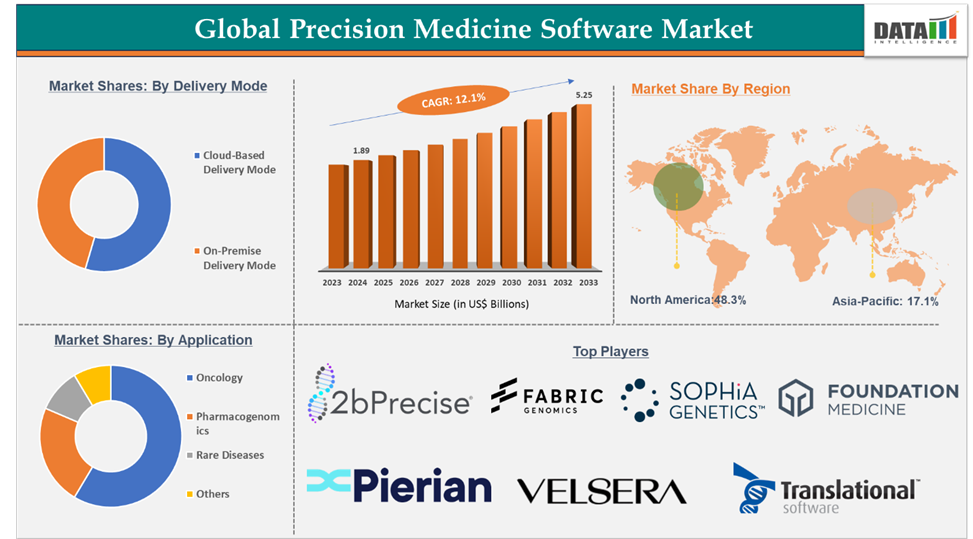
- The precision medicine software market growth is accelerating at 12.1% CAGR, significantly outpacing traditional healthcare IT segments.
- Cloud-based delivery holds 54.5% market share, driven by scalability and cross institution collaboration needs.
- North America dominates with 48.3% share, supported by strong research ecosystems and government initiatives.
- Asia-Pacific is expected to grow at 14.5% CAGR, reflecting rapid healthcare digitization and genomic investments.
- AI integration is becoming a core differentiator, improving diagnostic accuracy and treatment personalization.
- Data interoperability remains a critical bottleneck, limiting full scale deployment across healthcare systems.
- Increasing regulatory approvals and funding are accelerating commercialization of precision medicine platforms.
Market Dynamics: Technology, Data, and Clinical Outcomes Converge
Rising Demand for Personalized Healthcare Solutions
The shift toward personalized medicine is the primary growth engine of the precision medicine software market. Healthcare providers are increasingly leveraging genomic, clinical, and lifestyle data to deliver targeted treatments. This reduces trial and error prescribing and enhances patient outcomes, particularly in oncology and rare diseases.
The integration of artificial intelligence and machine learning enables real-time analysis of complex datasets, allowing clinicians to make faster and more accurate decisions.
Data Integration and Cost Barriers Limit Adoption
Despite strong demand, adoption is constrained by high implementation costs and infrastructure requirements. Integrating diverse datasets such as genomic sequencing, electronic health records, and clinical trial data remains technically complex.
Interoperability challenges and lack of standardized data frameworks create inefficiencies, particularly in developing regions where digital infrastructure is still evolving.
Segment Analysis: Cloud Platforms Lead, Oncology Drives Use Cases
Segmented by delivery mode (cloud-based, on-premise), by application (oncology, pharmacogenomics, rare diseases, others), by end user (healthcare providers, research institutes, pharmaceutical & biotechnology companies), and by Region - Share, Trends, and Forecast to 2035.
Cloud-Based Delivery: Enabling Scalable Precision Medicine
With 54.5% market share, cloud-based solutions dominate due to their ability to handle large-scale genomic datasets and enable collaboration across institutions. These platforms reduce the need for heavy IT infrastructure and support real-time analytics, making them highly suitable for precision medicine applications.
Cloud adoption is further supported by increasing demand for interoperable systems and remote access to clinical data.
Oncology Applications: Leading Clinical Adoption
Oncology remains the primary application area due to the complexity of cancer treatment and the need for personalized therapeutic approaches. Precision medicine software enables clinicians to identify genetic mutations and tailor treatment plans accordingly.
Other applications such as pharmacogenomics and rare diseases are also gaining traction, driven by advancements in genomic research.
Regional Analysis: Innovation vs Expansion Dynamics
North America: Established Leadership Through Innovation
North America holds the largest precision medicine software market share at 48.3%, supported by advanced healthcare infrastructure, strong research funding, and early adoption of digital health technologies.
The U.S. leads with initiatives such as the Precision Medicine Initiative and widespread adoption of electronic health records, enabling seamless integration of precision medicine software.
Asia-Pacific: Fastest Growth Driven by Healthcare Transformation
Asia-Pacific is the fastest-growing region with a CAGR of 14.5%, fueled by increasing investments in healthcare digitization and genomic research. Countries such as China, Japan, and South Korea are actively developing precision medicine programs to address rising chronic disease burdens.
Government support and expanding healthcare infrastructure are accelerating adoption across the region.
Europe: Collaborative Research and Regulatory Support
Europe is characterized by strong collaboration between academic institutions, healthcare providers, and technology companies. Regulatory frameworks supporting data sharing and patient privacy are shaping the development and deployment of precision medicine solutions.
Competitive Landscape: AI Integration and Platform Expansion Define Competition
The precision medicine software market is moderately competitive, with companies focusing on AI integration, platform scalability, and data interoperability.
Key players include 2bPrecise, Fabric Genomics, Sophia Genetics, Foundation Medicine, PierianDx, Velsera, MediCardia Health, and Translational Software.
Competitive strategies include:
- Development of AI-powered diagnostic tools
- Expansion of cloud-based platforms
- Partnerships with healthcare providers and research institutions
- Focus on regulatory approvals and clinical validation
Recent Developments
In June 2026, Tempus AI, Inc. expanded its precision medicine software platform with advanced AI-driven analytics for genomic data interpretation and clinical decision support. The innovation focuses on personalized treatment insights. This supports improved patient outcomes.
In May 2026, Illumina, Inc. introduced enhanced bioinformatics software solutions for genomic sequencing and precision medicine applications. The development improves data accuracy and workflow efficiency. This benefits healthcare providers and researchers.
In April 2026, IBM Corporation launched AI-powered precision medicine platforms with predictive analytics and real-world data integration. The development enhances clinical decision-making. This supports personalized healthcare strategies.
In March 2026, Oracle Health strengthened its precision medicine capabilities with cloud-based data platforms for integrating genomic and clinical data. The innovation focuses on interoperability and scalability. This supports advanced healthcare systems.
In February 2026, NVIDIA Corporation introduced accelerated computing platforms and AI frameworks for precision medicine and genomics research. The development improves processing speed and data analysis capabilities. This benefits life sciences organizations.
In January 2026, Flatiron Health (Roche Group) expanded its oncology-focused precision medicine software with real-world evidence and analytics tools. The focus is on data-driven treatment optimization. This supports cancer care advancements.
Regulatory and Policy Landscape
Regulatory frameworks are evolving to support precision medicine while ensuring patient data privacy and security. Governments are promoting the adoption of digital health technologies through funding initiatives and policy support.
Data protection regulations and interoperability standards are critical factors influencing software development and deployment strategies.
Strategic Insights and Analyst Perspective
The precision medicine software market is entering a phase where clinical validation, interoperability, and scalability will determine competitive positioning. Companies that can integrate AI with robust data management capabilities will have a clear advantage.
Strategic priorities include:
- Enhancing data integration capabilities
- Expanding cloud-based solutions
- Strengthening partnerships across healthcare ecosystems
- Navigating regulatory requirements effectively
Report Benefits
This precision medicine software market report supports:
- Healthcare providers in adopting data-driven treatment models and improving patient outcomes
- Pharmaceutical companies in accelerating drug development and clinical trials
- Investors in identifying high-growth digital health opportunities
- Technology providers in aligning product development with clinical needs
- Research institutions in leveraging data analytics for advanced studies
Target Audience
- Healthcare providers and hospital networks
- Pharmaceutical and biotechnology companies
- Health IT and software vendors
- Research institutions and academic centers
- Investors and venture capital firms




























































