


Digital Health Market Size and Forecast
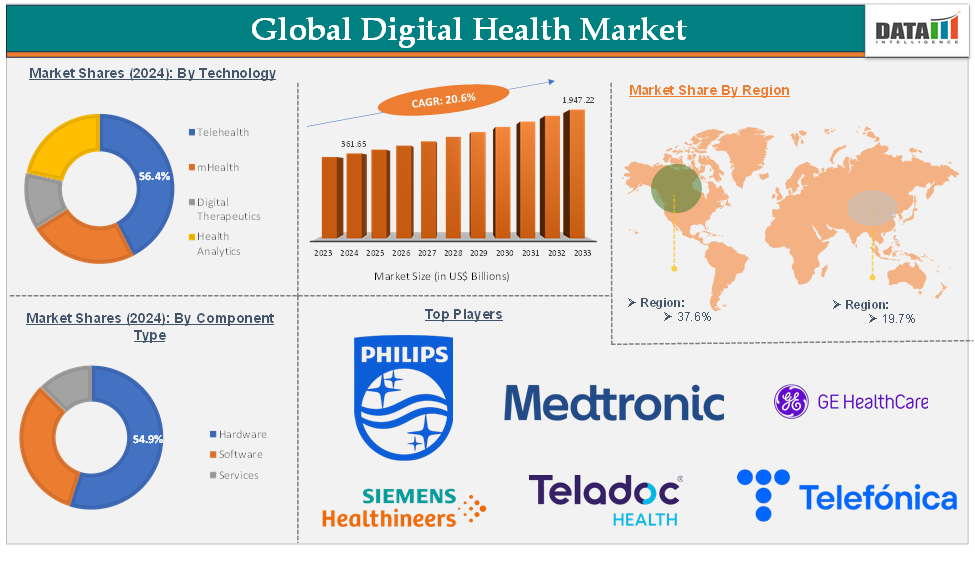
The Digital Health Market will reach US$ 526.75 billion in 2026, up from US$ 436.77 billion in 2025, and is projected to reach US$ 2,973.43 billion by 2035, registering exceptional growth at a CAGR of 20.6% during the forecast period from 2026 to 2035.
Digital health is the integration of digital technologies into healthcare systems and services, aimed at enhancing health outcomes, improving patient care, and optimizing healthcare delivery. These applications enable users to manage their health through smartphones and tablets, providing features like health tracking, medication reminders, and access to telehealth services.
The increasing adoption of digital healthcare, rapid technological innovations, including wearable devices, mobile health applications, and artificial intelligence (AI) enabled diagnostics, and telemedicine platforms, are significantly enhancing healthcare delivery and patient engagement. These advancements facilitate real-time monitoring and data collection, improving overall health management.
North America holds a major portion of the market share owing to the advanced treatment options, the rise in the prevalence of ocular diseases, and increasing research and development of efficient drugs and innovative products for digital health treatment.
Digital Health Market Executive Summary
For more details on this report, Request for Sample
Digital Health Market Scope
| Metrics | Details | |
| CAGR | 20.6% | |
| Market Size Available for Years | 2022-2035 | |
| Estimation Forecast Period | 2026-2035 | |
| Revenue Units | Value (US$ Bn) | |
| Segments Covered | Component Type | Hardware, Software, Services |
| Technology | Telehealth, mHealth, Digital Therapeutics, Health Analytics | |
| Delivery Mode | On-Premise Solutions, Cloud-Based Solutions | |
| Application | Chronic Disease Management, Diabetes Management, Cardiovascular Health, Behavioral Health, Health & Fitness, Oncology, Sleep Apnea Management, Others | |
| End-User | Healthcare Providers, Healthcare Payers, Patients & Consumers, Others | |
| Regions Covered | North America, Europe, Asia-Pacific, South America, and the Middle East & Africa | |
Key Takeaways
- North America accounted for approximately 42.5% of the global Digital Health Market in 2025, supported by widespread adoption of telehealth, AI-powered healthcare solutions, advanced healthcare IT infrastructure, and favorable reimbursement policies.
- Software and digital platform solutions represented approximately 47.8% of total market revenue, driven by rapid adoption of cloud-based healthcare management systems, AI-enabled clinical software, telemedicine platforms, and electronic health records.
- Healthcare providers remain the largest end-user segment, supported by increasing investments in hospital digitalization, remote patient monitoring, clinical workflow automation, and value-based care initiatives.
- Artificial intelligence, digital therapeutics, wearable health technologies, remote patient monitoring, cloud healthcare platforms, and interoperable electronic health records are transforming healthcare delivery by improving clinical outcomes, operational efficiency, and patient engagement.
- Leading healthcare technology companies continue expanding strategic collaborations with hospitals, pharmaceutical companies, insurers, and government organizations to accelerate digital transformation and integrated healthcare delivery.
- Growing investments in AI-enabled healthcare, personalized medicine, telehealth, cybersecurity, and healthcare interoperability are expected to create substantial long-term growth opportunities across the global Digital Health Market.
Digital Health Market Dynamics: Drivers
Increasing adoption of digital healthcare
The global digital health market is driven by multiple factors. One of the key factors is that the increasing adoption of digital healthcare is expected to drive the market. Digital healthcare includes the need for improved patient care, enhanced access to services, and the demand for more efficient healthcare systems.
Digital health technologies allow providers to gather and analyze patient data more effectively. EHRs enable the integration of comprehensive patient histories, including previous treatments, medications, and outcomes. This information helps healthcare providers create personalized treatment plans that cater to individual patient needs, improving the relevance and effectiveness of care.
Furthermore, key players’ strategies such as partnerships & collaborations, and product launches would drive this market growth. For instance, in October 2024, sehatUP, a health tech startup, launched a digital health clinic to bring a holistic approach to healthcare. Using technology, it provides tailored treatment plans that integrate modern medicine, ayurveda, and homeopathy to address individual health needs.
Global Digital Health Market Dynamics: Restraints
Privacy and data security concerns
Privacy and data security concerns are significant restraints in the global digital health market due to the sensitive nature and sheer volume of personal health information (PHI) being collected, stored, and transmitted by digital health platforms.
As healthcare systems increasingly adopt technologies like telemedicine, mobile health apps, and the Internet of Medical Things (IoMT), the risk of cyberattacks and unauthorized data access has surged dramatically, with healthcare organizations experiencing a notable rise in cyberattacks in recent years. Medical data is highly valuable on the black market, making it a prime target for criminals seeking to commit identity theft, insurance fraud, or illicitly obtain medical equipment.
Digital Health Market - Segment Analysis
The global digital health market is segmented based on component type, technology, delivery mode, application, end-user, and region.
Technology:
The telehealth technology segment is expected to hold 56.4% of the global digital health market in 2024
Telehealth segment of the Digital Health Market experienced substantial growth, increasing from an estimated $128.05 billion in 2023 to $148.28 billion in 2024.
Telehealth technology includes video consultations, remote patient monitoring (RPM), long-term care monitoring, and others. Continuous improvements in telehealth technologies, such as mobile applications and wearable devices, enhance patient engagement and streamline healthcare delivery. For instance, the integration of artificial intelligence (AI) and data analytics into telehealth platforms allows for personalized patient care and better health monitoring.
Telehealth technology plays a transformative role in the global digital health market, enhancing access to healthcare while addressing challenges related to chronic disease management and provider shortages. The combination of increasing smartphone penetration and robust government support for digital health initiatives is transforming telehealth into a vital component of modern healthcare. The convenience afforded by these technologies not only empowers patients to monitor their health but also facilitates timely consultations with healthcare providers.
This widespread availability allows patients to easily access telemedicine services, health applications, and wearable health technologies, fostering a proactive approach to healthcare management.
Furthermore, key players in the industry product launches and platforms help to propel this segment’s growth in the market. For instance, in September 2024, Iris Telehealth launched a new Virtual Clinic that incorporates AI insights specifically designed for behavioral health. This initiative aims to enhance the delivery of mental health services by leveraging artificial intelligence to improve patient care and treatment outcomes.
Similarly, in January 2024, Eli Lilly and Company introduced LillyDirect, a new digital healthcare experience designed specifically for patients in the U.S. living with obesity, migraine, and diabetes. This innovative platform aims to streamline disease management by providing a comprehensive suite of resources and services tailored to individual health needs. These factors have solidified the segment's position in the global digital health market.
Digital Health Market Geographical Analysis
North America is expected to hold 37.7% of the global digital health market in 2024
Digital Health Market in North America experienced substantial expansion, increasing from an estimated $116.70B in 2023 to $134.86B in 2024.
The rising prevalence of chronic diseases in the United States is driving the market, with approximately 6 in 10 Americans living with at least one chronic condition. This trend is significant as it drives the demand for digital health solutions that facilitate continuous monitoring and management of these conditions, ultimately improving patient outcomes and reducing hospital visits.
The growing acceptance of telehealth services among consumers has significantly influenced healthcare providers' willingness to adopt digital health solutions. This trend is evident across various dimensions, including convenience, satisfaction, and evolving consumer expectations.
Innovations in technology, including mobile applications, wearable devices, and advanced data analytics, are enhancing the functionality and appeal of digital health solutions. These advancements improve patient engagement and enable more personalized care approaches.
Moreover, in this region, a majority of key players’ presence, well-advanced healthcare infrastructure, government initiatives & regulatory support, product launches & approvals, and partnerships & collaborations would propel this market growth. For instance, in August 2024, Pfizer launched PfizerForAll, a digital platform designed to simplify access to healthcare for millions of Americans. This initiative aims to provide an integrated experience for managing health and wellness, particularly for individuals affected by common illnesses such as migraines and the flu, as well as those seeking adult vaccinations.
Also, in February 2024, the Digital Health Collaborative is a newly formed organization that brings together 14 prominent healthcare and consumer organizations, including the American Telemedicine Association (ATA), AARP, and the American Medical Association (AMA). This collaboration aims to advance evidence-based digital health research and technology adoption, addressing the growing need for effective digital health solutions in the healthcare landscape. Thus, the above factors are consolidating the region's position as a dominant force in the global digital health market.
Digital Health Market Artificial Intelligence and Clinical Decision Support Analysis
Artificial intelligence is becoming the backbone of next-generation digital healthcare by enabling faster diagnosis, personalized treatment planning, predictive analytics, and clinical workflow automation. AI-powered medical imaging, clinical decision support systems, virtual health assistants, ambient clinical documentation, and predictive risk models are helping healthcare providers improve patient outcomes while reducing administrative burden. Major healthcare technology companies including Microsoft, Google, Oracle Health, Epic Systems, Philips, and GE HealthCare are integrating generative AI and machine learning into hospital information systems, electronic health records (EHRs), and diagnostic platforms. AI adoption is expected to significantly improve clinical efficiency, reduce physician burnout, and accelerate value-based healthcare delivery
Digital Health Market Digital Therapeutics and Personalized Healthcare Analysis
Digital therapeutics (DTx) are emerging as an important component of modern healthcare by delivering evidence-based software interventions for the prevention, management, and treatment of chronic diseases. These solutions complement traditional therapies by providing personalized treatment plans, remote coaching, medication adherence monitoring, and behavioral health support. Integration of wearable devices, AI algorithms, genomic data, and patient-generated health information is enabling highly personalized care pathways for diabetes, cardiovascular diseases, respiratory disorders, mental health, obesity, and neurological conditions. As reimbursement frameworks evolve and clinical validation increases, digital therapeutics are expected to become an integral part of routine clinical practice.
Digital Health Market Remote Patient Monitoring and Virtual Care Analysis
Healthcare providers are increasingly deploying Remote Patient Monitoring (RPM), telemedicine, connected medical devices, and home healthcare platforms to improve patient access and reduce hospital admissions. Continuous monitoring of vital signs through smart wearables, biosensors, connected medical devices, and mobile applications enables early disease detection and proactive clinical intervention. Remote care solutions have become particularly valuable for managing chronic diseases, elderly populations, post-operative recovery, and rural healthcare delivery. Integration of cloud platforms and AI-powered analytics is further improving real-time patient monitoring and care coordination across healthcare systems.
Digital Health Market Healthcare Data Interoperability and Cybersecurity Analysis
The growing adoption of digital health platforms has increased the importance of secure health information exchange and interoperability across healthcare ecosystems. Healthcare organizations are investing in interoperable Electronic Health Records (EHRs), Fast Healthcare Interoperability Resources (FHIR)-based platforms, cloud infrastructure, API-enabled health information exchanges, and cybersecurity solutions to enable seamless data sharing while protecting sensitive patient information. Zero-trust security architectures, multi-factor authentication, encryption technologies, blockchain, and AI-powered threat detection are becoming critical components of digital healthcare infrastructure as cyber risks continue to evolve.
Consumer Digital Health and Wearable Ecosystem Analysis
Consumer engagement is reshaping healthcare delivery through wearable devices, mobile health applications, smartwatches, connected fitness platforms, and digital wellness ecosystems. Individuals are increasingly using wearable technologies to monitor heart rate, sleep quality, physical activity, blood oxygen levels, glucose trends, and overall wellness. Companies such as Apple, Fitbit (Google), Samsung, Garmin, Dexcom, Abbott, and Oura continue expanding connected health ecosystems that integrate with healthcare providers and electronic health records. Growing consumer awareness of preventive healthcare is expected to drive continued adoption of digital health solutions worldwide.
Digital Health Market Investment and Strategic Collaboration Analysis
Public and private investments supporting healthcare digitalization, artificial intelligence, precision medicine, cloud computing, and connected healthcare continue creating significant commercialization opportunities within the Digital Health Market. Hospitals, healthcare providers, pharmaceutical companies, insurers, technology firms, and research institutions are investing heavily in AI-powered diagnostics, telehealth platforms, digital therapeutics, wearable technologies, remote patient monitoring, and healthcare analytics. Leading companies including Oracle Health, Epic Systems, GE HealthCare, Philips, Siemens Healthineers, Teladoc Health, Amwell, Medtronic, Microsoft, Google Health, Amazon Health Services, and athenahealth continue strengthening strategic collaborations with healthcare providers, life science companies, insurers, and government agencies to accelerate digital transformation across healthcare systems. AI-enabled healthcare platforms and integrated care ecosystems continue attracting significant strategic investment globally.
Digital Health Market Major Players
The major global players in the digital health market include Koninklijke Philips N.V., Medtronic plc, GE HealthCare, Siemens Healthineers AG, Apple Inc., Teladoc Health, Inc., Telefónica S.A., AT&T, Veradigm LLC (Allscripts Healthcare Solutions Inc.), and AirStrip Technologies, Inc., among others.
Key Developments in Digital Health Market
- July 2026: GE HealthCare expanded its digital health portfolio by advancing AI-enabled imaging, cloud-based clinical workflows, and predictive analytics solutions to improve patient care and operational efficiency.
- July 2026: Koninklijke Philips N.V. strengthened its connected healthcare ecosystem through enhancements to remote patient monitoring, telehealth platforms, and AI-powered clinical decision support solutions.
- June 2026: Siemens Healthineers AG advanced its digital health strategy by expanding AI-powered diagnostic imaging, digital workflow automation, and cloud-enabled healthcare platforms.
- June 2026: Medtronic plc continued enhancing its digital healthcare capabilities through connected medical devices, remote patient monitoring technologies, and AI-driven chronic disease management solutions.
- May 2026: Apple Inc. strengthened its digital health ecosystem by expanding health monitoring features and interoperability capabilities across its wearable devices and health platforms.
- May 2026: Teladoc Health, Inc. advanced its virtual care platform by enhancing AI-assisted telehealth services, remote patient monitoring, and integrated chronic care management solutions.
- April 2026: Telefónica S.A. expanded its digital healthcare services by strengthening secure connectivity, cloud infrastructure, and IoT-enabled healthcare solutions for hospitals and healthcare providers.
- April 2026: Veradigm LLC enhanced its healthcare data analytics and interoperability solutions by advancing cloud-based clinical decision support and population health management platforms.
- March 2026: AT&T Inc. strengthened its healthcare connectivity portfolio by expanding secure 5G networking and edge computing solutions to support digital health applications and connected medical devices.
Why Choose DataM?
Technological Innovations: DataM provides comprehensive analysis of advanced digital health technologies including artificial intelligence, digital therapeutics, telemedicine, remote patient monitoring, wearable devices, Internet of Medical Things (IoMT), cloud healthcare platforms, blockchain, federated learning, digital twins, predictive analytics, and clinical decision support systems transforming modern healthcare.
Product Performance & Market Positioning: The report evaluates how leading companies differentiate their digital health solutions based on interoperability, AI capabilities, diagnostic accuracy, patient engagement, cybersecurity, scalability, regulatory compliance, user experience, clinical outcomes, and healthcare workflow integration.
Real-World Evidence: DataM highlights digital health adoption across hospitals, clinics, home healthcare, diagnostic centers, pharmacies, health insurers, pharmaceutical companies, and public health systems. The report examines industry initiatives involving Oracle Health, Epic Systems, GE HealthCare, Philips, Siemens Healthineers, Teladoc Health, Amwell, Medtronic, Microsoft, Google Health, Amazon Health Services, and athenahealth, demonstrating how AI, telehealth, wearable technologies, cloud computing, and digital therapeutics are improving patient care, operational efficiency, and healthcare accessibility.
Market Updates & Industry Changes: The report tracks AI adoption, telehealth expansion, reimbursement developments, digital therapeutics approvals, interoperability initiatives, cybersecurity regulations, strategic partnerships, mergers and acquisitions, cloud migration, and healthcare policy changes shaping the Digital Health Market.
Competitive Strategies: The report analyzes how leading companies strengthen market leadership through AI innovation, platform integration, cloud-based healthcare ecosystems, strategic acquisitions, digital therapeutics expansion, healthcare partnerships, and personalized medicine capabilities.
Pricing & Market Access: The report evaluates pricing variations based on software licensing, subscription models, cloud deployment, enterprise healthcare platforms, reimbursement frameworks, clinical applications, and managed services while assessing market access through hospitals, healthcare providers, insurers, employers, pharmaceutical companies, government agencies, and consumer health platforms.
Market Entry & Expansion: DataM identifies growth opportunities driven by AI-enabled healthcare, remote patient monitoring, value-based care, precision medicine, digital therapeutics, aging populations, and healthcare digitalization while outlining strategies including technology partnerships, regulatory compliance, cloud platform expansion, regional healthcare integration, and patient-centered innovation.
Target Audience
The Digital Health Market report is designed for hospitals, healthcare providers, physician networks, digital health platform providers, telemedicine companies, pharmaceutical manufacturers, biotechnology companies, health insurers, wearable device manufacturers, medical device companies, Electronic Health Record (EHR) providers, healthcare IT companies, cloud service providers, diagnostic laboratories, government healthcare agencies, research institutions, investors, venture capital firms, private equity organizations, healthcare consultants, and strategic decision-makers seeking insights into digital healthcare technologies, AI adoption, competitive positioning, regulatory trends, and long-term investment opportunities.




























































