


Precision Fermentation Market Size
The global precision fermentation market reached US$ 6.54 billion in 2025 and is projected to reach US$ 180.45 billion by 2035, expanding at a CAGR of 39.3% during 2026-2035. The market is moving from venture-backed technology validation toward commercial ingredient supply, customer qualification and industrial manufacturing. Growth will be concentrated in ingredients where biological production offers high functionality, consistent purity, supply security or access to molecules that are scarce through conventional extraction.
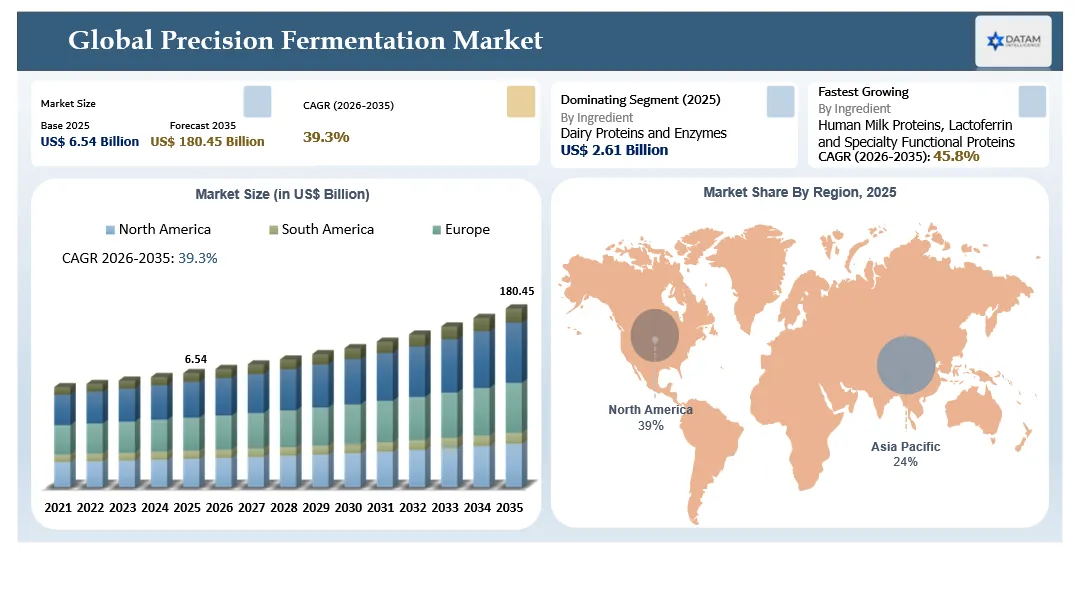
Commercial momentum is visible across whey proteins, casein, lactoferrin, egg proteins, collagen, specialty fats and human milk components. Sector investment rebounded from US$ 151 million in 2023 to US$ 321 million in 2024. Vivici raised EUR 32.5 million in February 2025 to commercialize its Vivitein beta-lactoglobulin platform. In late 2025, All G raised more than A$10 million and formed a joint venture with Armor Proteines to scale bovine and human lactoferrin. Its first bovine lactoferrin product was scheduled for launch in early 2026, showing the transition from R&D to regulated ingredient sales.
The central commercial challenge is cost-effective scale-up. Fermentation companies must improve strain productivity, reduce feedstock cost, increase vessel utilization and lower downstream purification expense. Buyers also require regulatory clearance, stable sensory performance and reliable multi-year supply. The strongest companies will combine differentiated biology with contract manufacturing, application support, customer partnerships and a disciplined path to high-value markets before moving into mass-volume proteins.
| Metric | Details |
| 2025 Market Size | US$ 6.54 Billion |
| 2035 Projected Market Size | US$ 180.45 Billion |
| CAGR (2026-2035) | 39.3% |
| Largest Region | North America |
| Fastest Growing Region | Asia-Pacific |
| Largest Ingredient Segment | Dairy proteins and enzymes |
| Fastest Growing Ingredient Segment | Human milk proteins, lactoferrin and specialty functional proteins |
| Report Insights | Commercial launches, scale-up economics, regulation, manufacturing capacity, buyer qualification and investment opportunities |
Precision Fermentation Market Key Takeaways
- The market is estimated at US$ 6.54 billion in 2025 and projected to reach US$ 180.45 billion by 2035.
- North America remains the largest market because of regulatory experience, venture funding, ingredient innovation and early commercial adoption.
- Asia-Pacific is the fastest growing region, supported by food-security priorities, biomanufacturing investment and strong demand for premium nutrition ingredients.
- Dairy proteins and enzymes represent the largest commercial base, while human milk proteins and lactoferrin create the strongest premium-value opportunity.
- Investment is shifting toward companies with regulatory clearance, customer contracts, manufacturing access and a clear margin pathway.
- Shared fermentation plants, contract manufacturing and joint ventures are becoming essential because dedicated facilities require substantial capital and specialist operating capability.
- All G raised more than A$10 million in late 2025, bringing total capital raised to about A$50 million, and formed a joint venture with Armor Proteines for bovine and human lactoferrin.
- All G reported that conventional production can require about 10,000 litres of cow milk to obtain one kilogram of lactoferrin, illustrating the supply advantage of fermentation-based production.
- Vivici raised EUR 32.5 million in February 2025 to support global commercialization of Vivitein beta-lactoglobulin.
- A proposed Abu Dhabi protein fermentation ecosystem includes a planned four-million-litre industrial facility, highlighting government-backed regional capacity development.
Why Does This Report Matter in 2026?
Precision fermentation entered 2026 with a clearer divide between technology platforms and commercially executable businesses. Buyers are no longer satisfied with proof that a microorganism can produce a target molecule. They need evidence that the ingredient can be manufactured repeatedly, cleared by regulators, delivered at contracted volume and incorporated into a product that consumers will purchase. This report supports decisions on which proteins are closest to scale, which applications can absorb premium pricing and where manufacturing bottlenecks may limit growth.
The All G funding and joint venture illustrate the new commercialization model. The company secured more than A$10 million ahead of a Series B and combined its fermentation platform with Armor Proteines manufacturing and market expertise. Its bovine lactoferrin product is positioned for commercial launch, while human-identical breast milk proteins follow a longer regulatory pathway. This separates near-term cash generation from longer-duration platform value and provides a model for other companies managing high-value pipelines.
Precision Fermentation Market White Space and Investment Opportunities
- Human lactoferrin, beta-casein and other human milk proteins for infant, maternal and clinical nutrition.
- Beta-lactoglobulin and casein platforms designed for sports nutrition, medical nutrition, beverages and functional foods.
- Contract manufacturing and shared fermentation capacity for companies without dedicated large-scale plants.
- Downstream processing platforms that reduce protein recovery, filtration and purification cost.
- AI-enabled strain design, media optimization and digital bioprocess control.
- Low-cost regional feedstocks and circular carbon inputs that reduce dependence on refined glucose.
- Regulatory dossier, toxicology and application-support services for novel ingredients.
Precision Fermentation Future Market Transformation
The market will transform from a collection of single-product startups into an integrated bioingredient ecosystem. Ingredient platforms will prioritize molecules that are scarce, expensive or difficult to source consistently before expanding toward commodity proteins. Large food and ingredient companies will use joint ventures, licensing and strategic investment to access intellectual property without carrying all early-stage development risk. Contract manufacturers will become more influential because they determine whether a promising strain can be converted into reliable commercial output.
Precision Fermentation Market Buyer Decision-Making Criteria
Buyers evaluate precision-fermented ingredients through functional equivalence, purity, sensory performance, regulatory status, allergen position, formulation behavior, supply continuity, price trajectory and sustainability evidence. Infant nutrition buyers require the highest documentation burden. Sports nutrition companies may adopt faster when the protein offers strong amino acid quality and solubility. Food manufacturers prioritize taste, texture, melting, emulsification and heat stability. The winning supplier must support formulation trials and provide a credible path from sample volume to multi-year commercial supply.
Precision Fermentation Market Economic and Investment Analysis
Investment has become more selective after the 2021-2022 funding peak. Capital is moving toward companies with defined regulatory pathways, premium initial applications and credible manufacturing access. All G raised over A$10 million in a convertible note round and reported total funding of about A$50 million. Vivici secured EUR 32.5 million in Series A funding. AuX Labs raised US$ 4 million in April 2026 to commercialize a cheese platform. These rounds are smaller and more execution-focused than earlier growth capital, reflecting investor demand for measurable commercialization milestones.
Investment Trends in the Market
- Funding for high-value proteins with clear B2B customers and higher price tolerance.
- Joint ventures between biotechnology companies and established dairy or ingredient manufacturers.
- Regional government support for fermentation infrastructure and bioeconomy clusters.
- Investment in 100,000-litre and larger flexible fermentation assets, downstream processing and food-grade purification.
- Strategic corporate participation through minority investment, offtake agreements and commercial partnerships.
Strategic Indicators
| Indicator | Current Position | Strategic Meaning |
| Regulation | High impact | Approval timing determines revenue conversion and market sequencing. |
| Manufacturing capacity | Constrained | Shared facilities and contract manufacturing are major growth enablers. |
| Funding environment | Selective recovery | Capital favors commercial milestones over platform-only narratives. |
| Buyer qualification | Lengthening | Food companies require application data and supply assurance. |
| Pricing | Premium-first | High-value nutrition and specialty ingredients support early margins. |
| AI adoption | Increasing | Improves strain design, yield optimization and process control. |
AI Impact Analysis
AI can shorten strain-development cycles by predicting promoter selection, pathway bottlenecks, protein expression and host compatibility. Machine learning can optimize media composition, oxygen transfer, feeding strategy and harvest timing. At commercial scale, digital twins can reduce failed batches and improve vessel utilization. Standardized bioprocess data remains a barrier, making interoperable ontologies and machine-readable process records strategically important for future automation.
Disruption Analysis
Precision fermentation disrupts conventional ingredient supply by separating molecular production from livestock, seasonality and geographic concentration. The disruption is strongest where conventional extraction is inefficient. Lactoferrin is a clear example because large milk volumes are required to isolate small quantities. Fermentation can create supply at a consistent specification and potentially expand use beyond premium products. The technology also changes bargaining power because intellectual property, strain performance and downstream know-how become as important as agricultural assets.
Precision Fermentation Market Dynamics
| Driver | Market Growth Impact | Demand Concentration | Impacted Use Case | Strategic Impact |
| Commercial protein launches | 28% | North America, Europe, Australia | Dairy, egg and lactoferrin | Validates customer demand and creates repeat orders. |
| New funding and corporate partnerships | 24% | Global | Scale-up and manufacturing | Finances regulatory work, capacity and market entry. |
| Food security and supply resilience | 18% | Asia-Pacific, Middle East | Nutrition proteins and ingredients | Supports local biomanufacturing investment. |
| AI and synthetic biology progress | 16% | U.S., Europe, Israel, Singapore | Strain optimization | Improves yield and lowers development cost. |
| Sustainability procurement | 14% | Europe, North America | Animal-free and lower-impact ingredients | Creates differentiation where verified data is available. |
Driver: Commercial Protein Launches Are Converting Technical Validation into Procurement Demand
Commercial launches matter because they force companies to solve regulatory, quality, manufacturing and distribution problems simultaneously. The launch of recombinant bovine lactoferrin by All G, beta-lactoglobulin commercialization by Vivici and cheese-focused platforms from New Culture and AuX Labs demonstrate that the market is moving toward specific products rather than broad technology claims. Each launch creates follow-on demand for contract capacity, application testing, customer qualification and ingredient distribution.
| Restraint | Drag on Growth | Primary Impact Area | Strategic Effect |
| High production cost | 24% | Commodity proteins | Limits adoption until yield and downstream costs improve. |
| Downstream processing burden | 21% | Purified proteins | Can account for a major portion of total production cost. |
| Regulatory complexity | 18% | Novel food and infant nutrition | Delays launch and increase evidence requirements. |
| Capacity shortage | 16% | Scale-up | Forces reliance on external manufacturers and long scheduling windows. |
| Consumer communication | 12% | Retail products | Requires careful positioning around biotechnology and labeling. |
Restraint: Scale-Up Economics Remain the Main Commercial Filter
A high-performing laboratory strain does not guarantee commercial economics. Large vessels introduce oxygen-transfer, heat-removal, contamination and mixing constraints. Downstream recovery can erase upstream yield gains when the molecule requires multiple purification steps. Companies must select applications where the value of functionality is high enough to support early production cost while process improvements move the ingredient toward broader markets.
Precision Fermentation Market Segmentation Analysis
The market is segmented by microbe, ingredient, application, production platform, end user, business model, manufacturing scale and region. The expanded segmentation reflects different strain requirements, regulatory burdens, cost structures and customer qualification pathways.
By Microbe: Yeast Remains the Leading Production Host
Yeast remains the most widely used host because of established food-grade fermentation, strong protein-expression capability and industrial processing experience. Bacteria can offer rapid growth and high productivity for selected proteins. Filamentous fungi are attractive for enzymes and secreted proteins. Emerging hosts are being developed for difficult post-translational modifications, lipids and specialty molecules.
By Ingredient: Dairy Proteins Form the Largest Commercial Category
Whey proteins, beta-lactoglobulin, casein and lactoferrin are the most visible precision-fermented food ingredients. Their functionality is familiar to formulators and can be benchmarked against conventional dairy. Human milk proteins offer higher value but carry greater regulatory requirements. Egg proteins, collagen, gelatin, fats, enzymes and flavor molecules diversify the addressable market.
By Application: Food and Beverages Lead, Infant and Clinical Nutrition Create Premium Growth
Food and beverages provide the broadest application base, but initial commercial margins are often stronger in active nutrition, clinical nutrition, infant nutrition and supplements. Personal care and therapeutics offer additional value for proteins such as lactoferrin and collagen. Industrial biotechnology applications can absorb fermentation capacity when product specifications and economics align.
By Production Platform: Fed-Batch Submerged Fermentation Dominates
Fed-batch submerged fermentation is the core production route because it balances process control, yield and industrial familiarity. Continuous fermentation offers productivity advantages but requires stronger contamination control and process stability. Integrated downstream processing is becoming a major differentiator because purification economics determine commercial competitiveness.
By End User: Food and Nutrition Companies Are Moving from Trials to Structured Supply Agreements
Large food and nutrition companies increasingly conduct formulation trials, regulatory review and supply-chain assessment before committing to launch. Biotechnology companies need application partners that can translate an ingredient into a product. Contract manufacturers and ingredient distributors are gaining influence because they provide scale and customer access.
By Business Model: Ingredient Supply and Joint Ventures Will Outperform Standalone Consumer Brands
Ingredient supply allows platform companies to serve several categories without funding large consumer-marketing programs. Joint ventures combine technology with manufacturing, regulatory and commercial reach. Licensing can expand geographically with lower capital needs. Branded consumer products remain useful for demonstrating functionality but can require high customer-acquisition spending.
By Manufacturing Scale: Commercial Capacity Is the Critical Bottleneck
Laboratory and pilot capacity is widely available relative to commercial food-grade fermentation and downstream processing. Demonstration plants help validate scale but may not support full customer demand. Commercial facilities require significant capital, operating expertise and reliable utilization. Shared facilities and regional hubs can reduce risk for emerging companies.
By Regulatory Readiness: Adult Nutrition and Supplements Offer Faster Entry than Infant Formula
Regulatory sequencing is becoming a strategic segmentation lens. Adult nutrition, supplements and selected foods can provide earlier market access. Infant formula and human-identical milk proteins require deeper safety, clinical and manufacturing evidence. Companies can use a staged strategy in which an initial ingredient generates revenue while higher-value applications progress through longer approval pathways.
Precision Fermentation Market Geographical Penetration
| Region | Indicative 2025 Share | Position | Primary Opportunity |
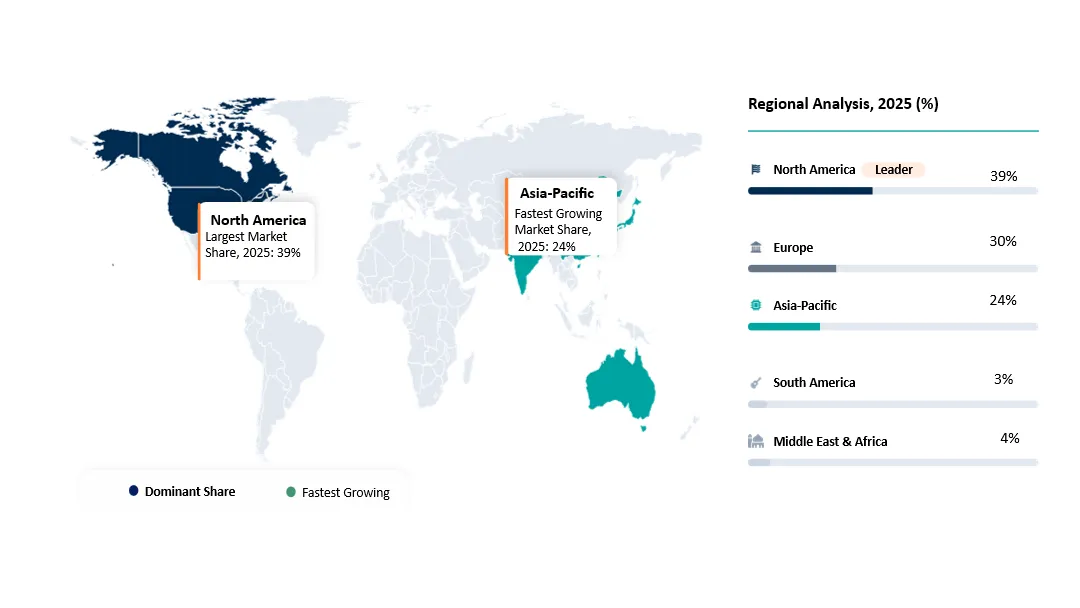
| North America | 39% | Largest | Commercial proteins, regulatory pathways and scale-up capital |
| Europe | 30% | Innovation and industrial partnerships | Dairy proteins, egg proteins and sustainable ingredients |
| Asia-Pacific | 24% | Fastest growing | Infant nutrition, food security and biomanufacturing localization |
| South America | 3% | Emerging | Feedstocks, food ingredients and regional manufacturing |
| Middle East and Africa | 4% | Strategic investment market | Government-backed fermentation capacity and food security |
North America Precision Fermentation Market
The U.S. remains the largest commercial market through biotechnology funding, regulatory experience and food-company partnerships. Commercial opportunities include whey proteins, egg proteins, lactoferrin, collagen and specialty ingredients. Canada is building strength in fermentation-based dairy and cheese platforms, including AuX Labs. Mexico can support manufacturing and regional food production as capacity develops.
Europe Precision Fermentation Market
Europe combines dairy expertise, fermentation engineering and strong consumer demand for sustainable ingredients. The Netherlands is an important hub through Vivici and other ingredient companies. Denmark supports industrial biotechnology and contract manufacturing. Germany, France and the UK provide research, food manufacturing and regulatory capabilities. Novel food approval timelines remain a key commercial consideration.
Asia-Pacific Precision Fermentation Market
Asia-Pacific is the fastest growing region. Australia is emerging through All G, Eden Brew and Cauldron Ferm. China offers a large infant nutrition and functional ingredient market, although regulatory entry requires local strategy. India is expanding bioprocess infrastructure and can provide lower-cost engineering and manufacturing capability. Singapore, South Korea and Japan support biotechnology research, food innovation and regional investment.
South America Precision Fermentation Market
Brazil and Argentina offer sugar, agricultural feedstocks, food manufacturing and established fermentation industries. The near-term opportunity is more likely to involve enzymes, flavors, animal nutrition and contract production before broad consumer protein adoption. Regional partnerships can reduce import dependence and use local carbon sources.
Middle East and Africa Precision Fermentation Market
The UAE is pursuing a regional protein fermentation ecosystem and a proposed four-million-litre industrial facility, demonstrating how food security can drive infrastructure investment. Saudi Arabia may follow through biotechnology and food localization programs. Israel provides synthetic biology capability. South Africa offers food manufacturing and regional distribution potential.
| Country | Priority Opportunity | Buyer-Intent Insight |
| U.S. | Dairy and egg proteins, lactoferrin, collagen | Buyers prioritize regulatory status, functional equivalence and volume assurance. |
| Netherlands | Whey and dairy protein platforms | Strong dairy-industry partnerships support commercialization. |
| Australia | Human milk proteins, lactoferrin and shared capacity | Government grants and strategic investors support scale-up. |
| China | Infant nutrition and functional proteins | Local regulatory clearance and distribution partnerships are essential. |
| India | Contract fermentation and process engineering | Cost-efficient scale-up and BioE3 policy support create opportunity. |
| UAE | Industrial fermentation hub | Government-backed capacity can serve regional food security goals. |
Precision Fermentation Market Competitive Landscape
- Competition is moving from strain discovery toward regulatory clearance, customer qualification and manufacturing execution.
- Established ingredient and dairy companies are entering through joint ventures, strategic investment and commercialization agreements.
- Companies with premium initial products can fund process improvement before entering larger-volume categories.
- Contract manufacturers and fermentation infrastructure providers are becoming strategic partners rather than simple suppliers.
- Regulatory dossiers, formulation support and multi-region approvals are major competitive barriers.
- Consolidation is likely as platforms seek stronger balance sheets and underutilized capacity requires higher throughput.
Key Companies of Precision Fermentation Market
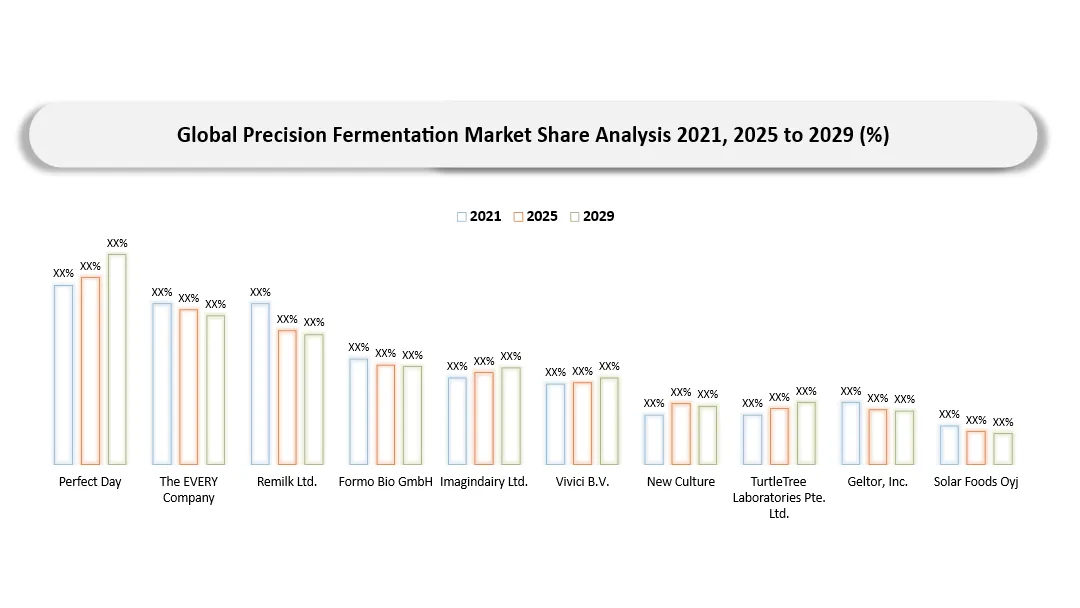
- Perfect Day (United States)
- The EVERY Company (United States)
- Imagindairy Ltd. (Israel)
- Vivici B.V. (Netherlands)
- All G Foods (Australia)
- Remilk Ltd. (Israel)
- New Culture (United States)
- Formo Bio GmbH (Germany)
- Change Foods (United States)
- TurtleTree Laboratories Pte. Ltd. (Singapore)
- Helaina Inc. (United States)
- Geltor, Inc. (United States)
- Shiru, Inc. (United States)
- Onego Bio Ltd. (Finland)
- Eden Brew Pty Ltd. (Australia)
- Melt&Marble AB (Sweden)
- Liberation Labs Holdings, Inc. (United States)
- 21st.BIO A/S (Denmark)
- Cauldron Ferm Pty Ltd. (Australia)
- Solar Foods Oyj (Finland)
Precision Fermentation Market Major Pain Points
- High fermentation and purification cost for lower-value proteins.
- Limited access to commercial food-grade fermentation and downstream processing capacity.
- Long regulatory approval timelines across novel food and infant nutrition categories.
- Difficulty translating laboratory yield into stable large-scale production.
- Need for customer application support, sensory testing and formulation redesign.
- Inconsistent sustainability claims caused by feedstock, energy mix and facility assumptions.
- Consumer confusion around genetically engineered production organisms and final ingredient labeling.
- Funding gaps between pilot validation and full commercial scale.
Precision Fermentation Market Recent Developments
- December 2025: All G raised more than A$10 million in a convertible note round and formed a joint venture with Armor Proteines to produce and commercialize bovine and human lactoferrin.
- January 2026: Agronomics invested an additional A$3 million in All G as the company moved toward commercial rollout.
- March 2026: All G received an A$1.1 million New South Wales government grant to scale human beta-casein for infant nutrition.
- April 2026: All G reported U.S. regulatory clearance for its cow-free lactoferrin ingredient for adult nutrition applications.
- February 2025: Vivici raised EUR 32.5 million to accelerate commercialization and international expansion of Vivitein beta-lactoglobulin.
- April 2026: AuX Labs raised US$ 4 million to commercialize a precision-fermented cheese platform.
- October 2025: Abu Dhabi Investment Office announced a protein fermentation ecosystem involving The EVERY Company and Vivici, with a proposed four-million-litre industrial facility.
Analyst View / Opinion
- The market will be won by companies that prove commercial supply, not only biological capability.
- High-value proteins such as lactoferrin and human milk components provide the strongest early margin pathway.
- Joint ventures with established ingredient companies can materially reduce manufacturing and market-entry risk.
- Commercial capacity and downstream processing will remain tighter than laboratory innovation capacity.
- Asia-Pacific and the Middle East will use food security and bioeconomy policy to accelerate regional infrastructure.
- Long-term leadership will depend on cost reduction, regulatory breadth, application support and customer contracts.
Precision Fermentation Market Target Audience
| Industry | Who Should Buy This Report? | Reason to Buy |
| Precision Fermentation Companies | CEOs, strategy heads, product leaders | To prioritize ingredients, applications, manufacturing partners and market entry. |
| Food and Beverage Manufacturers | R&D, procurement and innovation teams | To identify commercial proteins, qualification requirements and supply risk. |
| Nutrition Companies | Infant, clinical and sports nutrition teams | To evaluate lactoferrin, whey, casein and human milk protein opportunities. |
| Ingredient Companies | Business development and portfolio teams | To screen licensing, partnership and acquisition opportunities. |
| Equipment and CDMO Providers | Bioreactor, filtration and contract manufacturing teams | To estimate demand for scale-up, downstream processing and shared infrastructure. |
| Investors and Consultants | Private equity, venture capital and advisory teams | To evaluate commercial readiness, funding needs and white-space opportunities. |
| Government and Development Agencies | Bioeconomy and food-security teams | To identify regional capacity gaps and investment priorities. |
Why Choose DATAM?
- Data-driven insights covering market sizing, commercial launches, regulatory status, manufacturing capacity and buyer qualification.
- Post-purchase analyst support for target screening, partner identification and regional market entry.
- White papers and case studies covering lactoferrin, dairy proteins, egg proteins, fermentation capacity and infant nutrition.
- Annual updates to reflect approvals, funding, commercial launches and capacity changes.
- Specialized coverage of North America, Europe, Asia-Pacific, Middle East and emerging biomanufacturing hubs.
What DATAM Uniquely Provides
- Detailed 10-year forecasts by microbe, ingredient, application, production platform, end user, business model, manufacturing scale and region.
- Commercial readiness analysis covering regulatory status, customer partnerships, product launches and scale-up capability.
- Buyer decision intelligence covering performance, price, formulation, documentation and volume security.
- Investment analysis covering funding, government support, joint ventures, contract capacity and infrastructure.
- Country-level recommendations for ingredient companies, manufacturers, investors and policymakers.
Questions This Report Answers
- Which precision-fermented ingredients will commercialize fastest through 2035?
- Where can premium proteins support viable economics before commodity cost parity?
- Which companies have regulatory, manufacturing and customer advantages?
- How will joint ventures and contract manufacturing shape market structure?
- Which countries offer the strongest biomanufacturing and food-security investment opportunity?
- How will AI improve strain design, process control and downstream efficiency?



























































