


Marine Aluminum Market Size
The global marine aluminum market reached US$1,892.79 million in 2025 and is expected to reach US$2,431.45 million by 2033, growing at a CAGR of 3.18% during the forecast period 2026-2033. This growth is primarily attributed to the increasing adoption of lightweight, corrosion-resistant materials to enhance fuel efficiency and meet stringent maritime emission standards. Additionally, the rising demand for high-performance alloys in shipbuilding, naval vessels, and luxury yachts is further driving market expansion.
Marine Aluminum Industry Trends and Strategic Insights
The Asia-Pacific region emerged as the dominant market in the market, capturing the largest revenue share of 40.91% in 2025.
By product type, the sheet & plates segment is projected to experience the largest market, registering a significant 40.36% in 2025.
Marine Aluminum Market Size and Future Outlook
2025 Market Size: US$1,892.79 million
2033 Projected Market Size:US$2,431.45 million
CAGR (2026-2033): 3.18%
Largest Market: Asia-Pacific
Fastest Market: Europe
Marine Aluminum Market Key Takeaways
- The marine aluminum market is moving toward lightweight, fuel-efficient vessel construction. Demand is increasing as shipbuilders and vessel operators prioritize aluminum’s high strength-to-weight ratio, corrosion resistance and ability to reduce fuel consumption and emissions.
- Asia-Pacific remains the center of gravity. The region accounted for the largest revenue share of 40.91% in 2025, supported by strong shipbuilding capacity, expanding offshore projects and rising aluminum consumption across China, India and other Asian markets.
- Sheets and plates remain the core product category. The segment captured 40.36% of the market in 2025, reflecting its extensive use in hulls, decks and major structural components across passenger ships, cargo vessels, ferries and offshore platforms.
- Marine aluminum adoption is becoming increasingly performance-driven. Shipbuilders are seeking materials that combine low weight with high strength, corrosion resistance, fatigue performance and durability to improve vessel efficiency while maintaining structural integrity.
- Extrusions are gaining strategic importance in lightweight vessel design. Their ability to provide customized shapes with high strength and low weight supports applications including structural frameworks, railings, flooring, masts and marine fittings.
- Emission regulations are accelerating aluminum adoption. IMO efficiency and emission requirements are encouraging shipbuilders to replace heavier materials with lightweight, corrosion-resistant aluminum solutions that can improve fuel efficiency and reduce vessel operating emissions.
- Advanced marine alloys are becoming a competitive differentiator. High-strength 5000-series alloys and other specialized grades are being developed to deliver greater strength, material savings, corrosion resistance and improved environmental performance for marine and offshore applications.
- Sustainability is moving into material selection. Recycled content, life-cycle performance and lower-carbon aluminum are becoming increasingly important as shipbuilders, yacht manufacturers and marine suppliers respond to carbon-neutrality and environmental requirements.
- Trade policy is reshaping marine aluminum sourcing. US aluminum tariffs, EU safeguard measures and the implementation of “melt and pour” origin rules are influencing pricing, import flows, supplier selection and supply-chain resilience across marine aluminum markets.
- Europe is emerging as the fastest-growing regional market. Its advanced shipbuilding industry, naval applications, sustainability regulations and growing demand for lightweight materials are supporting faster market expansion.
- China and India are strengthening Asia-Pacific’s marine aluminum ecosystem. China benefits from its large-scale shipbuilding capacity, while India’s coastal shipping, fishing vessels, patrol boats and initiatives such as Sagarmala are creating additional demand for marine-grade aluminum.
- Competition is shifting toward material innovation and regulatory compliance. Leading producers and marine alloy suppliers are competing on cost efficiency, alloy performance, recycled content, sustainability credentials and compliance with increasingly stringent marine standards.
Marine Aluminum Market Scope
Metrics | Details |
By Product Type | Sheets & Plates, Extrusions, Tubes and Pipes, Others |
By Alloy | Aluminum Silicon Alloy, Aluminum Magnesium Alloy, Others |
By Manufacturing Process | Hot Rolling, Cold Rolling |
By Application | Passenger Ship, Cargo Ship |
By Region | North America, South America, Europe, Asia-Pacific, Middle East and Africa |
Report Insights Covered | Competitive Landscape Analysis, Company Profile Analysis, Market Size, Share, Growth |
Marine Aluminum Market Dynamics
The Push for Lightweighting and Fuel Efficiency
The marine industry is increasingly prioritizing lightweighting to improve fuel efficiency and reduce emissions, making aluminum the material of choice over heavier alternatives like steel. Its reduced weight allows ships to achieve higher speeds, consume less fuel, and carry more cargo while complying with IMO emission standards, lowering operational costs for operators.
This focus on lightweight solutions is evident in recent developments, such as CDT Marine launching The Aluminium Boat Company at Boatlife 2023, addressing the rising demand for aluminum boats in the UK. With strong interest from customers and plans to introduce premium brands like Buster boats and AB ribs, the emphasis on weight reduction and energy efficiency continues to drive aluminum adoption in the marine sector.
Marine Aluminum Market Segmentation Analysis
The Marine Aluminum market is segmented based on product type, alloy, manufacturing process, end-user and region.
Sheets & Plates Dominate Marine Aluminum Market for Hull and Structural Applications
Sheets and plates hold a significant share in the marine aluminum segment because they are essential for building ship hulls, decks, and structural components that require durability, corrosion resistance, and weight optimization. Their use in passenger ships, cargo vessels, ferries, and offshore platforms makes them the primary product type compared to extrusions or tubes, as they provide the large surface areas necessary for marine construction.
This dominance is further highlighted by new product introductions, such as Whittley Marine Group’s launch of the AL Series in June 2025, featuring aluminum boats, motor, and trailer packages designed for strength and performance. The series includes models like the Whittley AL 1150 TS, built with plate and pressed alloy construction to ensure toughness and longevity, reinforcing the critical role of sheets and plates in modern aluminum boat manufacturing.
Extrusions Gain Significant Share in Marine Aluminum Market for Structural Flexibility and Lightweight Design
Extrusions hold a significant share in the marine aluminum sector due to their versatility and strength, making them ideal for structural frameworks, railings, flooring, masts, and fittings in boats and ships. Their ability to be customized into complex shapes while maintaining lightweight properties supports the design of modern, fuel-efficient vessels and high-performance yachts.
Geographical Penetration
Asia-Pacific Dominates Marine Aluminum Market Driven by Shipbuilding Strength and Rising Aluminum Consumption
Asia-Pacific holds a major share in the global marine aluminum sector, driven by its strong shipbuilding industry, expanding offshore energy projects, and increasing adoption of lightweight materials for fuel efficiency. By 2030, aluminum consumption in Asia (outside China) is projected to increase by 8.6 million metric tons, with India alone accounting for about 61% of that growth, reflecting the region’s growing reliance on aluminum for marine and industrial applications.
India Marine Aluminum Market Outlook
India is emerging as a critical contributor with initiatives like Sagarmala and growing demand for fishing boats, patrol vessels, and coastal shipping. In February 2024, Marine Jet Power (MJP) launched MJP India, aiming to localize waterjet manufacturing for high-performance marine engines in defense and commercial sectors, further boosting aluminum adoption in marine applications.
China Marine Aluminum Market Trends
China leads the region with the world’s largest shipbuilding capacity, producing marine-grade aluminum for cargo vessels, ferries, and naval ships. Its advanced manufacturing capabilities and focus on green shipping strengthen its position as the key supplier of aluminum-based solutions for marine applications.
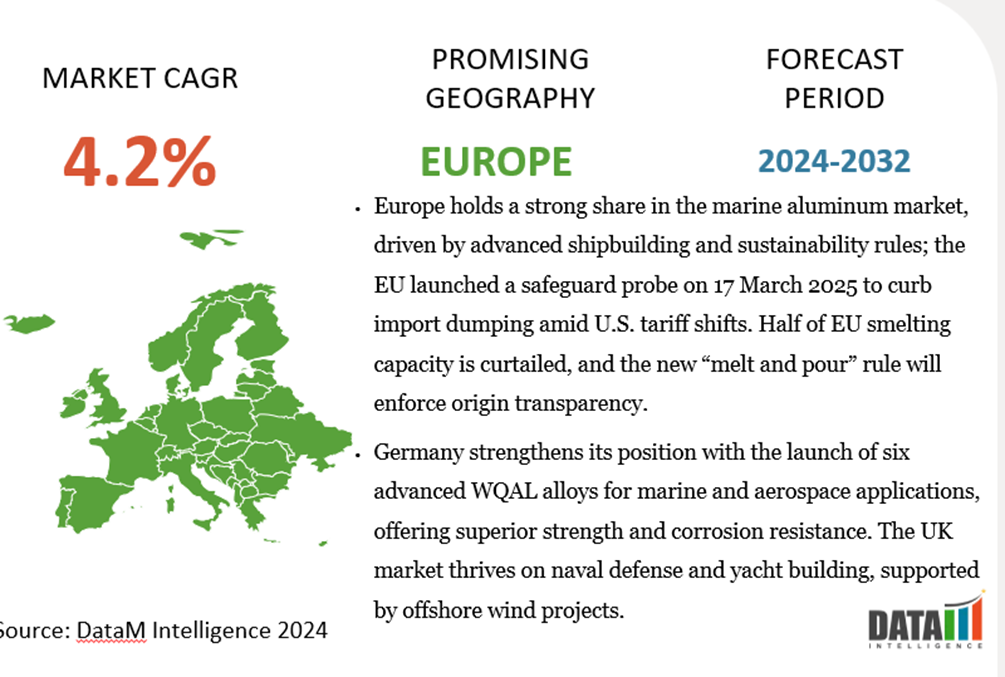
Europe Strengthens Market Position Amid Safeguard Measures and Sustainability Push
Europe maintains a significant share in the marine aluminum market, supported by its advanced shipbuilding industry and strict sustainability regulations. On 17 March 2025, the EU announced a safeguard investigation into aluminum imports after US tariffs raised fears of metal diversion to Europe. The European Commission highlighted that 50% of EU smelting capacity has been curtailed since 2021, with only 46% of demand met internally. To prevent dumping, the EU will implement the “melt and pour” rule, determining origin based on where the metal was melted.
Germany Marine Aluminum Market Insights
Germany remains a key player in the marine aluminum market due to its advanced shipbuilding technology and demand for lightweight, corrosion-resistant alloys. On 30 November 2023, WWEIQIAO Germany GmbH introduced six new WQAL aluminum materials, including high-strength and fatigue-resistant alloys, designed for marine, automotive, and aerospace applications. These alloys, such as WQAL WHS 340–400 and WQAL CHF 110–130, offer superior corrosion resistance and fatigue performance. The launch reinforces Germany’s leadership in innovation for the marine and shipbuilding sectors.
UK Marine Aluminum Industry Growth
The UK marine aluminum market benefits from a robust naval defense sector and an active yacht manufacturing industry. British shipyards increasingly use aluminum for high-speed vessels and patrol boats to meet efficiency and weight reduction standards. Investments in offshore wind and marine energy projects also boost demand for corrosion-resistant aluminum alloys. Sustainability targets and lightweight designs are pushing aluminum usage in new naval projects.
Marine Aluminum Market Economic and Investment Analysis
The marine aluminum industry is positioned for steady economic growth, supported by increasing investments in shipbuilding, marine transportation, offshore infrastructure, naval modernization, and recreational vessels. The growing demand for lightweight, corrosion-resistant, durable, and fuel-efficient materials is encouraging shipbuilders and marine equipment manufacturers to expand their use of aluminum alloys. Government investments in maritime infrastructure, fleet modernization, port development, and coastal transportation are further supporting market growth. Capital investment is increasingly focused on advanced alloy development, production capacity expansion, manufacturing automation, fabrication technologies, and regional facilities near major shipbuilding hubs. These investments help manufacturers improve production efficiency, material quality, supply reliability, and logistics while reducing overall operating costs. Advancements in high-strength aluminum alloys, corrosion-resistant materials, lightweight marine structures, and improved welding and fabrication technologies are also creating opportunities to enhance vessel durability, fuel efficiency, payload capacity, and lifecycle performance.
From an investment perspective, companies with strong alloy development capabilities, efficient manufacturing operations, reliable raw material supply networks, and established relationships with shipbuilders are expected to gain a competitive advantage. Manufacturers offering premium marine aluminum sheets, plates, extrusions, and specialized alloys with improved strength-to-weight ratios, corrosion resistance, durability, and fabrication characteristics can achieve stronger margins through value-added products. However, investors must consider challenges including aluminum price volatility, energy costs, geopolitical uncertainties, trade restrictions, supply chain disruptions, and increasingly stringent environmental regulations. Companies may also need to invest in energy-efficient production, recycling systems, cleaner manufacturing technologies, and regulatory compliance. Overall, continued investment in shipbuilding, offshore projects, naval modernization, maritime infrastructure, and lightweight vessel technologies is expected to create long-term growth and investment opportunities in the marine aluminum market.
Marine Aluminum Market Regulatory and Tariff Analysis
Regulatory frameworks for the global marine aluminum market focus heavily on environmental sustainability, safety standards, and emissions reduction. International Maritime Organization (IMO) regulations, such as the Energy Efficiency Design Index (EEDI) and stricter emission norms, are pushing shipbuilders toward lightweight, corrosion-resistant aluminum to improve fuel efficiency. Additionally, EU policies on carbon neutrality and recycling requirements promote the adoption of aluminum in marine structures, while classification societies set stringent material performance and safety standards for vessels.
On the tariff front, recent US measures, including a 25% tariff on aluminum imports, have disrupted global trade flows, leading to increased dumping risks in regions like Europe and Asia. The EU’s safeguard investigation and “melt and pour” rule aim to curb redirected imports from the US market and protect local producers. Meanwhile, trade tensions and regional tariff variations continue to influence aluminum pricing, sourcing strategies, and supply chain resilience in the marine sector.
Marine Aluminum Market Competitive Landscape
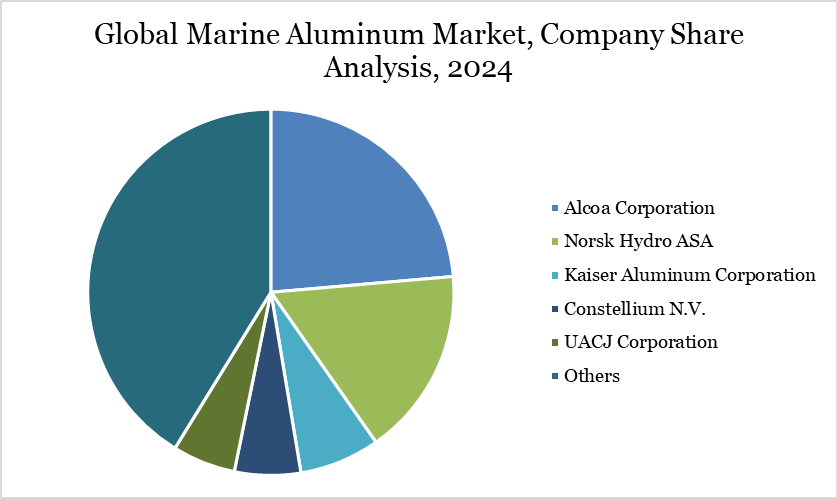
The marine aluminum market is moderately consolidated, with a mix of large integrated aluminum producers, regional alloy manufacturers, and specialized marine-grade material suppliers.
Key players include Alcoa Corporation, Norsk Hydro ASA, Kaiser Aluminum Corporation, Constellium N.V., UACJ Corporation, Novelis Inc., Century Aluminum Company, Aleris Corporation, China Zhongwang Holdings Limited, and Rusal.
Competition spans across primary metal producers, alloy manufacturers, and fabrication specialists serving shipbuilding, defense, and offshore sectors. Companies compete on cost efficiency, material innovation, and compliance with marine regulations.
Marine Aluminum Market Recent Developments
- June 2026 – Alcoa strengthens global aluminum supply position
Alcoa announced a strategic agreement to acquire South32’s bauxite, alumina, and aluminum assets for US$4.1 billion, strengthening its upstream aluminum portfolio and supporting long-term supply capabilities for customers across industrial and transportation applications. - May 2026 – Rio Tinto expands low-carbon aluminum production
Rio Tinto began commissioning its US$1.5 billion AP60 smelter expansion in Quebec, adding approximately 160,000 metric tons of annual primary aluminum capacity. The expansion strengthens the availability of lower-carbon aluminum for downstream applications, including transportation and marine industries. - May 2026 – Alcoa invests in recycled-content aluminum production
Alcoa announced a US$65 million investment at its Mosjøen smelter in Norway to expand recycled-content casting capabilities and increase production capacity by up to 75,000 metric tons, supporting growing demand for lower-carbon aluminum products. - May 2026 – Novelis advances lightweight marine aluminum solutions
Novelis continued promoting high-strength marine aluminum grades, including AA5059 (ALUSTAR®) and AA5083 H128, for hull plating, decks and ship superstructures, supporting demand for lightweight, corrosion-resistant materials in modern vessel construction. - May 2026 – Novelis expands recycled aluminum utilization
Novelis reported purchasing or tolling approximately 2.16 million metric tons of recycled aluminum in fiscal 2026, reinforcing the industry's shift toward circular aluminum supply chains. The company also continues to supply aluminum for ship hulls and superstructures where lightweighting and corrosion resistance are important. - April 2026 – Hydro strengthens aluminum applications in marine and offshore construction
Hydro highlighted the growing use of aluminum in marine and offshore structures, including cruise ships, yachts, defense vessels, passenger ferries and offshore installations. Its solutions incorporate extrusion and friction-stir-welding technologies to deliver lightweight, durable structures with improved production efficiency. - April 2026 – Advanced marine aluminum alloys gain attention for corrosion resistance
Research and industry developments in 2026 continued to focus on improving aluminum alloy performance in seawater environments, particularly through optimized alloy compositions and corrosion-resistant grades for shipbuilding and offshore applications. - March 2026 – Marine aluminum adoption supported by lightweight vessel design
Growing emphasis on fuel efficiency, payload optimization and vessel performance is strengthening the use of marine-grade aluminum. Aluminum's low density, corrosion resistance and weldability make it increasingly attractive for hulls, decks, superstructures and offshore components. - May 2026 – India accelerates shipbuilding infrastructure development
India signed an MoU for its first mega greenfield shipyard at Thoothukudi, Tamil Nadu, with planned capacity of 2.5 million gross tonnes. The development is expected to expand India's shipbuilding ecosystem and create additional long-term opportunities for marine-grade materials, including aluminum
Why Choose DataM?
Data-Driven Insights: Dive into detailed analyses with granular insights such as pricing, market shares and value chain evaluations, enriched by interviews with industry leaders and disruptors.
Post-Purchase Support and Expert Analyst Consultations: As a valued client, gain direct access to our expert analysts for personalized advice and strategic guidance, tailored to your specific needs and challenges.
White Papers and Case Studies: Benefit quarterly from our in-depth studies related to your purchased titles, tailored to refine your operational and marketing strategies for maximum impact.
Annual Updates on Purchased Reports: As an existing customer, enjoy the privilege of annual updates to your reports, ensuring you stay abreast of the latest market insights and technological advancements. Terms and conditions apply.
Specialized Focus on Emerging Markets: DataM differentiates itself by delivering in-depth, specialized insights specifically for emerging markets, rather than offering generalized geographic overviews. This approach equips our clients with a nuanced understanding and actionable intelligence that are essential for navigating and succeeding in high-growth regions.
Value of DataM Reports: Our reports offer specialized insights tailored to the latest trends and specific business inquiries. This personalized approach provides a deeper, strategic perspective, ensuring you receive the precise information necessary to make informed decisions. These insights complement and go beyond what is typically available in generic databases.
Target Audience
Manufacturers/ Buyers
Industry Investors/Investment Bankers
Research Professionals
Emerging Companies
Suggestions for Related Report





























































