


Aluminum Powder Market Overview
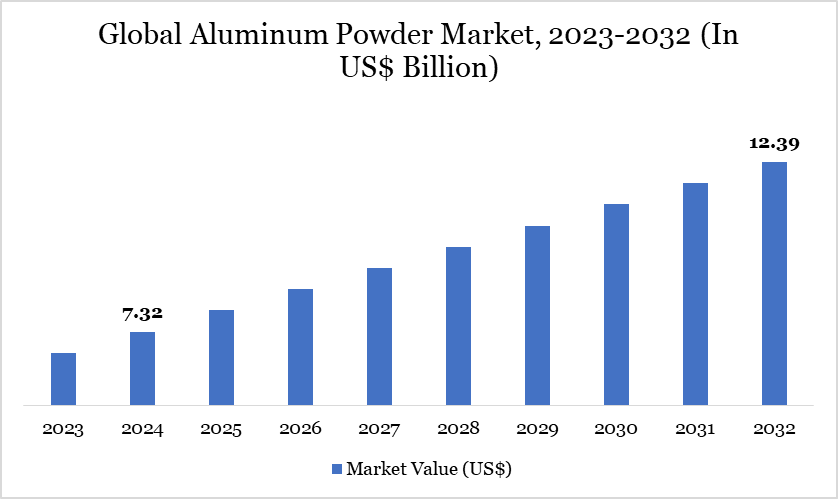
The global aluminum powder market is experiencing steady growth, driven by its wide-ranging applications across aerospace, automotive, construction, defense, electronics, and 3D printing industries. Adopting 3D printing (additive manufacturing) is a major factor boosting the aluminum powder market. Aluminum powders, especially atomized varieties, are essential for producing complex and lightweight Types in aerospace, automotive, and healthcare industries.
For instance, Eplus3D's 3D-printed aluminum powders include Alsi10Mg and AlSi7Mg. These 3D-printed aluminum alloys have been tested for use on Eplus3D's metal 3D printers. Eplus3D also offers a wide range of validated processes for each of the above materials to ensure that the performance of the 3D-printed parts is fully met.
Key Takeaways
- Asia-Pacific accounted for around 38.6% market share in 2025 and is projected to expand at the fastest CAGR of 6.8% through 2030, driven by rapid industrialization in China and India. China continues to dominate global output with strong integration across aluminum refining, atomization capacity, and downstream demand from aerospace, automotive, and additive manufacturing sectors. Government-backed policies supporting lightweight materials and defense self-reliance are accelerating adoption of high-purity aluminum powders.
- North America held approximately 29.1% market share in 2025, supported by strong demand from aerospace & defense, 3D printing, and specialty chemical applications. The U.S. remains a key innovation hub, with increasing investments in metal additive manufacturing and energetic materials, while regulatory scrutiny around powder handling safety (flammability and dust explosion risks) is shaping production and logistics standards.
- Europe continues to focus on high-value, precision-engineered aluminum powders, particularly for automotive lightweighting and sustainable mobility. The region is seeing steady adoption in electric vehicle components and powder metallurgy, supported by stringent carbon reduction targets and material efficiency mandates under EU green industrial policies.
- A key structural shift is emerging toward high-performance spherical aluminum powders, especially for additive manufacturing (3D printing), thermal spray coatings, and propellants. Manufacturers are moving away from conventional flake and granular forms toward controlled particle morphology with tighter size distribution, enabling higher performance in critical applications such as aerospace propulsion and defense energetics.
- Defense and aerospace applications are becoming a major demand driver globally. Aluminum powder is increasingly used in solid rocket propellants, pyrotechnics, and energetic formulations, with rising procurement activity from both government and private aerospace players. This segment is also experiencing tightening supply chain oversight due to its strategic importance.
- The market is also witnessing growing innovation in atomization technologies (gas, water, and plasma atomization). Companies are investing in advanced production methods to improve purity, reduce oxidation risk, and enhance particle uniformity key requirements for next-generation additive manufacturing and energy storage applications.
- Sustainability pressures are gradually influencing production economics. Energy-intensive aluminum powder manufacturing is being pushed toward low-carbon aluminum sourcing and recycled feedstock integration, particularly in Europe and North America, where ESG compliance is becoming a procurement criterion for industrial buyers.
Aluminum Powder Market Trends
Aluminum powder is crucial in the aerospace and defense industry for producing solid rocket propellants and explosives, due to its high reactivity and energy output. Governments and private defense contractors are significantly investing in military technologies, leading to a consistent demand for aluminum powder in missile and ammunition manufacturing. The increasing defense budgets, particularly in countries like the US, India, and China, are anticipated to drive this trend further. Additionally, aluminum powder’s use in thermal spray coatings to protect aerospace Types from corrosion also contributes to market expansion.
For more details on this report, Request for Sample
Aluminum Powder Market Scope
| Metrics | Details | |
| By Type | Atomized Powder, Flake Powder, Granular Powder, Fine Powder, Others | |
| By Production Process | Mechanical Comminution, Atomization, Chemical Methods, Electrolysis, Others | |
| By Purity Level | Commercial Grade – 92 to 98% Aluminum, High Purity – 99% to 99.9% Aluminum | |
| By Application | Aerospace & Defense, Automotive Industry, Construction & Building Materials, Additive Manufacturing & 3D Printing, Energy & Electronics, Printing & Packaging, Others | |
| By Region | North America, South America, Europe, Asia-Pacific, Middle East and Africa | |
| Report Insights Covered | Competitive Landscape Analysis, Company Profile Analysis, Market Size, Share, Growth |
Aluminum Powder Market Dynamics & Trends
Rising Demand from the Aerospace and Defense Sector
The rising demand from the aerospace and defense sector is a major driving force for the global aluminum powder market, primarily due to the material’s high energy density, lightweight properties, and reactivity. Aluminum powder is a crucial component in the manufacturing of solid rocket propellants, missile fuel, and pyrotechnic compositions.
For instance, in 2024, Fraunhofer Institute for Laser Technology (ILT) in Aachen, Germany, is at the forefront of this movement. Under the TIRIKA research initiative (Technologies and Innovations for Resource-saving, Climate-friendly Aviation), backed by the Federal Ministry for Economic Affairs and Climate Action, Fraunhofer ILT is developing specialized aluminum alloy powders optimized for use in hydrogen-powered aerospace engines.
Additionally, in the defense sector, the increasing investments in advanced weaponry, missile modernization programs, and tactical explosives are fueling demand for high-purity aluminum powder. Thus, the above factors help to boost the market growth.
Stringent Environmental and Safety Regulations
Stringent environmental and safety regulations significantly restrain the growth of the global aluminum powder market due to the material’s flammability, explosiveness, and potential health hazards. Regulatory bodies like OSHA (Occupational Safety and Health Administration) in the US, REACH in the European Union, and the ATEX Directive (for explosive atmospheres) have imposed strict guidelines on the handling, transportation, and storage of aluminum powder.
For instance, in 2022, a US-based aerospace firm was fined heavily following an explosion at its propellant manufacturing site, attributed to improper ventilation during aluminum powder mixing. Incidents like this have led to tightened inspections and licensing requirements, delaying production and distribution timelines.
Aluminum Powder Market Segment Growth Analysis
The global aluminum powder market is segmented based on type, production process, purity level, application and region.
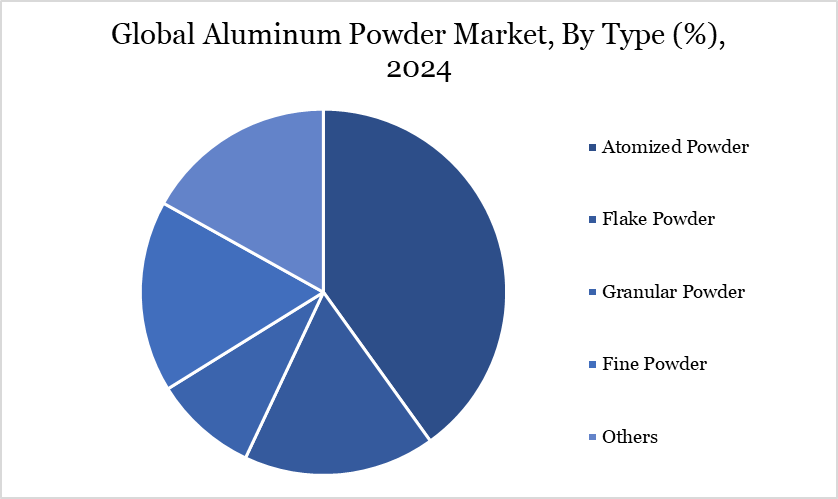
Atomized Aluminum Powder: The Preferred Choice for High-Precision Industrial Applications
Atomized aluminum powder dominates the global aluminum powder market due to its superior particle uniformity, controlled morphology, and high purity, which make it ideal for a wide range of industrial applications. The atomization process-particularly gas or water atomization-produces spherical or near-spherical particles with excellent flowability and packing density, properties that are critical in additive manufacturing (3D printing), metal injection molding (MIM), automotive coatings, and aerospace alloy production.
One of the most significant drivers for atomized powder's dominance is its widespread use in powder metallurgy, where precise particle size distribution and consistent shape are essential for producing high-performance metal components. For example, in the automotive sector, atomized aluminum powder is used in the fabrication of lightweight engine parts and structural components, helping manufacturers meet fuel efficiency and emission standards.
Why the Aluminum Powder Market Matters in 2026
The global materials and advanced manufacturing ecosystem is undergoing a significant transformation, with aluminum powder emerging as a critical enabler across multiple high-growth industries.
Aluminum powder is increasingly being used in aerospace, automotive, defense, construction, additive manufacturing (3D printing), chemicals, and energy storage applications, Growth by its lightweight properties, high energy density, and strong reactivity characteristics.
Several macroeconomic and industrial factors are driving market expansion:
- Growth of additive manufacturing and metal 3D printing
- Expansion of defense and pyrotechnics applications
- Increasing use in energy storage systems and solid propellants
- Shift toward fuel efficiency and emission reduction targets
- Advancements in powder metallurgy technologies
- Growing EV production requiring lightweight components
- Increasing applications in thermal spray coatings and paints
- Supply chain localization and critical mineral security strategies
Analyst View
DataM Intelligence Analyst Perspective
The aluminum powder market is transitioning from a conventional industrial material segment into a strategic advanced materials ecosystem supporting next-generation manufacturing and energy solutions.
The long-term growth trajectory will depend on:
- Raw material price stability and bauxite/alumina supply chains
- Expansion of additive manufacturing and powder metallurgy adoption
- Regulatory frameworks around safety and handling of fine metal powders
- Technological advancements in atomization and nano-powder production
- Defense and aerospace procurement cycles
- EV and lightweight vehicle material integration
- Energy storage and propellant innovation
- Regional manufacturing localization strategies
Asia-Pacific continues to lead global production and consumption, driven by China and India’s strong industrial base and manufacturing expansion. North America remains a key innovation hub for aerospace, defense, and advanced 3D printing applications, while Europe focuses on sustainability-driven material engineering and high-performance alloys.
Aluminum Powder Market Geographical Share
North America Aluminum Powder Market
North America remains a key market driven by strong aerospace, defense, automotive, and advanced manufacturing demand for high-performance metal powders.
The United States leads the region with increasing adoption of aluminum powder in additive manufacturing (3D printing), energetic materials, and lightweight vehicle components.
Major deployment areas include:
- California
- Texas
- Ohio
- Washington
- Alabama
Asia-Pacific Aluminum Powder Market
Asia-Pacific is expected to register the fastest CAGR during the forecast period.
China dominates large-scale production and consumption of aluminum powder, supported by its strong metals manufacturing base, defense applications, and expanding EV ecosystem.
Japan, South Korea, and India are rapidly increasing investments in powder metallurgy, battery materials, and aerospace-grade aluminum applications.
India represents a major future growth opportunity due to:
- Rapid industrialization and infrastructure expansion
- Growing aerospace and defense manufacturing programs
- Expansion of EV and energy storage sectors
Europe Aluminum Powder Market
Europe is witnessing steady growth supported by aerospace innovation, automotive lightweighting initiatives, and strong sustainability regulations.
Germany, France, and the UK are leading the region in advanced powder metallurgy applications and high-performance engineering materials.
Nordic countries are increasingly investing in green metallurgy and low-carbon metal production technologies.
Latin America Aluminum Powder Market Outlook
Latin America is gradually expanding its aluminum powder usage, mainly driven by automotive components, construction materials, and mining-related applications.
Brazil and Mexico are emerging as key markets due to growing industrial manufacturing and export-oriented metal processing activities.
Middle East & Africa Aluminum Powder Market Outlook
Middle East & Africa is expected to show long-term growth potential driven by infrastructure development, defense modernization, and diversification of industrial manufacturing.
UAE and Saudi Arabia are investing in advanced materials and additive manufacturing capabilities, while South Africa is gradually expanding its metal powder applications in mining and engineering sectors.
Impact of US Tariffs on the Aluminum Powder
The imposition of US tariffs on aluminum powder has significantly impacted the global market, particularly affecting major exporting countries like China. The US has a 25% import tariff on aluminum and steel, including aluminum powder, effective March 12, 2025. This tariff applies to all countries, and exemptions and quotas previously granted to certain countries have been revoked.
This means that imports of aluminum powder, like other steel and aluminum products, will be subject to this 25% tariff. These tariffs directly affected aluminum powder imports from key trading partners like China, Russia, Canada, and the European Union. Notably, while Canada and Mexico were temporarily exempted under the USMCA agreement, China was hit the hardest, as it was already facing additional duties of up to 25% on various aluminum products under anti-dumping and countervailing investigations.
As a result, Chinese aluminum powder exporters faced combined tariffs ranging from 15% to 35%, depending on the product classification. This has led to increased domestic production within the US and a shift toward alternative sourcing from tariff-exempt countries or regional allies.
Aluminum Powder Market Major Global Players
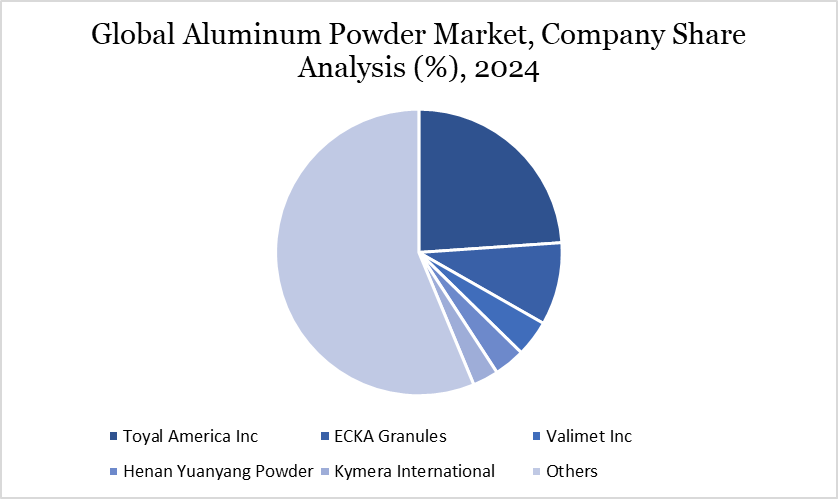
The major global players in the market include Toyal America Inc, Hunan Ningxiang Jiweixin Metal Powder Co., Ltd., ECKA Granules, Valimet Inc, Henan Yuanyang Powder, Kymera International, Angang Group Aluminium Powder Co., Ltd, Zhangqiu Metallic Pigment Co., Ltd., MMP Industries Ltd, Aluminium Powder Company Ltd and among others.
Aluminum Powder Market Investment & Funding Analysis
Global investments in advanced materials and metal powders continue to grow significantly, driven by rising demand from automotive, aerospace, defense, and additive manufacturing industries.
Major funding areas include:
- Advanced metal powder production technologies
- High-performance aluminum powder for aerospace applications
- Additive manufacturing (3D printing) material innovations
- Energy-efficient and low-emission production processes
- Nano and fine aluminum powder development
- Defense-grade energetic material innovations
Strategic Recommendations
For Industrial Manufacturers
- Scale up high-purity aluminum powder production
- Invest in atomization and advanced milling technologies
- Strengthen supply chain integration for raw aluminum
- Expand R&D in lightweight and high-strength applications
For Investors
- Focus on high-growth aerospace and defense material suppliers
- Target companies with additive manufacturing capabilities
- Evaluate long-term demand from EV and energy sectors
- Monitor raw material volatility and sustainability trends
For Governments
- Support domestic advanced materials manufacturing
- Promote R&D in aerospace-grade powder metallurgy
- Strengthen export-oriented production ecosystems
- Encourage clean production technologies
Why Buy This Aluminum Powder Market Report?
This report helps organizations:
- Understand future advanced materials demand trends
- Identify high-growth investment opportunities
- Benchmark key global competitors effectively
- Analyze regional industrial expansion patterns
- Optimize strategic sourcing decisions
- Evaluate technology disruption in powder metallurgy
- Assess defense, aerospace & EV material demand
- Track additive manufacturing adoption trends
What’s Included in the Aluminum Powder Market Report?
The report provides:
- Market size & forecast analysis
- Regional growth outlook
- Competitive intelligence
- Technology benchmarking
- Pricing & cost structure analysis
- Regulatory and sustainability assessment
- Supply chain insights
- Market share analysis
- Investment landscape analysis
- Strategic recommendations
- Emerging trend evaluation
- Company profiling
Who Should Buy This Report?
This aluminum powder market report is ideal for:
- Aerospace & defense manufacturers
- Automotive OEMs and EV companies
- Additive manufacturing firms
- Metal powder producers
- Industrial materials suppliers
- Venture capital & private equity firms
- Research & development organizations
- Government defense procurement agencies
- Chemical & metallurgy companies
- Market intelligence teams
Key Benefits for Stakeholders
Gain actionable market intelligence:
- Understand advanced materials transformation
- Analyze global industrial demand shifts
- Evaluate additive manufacturing expansion
- Identify high-growth application areas
- Benchmark global competitors
- Improve investment and sourcing decisions
- Track aerospace and EV material innovations
- Assess sustainability-driven market shifts
Related Reports
The Automotive Aluminum Market is strongly interconnected with broader material transformation and mobility efficiency trends across the automotive and manufacturing ecosystem. Increasing demand for lightweight vehicles, fuel efficiency, and electric mobility is accelerating the adoption of aluminum-based solutions across multiple value chains. Alongside this, adjacent markets such as recycled aluminum, aluminum extrusion, and aluminum scrap processing are playing a critical role in strengthening supply sustainability, cost efficiency, and circular economy integration.
The Recycled Aluminum Market is becoming a key pillar of sustainable automotive manufacturing, driven by the rising need to reduce carbon emissions and production costs. Automotive OEMs are increasingly integrating secondary aluminum to meet ESG targets and regulatory requirements while maintaining material performance standards. Advancements in recycling technologies, sorting systems, and closed-loop supply chains are enhancing material recovery efficiency and enabling large-scale adoption in vehicle production.
The Aluminum Extrusion Market plays a vital role in automotive lightweight structural design, enabling the production of complex, high-strength, and corrosion-resistant components. Growing demand for electric vehicles and crash-resistant vehicle architectures is driving the use of extruded aluminum in chassis systems, battery enclosures, and body frames. Continuous innovation in extrusion processes and alloy development is improving design flexibility and performance efficiency across automotive applications.
The Aluminum Scrap Market is a critical upstream supply source supporting cost-effective and sustainable aluminum production for the automotive industry. Increasing industrial waste recovery and end-of-life vehicle recycling are expanding scrap availability globally. Advanced sorting, melting, and refining technologies are improving scrap quality, making it a highly valuable input for secondary aluminum production and reducing dependency on primary aluminum extraction.
The Automotive Aluminum Market is witnessing strong structural growth, driven by rising electric vehicle penetration, stringent emission regulations, and the need for vehicle weight reduction. Aluminum is increasingly replacing steel in structural and non-structural components due to its high strength-to-weight ratio and recyclability. OEMs are focusing on multi-material vehicle architectures that integrate aluminum with advanced composites to optimize performance, safety, and energy efficiency.





























































