


Green Methanol Market Overview
The global green methanol market is witnessing significant growth, driven by rising sustainability goals, stringent environmental regulations, and increased integration of renewable energy sources. Green methanol, produced from biomass, carbon dioxide, and green hydrogen, is increasingly preferred in sectors such as transportation and chemicals due to its lower emissions profile.
Its application as a fuel for automobiles, ships, boilers, and as a feedstock in the production of formaldehyde, acetic acid, and plastics positions it as a viable alternative to fossil fuels. With growing consumer awareness and the global urgency to limit the rise in global temperatures to 1.5°C, there has been a surge in interest from governments and industries alike.
Although currently hindered by high production costs and limited output, green methanol is expected to become cost-competitive by 2050 with the implementation of supportive policies. Consequently, the market is expected to experience substantial investment and technological innovation, making it a cornerstone in the global transition to net-zero carbons emissions.
Key Takeaways
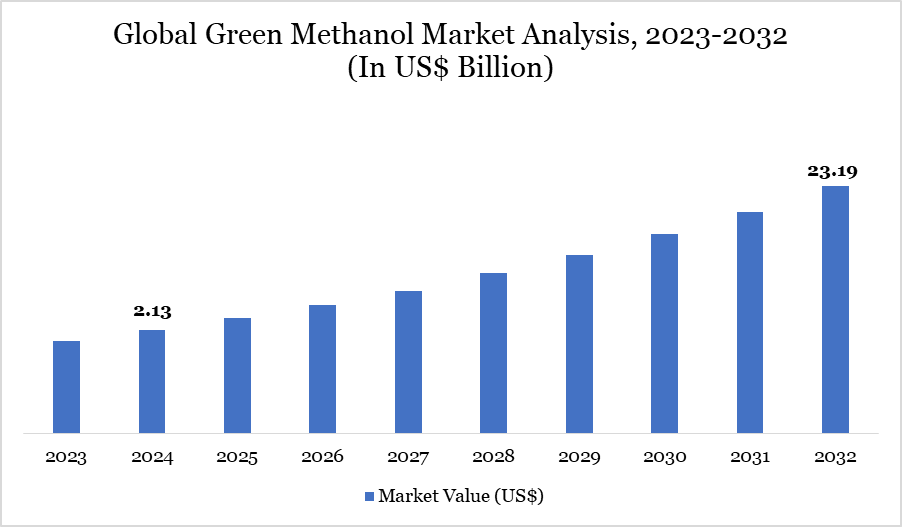
- E-methanol and biomethanol production capacity expansion is becoming the primary growth engine, with the market expected to increase by more than 10 times between 2025 and 2033, creating significant opportunities for project developers, technology providers, electrolyzer manufacturers and renewable energy suppliers.
- Maritime shipping is expected to remain the largest demand center as vessel operators accelerate low-carbon fuel adoption to meet international decarbonization targets, making green methanol one of the most commercially scalable alternative marine fuels available today.
- Strategic offtake agreements are emerging as a critical success factor, with fuel producers securing long-term contracts from shipping, chemicals and industrial customers to improve project bankability and attract large-scale infrastructure investments.
- Carbon capture integration is gaining importance across new production facilities as developers combine captured CO₂ with green hydrogen to produce e-methanol, strengthening circular carbon utilization and supporting regulatory compliance requirements.
- Green hydrogen availability remains the most influential cost driver because hydrogen contributes a major share of total production economics, making renewable electricity pricing, electrolyzer efficiency and capacity utilization key profitability metrics for industry participants.
- Europe continues to lead project deployment due to supportive climate policies, renewable energy investments and shipping decarbonization initiatives, while Asia-Pacific is rapidly emerging as a major future demand hub driven by industrial growth and expanding clean fuel strategies.
Green Methanol Market Trends
One of the dominant trends shaping the green methanol market is the shift towards a circular economy and low-carbon solutions. Governments and industry leaders are actively seeking sustainable alternatives to mitigate climate change, particularly by promoting fuels that reduce greenhouse gas emissions.
Green methanol fits seamlessly into this narrative, offering up to 95% CO₂ emissions reduction, 80% NOₓ reduction, and complete elimination of particulate matter emissions compared to conventional fuels. Additionally, it can be used directly in existing combustion engines, avoiding infrastructure overhaul costs. New policies under Europe’s Emissions Trading System and directives such as the Fuel Quality and Air Quality Directives are reinforcing this trend by encouraging renewable energy use.
Blending initiatives in countries like China, Israel, India, and Italy are further expanding the scope for green methanol. These developments highlight the market’s transition from early adoption to broader commercialization, propelled by regulatory frameworks and global climate commitments.
For more details on this report – Request for Sample
Green Methanol Market Scope
| Metrics | Details | |
| By Type | Biomethanol, E-Methanol | |
| By Production Route | Power to Methanol, Biomethane Reforming, Biomass Gasification, Waste to Methanol | |
| By Application | Chemical, Fuel | |
| By Region | North America, South America, Europe, Asia-Pacific and Middle East & Africa | |
| Report Insights Covered | Competitive Landscape Analysis, Company Profile Analysis, Market Size, Share, Growth |
Green Methanol Market Dynamics
Government Initiatives Bolstering Green Methanol Demand
A critical driver for the green methanol market is the wave of government initiatives aimed at reducing carbon emissions and promoting renewable fuels. Countries worldwide are recognizing the potential of green methanol to serve as a low-emission alternative in hard-to-decarbonize sectors.
China mandates methanol blending in gasoline across various provinces, while nations like Israel, Egypt, and India are testing methanol-gasoline blends with positive outcomes. Additionally, green methanol’s versatility allows its use in existing infrastructure and engines, enabling a smoother transition to sustainable energy systems. These initiatives are reinforced by climate policies such as the EU Emissions Trading System, aimed at decarbonizing the industrial and transportation sectors.
With mounting pressure to meet the global target of net-zero emissions by 2050, governments are increasingly investing in and incentivizing green methanol production and adoption. This regulatory backing is expected to significantly accelerate market growth.
High Production Costs Limit Market Expansion
Despite its vast potential, the high production cost of green methanol remains a key restraint to market expansion. The process relies heavily on bio-feedstocks, municipal solid waste (MSW), and green hydrogen, each contributing to the elevated cost structure. Feedstock costs alone can range from US$ 0.5 to US$ 17 per gigajoule, while biomass prices vary significantly, from US$ 320 to US$ 770 per ton. These fluctuations create investment uncertainties, deterring large-scale commercial adoption.
The limited availability of sustainable feedstocks and low-scale green hydrogen production exacerbate the issue. Until cost-effective production techniques are established and supply chains are optimized, green methanol’s market penetration will remain limited. Addressing these economic challenges is critical to realizing its full potential as a climate-friendly alternative to fossil fuels.
Green Methanol Market Segmentation Analysis
The global green methanol market is segmented based on type, production route, application, and region.
Expanding Adoption of Renewable Liquid Fuels Strengthens the Biomethanol Segment
The Biomethanol segment holds the largest share of the global green methanol market, driven by its commercial maturity, established production technologies, and the growing availability of sustainable feedstocks such as agricultural residues, forestry waste, municipal solid waste, and biogas. Biomethanol has gained significant traction across the chemical and marine sectors as industries seek low-carbon alternatives to conventional methanol while leveraging existing fuel and chemical infrastructure. Its scalable production routes and compatibility with circular economy initiatives continue to support widespread commercial deployment.
Reflecting this industry momentum, several commercial-scale biomethanol projects have entered operation globally. For instance, in 2025, China commissioned one of its first large-scale biomethanol plants in Guangdong Province, utilizing biomass waste feedstocks to produce approximately 50,000 tons of green methanol annually for the maritime sector. The project highlights the accelerating commercialization of biomass-based methanol production to support shipping decarbonization and renewable fuel adoption.
Rapid Expansion of Power-to-X Projects Accelerates the E-Methanol Segment
The E-Methanol segment represents the fastest-growing category within the green methanol market, supported by increasing investments in green hydrogen, carbon capture, and Power-to-X technologies. E-methanol is produced by combining renewable hydrogen with captured carbon dioxide, making it an important pathway for reducing emissions in hard-to-abate sectors such as marine transportation, aviation fuels, and sustainable chemicals. Strong policy support, expanding renewable energy capacity, and rising demand for carbon-neutral fuels are further accelerating project development worldwide.
Supporting this growth trajectory, the world's first commercial-scale e-methanol facility commenced operations in Denmark in 2025. Developed by European Energy and Mitsui, the Kasso plant produces approximately 42,000 tonnes of e-methanol annually using renewable electricity and captured CO₂, with customers including Maersk, LEGO, and Novo Nordisk. The project represents a significant milestone in scaling commercial e-methanol production for industrial and maritime applications.
Green Methanol Market Geographical Share
Asia-Pacific Leads the Global Market Through Aggressive Capacity Expansion and Clean Energy Initiatives
Asia-Pacific is emerging as the most dominant region in the global green methanol market. This growth is largely attributed to aggressive capacity expansion in China, which is expected to account for approximately 90% of regional production and consumption by the end of 2025, according to the Methanol Institute.
China, already the world’s largest producer and consumer of methanol, is leveraging its energy transition goals to promote renewable methanol as a cleaner alternative to fossil fuels. The nation faces pressing challenges around air pollution and energy security, making green methanol a strategic solution.
Strong government support for renewable energy development, including wind, tidal, and geothermal power, provides a conducive ecosystem for market growth. The region’s rapid urbanization, expanding transportation sector, and environmental initiatives are further contributing to its dominance in the global green methanol market landscape.
Sustainability Analysis
Green methanol is a major advance in sustainable chemical synthesis. It is created by combining green hydrogen, which is generated through water electrolysis driven by renewable energy, with collected carbon dioxide (CO₂). Green methanol provides a carbon-neutral substitute for traditional methanol made from fossil fuels, significantly lowering greenhouse gas emissions.
This is especially important in industries that are difficult to decarbonize, including shipping and chemical manufacture, where conventional processes can release up to 1.5 metric tons of CO₂ for every ton of methanol produced. By using waste CO₂ as a feedstock and renewable energy sources like solar and wind, the switch to green methanol is in line with global climate goals and presents a viable path toward decarbonization.
However, there are operational difficulties with incorporating intermittent renewable energy into manufacturing systems. Using a dual-comparative approach, this study evaluates four seasonal renewable energy configurations backed by hybrid energy storage devices in order to resolve such complications. The results enhance the resilience of sustainable industrial pathways and optimize the production of green methanol.
Green Methanol Market Major Global Players
The major global players in the market include Ørsted A/S, A.P. Moller – Maersk A/S, Carbon Recycling International (CRI),Proman AG, Methanex Corporation, OCI N.V., BASF SE, Liquid Wind AB, WasteFuel, Southern Green Gas.
Recent Developments of the Green Methanol Market
- May 2026 – Carbon Recycling International (CRI) partners in large-scale green methanol project development for industrial decarbonization
Carbon Recycling International (CRI) signed an MoU with JSW Steel Limited and Bhartia to evaluate a 300 KTPA green methanol project in India, utilizing captured industrial CO₂ and green hydrogen to accelerate e-methanol production and carbon utilization technologies. - May 2026 – A.P. Moller – Maersk strengthens green methanol demand through commercial-scale e-methanol sourcing
A.P. Moller – Maersk expanded its green fuel transition strategy by securing e-methanol supply from the commercial-scale Kassø Power-to-X facility in Denmark, supporting low-emission shipping operations and accelerating maritime decarbonization initiatives. - April 2026 – Liquid Wind advances European green methanol production ecosystem expansion
Liquid Wind continued expanding its eFuel facility development pipeline across Europe, focusing on large-scale renewable methanol projects designed to support shipping, industrial fuel substitution, and carbon reduction targets. - March 2026 – A.P. Moller – Maersk orders additional methanol-powered container vessels
Maersk placed orders for eight additional dual-fuel container ships capable of operating on green methanol, increasing its methanol-enabled fleet and reinforcing long-term demand for sustainable marine fuels. - February 2026 – Ørsted A/S expands renewable energy integration supporting e-methanol value chains
Ørsted continued advancing offshore wind and renewable hydrogen infrastructure projects that support future green methanol production, strengthening low-carbon fuel supply chains for industrial and maritime sectors.
Why Choose DataM?
Technological Innovations: Explores advancements in green methanol production technologies, including biomass gasification, renewable hydrogen-based e-methanol synthesis, carbon capture and utilization (CCU), Power-to-Methanol (PtMeOH) processes, advanced catalytic conversion systems, electrolyzer integration, and process optimization technologies that improve production efficiency, reduce lifecycle carbon emissions, and support large-scale commercialization.
Product Performance & Market Positioning: Evaluates how manufacturers differentiate green methanol based on feedstock sustainability, carbon intensity, production efficiency, purity levels, certification standards, renewable energy integration, lifecycle emissions, scalability, and supply reliability, highlighting competitive positioning across marine fuel, chemical, and industrial applications.
Real-World Evidence: Highlights the growing adoption of green methanol across the shipping industry, chemical manufacturing, power generation, and sustainable fuel initiatives, demonstrating its role in reducing greenhouse gas emissions, supporting decarbonization targets, enabling compliance with evolving environmental regulations, and facilitating the transition toward low-carbon energy systems.
Market Updates & Industry Changes: Tracks key developments including commercial-scale green methanol plant announcements, renewable hydrogen investments, carbon capture projects, strategic supply agreements, shipping fuel adoption, government decarbonization initiatives, technology advancements, and regional capacity expansion across Europe, North America, Asia-Pacific, and the Middle East.
Competitive Strategies: Analyzes how leading companies strengthen market presence through renewable energy integration, strategic partnerships, long-term offtake agreements, investments in e-methanol production facilities, technology collaborations, carbon capture integration, feedstock diversification, and expansion of global production capacity to meet rising demand for sustainable fuels.
Pricing & Market Access: Explains pricing variations based on renewable electricity costs, green hydrogen availability, biomass feedstock sourcing, carbon capture expenses, production technology, plant scale, certification requirements, logistics, and distribution networks, along with market access through fuel suppliers, chemical distributors, energy companies, and direct industrial supply agreements.
Market Entry & Expansion: Identifies growth opportunities driven by global decarbonization policies, maritime emission reduction targets, increasing demand for sustainable marine fuels, renewable hydrogen expansion, carbon capture investments, and industrial net-zero commitments, while outlining strategies such as regional production expansion, technology innovation, strategic collaborations, and long-term customer partnerships.
Target Audience
- Green Methanol Producers
- Renewable Hydrogen Producers
- Shipping & Maritime Companies
- Chemical Manufacturers
- Renewable Energy Developers
- Carbon Capture, Utilization & Storage (CCUS) Companies
- Oil & Gas Companies Transitioning to Low-Carbon Fuels
- Industrial Fuel Suppliers & Energy Companies




























































