


Generative AI in Healthcare Market Size
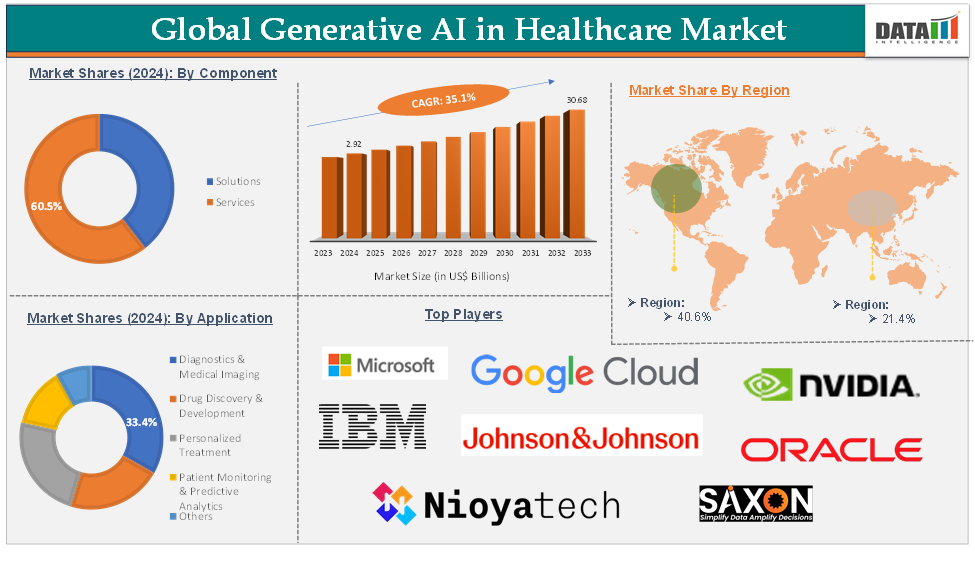
The Generative AI in Healthcare Market will reach US$ 5.37 billion in 2026, up from US$ 3.98 billion in 2025, and is projected to reach US$ 643.47 billion by 2035, registering exceptional growth at a CAGR of 35.1% during the forecast period from 2026 to 2035.
Generative AI in healthcare refers to the utilization of advanced artificial intelligence technologies that can create new data, insights, and content based on existing healthcare information. This innovative approach employs sophisticated algorithms, including machine learning and deep learning techniques, to analyze extensive amounts of unstructured data, such as medical records, imaging data, and clinical notes.
The primary objective is to enhance various facets of healthcare delivery, including diagnostics, treatment planning, patient engagement, and operational efficiency. This market is primarily driven by the increasing demand for personalized healthcare solutions and advancements in AI and machine learning technologies.
Opportunities include integration with real-time decision support and predictive analytics abound in areas such as drug discovery-where generative AI is expected to facilitate the market expansion. Key trends include the integration of generative AI with large healthcare datasets to generate synthetic data, enhance diagnostic accuracy, and create tailored treatment plans.
Generative AI in Healthcare Market Key Takeaways
- The market is forecast to increase from USD 3.98 billion in 2025 to USD 643.47 billion by 2035, highlighting one of the fastest growth trajectories across healthcare technologies.
- AI solutions account for nearly 70% of total market revenue, reflecting broad deployment across diagnostics, medical imaging, clinical decision support, and administrative automation.
- Hospitals and healthcare organizations contribute more than 60% of market demand, demonstrating that enterprise healthcare providers remain the primary adopters.
- North America represents approximately 42% to 45% of global revenue, supported by advanced healthcare infrastructure, strong AI investment, and favorable digital health adoption.
- More than 65% of healthcare organizations are expected to integrate generative AI into both clinical and administrative workflows by 2030.
- Demand across drug discovery, personalized medicine, clinical documentation, and AI-powered medical imaging continues to expand at over 40% annually, creating substantial opportunities for software vendors, cloud providers, and healthcare technology companies.
- Strategic partnerships between AI developers, healthcare providers, pharmaceutical companies, and cloud infrastructure providers are becoming a key competitive advantage across the market.
Generative AI in Healthcare Market Scope
| Metrics | Details |
| Market Size (2025) | USD 3.98 Billion |
| Market Size (2026) | USD 5.37 Billion |
| Forecast Market Size (2035) | USD 643.47 Billion |
| CAGR (2026-2035) | 35.10% |
| Historic Years | 2023-2024 |
| Base Year | 2025 |
| Forecast Period | 2026-2035 |
| Segments Covered | Component, Application, End User, Region |
| Leading Region | North America |
| Fastest Growing Region | Asia-Pacific |
Generative AI in Healthcare Executive Summary
Source : DataM Intelligence
For more details on this report - Request for Sample
Generative AI in Healthcare Market Dynamics: Drivers
Increasing demand for personalized healthcare solutions
The healthcare industry is increasingly embracing personalized medicine, which tailors treatment plans to the specific needs of patients based on their genetic profiles, medical histories, and lifestyle factors. Generative AI in healthcare plays a vital role in this transition by analyzing large datasets to identify patterns and correlations that inform personalized treatment strategies.
Generative AI in healthcare excels at processing vast amounts of unstructured data, including electronic health records (EHRs), genomic data, and clinical notes. This capability allows healthcare providers to create comprehensive health profiles for patients, which can be used to tailor interventions more effectively. By synthesizing diverse data types, generative AI helps identify risk factors and health trends specific to individual patients, facilitating proactive care and early intervention.
Furthermore, major players in the industry have key initiatives and product launches that would drive the global generative AI in healthcare market growth. For instance, as per Microsoft Azure news in June 2023, generative AI has the potential to revolutionize medical research, diagnosis, treatment, and patient care by enabling healthcare providers to increase efficiency, personalize care, and enhance decision-making processes. Generative AI in healthcare empowers researchers to analyze vast amounts of medical data rapidly and efficiently. It automates data extraction and document reviews, significantly reducing the time spent on administrative tasks.
Similarly, in April 2024, the World Health Organization (WHO) announced the launch of S.A.R.A.H., which stands for Smart AI Resource Assistant for Health. This innovative digital health promoter prototype is powered by generative artificial intelligence (AI) and is designed to enhance public health engagement ahead of World Health Day, which focuses on the theme “My Health, My Right."
Also, in October 2024, Amazon One Medical integrated advanced AI technology into its healthcare services, leveraging AWS generative AI services, including Amazon Bedrock and AWS HealthScribe, to help doctors save time and enhance patient care. All these factors drive the global generative AI in healthcare market.
Moreover, the rising demand for the growth of integration with telemedicine contributes to the global generative AI in healthcare market expansion.
Generative AI in Healthcare Market Restraints
Data security and privacy concerns
Generative AI in healthcare systems often requires access to large volumes of sensitive patient data, including electronic health records (EHRs), medical imaging, and personal health information (PHI). This data is highly confidential and must be protected to maintain patient trust and comply with legal standards.
In the US, HIPAA establishes strict guidelines for handling PHI. Healthcare organizations must ensure that any technology they utilize complies with these regulations. This includes implementing safeguards to protect the confidentiality, integrity, and availability of PHI. For instance, any generative AI tool used in a healthcare setting must undergo a thorough security review and have a signed Business Associate Agreement (BAA) with the provider to ensure compliance.
According to the National Center for Biotechnology Information (NCBI) research publication in March 2024, the integration of generative AI in healthcare offers transformative potential, but it also introduces significant privacy and security risks due to its extensive data requirements and inherent opacity. Generative AI systems necessitate access to vast amounts of sensitive patient data, including electronic health records (EHRs), medical imaging, and personal health information (PHI). Thus, the above factors could be limiting the global generative AI in healthcare market's potential growth.
Generative AI in Healthcare Market Segmentation Analysis
The global generative AI in healthcare market is segmented based on component, application, end-user, and region.
Application:
The diagnostics & medical imaging application segment is expected to hold 33.2% of the global generative AI in healthcare market
The diagnostics & medical imaging segment is a crucial component of the generative AI in healthcare market, significantly enhancing healthcare professionals' capabilities to analyze and interpret medical images. The integration of generative AI in healthcare technologies has transformed traditional imaging practices, leading to improved diagnostic accuracy and operational efficiency.
Generative AI in healthcare technologies, such as generative adversarial networks (GANs) and variational autoencoders (VAEs), equip healthcare providers with advanced tools for analyzing complex medical images, including MRIs, CT scans, and X-rays. These models enhance diagnostic accuracy by identifying subtle abnormalities that may be overlooked by human practitioners, thereby facilitating early disease detection.
Furthermore, major players in the industry product launching products that would drive the global generative AI in healthcare market growth. For instance, in September 2024, Harrison.ai launched a radiology-specific vision language model named Harrison. rad.1, marking a significant advancement in healthcare artificial intelligence. This model is designed to address specific needs in the field of radiology, enhancing the capabilities of AI in medical imaging and diagnostics.
Also, in December 2023, Google launched MedLM, a suite of generative AI models specifically designed for the healthcare industry. This initiative is part of Google's ongoing efforts to leverage artificial intelligence to enhance healthcare delivery and improve patient outcomes. These factors have solidified the segment's position in the global generative AI in healthcare market.
Generative AI in Healthcare Market Geographical Shares
North America is expected to hold 40.6% of the global generative AI in healthcare market
Healthcare institutions across North America, including hospitals, clinics, and diagnostic centers, are increasingly recognizing the potential of generative AI. The integration of AI into clinical workflows is viewed as a means to enhance diagnostic accuracy, optimize treatment planning, and improve patient outcomes. This trend is bolstered by a growing body of evidence supporting the effectiveness of AI technologies in various clinical domains such as radiology, pathology, and cardiology.
Rapid advancements in generative AI technologies, including Generative Adversarial Networks (GANs) and Variational Autoencoders (VAEs), enable more effective analysis of complex medical data. These technologies allow healthcare providers to generate synthetic data for training machine learning models, thereby improving diagnostic capabilities and facilitating personalized medicine.
Furthermore, in this region, a major number of key players' presence, well-advanced healthcare infrastructure, government initiatives & regulatory support, investments, and product launches would propel the global generative AI in healthcare market.
For instance, in February 2024, in New Jersey, CitiusTech launched an industry-first solution for healthcare organizations to help address the reliability, quality, and trust requirements for generative AI in healthcare solutions. The CitiusTech Gen AI Quality & Trust solution will help organizations design, develop, integrate, and monitor quality and facilitate trust in Generative AI applications, providing the confidence needed to adopt and scale Gen AI applications enterprise-wide.
Also, in June 2024, in New Jersey, Cognizant launched its first set of healthcare large language model (LLM) solutions as part of an expanded generative AI partnership with Google Cloud. This initiative aims to harness the power of generative AI in healthcare to address various challenges in the healthcare sector, enhancing operational efficiency, improving patient care, and streamlining administrative processes. Thus, the above factors are consolidating the region's position as a dominant force in the global generative AI in healthcare market.
Asia Pacific is expected to hold 21.4% of the global generative AI in healthcare market
The Asia-Pacific region is undergoing a significant digital transformation, with healthcare systems increasingly adopting advanced technologies. This shift facilitates the integration of generative AI solutions that enhance patient care, streamline processes, and improve operational efficiency.
Countries such as China, India, Japan, and Singapore have vast and diverse patient populations, providing a rich dataset for training generative AI in healthcare models. This diversity enables the development of robust and accurate algorithms that can address unique regional health challenges, improving diagnosis and treatment planning.
Governments across the Asia-Pacific region are actively promoting the adoption of AI technologies in healthcare. They provide funding, infrastructure support, and regulatory frameworks to encourage research and development in generative AI in the healthcare industry. These initiatives foster collaborations between industry, academia, and healthcare institutions, accelerating the development and deployment of generative AI solutions.
Furthermore, key players in the industry's technological advancements help to drive the global generative AI in healthcare market growth. For instance, in November 2024, in Japan, healthcare innovators are developing AI-augmented systems to enhance the capabilities of radiologists and surgeons, providing them with "real-time superpowers" to improve patient care and operational efficiency. A notable instance of this advancement is Fujifilm's collaboration with NVIDIA, which has resulted in the creation of an AI application designed to assist surgeons during procedures.
Also, in October 2024, China made a significant leap in healthcare innovation by announcing the establishment of the world’s first AI hospital, known as the Agent Hospital. This pioneering facility, developed by researchers from Tsinghua University, represents an innovative approach to integrating artificial intelligence into medical practice, marking Asia's leadership in healthcare technology. Thus, the above factors are consolidating the region's position as the fastest-growing force in the global generative AI in healthcare market.
Generative AI in Healthcare Market Trends and Insights
Multimodal Generative AI
Healthcare AI is increasingly moving beyond text-based models toward multimodal systems capable of working with clinical notes, medical images, laboratory information, genomic data, and other healthcare inputs.
This development is particularly relevant to radiology, pathology, clinical decision support, medical research, and personalized treatment planning. Multimodal systems can potentially provide a broader clinical context than solutions focused on a single data type.
AI-Powered Clinical Documentation
Automated clinical documentation is becoming one of the most practical applications of generative AI.
AI systems can assist with converting clinician-patient conversations into structured notes, summarizing encounters, generating documentation drafts, and supporting administrative workflows. This creates an opportunity to reduce documentation workloads while allowing healthcare professionals to spend more time on patient-facing activities.
Generative AI in Drug Discovery
Pharmaceutical companies are increasingly exploring generative AI to identify potential drug candidates, optimize molecules, analyze biological information, and support early-stage research.
The technology can accelerate the evaluation of large chemical and biological datasets and potentially reduce the time required to identify promising candidates. However, generated candidates still require extensive laboratory validation, preclinical assessment, and clinical testing.
Synthetic Healthcare Data
Synthetic data generation is becoming increasingly important because access to high-quality healthcare datasets can be restricted by privacy, security, and regulatory requirements.
Generative AI can create artificial datasets that replicate selected characteristics of real patient populations without directly exposing individual patient records. These datasets can support algorithm development, testing, simulation, and research when appropriately validated.
AI Copilots for Healthcare Professionals
Healthcare-specific AI copilots are emerging as an important application area.
These systems can assist with information retrieval, clinical documentation, literature review, patient communication, administrative tasks, and workflow navigation. The emphasis is increasingly shifting from standalone chatbots toward AI embedded directly within existing healthcare applications and workflows.
Generative AI in Healthcare Market Major Players
The major global players in the generative AI in healthcare market include IBM, Google LLC, Microsoft, OpenAI, NVIDIA Corporation, Oracle, Johnson & Johnson Services, Inc., NioyaTech, and Saxon. among others.
Key Developments in the Generative AI in Healthcare Market
- June 2026: Microsoft expanded its healthcare AI capabilities by introducing new generative AI features for clinical documentation, medical workflow automation, and healthcare data management.
- June 2026: Google LLC enhanced its healthcare-focused generative AI models with advanced multimodal capabilities to support medical imaging analysis, clinical research, and patient care applications.
- May 2026: OpenAI announced new enterprise AI capabilities designed to help healthcare organizations build secure generative AI applications for clinical, administrative, and research workflows.
- May 2026: NVIDIA Corporation expanded collaborations with healthcare organizations and medical technology companies to accelerate the adoption of generative AI for drug discovery, medical imaging, and precision medicine.
- April 2026: IBM strengthened its healthcare AI portfolio by expanding generative AI solutions for clinical decision support, healthcare analytics, and life sciences research.
- April 2026: Oracle enhanced its healthcare cloud platform with new generative AI capabilities to improve electronic health records (EHR), clinical documentation, and administrative efficiency.
- March 2026: Johnson & Johnson Services, Inc. expanded the use of generative AI across pharmaceutical research and clinical development to accelerate drug discovery and optimize clinical trial operations.
- March 2026: NioyaTech introduced enhanced AI-powered healthcare solutions focused on medical data analytics and intelligent clinical workflow automation for healthcare providers.
- In December 2024, DexCom, Inc. launched a proprietary Generative AI (GenAI) platform, making it the first continuous glucose monitor (CGM) manufacturer to integrate GenAI into glucose biosensing technology. The Dexcom GenAI platform leverages advanced AI to analyze individual health data patterns, uncovering direct links between lifestyle choices and glucose levels, and delivering actionable insights to help users improve their metabolic health.
- In October 2024, Microsoft announced significant advancements in its Cloud for Healthcare offerings, unveiling several artificial intelligence enhancements aimed at improving healthcare delivery. These enhancements include new healthcare AI models in Azure AI Studio, enhanced data capabilities in Microsoft Fabric, and developer tools within Copilot Studio.
- In June 2024, Cognizant unveiled its first suite of healthcare large language model (LLM) solutions developed in collaboration with Google Cloud, leveraging generative AI technologies such as the Vertex AI platform and Gemini models.
- In March 2024, NVIDIA Healthcare launched a suite of generative AI microservices aimed at advancing drug discovery, medical technology (MedTech), and digital health. This initiative includes a catalog of 25 new cloud-agnostic microservices that enable healthcare developers to leverage the latest advancements in generative AI across various applications, including biology, chemistry, imaging, and healthcare data management.
Generative AI in Healthcare Market Investment and Strategic Development Analysis
Investment opportunities are expanding across healthcare foundation models, AI-enabled drug discovery, clinical documentation, medical imaging, synthetic data, clinical decision support, healthcare cybersecurity, and AI infrastructure.
Technology companies are increasingly partnering with healthcare providers and pharmaceutical organizations to develop domain-specific AI applications rather than relying solely on general-purpose models.
Pharmaceutical companies represent an especially attractive investment segment because generative AI can potentially improve several stages of the drug-development process, from target identification and molecule design to clinical-trial optimization.
Medical imaging is another major investment area. DataM Intelligence highlights developments such as Google's MedLM healthcare models and Harrison.ai's radiology-focused vision-language model as examples of the industry's movement toward specialized healthcare AI.
Generative AI in Healthcare Market Emerging Technologies Analysis
Large Healthcare Language Models: Specialized LLMs are being developed to understand medical terminology, clinical documentation, research literature, and healthcare workflows.
Multimodal AI: Models capable of processing text, images and other clinical information are expanding opportunities in diagnostics and clinical decision support.
Synthetic Data Generation: Generative models can produce artificial healthcare datasets for research, testing, and AI development.
AI-Assisted Medical Imaging: Generative AI can support image interpretation, report generation, image enhancement, and clinical information synthesis.
AI Drug Design: Generative models can assist pharmaceutical researchers in identifying and optimizing potential molecules.
Clinical AI Copilots: AI assistants are being integrated into clinical and administrative workflows to support documentation, information retrieval, and decision-making.
Federated and Privacy-Preserving AI: Privacy-focused approaches can enable collaborative model development while reducing the need to centralize sensitive healthcare information.
Why Choose DataM?
Technological Innovations: DataM evaluates advancements in healthcare large language models, multimodal AI, synthetic healthcare data, AI-powered medical imaging, clinical AI copilots, generative drug-design platforms, predictive analytics, cloud AI infrastructure, privacy-preserving AI, and automated clinical documentation technologies that are transforming healthcare delivery and research.
Product Performance & Market Positioning: The report evaluates how leading generative AI providers differentiate their solutions based on model accuracy, clinical relevance, multimodal capabilities, interoperability, data security, scalability, response quality, workflow integration, customization, explainability, and regulatory readiness across healthcare and life sciences applications.
Real-World Evidence: DataM connects market developments with practical healthcare applications, including AI-assisted medical imaging, clinical documentation, drug discovery, healthcare analytics, patient engagement, and personalized treatment. Developments involving Google, Microsoft, NVIDIA, Cognizant and other technology and healthcare organizations demonstrate the transition toward specialized generative AI solutions.
Market Updates & Industry Changes: The report tracks healthcare AI investments, foundation-model development, regulatory changes, AI partnerships, product launches, clinical applications, pharmaceutical adoption, healthcare digitalization, and developments in data governance and cybersecurity.
Competitive Strategies: DataM analyzes how leading companies strengthen market positioning through healthcare-specific AI models, cloud partnerships, strategic collaborations, proprietary healthcare datasets, platform integration, product launches, acquisitions, and expansion across clinical and pharmaceutical applications.
Pricing & Market Access: The report evaluates pricing and commercialization models based on AI capabilities, number of users, data volume, deployment model, customization, integration requirements, computing infrastructure, application complexity, and enterprise support. It also examines market access through hospitals, healthcare organizations, diagnostic centers, pharmaceutical companies, technology partners, and cloud platforms.
Market Entry & Expansion: DataM identifies opportunities created by healthcare digitalization, AI-assisted diagnostics, pharmaceutical research, clinical workflow automation, personalized medicine, and synthetic data. The report outlines strategies involving healthcare partnerships, localized AI solutions, regulatory compliance, secure cloud deployment, clinical validation, and expansion into high-growth markets.
Target Audience
The Generative AI in Healthcare Market Report is designed for AI technology companies, healthcare providers, pharmaceutical and biotechnology companies, medical imaging and diagnostic organizations, healthcare software providers, cloud and AI infrastructure companies, and digital-health businesses seeking insights into AI adoption, technology development, commercialization opportunities, and competitive positioning.
The report is particularly valuable for CEOs, CTOs, CIOs, healthcare IT leaders, clinical innovation teams, AI and data-science professionals, R&D managers, procurement executives, business development teams, and investment analysts evaluating AI deployment, partnerships, product development, and technology investments.
Investors, government agencies, regulatory authorities, consulting firms, academic institutions, and research organizations can use the report to assess market opportunities, regulatory developments, emerging technologies, regional growth, competitive strategies, and investment prospects across the rapidly evolving healthcare generative AI ecosystem.





























































