


Personalized Medicine Market Size
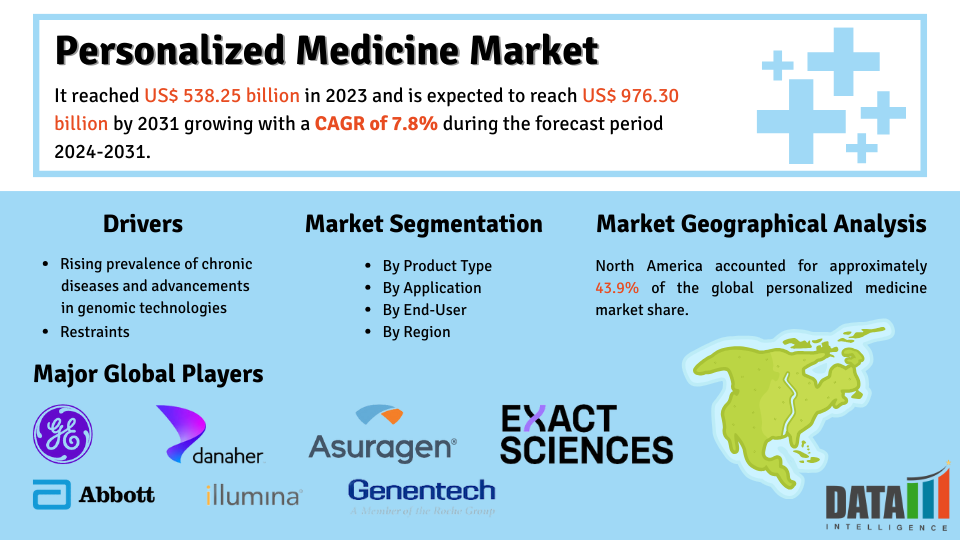
The Global Personalized Medicine Market reached US$ 670.0 billion in 2025 and is expected to reach US$ 1,286.2 billion by 2033, growing with a CAGR of 7.8% during the forecast period 2026-2033.
Personalized medicine is an innovative approach in healthcare that customizes medical treatments based on the unique characteristics of each patient. This methodology takes into various factors such as an individual's genetic profile, lifestyle choices, and medical history to formulate more effective and targeted treatment plans. By introducing advanced tools and techniques, healthcare providers can identify specific genetic variations or biomarkers linked to particular diseases, which enables them to create tailored interventions that enhance patient outcomes.
This market is rapidly evolving and holds the potential to transform healthcare by improving the precision and efficacy of medical treatments, thereby reducing costs and enhancing overall patient care. Personalized medicine aims to tailor prevention, and treatment methods according to a thorough understanding of a person's genetic profile. For instance, genetic testing can identify the most suitable medications for a patient and establish the correct dosages, thereby reducing the likelihood of adverse reactions and improving treatment effectiveness.
Market Scope
| Metrics | Details |
| CAGR | 7.8% |
| Size Available for Years | 2024-2033 |
| Forecast Period | 2026-2033 |
| Data Availability | Value (US$ Mn) |
| Segments Covered | Product Type, Application, and End-User |
| Regions Covered | North America, Europe, Asia-Pacific, South America, and Middle East & Africa |
| Largest Region | North America |
| Fastest Growing Region | Asia-Pacific |
| Report Insights Covered | Competitive Landscape Analysis, Company Profile Analysis, Market Size, Share, Growth, Demand, Recent Developments, Mergers and Acquisitions, New Product Launches, Growth Strategies, Revenue Analysis, Porter’s Analysis, Pricing Analysis, Regulatory Analysis, Supply-Chain Analysis, and Other Key Insights. |
For more details on this report - Request for Sample
Market Dynamics: Drivers
Rising prevalence of chronic diseases and advancements in genomic technologies
The demand for the global personalized medicine market is driven by multiple factors. One of the primary factors is the rising prevalence of chronic diseases and advancements in genomic technologies. The increasing incidence of chronic conditions such as cancer, diabetes, and cardiovascular diseases is significantly driving the demand for personalized therapeutics. As these diseases become more prevalent, the need for advanced treatment options that can effectively address individual patient needs is rising.
Innovations in genomic research and next-generation sequencing (NGS) technologies have significantly transformed the landscape of healthcare by facilitating the analysis of genetic information. This advancement enables healthcare providers to create more effective, individualized treatment plans innovative to a patient's unique genetic makeup.
For instance, NGS can identify mutations in cancer-related genes, enabling oncologists to select targeted therapies that are more likely to be effective based on the specific genetic alterations present in a tumor. For instance, pharmacogenomics, a subset of personalized medicine, studies how genetic variations affect drug metabolism and response, allowing healthcare providers to optimize drug selection and dosing.
Restraints
Factors such as high costs & reimbursement difficulties, regulatory and compliance challenges, and interoperability & data privacy issues are expected to hamper the market.
Personalized Medicine Market Segmentation
The global personalized medicine market is segmented based on product type, application, end-user, and region.
The personalized nutrition & wellness segment accounted for approximately 48.6% of the global personalized medicine market share
The personalized nutrition & wellness segment is expected to hold the largest market share over the forecast period. The personalized nutrition and wellness domain within the personalized medicine market is garnering significant attention for its capacity to enhance health outcomes by providing customized dietary and lifestyle recommendations. This segment concentrates on tailoring nutrition plans based on individual genetic makeup, lifestyle factors, and health data, empowering consumers to optimize their well-being and mitigate the risk of chronic diseases.
By leveraging genetic insights, healthcare providers can create personalized dietary plans that address specific health concerns, such as obesity, diabetes, and cardiovascular diseases. This approach not only enhances metabolic efficiency but also promotes overall well-being. The integration of digital health technologies, including mobile applications and wearable devices, has further propelled the growth of personalized nutrition. These tools enable individuals to track their dietary habits, physical activity, and health metrics, facilitating the delivery of personalized nutrition advice and real-time feedback on dietary choices based on their health goals and genetic profiles.
Market Geographical Share
North America accounted for approximately 43.9% of the global personalized medicine market share
North America region is expected to hold the largest market share over the forecast period owing to the increasing incidence of chronic conditions such as cancer, diabetes, and cardiovascular diseases is significantly driving the demand for personalized therapeutics. Personalized medicine offers more targeted and effective treatments for these diseases by tailoring interventions to individual patients based on their unique genetic, environmental, and lifestyle factors.
In this region, a major number of key players are present, and key developments in the U.S. are driving this market growth. For instance, Abbott is expanding the application of personalized medicine beyond oncology into infectious diseases. They received FDA approval for the first U.S. hepatitis C genotyping test. This test identifies the specific genotype of the hepatitis C virus present in an infected patient's blood. By determining the HCV genotype, doctors can select the most suitable therapy and create a personalized treatment plan tailored to the individual.
Similarly, Illumina hosted a private summit in San Diego where 30 leaders from 12 pioneering U.S. health systems came together to discuss strategies for integrating genomics into clinical care. The two-day event provided a platform for these healthcare leaders to share their experiences, challenges, and opportunities related to implementing genomic technologies to improve patient outcomes.
Personalized Medicine Market Companies
The major global players in the personalized medicine market include Abbott, GE HealthCare., Danaher Corporation (Cepheid, Inc.), ASURAGEN, INC., Exact Sciences Corporation, Illumina, Inc., QIAGEN, Genentech, Inc., Biogen, and IBM among others
Recent Developments
- April 2026 – Illumina, Inc. expands AI-powered genomic sequencing and precision medicine capabilities
Illumina strengthened its personalized medicine portfolio through advanced multiomics sequencing, AI-driven genomic interpretation, and population-scale precision healthcare initiatives supporting oncology and rare disease diagnostics. - April 2026 – GE HealthCare advances precision diagnostics and AI-enabled imaging for personalized treatment planning
GE HealthCare expanded digital diagnostics and precision imaging technologies designed to support individualized disease detection, therapy selection, and patient-specific clinical decision-making. - March 2026 – Exact Sciences Corporation strengthens molecular diagnostics and cancer precision medicine programs
Exact Sciences expanded development of genomic testing and early cancer detection solutions supporting personalized oncology treatment strategies and biomarker-driven care pathways. - March 2026 – QIAGEN N.V. enhances companion diagnostics and clinical genomics solutions
QIAGEN strengthened its precision medicine ecosystem with expanded bioinformatics, companion diagnostics, and molecular testing capabilities supporting targeted therapies and personalized treatment approaches. - February 2026 – Danaher Corporation advances precision diagnostics through Cepheid molecular testing technologies
Danaher expanded personalized medicine initiatives by strengthening Cepheid’s rapid molecular diagnostic platforms and integrated genomic testing solutions for infectious disease and oncology applications. - February 2026 – Genentech, Inc. expands biomarker-driven oncology and targeted therapy development
Genentech accelerated personalized medicine research programs focused on biomarker-guided treatments, precision oncology therapies, and individualized patient response prediction technologies.
Why Purchase the Report?
- To visualize the global personalized medicine market segmentation based on product type, application, end-user, and region and understand key commercial assets and players.
- Identify commercial opportunities by analyzing trends and co-development.
- Excel data sheet with numerous data points of the personalized medicine market with all segments.
- PDF report consists of a comprehensive analysis after exhaustive qualitative interviews and an in-depth study.
- Product mapping is available in excel consisting of key products of all the major players.
The global personalized medicine market report would provide approximately 62 tables, 56 figures, and 183 pages.
Target Audience
- Manufacturers/ Buyers
- Industry Investors/Investment Bankers
- Research Professionals
- Emerging Companies



























































