


AI in Drug Discovery and Development Market Overview
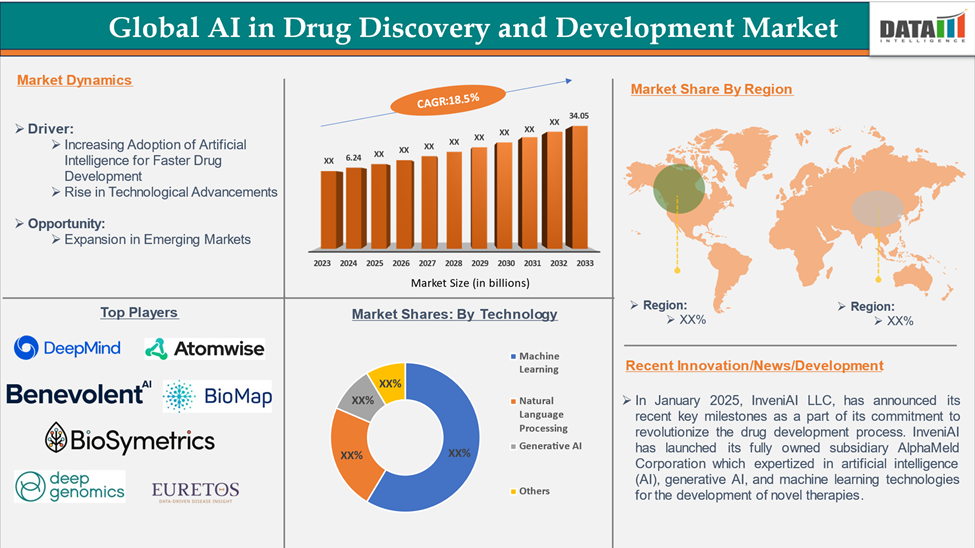
Drug development timelines, historically stretching over a decade, are being compressed as artificial intelligence becomes embedded across discovery, screening, and clinical development workflows. The AI in drug discovery and development market is not just improving efficiency, it is redefining how pharmaceutical pipelines are built, validated, and commercialized.
For decision-makers, the timing is critical. AI is shifting from experimental deployment to core infrastructure in drug discovery, directly impacting cost structures, time-to-market, and pipeline success rates.
Market Scope
| Metric | Details |
| Market Size (2025) | USD 7.39 Billion |
| Market Size (2035) | USD 48.04 Billion |
| CAGR | 18.50% |
| Historic Years | 2022–2023 |
| Base Year | 2025 |
| Forecast Period | 2026–2035 |
| Segments Covered | Technology, Application, Region |
| Leading Region | Asia-Pacific |
For more details on this report – Request for Sample
Executive Summary
Key Takeaways
- Acceleration in market scale from USD 7.39 billion in 2025 to over USD 48 billion by 2035 signals strong long-term AI integration across pharma R&D.
- Machine learning remains the dominant technology backbone, enabling faster target identification and compound screening.
- Software segment expansion, growing from USD 0.95 billion in 2022 to USD 1.08 billion in 2023, reflects increasing reliance on AI platforms rather than standalone tools.
- Asia-Pacific is emerging as a strategic growth region, supported by rising investments and cross-border collaborations.
- Clinical trial optimization and drug repurposing are becoming high-impact use cases with measurable ROI.
- Regulatory uncertainty remains a gating factor, especially around validation and explainability of AI models.
Market Dynamics: AI is Reshaping Pharmaceutical R&D Economics
Faster Drug Development and Cost Efficiency
AI technologies such as machine learning, deep learning, and natural language processing are enabling pharmaceutical companies to analyze vast biological datasets, identify drug targets, and predict molecular interactions with higher precision. This significantly reduces the cost and time associated with traditional drug discovery processes.
AI-driven models are improving hit identification, lead optimization, and preclinical testing efficiency, while also supporting real-time decision-making in clinical trials. This is particularly valuable as drug development costs continue to rise and success rates remain low.
Clinical Trial Transformation and Data Utilization
AI is increasingly being deployed to design clinical trials, predict patient responses, and optimize enrollment strategies. By leveraging real-world data and predictive analytics, companies can reduce trial failures and accelerate approvals.
Drug repositioning is another key area where AI is delivering value by identifying new therapeutic uses for existing compounds, improving return on investment for pharmaceutical companies.
Regulatory and Data Challenges
Despite strong growth, the AI in drug discovery and development market faces challenges related to regulatory frameworks. The absence of standardized protocols for AI validation, data handling, and algorithm transparency creates uncertainty for market participants.
Concerns around data privacy, ethical use of AI, and explainability of model outputs are also influencing adoption, particularly among smaller biotech firms.
Segment Analysis: Technology-Led Differentiation
Segmented by technology (Machine Learning, Natural Language Processing, Generative AI, Others), by application (Target Discovery & Validation, Screening, Lead Optimization, Clinical Trials, Others), and by Region - Share, Trends, and Forecast to 2035.
Machine Learning: Core Engine of Market Growth
Machine learning is the most influential technology in this market, enabling pattern recognition across large datasets and improving decision accuracy in early-stage drug discovery. It supports target identification, toxicity prediction, and compound optimization, making it indispensable for pharmaceutical R&D.
Application Spectrum: From Discovery to Clinical Trials
AI is being deployed across the entire drug development lifecycle:
- Target discovery and validation for identifying new therapeutic pathways
- Screening and hit-to-lead processes for faster compound selection
- Clinical trials for patient stratification and outcome prediction
This end-to-end integration is increasing the strategic value of AI platforms.
Regional Analysis: Investment and Collaboration Define Growth
Asia-Pacific: Fast-Rising Innovation Hub
Asia-Pacific is gaining a significant share in the AI in drug discovery and development market, driven by rising pharmaceutical investments and growing adoption of AI technologies in countries such as China, India, and Japan.
Japan, in particular, is leading with strong R&D capabilities and collaborations between pharmaceutical companies and AI technology providers. Partnerships such as Ono Pharmaceutical with InveniAI and Takeda with Atinary Technologies highlight the region’s focus on integrating AI into drug discovery workflows.
North America: Technology Leadership and Ecosystem Strength
North America remains a key market, supported by strong presence of AI technology companies, pharmaceutical giants, and advanced research infrastructure. The region continues to lead in innovation, particularly in generative AI and cloud-based drug discovery platforms.
Europe: Regulatory Influence and Research Excellence
Europe plays a critical role in shaping regulatory frameworks and advancing research collaborations. The region’s focus on ethical AI and data governance is influencing global standards.
Competitive Landscape: Platform Integration is the New Differentiator
The AI in drug discovery and development market is characterized by collaborations between technology providers and pharmaceutical companies.
Key players include Alphabet (Google DeepMind), Atomwise, BenevolentAI, BioMap, BioSymetrics, Deep Genomics, Euretos, Exscientia, IBM, and Iktos.
Competitive positioning is driven by:
- Proprietary AI platforms and algorithms
- Integration with cloud and lab automation systems
- Strategic partnerships with pharmaceutical companies
- Ability to deliver end-to-end drug discovery solutions
Recent Developments
In June 2026, IBM Corporation expanded its AI-driven drug discovery capabilities with advanced foundation models for molecular design and simulation. The innovation focuses on accelerating target identification and lead optimization. This supports faster drug development timelines.
In May 2026, Insilico Medicine introduced new generative AI platforms for end-to-end drug discovery, integrating target discovery, molecule generation, and clinical candidate prediction. The development improves efficiency and success rates. This benefits pharmaceutical research.
In April 2026, Exscientia plc launched AI-powered precision medicine solutions for designing patient-specific drug candidates. The development enhances clinical success probability. This supports personalized healthcare approaches.
In March 2026, Schrödinger, Inc. strengthened its computational drug discovery platform with advanced AI algorithms for molecular modeling and simulation. The innovation focuses on accuracy and speed. This supports high-quality drug design.
Regulatory and Policy Analysis
Regulatory frameworks for AI in drug discovery are evolving, with agencies such as the FDA and EMA working to establish guidelines for AI validation, transparency, and data integrity. These regulations are critical to ensuring safety and reliability but also introduce complexity for market participants.
The lack of standardized protocols for AI model validation and explainability remains a key challenge. Companies must navigate data privacy regulations, ethical considerations, and compliance requirements while integrating AI into drug development processes.
Strategic Insights and Analyst Perspective
The AI in drug discovery and development market is shifting toward an integrated, platform-driven model where competitive advantage is defined not just by algorithms, but by how effectively companies connect data, biology, and clinical execution. Organizations that move beyond isolated AI use cases and build scalable, interoperable ecosystems will be better positioned to improve pipeline productivity and reduce development risk.
From an analyst standpoint, the next phase of market leadership will depend on execution discipline, regulatory readiness, and the ability to demonstrate measurable ROI across the drug lifecycle. The following strategic priorities are emerging as critical for long-term success:
- End-to-End AI Deployment Across Drug Development
Companies are moving beyond isolated AI applications and embedding AI across discovery, preclinical, and clinical stages to improve pipeline efficiency and reduce attrition rates. - Cross-Industry Partnerships as a Growth Lever
Strategic collaborations between pharmaceutical firms and AI technology providers are enabling faster innovation, access to advanced platforms, and shared development risks. - Regulatory-Ready and Explainable AI Models
Investment in transparent, validated, and compliant AI systems is becoming essential to meet regulatory expectations and support clinical decision-making. - Cloud-Based Scalability and Infrastructure Optimization
Adoption of cloud-native platforms is helping organizations handle large-scale biological datasets, accelerate model training, and enable global R&D collaboration. - Data-Centric Competitive Advantage
Companies that build strong data ecosystems with high-quality, diverse datasets and robust governance frameworks are gaining a measurable edge in model performance and drug discovery outcomes.
Overall, the AI in drug discovery and development market analysis indicates that success will depend less on access to AI tools and more on how effectively organizations operationalize them within complex pharmaceutical workflows.
Report Benefits
This AI in drug discovery and development market report supports:
- Pharmaceutical and biotech companies in accelerating R&D pipelines and improving success rates
- Investors in identifying high-growth AI-driven healthcare opportunities
- Technology providers in aligning AI solutions with pharmaceutical needs
- Clinical research organizations in optimizing trial design and execution
- Strategy teams in evaluating partnerships, investments, and market entry strategies
The global AI in drug discovery and development market report would provide approximately 54 tables, 47 figures, and 180 pages.
Target Audience
- Pharmaceutical and biotechnology companies
- AI and technology providers
- Clinical research organizations
- Healthcare investors and venture capital firms
- Regulatory bodies and policy makers
- Academic and research institutions




























































