


CAR-T Cell Therapy for Pediatric Cancers Market Size
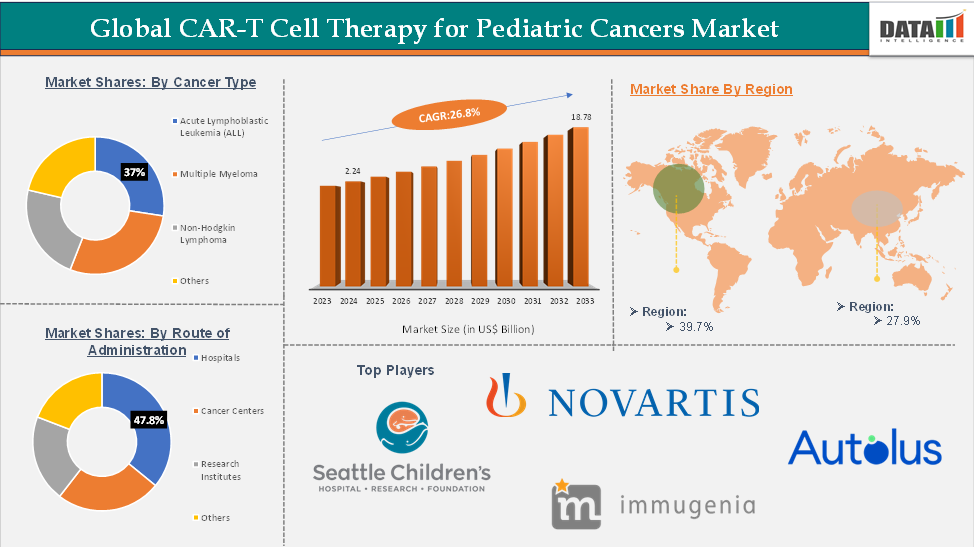
CAR-T Cell Therapy for Pediatric Cancers Market size reached US$ 2.24 billion in 2025 and is expected to reach US$ 24.03 billion by 2033, growing at a CAGR of 26.8% during the forecast period 2026-2035.
Chimeric antigen receptor (CAR) T-cell therapy is a way to get immune cells called T cells to fight cancer by genetically engineering them in a laboratory. CAR-T cell therapy is an incredibly promising emerging treatment for cancer patients and is increasingly being preferred over chemotherapy, surgery, and radiation. It is increasingly used to treat pediatric patients with B-cell acute lymphoblastic leukemia and in certain types of lymphoma.
The CAR-T cell therapy market for pediatric cancers is witnessing significant growth, fueled by its high therapeutic efficacy in treating relapsed or refractory hematologic malignancies, particularly B-cell acute lymphoblastic leukemia (ALL). Key drivers include rapid technological advancements in CAR-T engineering, strong regulatory support, increased public and private investment, and an expanding pipeline of clinical trials globally.
North America is expected to dominate the market due to its advanced healthcare infrastructure, early adoption, and robust research activity, while Asia-Pacific, especially China, is emerging as a fast-growing region due to increased clinical trial activity and government support.
CAR-T Cell Therapy for Pediatric Cancers Market Key Takeaways
- The market is expected to expand from US$ 2.24 Billion in 2025 to nearly US$ 24.03 Billion by 2035, highlighting substantial long-term investment potential.
- Acute Lymphoblastic Leukemia (ALL) remains the leading therapeutic application, accounting for 46.7% of the global market due to strong clinical efficacy.
- North America commands the largest regional position with 42.1% market share, supported by advanced healthcare infrastructure and early CAR-T adoption.
- Asia-Pacific represents the fastest-growing regional opportunity as governments increase biotechnology funding and clinical trial activity.
- Continued advances in multi-antigen targeting, engineered CAR constructs, and pediatric-focused research are broadening treatment opportunities.
- High treatment costs remain a major commercialization challenge despite significant improvements in clinical outcomes.
CAR-T Cell Therapy for Pediatric Cancers Market Market Scope
| Metrics | Details |
| Market Size (2025) | US$ 2.24 Billion |
| Forecast Market Size (2035) | US$ 24.03 Billion |
| CAGR (2026-2035) | 26.80% |
| Historic Years | 2023-2024 |
| Base Year | 2025 |
| Forecast Period | 2026-2035 |
| Segments Covered | Cancer Type, End User, Region |
| Leading Region | North America |
| Fastest Growing Region | Asia-Pacific |
Executive Summary
Source: DataM Intelligence
For more details on this report – Request for Sample
CAR-T Cell Therapy for Pediatric Cancers Market Dynamics: Drivers & Restraints
Rising Research and Developmental Activities in Pediatric Cancer Treatment are Expected to Drive the CAR-T Cell Therapy for Pediatric Cancers Market
Rising research and developmental activities in pediatric cancer treatment are playing a crucial role in driving the CAR-T cell therapy market for pediatric cancers. Increasing investment and focus on next-generation CAR-T therapies, particularly those utilizing advanced engineering techniques and multi-antigen targeting, are significantly expanding treatment possibilities and improving clinical outcomes. These innovations are especially vital for addressing the diverse and complex nature of pediatric cancers.
For instance, on May, 2022, Novartis announced that the U.S. FDA granted accelerated approval for Kymriah (tisagenlecleucel) for the treatment of relapsed or refractory follicular lymphoma after two or more lines of systemic therapy. This approval marked Kymriah’s third indication, solidifying its status as the only CAR-T therapy approved for both adult and pediatric populations.
Such advancements highlight the increasing momentum in pediatric cancer R&D, with major biopharmaceutical players continually expanding the therapeutic potential of CAR-T treatments. As a result, ongoing innovation in this area is expected to significantly boost market growth and enhance the availability of effective therapies for children battling cancer.
High Treatment Costs of CAR-T Cell Therapy are Expected to Hinder the CAR-T Cell Therapy for Pediatric Cancers Market
Many patients cannot afford CAR-T cell therapy due to its high cost, which frequently exceeds several hundred thousand dollars per patient. This restricts pediatric patients who require potentially life-saving treatments from having access to them. For instance, Kymriah's list price is $475,000, not accounting for costs related to the delivery of care, inpatient hospitalization, toxicity management, or follow-up.
CAR-T Cell Therapy for Pediatric Cancers Market Segment Analysis
The global CAR-T cell therapy for pediatric cancers market is segmented based on cancer type, end user, and region.
Treatment:
The acute lymphoblastic leukemia segment is expected to hold 46.7% of the global CAR-T cell therapy for pediatric cancers market
Acute lymphoblastic leukemia (ALL) is expected to dominate the CAR-T cell therapy market for pediatric cancers due to its high prevalence among children and the remarkable success of CAR-T therapies in treating this condition. ALL is the most common type of childhood cancer, accounting for nearly 25% of all pediatric cancer cases. CAR-T therapies, particularly tisagenlecleucel (Kymriah), have demonstrated high remission rates in relapsed or refractory pediatric ALL, significantly improving outcomes where conventional therapies have failed.
For instance, Autolus Therapeutics reported positive updates in September 2024 from its AUTO1/22 study targeting pediatric B-ALL, showing improved safety and sustained efficacy. Given its clinical success and regulatory momentum, ALL remains the leading indication for CAR-T cell therapies in children, reinforcing its dominant position in this rapidly growing market.
High rates of total recovery have been achieved with CAR-T treatments, especially those that target CD19, such as Kymriah, which have demonstrated remarkable success in treating relapsed or refractory B-cell ALL. Because of this achievement, CAR-T is now the suggested method of treatment for this group of patients. Thus, the above factors are expected to hold the segment in the dominant position.
CAR-T Cell Therapy for Pediatric Cancers Market Geographical Analysis
North America is expected to hold 42.1% of the global CAR-T cell therapy for pediatric cancers market
North America holds the largest share of the global CAR-T cell therapy market for pediatric cancers and is expected to maintain its dominance in the coming years. This dominance is primarily driven by the region's high incidence of childhood cancers, increasing public awareness of advanced treatment options, and robust investment in research and development.
For instance, according to the American Childhood Cancer Organization, in the United States alone, approximately 15,780 children between birth and 19 years of age are diagnosed with cancer annually, with about 1 in 285 children projected to be diagnosed before turning 20. The rising burden of pediatric cancer has fueled demand for innovative therapies like CAR-T, which offer hope for patients with relapsed or refractory diseases.
Additionally, North America benefits from a well-established healthcare infrastructure, early regulatory approvals, and the presence of leading biotechnology companies, all of which contribute to the accelerated development and adoption of CAR-T therapies in the region. These factors collectively position North America as a key driver of growth in the global pediatric CAR-T cell therapy market.
Asia-Pacific is expected to hold 26.8% of the global CAR-T cell therapy for pediatric cancers market
The Asia-Pacific region is projected to be the fastest-growing market for CAR-T cell therapy in pediatric cancers, driven by a combination of rising cancer incidence, increasing investment in biotechnology, and supportive government South Korea, and India are making significant strides in cancer research and the development of cell-based initiatives.
Countries like China, Japan, therapies. China, in particular, has surpassed the U.S. in the number of CAR-T clinical trials, highlighting its rapid progress and commitment to becoming a global leader in this field.
Government support through funding, regulatory reforms, and public-private partnerships is further fueling innovation and commercialization. As the demand for effective pediatric cancer treatments rises, the Asia-Pacific region is well-positioned to experience substantial growth and emerge as a key player in the global CAR-T cell therapy landscape.
CAR-T Cell Therapy for Pediatric Cancers Market Opportunities
Significant commercial opportunities are emerging across next-generation pediatric CAR-T technologies, particularly for therapies capable of improving safety, reducing manufacturing timelines, and expanding treatment beyond current hematological indications.
Technology developers are increasingly focusing on advanced CAR constructs with improved persistence, dual-antigen targeting, and reduced relapse rates. Manufacturers investing in scalable manufacturing platforms and automated cell processing technologies may gain competitive advantages by lowering production costs and increasing treatment accessibility.
Research collaborations between hospitals, biotechnology companies, and academic institutions are expected to strengthen clinical pipelines while supporting broader regulatory approvals across additional pediatric cancer indications.
CAR-T Cell Therapy for Pediatric Cancers Market Top Companies
The top companies in the CAR-T cell therapy for pediatric cancers market include Novartis AG, and Autolus Therapeutics, Seattle Children’s Hospital, among others.
CAR-T Cell Therapy for Pediatric Cancers Market Key Developments
June 2026: Autolus Therapeutics advanced the clinical development of its next-generation CAR-T cell therapies for pediatric hematologic malignancies, reporting encouraging safety and efficacy data to support future regulatory submissions and commercialization.
May 2026: Novartis expanded research collaborations focused on next-generation CAR-T therapies for pediatric cancers, emphasizing improved persistence, reduced toxicity, and broader applicability across relapsed and refractory blood cancers.
April 2026: Bristol Myers Squibb strengthened its pediatric cell therapy pipeline by advancing clinical studies evaluating CAR-T therapies for children with relapsed or refractory B-cell acute lymphoblastic leukemia (B-ALL) and other hematologic malignancies.
March 2026: Cellectis announced progress in the development of allogeneic (off-the-shelf) CAR-T cell therapies designed to improve treatment accessibility, reduce manufacturing timelines, and expand options for pediatric cancer patients.
February 2026: Fate Therapeutics accelerated the development of induced pluripotent stem cell (iPSC)-derived CAR-T cell therapies for pediatric oncology, aiming to deliver scalable, ready-to-use immunotherapies with enhanced anti-tumor activity and improved safety profiles.
Market Impact Analysis
Growing regulatory support, expanding clinical research activity, and increased investment in pediatric immunotherapy continue accelerating commercialization across global markets. However, high manufacturing costs and complex treatment delivery remain important factors influencing reimbursement policies and patient accessibility. Future improvements in manufacturing efficiency and broader healthcare funding could significantly improve adoption rates over the coming decade.
Report Benefits
This report provides strategic intelligence for:
- Biotechnology and pharmaceutical manufacturers evaluating pipeline expansion.
- Investors assessing long-term growth opportunities within pediatric immunotherapy.
- Healthcare providers planning advanced oncology treatment capabilities.
- Research institutions pursuing next-generation CAR-T technologies.
- Procurement teams evaluating future cell therapy investments.
- Corporate strategy teams monitoring competitive positioning and commercialization trends.
Target Audience
- Pharmaceutical Companies
- Biotechnology Companies
- Pediatric Oncology Centers
- Hospitals
- Research Institutes
- Academic Organizations
- Healthcare Investors
- Venture Capital Firms
- Contract Manufacturing Organizations
- Government Healthcare Agencies
- Regulatory Authorities
- Strategic Consulting Firms
Conclusion
The CAR-T Cell Therapy for Pediatric Cancers Market represents one of the most promising segments within precision oncology, supported by strong clinical outcomes, continuous innovation, and increasing investment in pediatric immunotherapy. Acute lymphoblastic leukemia continues to anchor market growth, while expanding research into additional pediatric malignancies is expected to widen future commercial opportunities. Although high treatment costs remain a significant challenge, advances in manufacturing technologies, supportive regulatory environments, and expanding clinical evidence are expected to improve accessibility over time. Organizations capable of combining scientific innovation with scalable manufacturing and strategic clinical partnerships will be well positioned to capitalize on the market's substantial growth potential through 2035.
The global CAR-T cell therapy for pediatric cancers market report delivers a detailed analysis with 57 key tables, more than 46 visually impactful figures, and 168 pages of expert insights, providing a complete view of the market landscape.




























































