


Bioprocess Automation and Control Software Market Overview
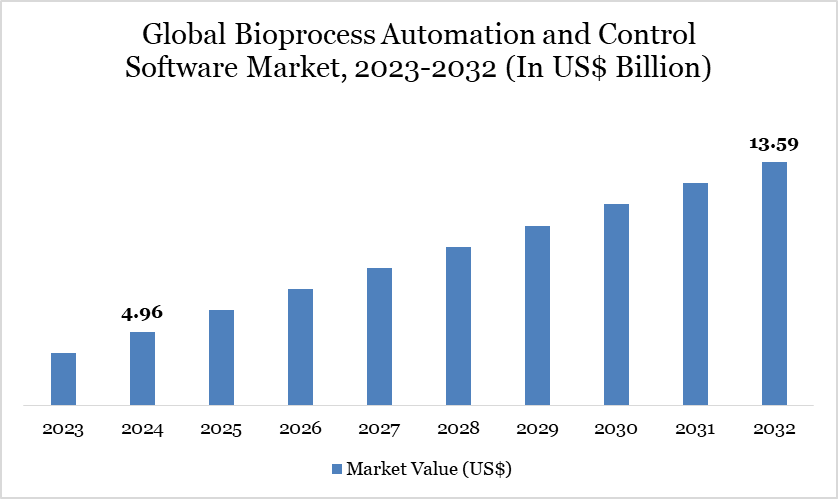
The Bioprocess Automation and Control Software Market reached US$4.96 billion in 2024 and is expected to reach US$13.59 billion by 2032, growing at a CAGR of 13.7% during the forecast period of 2025-2032, according to a DataM Intelligence report.
The global bioprocess automation and control software market is witnessing significant growth, driven by the expanding biopharmaceutical industry and increasing demand for biologics, biosimilars, and personalized medicines. Bioprocess automation and control software play a crucial role in enhancing manufacturing efficiency, ensuring product consistency, and maintaining regulatory compliance in biopharmaceutical production. The market is expected to grow substantially over the coming years, supported by advancements in automation technologies, increasing investments in biomanufacturing infrastructure, and a rising focus on operational efficiency.
Governments and private investors worldwide are investing heavily in biopharmaceutical infrastructure to meet growing healthcare demands. For example, China’s "Made in China 2025" initiative and India’s "Pharma Vision 2020" aim to strengthen domestic pharmaceutical manufacturing capabilities. Such initiatives drive the adoption of advanced automation and control systems that ensure scalable, efficient, and compliant production processes, thereby expanding market opportunities.
Bioprocess Automation and Control Software Market Trend
Technological advancements in bioprocessing are key drivers of the global bioprocess automation and control software market, as they enable more efficient, scalable, and precise manufacturing processes. Innovations such as single-use bioreactors, continuous bioprocessing, and real-time monitoring systems have transformed traditional biomanufacturing by reducing costs, increasing flexibility, and enhancing product quality. Continuous bioprocessing, another significant advancement, allows for uninterrupted production, improving yield and reducing production time.
Companies like Amgen and Biogen have adopted continuous manufacturing techniques supported by advanced control software to enhance process efficiency and meet growing market demands. For instance, Sartorius offers cutting-edge technologies like BioBrain Supervise and BioPAT DCU, which play a pivotal role in automating bioprocess workflows. BioBrain Supervise is designed for centralized data management, process visualization, and control of bioprocesses, enabling real-time decision-making and process optimization.
For more details on this report – Request for Sample
Market Scope
Metrics | Details |
By Software Type | Bioprocess Control Software, Data Management and Analytics Software, Quality Management Software (QMS), Laboratory Information Management Systems(LIMS), Manufacturing Execution Systems |
By Deployment | On-Premises, Cloud-Based, Hybrid |
By Application | Upstream Processing, Downstream Processing, Bioprocess Monitoring, R&D and Process Development, Process Optimization and Scale-Up |
By End-User | Biopharmaceutical and Pharmaceutical Companies, Contract Manufacturing Organizations, Academic and Research Institutes, Food and Beverage Industry, Others |
By Region | North America, South America, Europe, Asia-Pacific, Middle East and Africa |
Report Insights Covered | Competitive Landscape Analysis, Company Profile Analysis, Market Size, Share, Growth |
Bioprocess Automation and Control Software Market Dynamics
Rising Demand for Biopharmaceuticals and Biologics
The rising demand for biopharmaceuticals and biologics is a key driver for the global bioprocess automation and control software market, as these products require highly precise, scalable, and compliant manufacturing processes. Unlike traditional pharmaceuticals, biopharmaceuticals are produced using living organisms, requiring complex and highly regulated manufacturing processes. Automation and control software play a crucial role in ensuring the precision, consistency, and scalability needed for biopharmaceutical production.
For instance, according to International Federation Of Pharmaceutical Manufacturers & Associations, 2022, stated that combined direct, indirect and induced effects of the biopharmaceutical industry’s total contribution to the world’s GDP is US$1,838 billion. The biopharmaceutical industry employs about 5.5 million people globally, including the manufacturing of generic medicines. Global sales of biopharmaceutical products continue growing and represent the international distribution of medical technology resulting from highly intensive R&D efforts in the exporting countries.
Data Privacy and Security Concerns
Bioprocess automation and control software manage critical data, including proprietary biopharmaceutical formulations, genetic information, and process parameters. This data is highly sensitive and valuable, making it a prime target for cyberattacks. A successful breach can lead to the theft of intellectual property (IP), resulting in significant financial losses and damage to a company's competitive position.
For instance, in 2020, several pharmaceutical companies developing COVID-19 vaccines reported cyberattacks aimed at stealing vaccine research data. Such incidents highlight the vulnerability of bioprocessing operations to cybersecurity threats, discouraging companies from fully adopting automation solutions without robust security measures in place. The fear of losing proprietary data to competitors or malicious actors becomes a major restraint, especially when companies operate in highly competitive markets.
Bioprocess Automation and Control Software Market Segment Analysis
The global bioprocess automation and control software market is segmented based on offering, deployment, application, end-user and region.
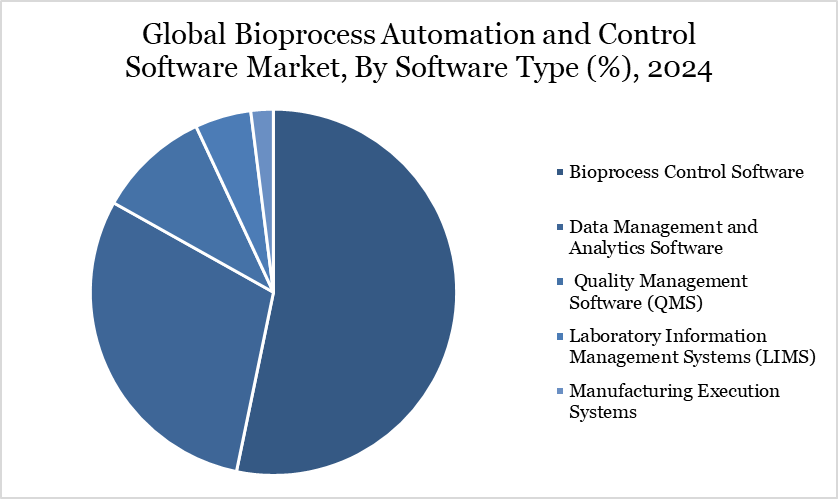
Rapid Growth of Biopharmaceutical Industry Drives Bioprocess Control Software Segment Growth
Bioprocess control software refers to specialized programs designed to monitor and control bioprocesses, particularly those involving bioreactors. The software solutions manage various parameters such as pH, temperature, dissolved oxygen and agitation speed to maintain optimal conditions for biological reactions.
The biopharmaceutical industry has seen rapid growth, with monoclonal antibodies (mAbs) being a significant contributor. From 2008 to 2013, global sales of mAb products grew from approximately US$ 39 billion to US$ 75 billion, with projections reaching US$125 billion by 2020 and US$ 138.6 billion by 2024. This surge necessitates advanced control systems to ensure efficient and scalable production.
Bioprocess Automation and Control Software Market Geographical Share
Strong Biotechnology and Pharmceutical Industry in North America
North America holds a significant share in the bioprocess automation and control software market due to its strong biotechnology and pharmaceutical industry, which demands advanced bioprocess solutions to enhance productivity and compliance. The region is home to major biopharmaceutical players and contract manufacturing organizations (CMOs) that heavily invest in automation to streamline drug development and production.
The OECD's latest biotechnology indicators reaffirm the U.S. as a global biotech leader, with 2,840 active companies and an R&D intensity of 17%. This dominance fuels North America's significant share in the bioprocess automation and control software market by driving innovation, investment, and demand for advanced bioprocessing solutions.
Sustainability Analysis
The global bioprocess automation and control software market plays a significant role in supporting sustainability goals within the biopharmaceutical and biotechnology industries. By enhancing process efficiency, minimizing waste, and reducing energy consumption, these software systems contribute to greener and more resource-efficient manufacturing environments. Automated control systems enable precise monitoring and optimization of fermentation, cell culture, and purification processes, thereby reducing the variability and resource intensity of bioprocessing.
Sustainability is further advanced through the use of predictive analytics and real-time monitoring tools integrated into these platforms. These features help companies minimize raw material usage, reduce batch failures, and improve yield, all of which contribute to lower environmental footprints. Moreover, many solutions now support paperless documentation and electronic batch records, reducing paper waste and simplifying compliance with environmental regulations.
Bioprocess Automation and Control Software Market Major Players
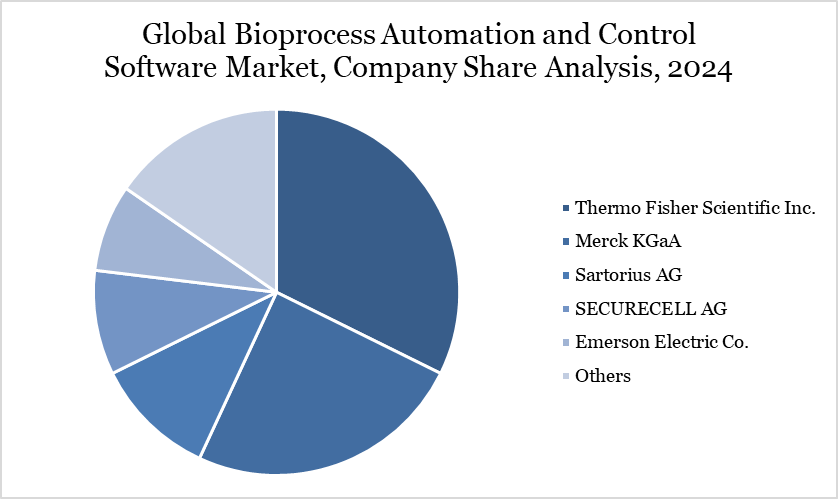
The major global players in the market include Thermo Fisher Scientific Inc., Merck KGaA, Sartorius AG, SECURECELL AG, Emerson Electric Co., Agilent Technologies, Inc, Siemens AG, Cytiva (Danaher Corporation), Eppendorf SE and Waters Corporation.
Key Developments
In December 2024, Eppendorf and DataHow AG announced a strategic partnership to transform bioprocess development. The partnership will integrate DataHow's AI-enabled analytics solution, DataHowLab, with Eppendorf's BioNsight cloud, offering scientists unparalleled insight and analytics capabilities.
In January 2024, Merck signed a Memorandum of Understanding (MoU) with Mycenax Biotech to introduce cutting-edge, high-capacity bioprocessing solutions in Taiwan and other global markets. This collaboration will involve the integration of Merck’s BioContinuum Platform across the entire bioprocessing spectrum for Mycenax’s customers, with a focus on the automation and digitalization of processes to enhance efficiency, scalability, and compliance in biomanufacturing operations.
Why Choose DataM?
Data-Driven Insights: Dive into detailed analyses with granular insights such as pricing, market shares and value chain evaluations, enriched by interviews with industry leaders and disruptors.
Post-Purchase Support and Expert Analyst Consultations: As a valued client, gain direct access to our expert analysts for personalized advice and strategic guidance, tailored to your specific needs and challenges.
White Papers and Case Studies: Benefit quarterly from our in-depth studies related to your purchased titles, tailored to refine your operational and marketing strategies for maximum impact.
Annual Updates on Purchased Reports: As an existing customer, enjoy the privilege of annual updates to your reports, ensuring you stay abreast of the latest market insights and technological advancements. Terms and conditions apply.
Specialized Focus on Emerging Markets: DataM differentiates itself by delivering in-depth, specialized insights specifically for emerging markets, rather than offering generalized geographic overviews. This approach equips our clients with a nuanced understanding and actionable intelligence that are essential for navigating and succeeding in high-growth regions.
Value of DataM Reports: Our reports offer specialized insights tailored to the latest trends and specific business inquiries. This personalized approach provides a deeper, strategic perspective, ensuring you receive the precise information necessary to make informed decisions. These insights complement and go beyond what is typically available in generic databases.
Target Audience 2024
Manufacturers/ Buyers
Industry Investors/Investment Bankers
Research Professionals
Emerging Companies




























































