


AI Data Center Expansion Is Driving a New Wave of Industrial Infrastructure Demand
The artificial intelligence boom is moving beyond semiconductors and servers to reshape demand across the broader industrial equipment supply chain. As hyperscalers, cloud providers and data center developers accelerate AI infrastructure deployment, manufacturers of generators, electrical systems, energy storage and cooling technologies are seeing a growing opportunity in the physical infrastructure required to operate high-density computing facilities.
Recent industry developments highlight the scale of this shift. Caterpillar is investing $725 million to expand generator production in Indiana and has converted another facility to manufacture turbine engines used in data-center power applications. Cummins is investing $450 million to increase generator production and expects its data-center-related sales to reach $9 billion by 2030, up 80% from 2026, according to reporting by The Wall Street Journal.
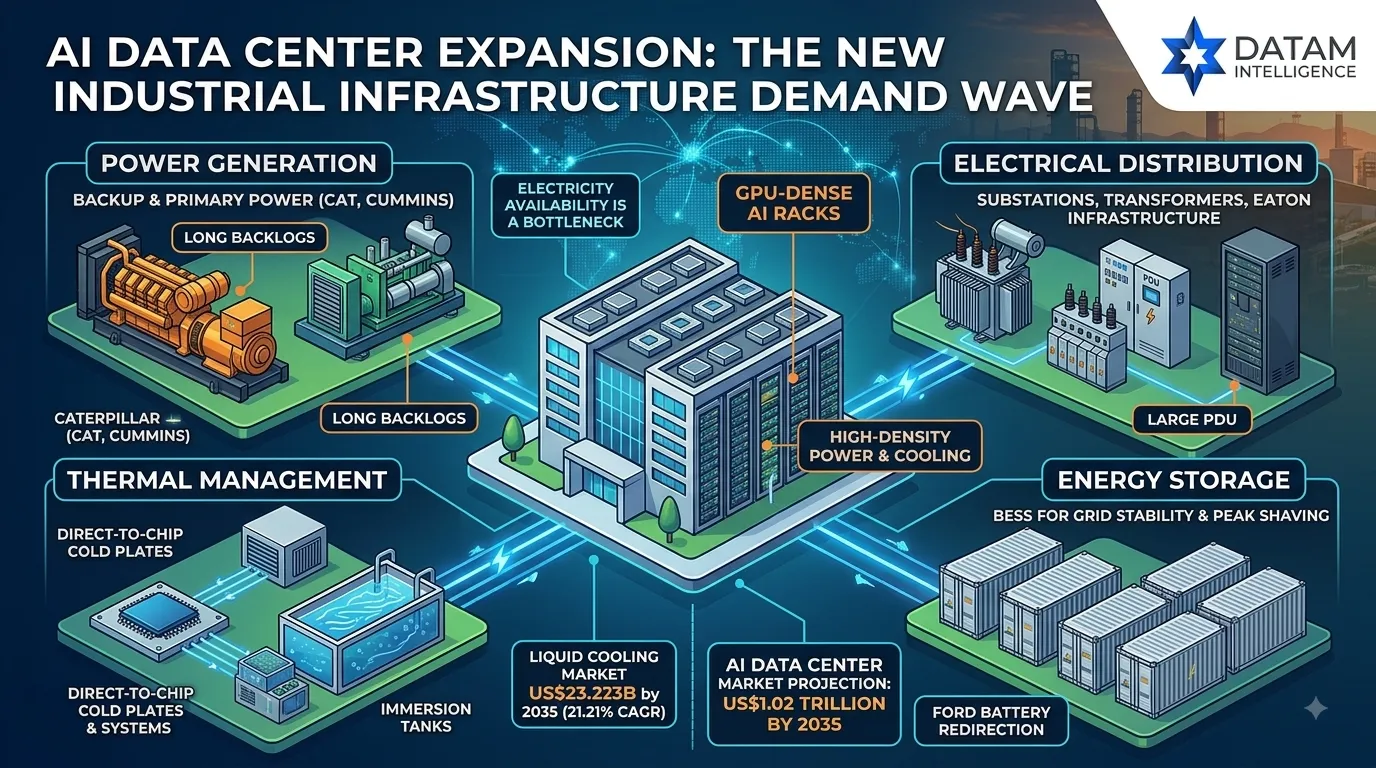
Eaton is also expanding its exposure to the sector through acquisitions and data-center infrastructure investments. Meanwhile, Ford is exploring an alternative route into the market by redirecting excess electric-vehicle battery capacity toward energy-storage applications for data centers and other industrial power users.
The trend signals a broader transformation: AI infrastructure demand is increasingly becoming an industrial-equipment demand story.
Why AI Data Centers Need More Infrastructure Than Traditional Data Centers
AI workloads require substantially greater computing density than many traditional enterprise workloads. Large-scale training and inference rely on GPU and accelerator clusters that require higher power availability, more sophisticated thermal management and increasingly dense rack architectures.
This is creating demand across multiple infrastructure categories:
- Power-generation equipment
- Backup and standby generators
- Natural-gas generation systems
- Electrical distribution equipment
- Switchgear and power distribution units
- Transformers
- Battery energy storage systems
- Liquid cooling systems
- Coolant distribution units
- Direct-to-chip cooling
- Networking infrastructure
- High-density AI racks
- Data center monitoring and control systems
Deloitte estimates that power and cooling equipment, storage hardware and networking could account for approximately one-third of anticipated global data-center spending in 2026, with chips representing much of the remaining expenditure. The firm also highlights the rapid increase in AI rack power density and the resulting need for liquid cooling and higher-voltage power architectures.
This means the AI data-center opportunity extends well beyond GPUs and servers.
Power Availability Is Becoming a Critical AI Data Center Bottleneck
One of the most important consequences of AI infrastructure expansion is the growing importance of electricity availability.
AI data centers can require enormous amounts of power, while grid connections can take years in constrained markets. This is encouraging developers to consider a combination of grid power, on-site generation, battery storage and other distributed-energy solutions.
The trend is already influencing equipment purchasing decisions.
Caterpillar's generator backlog from data center customers reportedly extends as far as 2030, while Cummins is developing larger generator platforms intended for use as primary power sources at data centers.
Other research also points to the same structural constraint. Roland Berger identifies electricity availability and rack-level power density as two distinct bottlenecks for AI data center expansion, arguing that conventional power distribution and cooling architectures are increasingly challenged by high-density AI infrastructure.
For data center developers, securing power is increasingly becoming as important as securing compute hardware.
AI Data Center Cooling Emerges as a Strategic Infrastructure Market
Power is only one side of the infrastructure equation. The electricity consumed by AI accelerators ultimately becomes heat that must be removed reliably and efficiently.
This is accelerating investment in liquid cooling technologies.
DataM Intelligence estimates that the global AI Data Center Liquid Cooling Market reached US$3.39 billion in 2025 and is projected to reach US$23.23 billion by 2035, representing a 21.21% CAGR from 2026 to 2035. The market is being driven by GPU-dense clusters, generative AI, high-performance computing and increasingly demanding AI workloads.
Direct-to-chip cooling, immersion cooling, rear-door heat exchangers and coolant distribution units are therefore becoming increasingly relevant to AI data-center design.
The broader DataM Intelligence Data Center Cooling Market is projected to reach US$58.80 billion by 2035, with a 13.64% CAGR during 2026 - 2035.
The implication for equipment manufacturers is significant: cooling is moving from a supporting facility function toward a core determinant of how much computing capacity a data center can deploy.
Manufacturers Are Repositioning Existing Capacity for AI Infrastructure
The current AI infrastructure cycle is notable because manufacturers do not necessarily need to create entirely new businesses to participate.
Existing industrial capabilities can often be adapted to AI data-center applications.
Caterpillar and Cummins can leverage established generator and engine platforms.
Eaton can use its electrical-equipment expertise to serve data-center power-distribution requirements.
Ford is exploring how surplus battery production can be redirected toward stationary energy storage.
This creates an important strategic opportunity for industrial companies facing weaker demand in traditional end markets.
AI data centers can provide a new source of growth for manufacturers exposed to construction, automotive, industrial machinery, electrical equipment and energy infrastructure.
AI Data Center Equipment Demand Is Expanding Across the Supply Chain
The opportunity is increasingly spreading across multiple tiers of the infrastructure ecosystem.
Power Infrastructure
Data-center operators require generators, transformers, switchgear, PDUs, UPS systems and other electrical equipment to deliver reliable high-density power.
Energy Storage
Battery energy-storage systems can provide backup capacity, load management and additional flexibility where grid availability is constrained.
DataM Intelligence estimates that the global AI Data Center BESS Market could grow from US$1.65 billion in 2025 to US$31.97 billion by 2035, representing a 34.5% CAGR during 2026–2035.
Thermal Management
As rack power density rises, liquid cooling is becoming increasingly important. This creates opportunities for manufacturers of cold plates, CDUs, heat exchangers, pumps, manifolds, engineered coolants and immersion systems.
Networking and Compute Infrastructure
AI clusters require high-speed networking and specialized infrastructure to connect large numbers of accelerators while maintaining performance and minimizing bottlenecks.
AI-Ready Data Center Construction
The physical construction of hyperscale and AI-focused facilities is generating demand for electrical, mechanical, structural and specialized data-center infrastructure.
AI Data Center Market Growth Creates Opportunities for Industrial Suppliers
The broader market opportunity is substantial.
According to DataM Intelligence, the global AI Data Centers Market was valued at US$120.74 billion in 2025 and is projected to reach US$1.02 trillion by 2035, expanding at a 22.8% CAGR during 2026–2035. North America currently leads the market, while Asia-Pacific is identified as the fastest-growing region.
The market expansion is being supported by hyperscale investment, generative AI adoption, enterprise AI deployment, high-performance computing and the increasing need for AI-optimized infrastructure.
For industrial suppliers, this represents a potentially long-duration demand cycle rather than a single equipment replacement opportunity.
AI Infrastructure Boom Also Creates Overcapacity Risks
Despite strong near-term demand, the AI data-center equipment market is not without risks.
The pace of investment has raised concerns that data center capacity could eventually exceed demand or that technological improvements could reduce the amount of infrastructure required per unit of computing output.
The Wall Street Journal notes that economists and industry observers are concerned about aggressive data-center spending and the possibility that future technological advances could make some infrastructure smaller, cheaper or less power-intensive. The comparison with previous infrastructure investment cycles highlights the potential for a future correction if capacity expansion significantly exceeds sustainable demand.
For equipment manufacturers, this makes capacity planning particularly important.
Companies expanding production must balance today's order backlog against the possibility of changing AI architectures, improved accelerator efficiency, alternative power technologies and shifting data-center deployment strategies.
What This Means for AI Data Center Equipment Manufacturers
The current market presents both a growth opportunity and a strategic test.
Manufacturers positioned around power, cooling, electrical distribution, energy storage and high-density infrastructure are likely to benefit as AI data-center construction expands.
However, long-term winners will need to do more than increase production volumes.
They will need to address:
- Higher rack power density
- Faster equipment deployment requirements
- Grid interconnection constraints
- Energy efficiency
- Cooling performance
- Equipment lead times
- Supply-chain resilience
- Total cost of ownership
- Modular infrastructure requirements
- AI hardware technology changes
The competitive advantage is increasingly shifting toward companies capable of delivering integrated, scalable and energy-efficient infrastructure rather than standalone components.
Analyst View: AI Is Turning Data Centers Into an Industrial Infrastructure Opportunity
The latest manufacturer investments demonstrate that AI's economic impact is extending into sectors traditionally associated with industrial equipment rather than digital technology.
The critical investment opportunity is not limited to AI chips or cloud platforms. Every new AI data center requires a physical ecosystem capable of supplying electricity, distributing power, removing heat, storing energy and maintaining uptime.
From an infrastructure perspective, power availability, thermal management and deployment speed are becoming strategic constraints on AI compute expansion.
This creates an expanding addressable market for manufacturers that can translate established industrial capabilities into AI-ready infrastructure solutions.
At the same time, investors and equipment suppliers should distinguish between temporary order acceleration and sustainable structural demand. AI architecture evolution, energy efficiency improvements and potential data-center overbuilding could change equipment requirements over the medium term.
The strongest suppliers are therefore likely to be those with scalable manufacturing capabilities, diversified customer bases, strong technology roadmaps and the flexibility to adapt to changing AI infrastructure designs.
Market Outlook: AI Data Center Infrastructure Demand to Remain a Key Growth Theme
The convergence of artificial intelligence, hyperscale computing and energy-intensive data-center workloads is creating a new infrastructure investment cycle.
The latest moves by Caterpillar, Cummins, Eaton and Ford illustrate how established manufacturers are adapting to this opportunity.
Meanwhile, the expansion of liquid cooling, battery energy storage, power distribution and AI-optimized data centers is broadening the addressable market beyond traditional computing hardware. DataM Intelligence's market research indicates strong long-term growth across AI data centers, liquid cooling and AI data-center energy storage.
As AI adoption continues to move from experimentation toward large-scale commercial deployment, the companies supplying the physical infrastructure behind AI could become increasingly important beneficiaries of the AI investment cycle.
The next phase of AI competition may therefore be determined not only by who develops the most powerful models, but also by who can build, power and cool the infrastructure required to run them at scale.
Key Takeaways
- AI data center expansion is creating new demand for industrial power and infrastructure equipment.
- Caterpillar and Cummins are increasing generator capacity to address data-center demand.
- Eaton is expanding its data-center exposure through electrical infrastructure and acquisitions.
- Ford is targeting stationary energy storage as another route into the data center power market.
- Liquid cooling is becoming increasingly important as AI rack power density rises.
- DataM Intelligence projects the AI Data Centers Market to reach US$1.02 trillion by 2035.
- AI data center BESS demand is projected to expand rapidly through 2035.
- Overbuilding, technology changes and infrastructure costs remain important long-term risks.
News source; https://www.wsj.com/business/big-manufacturers-find-new-demand-in-equipping-ai-data-centers-14e869ee