


AI Data Center BESS Market Overview
The global AI data center BESS market reached US$ 1.65 billion in 2025 and is expected to reach US$ 31.97 billion by 2035, growing with a CAGR of 34.5% during the forecast period 2026-2035. The sharp increase in the power density needed due to training and inference in artificial intelligence, especially in generative AI, has led to the need for energy storage systems in data centers. According to International Energy Agency (IEA), the global electricity requirement from data centers could exceed 1,000 TWh in 2026, and most of this growth will come due to advancements in AI technologies, requiring a dynamic energy infrastructure, such as BESS. Also, Microsoft and Google are making significant investments in carbon-free electricity and grid-enabled data centers, where Microsoft is targeting to run entirely on carbon-free energy 24/7 by 2030, and Google is spending over US$ 10 billion annually on its data center and AI infrastructure.
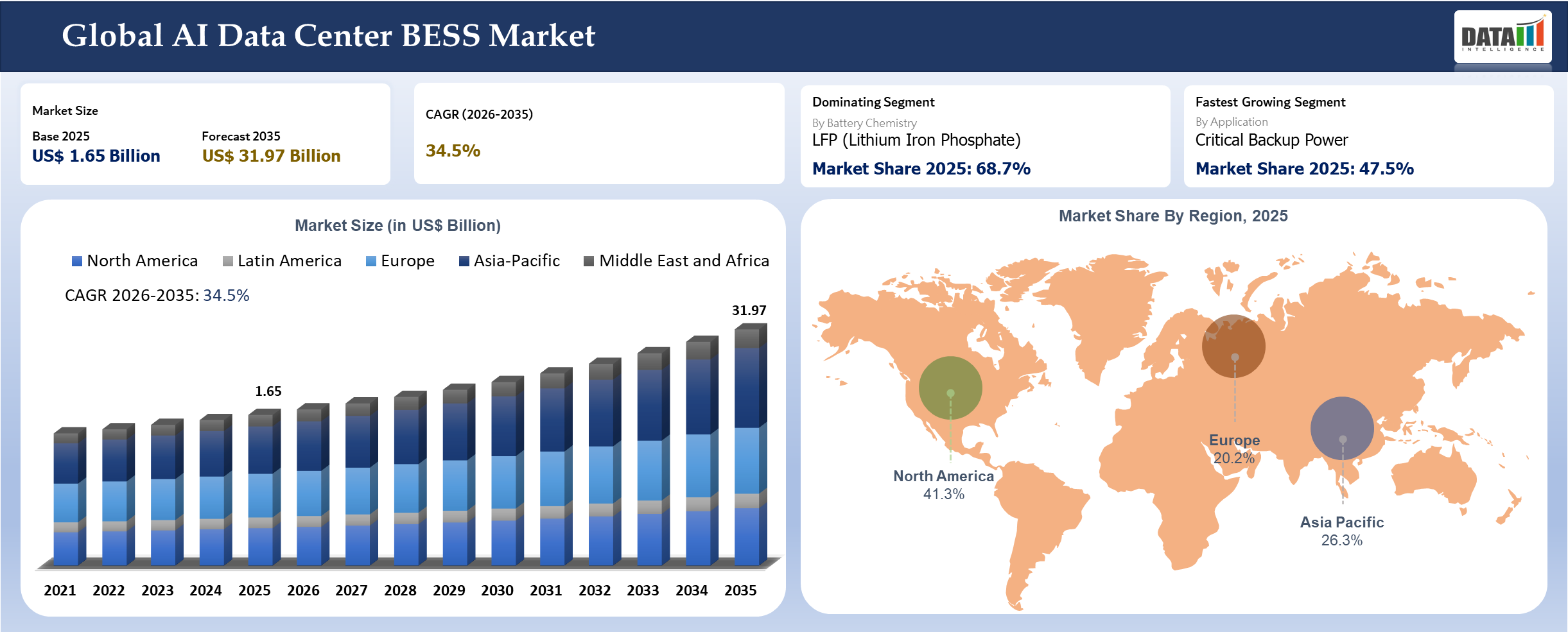
Emission regulations for digital infrastructure have become more stringent, while utilities are finding it difficult to handle intermittent power from renewable sources. As per U.S. Department of Energy, energy storage capacities have seen an uptick in the United States, where grid-scale battery capacities exceed 15 GW. The growth in installations can be attributed to supportive policies and funding. Many data centers are incorporating BESS technology with renewable power sources, including solar and wind energy, to guarantee continuous operations without using diesel generators. With an increase in the use of AI-based data centers, which require round-the-clock operations, there has been research into lithium-ion batteries and other next-generation battery chemistries.
AI Data Center BESS Industry Trends and Strategic Insights
- Hyperscale data center operators are implementing lithium-ion and advanced solid-state batteries to handle dense power requirements, as seen in companies like Tesla that utilize Megapack systems with an annual output of more than 3 GWh.
- Many data centers have partnered with their renewable energy resources alongside BESS, making it possible to achieve continuous carbon-neutral operation 24/7, such as Google’s round-the-clock carbon-neutral energy project.
AI Data Center BESS Market Scope
| Metrics | Details | |
| 2025 Market Size | US$ 1.65 Billion | |
| 2035 Projected Market Size | US$ 31.97 Billion | |
| CAGR (2026-2035) | 34.5% | |
| Largest Market | North America | |
| Fastest Growing Market | Asia-Pacific | |
| By Battery Chemistry | LFP (Lithium Iron Phosphate), NMC (Nickel Manganese Cobalt), Lead, Acid Battery, Nickel Zinc, Sodium Ion, Flow Battery (Vanadium Flow) | |
| By Battery Form | Prismatic, Pouch, Cylindrical | |
| By System Architecture | Deployment Architecture, Electrical Coupling, Power Architecture | |
| By Application | Critical Backup Power, Ride Through and Bridging, Peak Shaving and Demand Charge Management, Renewable Firming, Black Start Support, Grid Services | |
| By Runtime | Less Than 15 Minutes, 15 To 30 Minutes, 30 To 60 Minutes, 1 To 2 Hours, More Than 2 Hours | |
| By Power Rating | Below 1 MW, 1 To 5 MW, 5 To 20 MW, 20 To 50 MW, above 50 MW | |
| By Data Center Type | Hyperscale Owner Operated, Colocation, Enterprise, Edge and Regional | |
| By Project Stage | New Build, Expansion and retrofit | |
| By Distribution Channel | Direct OEM Supply, Via UPS OEM, Via System Integrator, Via EPC Or Developer | |
| By Software Layer | BMS, EMS, Remote Monitoring and Diagnostics | |
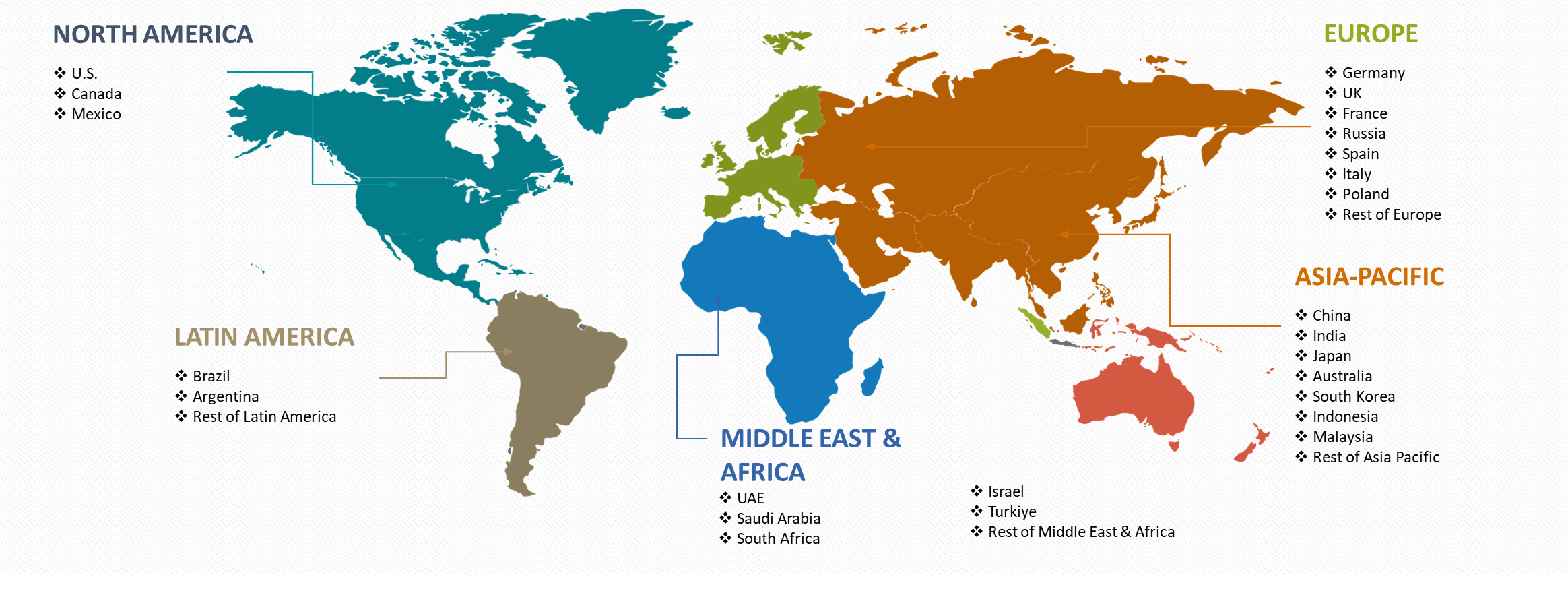
| By Region | North America | USA, Canada, Mexico |
| Europe | Germany, UK, France, Spain, Italy, Poland | |
| Asia-Pacific | China, India, Japan, Australia, South Korea, Indonesia, Malaysia | |
| Latin America | Brazil, Argentina | |
| Middle East and Africa | UAE, Saudi Arabia, South Africa, Israel, Türkiye | |
| Report Insights Covered | Competitive Landscape Analysis, Company Profile Analysis, Market Size, Share, Growth | |
Disruption Analysis
Unprecedented level of disruption occurring within the AI data center BESS market, driven by the overlap between high-performance computing and innovations in energy storage. While companies such as NVIDIA Corporation will not directly impact the power consumption pattern, their indirect influence via increased processing speeds will push operators towards highly efficient and agile energy storage systems. Energy storage devices with the ability to communicate with the electric grid, offered by companies like Fluence Energy, have brought energy arbitrage and demand response to the table, making the storage profitable for their companies. Advances in the field of battery technology through new technologies such as solid-state batteries and chemistry by companies such as QuantumScape will alter the standards of performance for the industry.
BCG Matrix: Company Evaluation
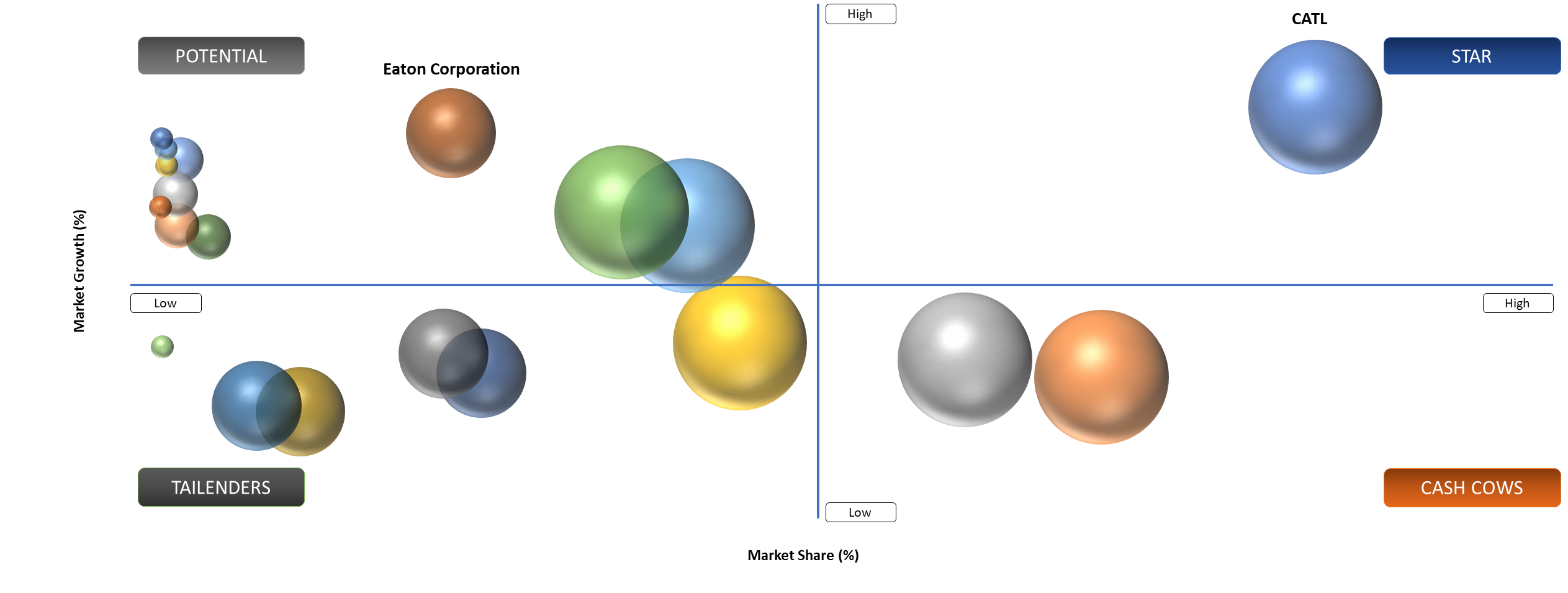
Leading integrators like Tesla Inc. and BYD Company Ltd. are categorized as Stars because of their high market growth due to hyperscale AI data centers' demand for high-density, fast-response storage solutions. Tesla and BYD Company can take advantage of their vertically integrated business models and large lithium-ion deployments. Established companies like Schneider Electric and ABB Ltd., which have stable UPS and energy management solutions in data centers, can be considered as Cash Cows since they have incremental BESS capabilities. Question Marks are represented by innovative companies like Fluence Energy and Northvolt that are developing AI-optimized energy storage solutions, but do not yet have economies of scale and profitability.
AI Data Center BESS Market Dynamics
Surging AI Workloads Driving Energy Storage Demand
The fast growth in AI workloads forms the key reason for BESS adoption within the data center industry. The training of large AI models demands tremendous computing resources, sometimes utilizing hundreds of megawatt-hours for each training session. As estimated by the Lawrence Berkeley National Laboratory, the load in U.S. data centers may reach up to 35 GW by 2030, where a significant portion of the increase will be attributed to AI technology usage. With BESS, data center managers can handle fluctuating loads through energy storage during non-peak periods and energy discharge during peak periods without relying on the grid system and minimize the risk associated with operation. Moreover, AI data centers require zero downtime, which BESS ensures instantly as opposed to diesel-powered generators.
Grid Constraints and Power Infrastructure Challenges
Restricting the growth of AI data center BESS in the market is the current inability of grid infrastructure to sustain the growing demand for electricity from AI projects. Many areas are suffering from long delays in connecting their grids due to capacity issues. The National Grid has been reporting delays of up to 10 years in connecting major consumers of electricity, such as data centers. Therefore, it has made them turn to on-site power solutions through energy storage devices. In addition, the issue of high initial cost for setting up BESS, as well as battery life cycle and recycling, is a limiting factor.
AI Data Center BESS Market Segmentation Analysis
The global AI data center BESS market is segmented based on battery chemistry, battery form, system architecture, application, runtime, power rating, data center type, project stage, distribution channel, software layer and region.
Hyperscale Data Centers Leading Adoption
The hyperscale data centers’ operators have picked up the torch of implementing BESS due to the massive energy consumption requirements and capital investment needed for such implementations. Large corporations like Amazon Web Services (AWS) and Meta Platforms have already implemented BESS systems to provide an uninterrupted power supply to fuel their artificial intelligence (AI) and cloud computing services. Meta implemented data centers with all energy generated by renewable sources, while BESS solutions would serve as backup options to ensure continuous operations. Similarly, AWS is striving for full coverage by renewable energy sources, while energy storage solutions can serve as alternatives.
Renewable Integration and Peak Load Management
Solar and wind power, among other sources of energy, are being integrated into BESS technology to make AI data centers efficient. The source of energy is unreliable; the need for BESS technology is therefore high in ensuring reliability. As per the data released by the International Renewable Energy Agency, over 500 GW of renewable energy sources were put up worldwide in 2023 and it was necessary to employ energy storage systems due to supply-demand problems. In AI data centers, energy from renewable sources can be stored using BESS technology to increase efficiency.
AI Data Center BESS Market Geographical Penetration
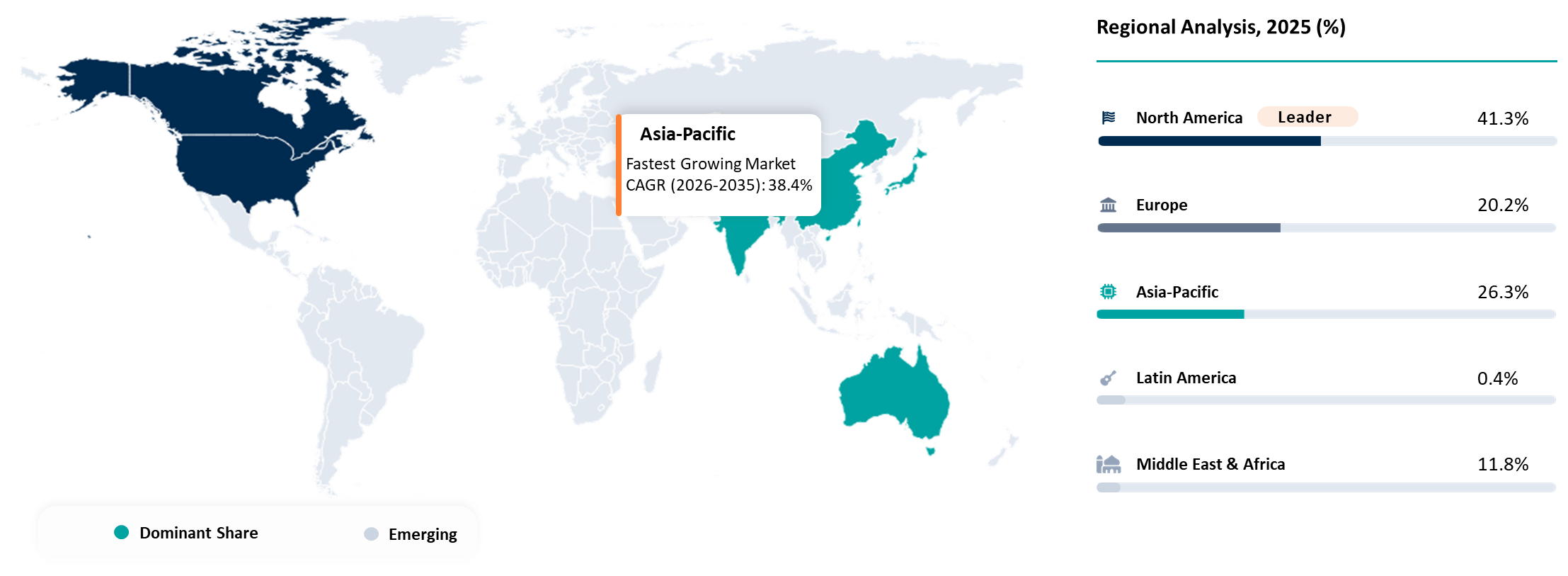
North America Focuses on Innovation and Sustainability
North America is at the forefront in relation to innovative BESS technology for AI data centers through extensive funding towards AI technology, cloud computing and environmentally friendly technologies. There are significant investments in advanced battery technologies by US Department of Energy, together with other private players. The investments have been directed towards various battery technologies,s including solid state batteries and long-duration batteries. It is part of the Energy Storage Grand Challenge that was launched in 2024 by the US Department of Energy. In addition, there are certain states in North America that lead in battery technology, among them California and Texas. In 2024, California had 13 GW of battery storage, mainly to generate power in AI data centers and green energy generation plants.
USA AI Data Center BESS Market Trends
In North America, the demand for data center battery energy storage systems (BESS) related to artificial intelligence (AI) is expected to grow immensely in USA due to hyperscale AI loads and grid reliability issues. Data center electricity consumption in the US is forecasted to increase by over 100 percent by 2030, mainly because of AI training and inference clusters. Lithium-ion batteries and other new types of long-duration BESSs have been increasingly utilized to cope with the increasing electricity demand. According to the U.S. Department of Energy, over US$ 20 billion has been spent on grid storage and resilience initiatives in the country since 2022, primarily to support data centers' operations. Cloud service providers have been building AI data centers that integrate BESS systems to minimize their dependence on diesel generators and take part in demand response programs.
Canada AI Data Center BESS Market Trends
The Canadian AI-powered data center BESS market is growing consistently due to clean energy initiatives and policies related to digital infrastructure development. More than 80% of total energy consumption in the country originates from emissions-free energy sources, allowing data centers to combine BESS with renewable sources to ensure carbon-neutral operation. The rising interest in building AI-related infrastructure, which includes more than CAD 2 billion worth of investments from the federal government as part of various AI projects, fuels the growth of the market as well. BESS installations are seen in provinces like Quebec and Ontario, where hyperscale data centers relying on hydropower emerge. Energy storage technologies are currently being tested by grid managers to address seasonal energy peaks due to increased use of AI-powered clusters.
AI Data Center BESS Market Competitive Landscape
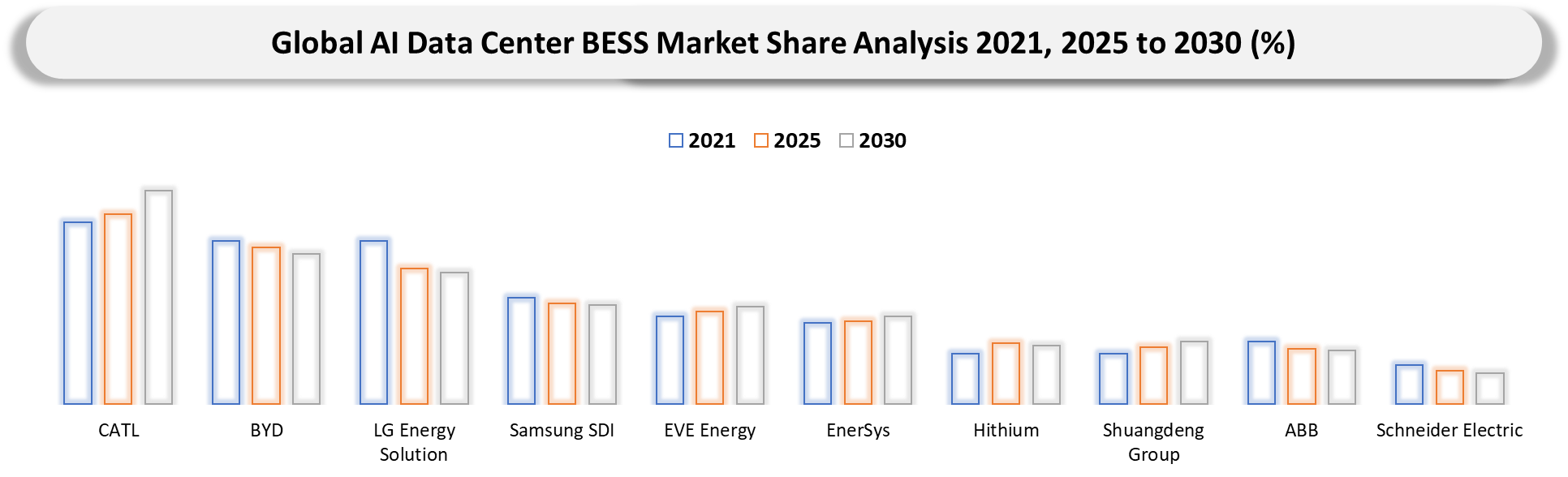
- The global AI Data Center BESS market features a competitive landscape driven by battery manufacturers, energy technology firms and data center infrastructure providers.
- Key players include Tesla, LG Energy Solution, CATL, BYD, Fluence Energy, Schneider Electric and ABB.
- Companies are differentiating through advanced battery chemistries, energy management software and integration capabilities with AI-driven data center operations.
- Strategic investments in solid-state batteries, AI-based energy optimization platforms and recycling technologies are becoming critical as sustainability and efficiency take center stage in data center energy strategies.
Key Developments
- April 2026: CATL invested US$ 600 million in Zhongheng Electric to expand AI data center power infrastructure and HVDC-aligned energy storage systems.
- April 2026: GE Vernova strengthened its grid-scale storage and power solutions portfolio, addressing AI data center electricity demand growth and renewable integration challenges globally.
- March 2026: BYD accelerated Blade battery deployment for stationary storage, targeting AI data center resilience and fast-charging capabilities amid rising hyperscale demand.
- March 2026: Eaton Corporation expanded its distributed energy storage and UPS solutions portfolio, targeting AI data centers, improving grid interaction, resilience and energy optimization capabilities.
- March 2026: EVE Energy increased production of large-format LFP cells targeting data center BESS applications, emphasizing cost efficiency and long-duration storage performance.
- March 2026: Fluence Energy expanded grid-scale and behind-the-meter storage deployments supporting AI data center energy demands, leveraging digital optimization platforms for performance improvements.
- February 2026: Huawei Technologies launched AI-driven smart energy solutions integrating BESS with digital power systems to optimize hyperscale data center energy efficiency and reliability.
- February 2026: LG Energy Solution expanded North American ESS manufacturing capacity, focusing on lithium-ion systems supporting AI-driven data center uptime and grid-interactive storage integration.
- February 2026: Vertiv introduced integrated energy storage and thermal management solutions supporting high-density AI data centers with improved efficiency and uptime performance.
- January 2026: Delta Electronics advanced lithium-ion UPS and energy storage solutions for hyperscale data centers, aligning with AI-driven demand for high-efficiency power infrastructure.
- January 2026: Samsung SDI advanced high-density prismatic batteries for UPS and data center applications, enhancing safety and lifecycle performance for AI infrastructure operators.
- January 2026: Tesla Energy expanded Megapack deployments for large-scale storage supporting AI data centers, enabling grid balancing and uninterrupted power supply for hyperscale facilities.
Why Choose DataM?
- Data-Driven insights: Dive into detailed analyses with granular insights such as pricing, market shares and value chain evaluations, enriched by interviews with industry leaders and disruptors.
- Post-Purchase Support and Expert Analyst Consultations: As a valued client, gain direct access to our expert analysts for personalized advice and strategic guidance, tailored to your specific needs and challenges.
- White Papers and Case Studies: Benefit quarterly from our in-depth studies related to your purchased titles, tailored to refine your operational and marketing strategies for maximum impact.
- Annual Updates on Purchased Reports: As an existing customer, enjoy the privilege of annual updates to your reports, ensuring you stay abreast of the latest market insights and technological advancements. Terms and conditions apply.
- Specialized Focus on Emerging Markets: DataM differentiates itself by delivering in-depth, specialized insights specifically for emerging markets, rather than offering generalized geographic overviews. The approach equips our clients with a nuanced understanding and actionable intelligence that are essential for navigating and succeeding in high-growth regions.
- Value of DataM Reports: Our reports offer specialized insights tailored to the latest trends and specific business inquiries. The personalized approach provides a deeper, strategic perspective, ensuring you receive the precise information necessary to make informed decisions. The insights complement and go beyond what is typically available in generic databases.
Target Audience
- Data Center Developers & Operators: Hyperscale, colocation and enterprise operators deploying battery energy storage systems (BESS) to ensure uptime, peak shaving and energy resilience for AI-driven workloads.
- Cloud Service Providers & AI Companies: Large-scale compute providers and AI firms integrating BESS to manage power fluctuations, optimize energy costs and support high-density GPU clusters.
- Energy Storage Integrators & EPC Contractors: Engineering, procurement and construction firms designing and deploying grid-connected and behind-the-meter BESS solutions for data center infrastructure.
- Utility Companies & Grid Operators: Power utilities and transmission operators leveraging BESS-enabled data centers for grid stability, demand response participation and renewable energy balancing.
- Government & Regulatory Authorities: Energy regulators, digital infrastructure policymakers and smart city authorities supporting sustainable data center expansion and energy efficiency mandates.
- OEMs & Battery Technology Providers: Manufacturers of lithium-ion, solid-state and advanced battery systems developing high-performance storage solutions tailored for AI data center applications.
- Investors & Private Equity Firms: Institutional investors and infrastructure funds targeting high-growth opportunities in energy storage, digital infrastructure and AI-driven power demand ecosystems.
- Renewable Energy Developers: Solar, wind and hybrid energy project developers integrating BESS with AI data centers to enable round-the-clock clean energy supply.
- Technology Providers & Software Platforms: Companies offering energy management systems (EMS), AI-driven optimization software and grid-interactive solutions for efficient BESS operation.
- Facility Management & Service Providers: Data center maintenance firms, energy service companies (ESCOs) and lifecycle service providers ensuring reliability, monitoring and performance optimization of BESS assets.



























































