


Micro-Subscription Service Market Overview
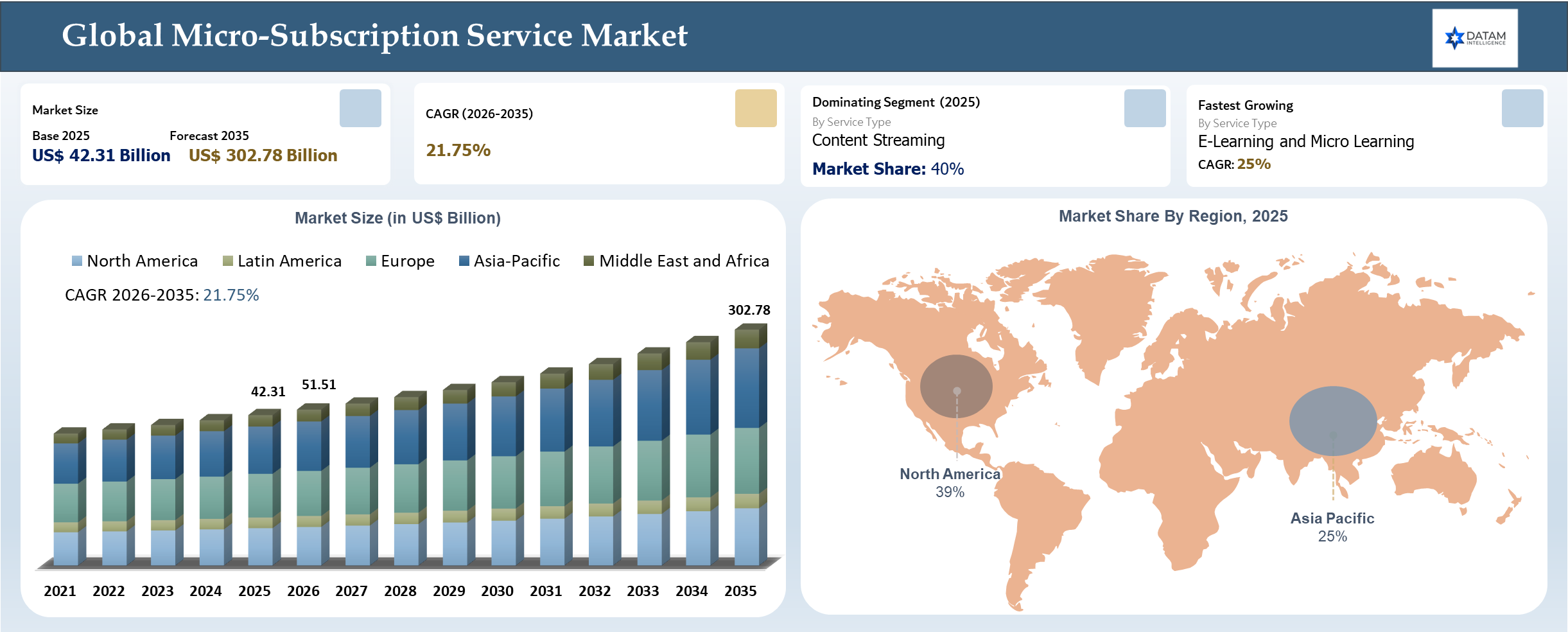
The global micro-subscription service market reached US$ 42.31 billion in 2025 and is expected to reach US$ 302.78 billion by 2035, growing with a CAGR of 21.75% during the forecast period 2026-2035. The global micro-subscription service market is expanding due to the rising demand for short-form digital content and creator-driven monetization models. Consumers increasingly prefer quick, mobile-first media formats and flexible subscription options that allow access to niche content, newsletters, and short videos at low cost. Platforms are therefore integrating short-video features and personalized feeds to increase engagement and subscription conversions.
Digital platforms are responding to this trend. For example, in 2025, Substack introduced a TikTok-like video feed within its app to enable creators to share short-form videos alongside newsletters and paid content. The feature aims to help creators attract audiences and convert them into paid micro-subscribers, demonstrating how platforms are evolving toward multimedia subscription ecosystems.
Micro-Subscription Service Industry Trends and Strategic Insights
- The industry of micro subscription services is growing at a fast rate because of consumer demand for cheaper and highly personalized digital subscriptions. Various digital products such as media streaming, creator platforms, games, AI, productivity software, and wellness are adopting micro subscriptions based on weeks, usage, and feature.
- Personalization engines powered by AI have been critical in making subscription businesses more effective. They enable platforms to offer recommendations for premium features and price tiers based on dynamic user behaviors.
- Monetization strategies are moving away from all-access bundles towards subscription ecosystems, whereby customers choose specific niches, exclusive AI powers, community access, and even ads-free versions of products.
- Increasing regulation over auto-renewal policies, use of “dark pattern” billings, and the transparency of subscription billing is occurring across the globe. In the US, Europe, and the UK, stricter measures related to the ability for customers to cancel their subscriptions are being enforced.
Market Scope
| Metrics | Details | |
| 2025 Market Size | US$ 42.31 Billion | |
| 2035 Projected Market Size | US$ 302.78 Billion | |
| CAGR (2026-2035) | 21.75% | |
| Largest Market | North America | |
| Fastest Growing Market | Asia-Pacific | |
| By Service Type | Content Streaming, Newsletters and Blogs, E-learning and Micro Learning, Health and Fitness Gaming, Others | |
| By Revenue Model | Recurring Micro-Payments, Freemium and Tiered Upgrades, Pay-per-use with Subscription Perks, Others | |
| By Platform | Web-Based Services, Mobile Applications, Cross-Platform Ecosystems | |
| By End-User | Individual Consumers, Freelancers and Creators, Startups and Micro-enterprises, Educational Institutions, Others | |
| By Region | North America | U.S., Canada, Mexico |
| Europe | Germany, UK, France, Spain, Italy, Poland | |
| Asia-Pacific | China, India, Japan, Australia, South Korea, Indonesia, Malaysia | |
| Latin America | Brazil, Argentina | |
| Middle East and Africa | UAE, Saudi Arabia, South Africa, Israel, Turkiye | |
| Report Insights Covered | Competitive Landscape Analysis, Company Profile Analysis, Market Size, Share, Growth | |
Disruption Analysis
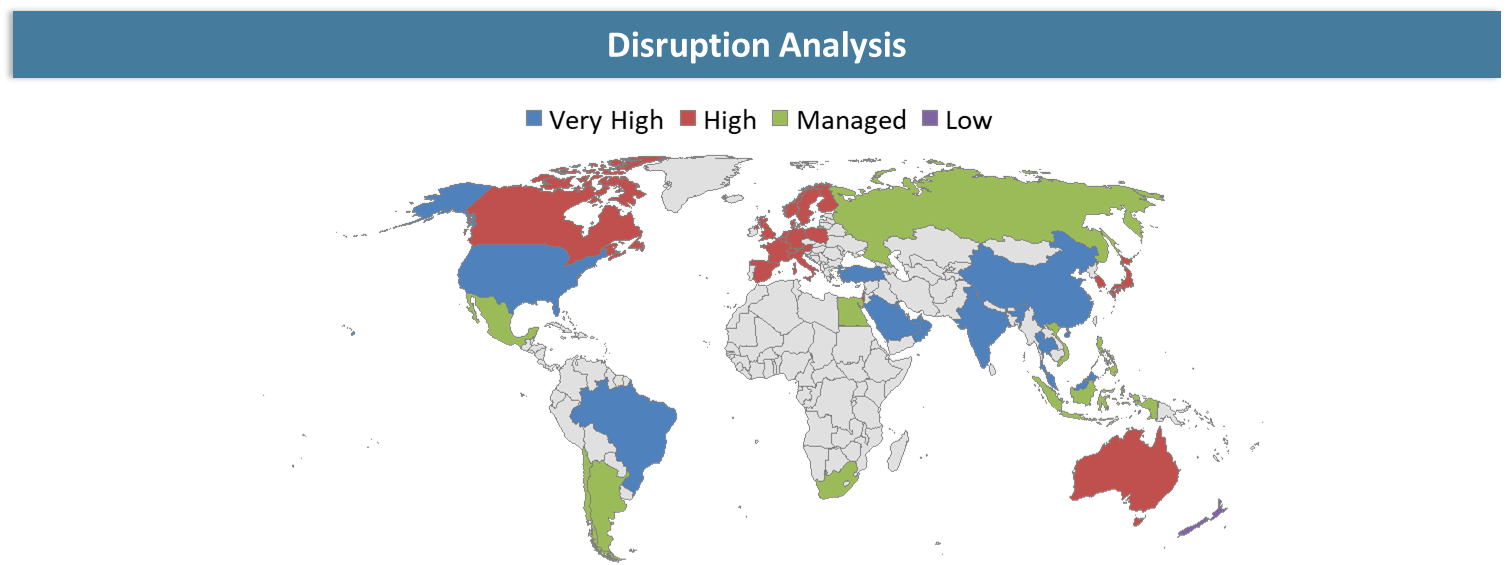
Shift Toward Creator-Led Monetization Models Reshaping Digital Content Economies
The major disruptive trend is the shift from platform-centric subscription business models to a creator-driven monetization system that involves creators making money out of niche content through micropayments. While the shift decreases dependency on advertisements and centralized platforms, it increases financial diversity for creators. It fundamentally changes competitive dynamics because platforms have to incorporate tools to help creators own their audiences, get analytics, and develop pricing strategies.
Another disruptive development is the application of AI for personalized content and micro-bundling. Platforms will offer subscribers tailor-made subscriptions based on their preferences and behaviors. The trend will lead to reduced customer churn rates as platforms will be able to provide more personalized content in different categories including learning and wellness. In other words, AI is transforming the industry by providing dynamic pricing capabilities and personalized content to users.
BCG Matrix: Company Evaluation

Stars and Question Mark platforms represent those which have high user engagement and scalable business models. Substack, Canva, Duolingo, and Notion can be classified as Stars since they have high retention, a global user base, and strong fit into the ecosystem for creators' economy and productivity tools. Medium, Scribd, and DramaBox represent Question Mark platforms due to their strong content ecosystem but low monetization efficiency and differentiation challenges amid growing subscription competition.
Potential Players and Tail Enders represent platforms that have niche focus or wellbeing features and selective growth paths. Calm, Headspace, and Vigloo belong to Potential Player category, being characterized by the growing trend for mental well-being and niche content subscription business but still limited by high user acquisition cost and varied user retention.
Market Dynamics
Rising Consumer Preference for Curated and Personalized Experiences
The growing demand for highly personalized and curated shopping experiences is driving innovation across the retail and fashion industries. Consumers increasingly expect tailored recommendations, virtual try-ons, and interactive product discovery that match their individual preferences and style. Retailers and tech companies are leveraging AI and computer vision technologies to deliver these personalized experiences at scale.
For instance, SpreeAI, a U.S.-based AI commerce company, introduced a revolutionary shopping experience that uses AI-driven photorealistic try-ons and interactive virtual shopping to enhance personalization and engagement for consumers. This approach allows shoppers to see products in realistic contexts before purchase, improving confidence and conversion rates. Similarly, Perfect Corp, a Taiwan-based technology company, launched new AI-powered APIs for its fashion category, enabling brands and retailers to integrate virtual try-on, style recommendations, and product customization directly into their apps and e-commerce platforms. These tools help businesses deliver curated experiences tailored to individual consumer preferences, increasing satisfaction and loyalty.
High Customer Churn and Subscription Fatigue
Although subscription-based services continue to attract users, many markets are experiencing elevated churn rates and signs of subscription fatigue. Consumers increasingly juggle multiple recurring payments across entertainment, software, and lifestyle platforms, leading to diminished willingness to maintain all subscriptions. High churn not only affects revenue predictability but also increases customer acquisition costs, as companies must constantly replace lost subscribers to sustain growth.
Service providers face challenges in differentiating offerings, maintaining engagement, and delivering consistent value to prevent cancellations. Limited perceived value, redundant service overlap, and frequent pricing adjustments exacerbate fatigue, prompting users to consolidate or cancel subscriptions. Companies with narrow service portfolios or limited cross-platform integration struggle to retain loyalty, while larger providers offering bundled services or flexible payment models can better absorb churn and maintain long-term subscriber relationships.
Segment Analysis
The global micro-subscription service market is segmented based on service type, revenue model, platform, end-user, and region.
AI‑Driven Content Streaming Expands Global Viewer Engagement
The content streaming segment is dominating, with an estimated 40% share in 2025, as mobile-first, bite-sized content reshapes global media consumption. Generative AI accelerates production cycles, reduces costs, and allows more frequent releases, supporting recurring micro-subscription adoption. The telecom and entertainment industries are leveraging AI dramas to attract viewers and advertisers and expand revenue streams. High smartphone penetration and demand for short form storytelling further fuel commercial adoption.
For instance, in 2025, Vigloo, a South Korea-based micro drama platform, launched AI-produced full-length vertical dramas Met a Savior in Hell and Seoul: 2053, demonstrating scalability and efficiency. Platforms can now commercialize micro-subscriptions while maintaining high engagement. Infrastructure improvements in mobile streaming and AI production pipelines enhance content delivery. Overall, AI vertical dramas are solidifying as a key driver of micro-subscription market expansion.
AI‑Enhanced Microlearning Accelerates Skill Development Demand
AI-powered microlearning is rapidly expanding as enterprises and individual learners demand adaptive, bite-sized upskilling solutions with 17% in 2025. Industries such as healthcare, IT, and industrial services adopt microlearning to reduce training time and scale workforce capabilities efficiently. AI-driven personalization increases engagement and retention, while digital infrastructure enables seamless delivery across web and mobile. Micro-subscription models allow monetization of short-form learning modules for global audiences.
For example, in 2025, Udemy, a U.S.-based AI-powered learning platform, introduced AI-driven microlearning to convert traditional courses into adaptive short modules accessible via web, mobile, and enterprise platforms. This demonstrates scalability and enhanced subscription retention. AI integration and infrastructure evolution create highly personalized learning ecosystems. In conclusion, AI-enhanced microlearning is a fast-growing segment driving micro-subscription market expansion through efficiency, adaptability, and global reach.
Geographical Penetration
Growing Adoption of Micro-Drama Platforms in Asia-Pacific
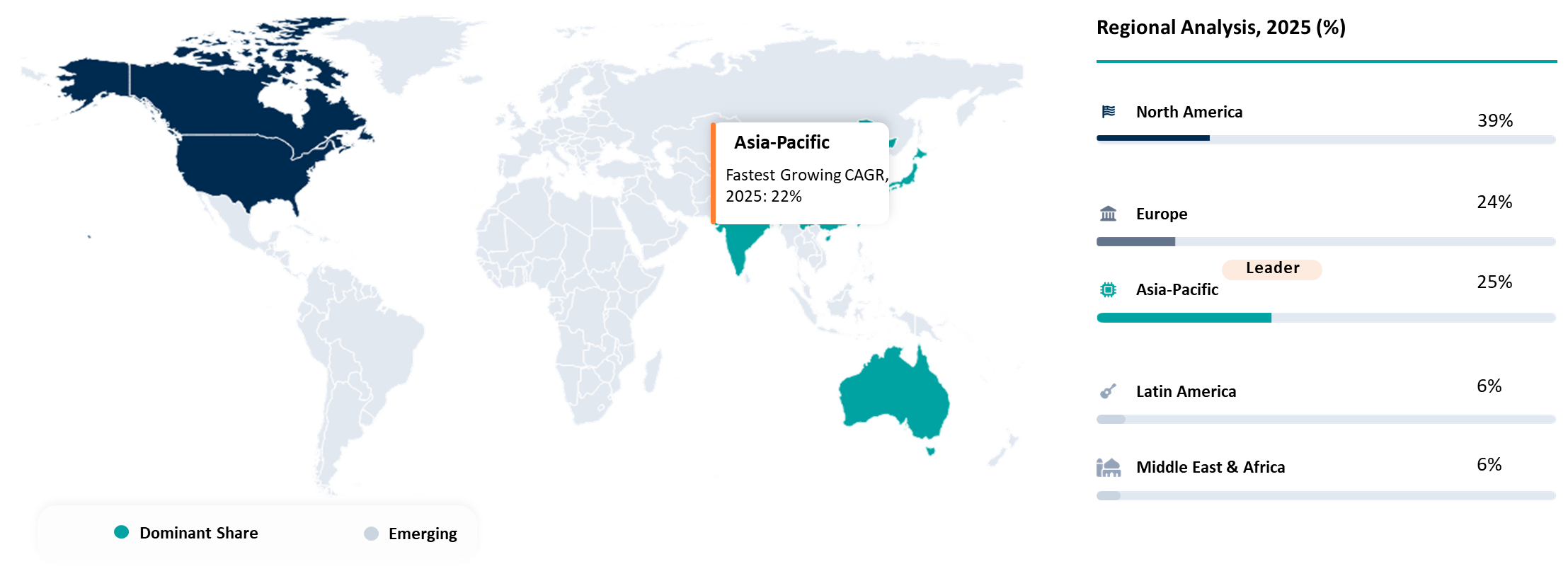
Asia-Pacific is the fastest-growing region in the global micro-subscription service market, holding about 25% share in 2025. Rapid smartphone penetration, expanding digital entertainment ecosystems, and increasing demand for short-form mobile content are driving the adoption of micro-subscription platforms across the region. Media companies are introducing innovative short-episode formats designed specifically for mobile viewing, enabling flexible and low-cost subscription models for consumers.
For instance, in 2025, Zee Entertainment Enterprises, an India-based media company, partnered with content-technology startup Bullet to launch a micro-drama application within the ecosystem of ZEE5. The platform delivers short, vertical-format drama episodes optimized for smartphone users, supporting micro-subscription-based entertainment consumption in the region. This initiative highlights the increasing investment in short-form digital content platforms across Asia-Pacific.
India Micro-Subscription Service Market Outlook
India is emerging as a rapidly expanding market for micro-subscription services, driven by increasing smartphone penetration, affordable mobile data, and rising demand for short-duration digital entertainment. Media and OTT platforms are introducing micro-drama formats designed for quick mobile viewing, allowing users to access short episodic content through flexible subscription or bundled streaming services.
For instance, in 2026, Tata Play, an India-based digital television and OTT aggregation company, launched “Shots,” a dedicated micro-drama aggregator within Tata Play Binge, offering short vertical micro-drama episodes designed for mobile-first audiences. This initiative reflects the growing expansion of micro-drama content and micro-subscription-based streaming services in India’s digital entertainment market.
China Micro-Subscription Service Market Trends
China is one of the leading markets for micro-subscription and short-form entertainment services, driven by strong mobile-first content consumption and the popularity of vertical video storytelling. The country’s large base of digital users and creator ecosystems has accelerated the growth of micro-drama platforms, where short serialized content is delivered through smartphone-optimized formats.
For instance, in 2026, ByteDance, a China-based technology company and parent of TikTok, launched a standalone micro-drama application called PineDrama. The platform offers serialized fictional shows delivered through one-minute vertical episodes, enabling users to watch short drama stories in a mobile-first streaming format. This launch highlights China’s strong influence in shaping the global micro-drama and micro-subscription content ecosystem.
Expansion of Low-Cost Subscription Streaming Services in North America
North America holds a significant share of 39% in 2025 in the global micro-subscription service market due to its advanced digital infrastructure, high OTT adoption, and strong presence of streaming technology providers. Consumers in the region are increasingly adopting low-cost subscription models that provide flexible access to entertainment content, encouraging media companies to introduce affordable micro-subscription streaming platforms.
For instance, in 2025, Roku, a U.S.-based streaming technology company, launched an ad-free subscription video-on-demand service called Howdy (streaming service), priced at $2.99 per month. The platform offers thousands of movies and TV shows and nearly 10,000 hours of content from partners such as Lionsgate, Warner Bros. Discovery, and FilmRise, expanding access to low-cost subscription-based digital entertainment in the region. This launch highlights the growing adoption of affordable micro-subscription streaming services across North America.
U.S. Micro-Subscription Service Market Insights
The U.S. is a key market in North America for micro-subscription and short-form streaming services, supported by high smartphone penetration, mature OTT ecosystems, and increasing demand for mobile-first entertainment formats. Media startups and streaming platforms are investing in short-episode storytelling designed specifically for vertical viewing and quick consumption on mobile devices.
For instance, in 2025, GammaTime, a U.S.-based streaming startup, raised $14 million in seed funding to support the launch of its premium micro-drama platform in the country. The application, available on iOS and Android, features more than 20 original vertical short-drama series across genres such as romance, suspense, and true crime, targeting mobile-first audiences through a freemium model. This development highlights the growing investment in micro-drama content platforms within the U.S. digital entertainment ecosystem.
Canada Micro-Subscription Service Industry Growth
Canada is increasingly becoming a production hub for micro-drama and short-form streaming content due to its established film production ecosystem and rising demand for smartphone-optimized entertainment formats. The country’s studios and creative teams are collaborating with global micro-drama platforms to produce localized vertical series aimed at mobile audiences.
For instance, in 2025, ReelShort began development of its first Canadian-made micro-drama titled The Billionaire’s Fake Wife, produced in collaboration with Vancouver-based production company Service Street Pictures. The project adapts a classic Bollywood storyline and marks the platform’s expansion into Canadian production for vertical micro-drama content. This development highlights Canada’s growing role as a production center for the expanding global micro-drama and micro-subscription content industry.
Regulatory Analysis
The micro-subscription service market is influenced by digital media regulations, data privacy frameworks, and consumer protection laws that govern online subscription services and streaming platforms. In the European region, the Digital Services Act requires online platforms to establish mechanisms for reporting illegal content and ensure transparency in content moderation and recommendation systems. Additionally, the General Data Protection Regulation (GDPR) mandates explicit user consent for collecting and processing personal data, which impacts micro-subscription platforms that rely on user analytics and personalized content delivery.
In the United States, the Restore Online Shoppers’ Confidence Act (ROSCA) regulates online subscription services by requiring clear disclosure of billing terms and simple cancellation processes for recurring payments. Regulatory oversight from the Federal Trade Commission also addresses deceptive subscription practices and ensures transparent pricing models. In Canada, the Online Streaming Act (Bill C‑11) expands broadcasting rules to digital platforms and encourages the promotion of domestic content across streaming services. These regulatory frameworks strengthen consumer protection, responsible content distribution, and data security while increasing compliance responsibilities for micro-subscription service providers.
Competitive Landscape
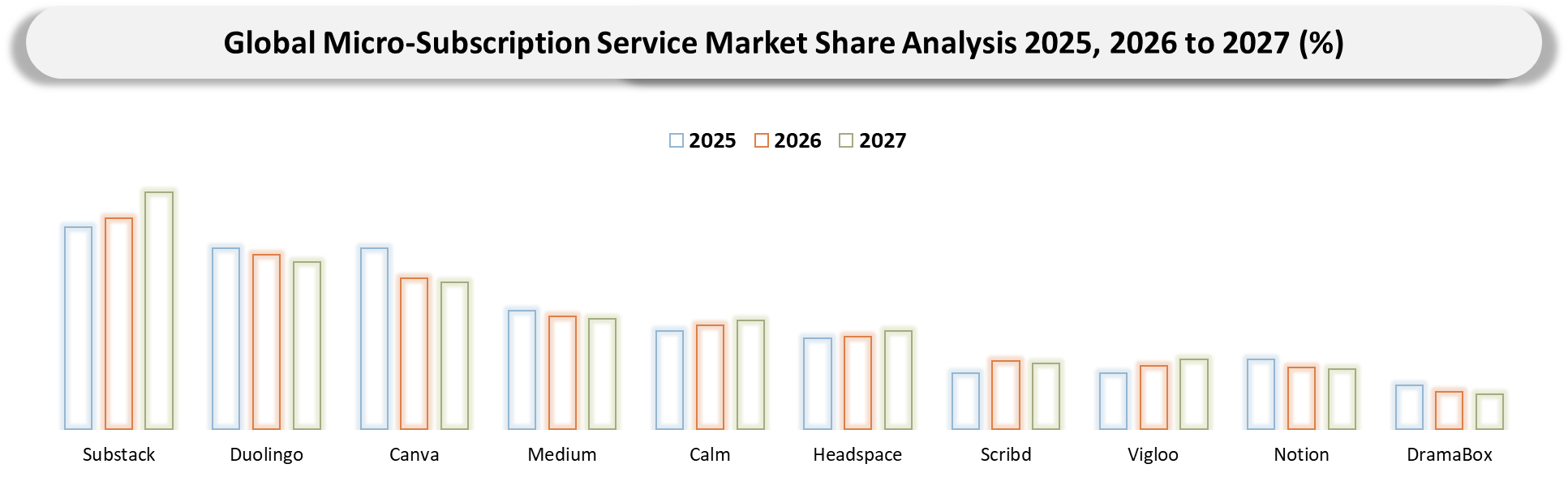
- The global micro-subscription service market is characterized by a competitive landscape that includes both established and regional players.
- Key players include Substack, Duolingo, Canva, Medium, Calm, Headspace, Scribd, Vigloo, Notion, DramaBox
Key Developments
- In 2025, Spotify, a Sweden-based audio streaming company, signed a multi-year agreement with Warner Music Group to introduce additional paid subscription tiers and differentiated content bundles, aiming to enhance fan experiences and expand monetization opportunities within its streaming platform.
- In 2026, Substack, a U.S.-based creator subscription platform, launched a TV application for Apple TV and Google TV, enabling subscribers to watch video posts and livestreams from creators on larger screens, thereby expanding its subscription-based multimedia ecosystem.
Why Choose DataM?
- Data-Driven Insights: Dive into detailed analyses with granular insights such as pricing, market shares and value chain evaluations, enriched by interviews with industry leaders and disruptors.
- Post-Purchase Support and Expert Analyst Consultations: As a valued client, gain direct access to our expert analysts for personalized advice and strategic guidance, tailored to your specific needs and challenges.
- White Papers and Case Studies: Benefit quarterly from our in-depth studies related to your purchased titles, tailored to refine your operational and marketing strategies for maximum impact.
- Annual Updates on Purchased Reports: As an existing customer, enjoy the privilege of annual updates to your reports, ensuring you stay abreast of the latest market insights and technological advancements. Terms and conditions apply.
- Specialized Focus on Emerging Markets: DataM differentiates itself by delivering in-depth, specialized insights specifically for emerging markets, rather than offering generalized geographic overviews. This approach equips our clients with a nuanced understanding and actionable intelligence that are essential for navigating and succeeding in high-growth regions.
- Value of DataM Reports: Our reports offer specialized insights tailored to the latest trends and specific business inquiries. This personalized approach provides a deeper, strategic perspective, ensuring you receive the precise information necessary to make informed decisions. These insights complement and go beyond what is typically available in generic databases.
Target Audience
- Manufacturers/ Buyers
- Industry Investors/Investment Bankers
- Research Professionals
- Emerging Companies


























































