


Zero Trust Security Market Forecast 2033: Adoption Trends, Investment Opportunities, and Strategic Insights for Enterprises
Why Zero Trust Security Has Become a Boardroom Priority
Cybersecurity is no longer just an IT concern it has become a business-critical priority influencing enterprise resilience, regulatory compliance, digital transformation strategies, and investor confidence. As cyberattacks become increasingly sophisticated and organizations operate across cloud, hybrid, and remote environments, traditional perimeter-based security models are proving insufficient.
This shift is accelerating the adoption of Zero Trust Security, a cybersecurity framework based on the principle of "never trust, always verify." Instead of assuming users or devices inside a network are trustworthy, Zero Trust continuously validates identity, device health, application access, and user behavior before granting access.
According to DataM Intelligence analysis, the Zero Trust Security Market is entering a period of strong expansion as enterprises increase investments in identity security, privileged access management (PAM), multi-factor authentication (MFA), zero trust network access (ZTNA), and threat detection solutions.
For CISOs, CIOs, security architects, investors, and enterprise technology leaders, understanding the future direction of the Zero Trust Security Market has become essential for strategic planning and cybersecurity risk management.
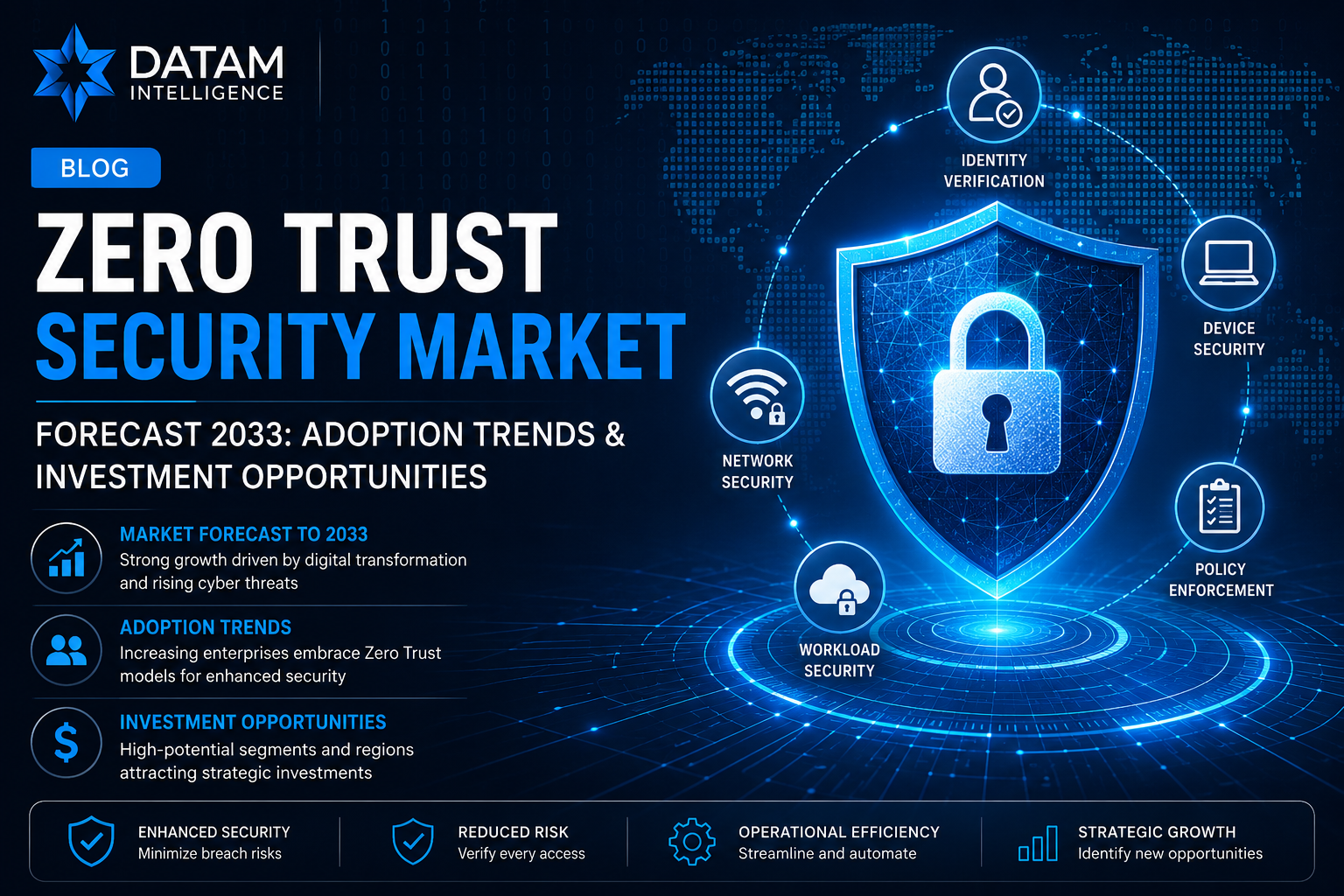
Zero Trust Security Market at a Glance
| Market Indicator | Market Outlook |
| Primary Growth Driver | Rising cyberattacks and ransomware incidents |
| Key Technology Segment | Zero Trust Network Access (ZTNA) |
| Fastest Growing Area | Identity-Centric Security |
| Major Enterprise Focus | Cloud Security & Remote Workforce Protection |
| Leading End Users | BFSI, Government, Healthcare, IT & Telecom |
| High-Growth Regions | North America, Europe, Asia-Pacific |
| Strategic Investment Themes | PAM, Identity Security, Threat Detection, AI Security |
What Is Zero Trust Security?
Zero Trust Security is a cybersecurity architecture that requires continuous verification of every user, device, workload, and application attempting to access enterprise resources.
Unlike traditional security approaches that rely on perimeter defenses, Zero Trust assumes that threats can originate both outside and inside the network.
Core principles include:
- Verify every access request
- Enforce least-privilege access
- Continuously monitor user behavior
- Secure cloud environments
- Protect identities and credentials
- Segment networks and workloads
As organizations accelerate digital transformation initiatives, Zero Trust has become a foundational security framework.
Top Zero Trust Security Market Trends Reshaping Enterprise Cybersecurity
1. Identity Security Is Becoming the New Security Perimeter
Enterprise security strategies are increasingly focused on identity rather than network boundaries.
As organizations deploy hybrid work models and cloud applications, identity becomes the most critical attack surface.
Organizations are investing heavily in:
- Identity and Access Management (IAM)
- Privileged Access Management (PAM)
- Multi-Factor Authentication (MFA)
- Identity Threat Detection and Response (ITDR)
Identity-centric security remains one of the fastest-growing segments within the Zero Trust ecosystem.
2. Zero Trust Network Access (ZTNA) Is Replacing VPNs
Traditional VPN-based architectures are increasingly being replaced by Zero Trust Network Access solutions.
ZTNA provides:
- Granular application-level access
- Continuous authentication
- Reduced attack surfaces
- Better user experience
- Improved remote workforce security
As organizations modernize cybersecurity infrastructure, ZTNA adoption continues accelerating globally.
3. AI-Powered Threat Detection Is Transforming Security Operations
Artificial intelligence and machine learning are becoming central to Zero Trust implementation.
Advanced threat detection solutions now analyze:
- User behavior patterns
- Device activities
- Access anomalies
- Insider threats
- Credential misuse
AI-driven security analytics enable enterprises to detect and respond to threats in real time.
4. Cloud Security Investments Continue to Rise
Cloud migration is a major catalyst for Zero Trust adoption.
Organizations moving workloads to:
- AWS
- Microsoft Azure
- Google Cloud
- Multi-cloud environments
require continuous visibility, identity validation, and secure access management.
Cloud-native Zero Trust architectures are becoming a preferred security model for modern enterprises.
How Is Zero Trust Adoption Progressing in North America?
North America remains the largest Zero Trust Security Market globally.
Several factors support regional growth:
- High cybersecurity spending
- Strong regulatory requirements
- Advanced cloud adoption
- Large-scale digital transformation initiatives
- Frequent cyberattack incidents
The United States continues to lead global Zero Trust implementation, supported by federal cybersecurity mandates and increasing enterprise security investments.
Government agencies, financial institutions, healthcare providers, and technology companies are among the most active adopters.
Europe Zero Trust Security Market: Growth Driven by Compliance and Privacy Regulations
The Europe Zero Trust Security Market continues to expand due to increasing emphasis on:
- GDPR compliance
- Data protection requirements
- Critical infrastructure security
- Identity governance
- Cloud security modernization
Countries such as Germany, the United Kingdom, France, and the Netherlands are investing heavily in advanced Zero Trust architectures to strengthen cyber resilience.
Germany Zero Trust Security Market Shows Strong Growth Potential
Germany remains one of Europe's most important cybersecurity markets.
Growth is driven by:
- Industry 4.0 initiatives
- Manufacturing digitalization
- Industrial cybersecurity investments
- Cloud adoption
- Critical infrastructure protection
German enterprises are increasingly implementing Zero Trust strategies to secure operational technology (OT) and information technology (IT) environments.
Japan Zero Trust Network Access Market Gains Momentum
Japan is emerging as a high-growth market for Zero Trust Network Access solutions.
Organizations across:
- Financial services
- Manufacturing
- Telecommunications
- Government
are accelerating ZTNA deployments to improve cybersecurity posture while supporting digital transformation initiatives.
The country's focus on cloud adoption and cybersecurity modernization continues to create opportunities for Zero Trust vendors.
Why Investors Are Tracking the Zero Trust Security Market
Investors view Zero Trust Security as one of the most attractive segments within enterprise cybersecurity.
Several long-term growth drivers support market expansion:
- Increasing ransomware attacks
- Rising cloud adoption
- Hybrid workforce security requirements
- Identity security investments
- Regulatory compliance demands
- Growing cybersecurity budgets
Key investment themes include:
- Zero Trust Network Access (ZTNA)
- Identity Security
- Privileged Access Management (PAM)
- Identity Threat Detection and Response (ITDR)
- Cloud Security
- Security Analytics
- AI-Powered Threat Detection
As cybersecurity spending becomes increasingly non-discretionary, Zero Trust solutions are expected to attract sustained investment.
Competitive Landscape
The Zero Trust Security Market is highly competitive and innovation-driven.
Leading cybersecurity vendors continue investing in:
- Identity security platforms
- Cloud-native security solutions
- ZTNA technologies
- Behavioral analytics
- AI-powered threat detection
- Integrated cybersecurity ecosystems
Major market participants include global cybersecurity providers, identity management vendors, cloud security specialists, and network security companies.
Competition increasingly revolves around platform integration, automation, scalability, and user experience.
Strategic Questions Enterprises Are Asking
The DataM Intelligence Zero Trust Security Market Report helps answer critical questions such as:
- How large is the Zero Trust Security Market today?
- What will market growth look like through 2033?
- Which regions offer the strongest opportunities?
- How is ZTNA adoption progressing globally?
- What role does identity security play in Zero Trust?
- Which cybersecurity technologies are gaining traction?
- How are regulatory frameworks affecting adoption?
- What are the leading competitive strategies?
- Which industries are investing most aggressively?
- Where are the biggest investment opportunities emerging?
Why Organizations Need the Full Zero Trust Security Market Report
Public information often provides fragmented insights into cybersecurity trends.
The DataM Intelligence report delivers comprehensive intelligence including:
✔ Market size and forecast analysis
✔ Regional market outlook
✔ Technology segmentation
✔ Competitive benchmarking
✔ Identity security trends
✔ ZTNA adoption analysis
✔ Investment opportunity assessment
✔ Regulatory landscape evaluation
✔ Enterprise adoption insights
✔ Strategic recommendations
Organizations can leverage the report to support cybersecurity investments, product development strategies, market entry decisions, and competitive planning initiatives.
Frequently Asked Questions
What is Zero Trust Security?
Zero Trust Security is a cybersecurity framework that continuously verifies every user, device, application, and workload before granting access to enterprise resources.
Why is Zero Trust adoption increasing?
The rise of ransomware, cloud computing, remote work, identity-based attacks, and regulatory requirements is accelerating adoption.
What is Zero Trust Network Access (ZTNA)?
ZTNA is a security approach that provides secure application-level access based on user identity, device posture, and contextual information.
Why is identity security important for Zero Trust?
Identity is the foundation of Zero Trust. Organizations must continuously verify users and monitor access behaviors to reduce cyber risks.
Which region leads the Zero Trust Security Market?
North America currently leads due to strong cybersecurity spending, advanced cloud adoption, and regulatory initiatives.
Why are investors interested in the Zero Trust Security Market?
Growing cyber threats, increasing enterprise security budgets, cloud transformation, and regulatory requirements make Zero Trust one of the fastest-growing cybersecurity segments.
How is Zero Trust Security adoption progressing globally?
Zero Trust Security adoption is accelerating globally as enterprises strengthen identity security, implement Zero Trust Network Access (ZTNA), secure cloud environments, and comply with evolving cybersecurity regulations. North America currently leads adoption, while Europe, Germany, Japan, and Asia-Pacific are experiencing significant growth driven by digital transformation and rising cyber threats.
Related Reports
- Identity and Access Management Market
- Cloud Security Market
- Cybersecurity Market
- Managed Security Services Market
- Multi-Factor Authentication Market
- Network Security Policy Management Market
- Advanced Persistent Threat (APT) Protection Market
Final Thoughts
The Zero Trust Security Market is rapidly becoming one of the most important segments within enterprise cybersecurity. As organizations prioritize identity-centric security, cloud protection, threat detection, and secure access management, Zero Trust frameworks are evolving from optional security models to strategic business imperatives.
Organizations that understand adoption trends, investment opportunities, regional dynamics, and competitive developments will be better positioned to strengthen cybersecurity resilience and capitalize on emerging market opportunities.