


Cloud Security Market Size and Overview
The global cloud security market reached USD 40.6 billion in 2025 and is expected to reach USD 141.5 billion by 2035, growing with a CAGR of 13.3% during the forecast period 2026-2035. The market is expanding as enterprises increase protection of cloud infrastructure, identities, workloads, applications, and data in light of the increasingly integrated digital space. In December 2025, according to Mallory, Google had agreed to acquire Wiz for roughly USD 32 billion, Palo Alto Networks had agreed to acquire CyberArk for about USD 25 billion, and Palo Alto Networks had purchased Chronosphere for roughly USD 3.35 billion, illustrating the change in strategy towards integration of cloud, identity, observability, and security platforms. Mallory further reported that AWS, Microsoft, and Google had collectively won over 70% of the cloud contracts in Europe in 2025, reinforcing the importance of cloud-security capabilities and digital sovereignty in enterprise cloud infrastructure.
White-Space Opportunities for Cloud Security from EU Cyber-Resilience and Cloud Infrastructure Investments
In March 2025, the European Commission allocated €1.3 billion (USD 1.52 billion) through the Digital Europe Programme for 2025–2027 to accelerate the deployment of strategic digital technologies, with cybersecurity and cyber-resilience representing the highest-priority area for the cloud security market, alongside artificial intelligence (AI), cloud and data infrastructures, and advanced digital skills. The cybersecurity focus covers preventive systems, the EU Cybersecurity Reserve, and protection of critical infrastructure including healthcare systems, networks and subsea cables, while cloud and data infrastructure investment creates opportunities for secure cloud environments, data protection and resilient digital infrastructure.
Other investment areas include AI deployment, generative AI, data spaces, AI factories, European Digital Innovation Hubs (EDIHs), and digital skills. Subsequent funding further demonstrates the scale of these opportunities: the Commission opened €140 million (USD 164 million) in Digital Europe calls in April 2025, including €55 million (USD 64 million) for generative AI, data spaces and related technologies, €27 million (USD 32 million) for advanced digital-skills academies, €11 million (USD 13 million) for EDIHs, and €47 million (USD 55 million) for the deployment and best use of digital technologies.
In cybersecurity specifically, the EU later opened €50 million (approximately USD 58.5 million) in 2025 for AI-powered cybersecurity solutions, SME cybersecurity adoption, preparedness testing and regional submarine-cable hubs, including €15 million (USD 17.6 million) for AI-powered cybersecurity, €15 million (USD 17.6 million) for SME cybersecurity adoption, €10 million (USD 11.7 million) for coordinated preparedness testing and €10 million (USD 11.7 million) for regional cable hubs.
The investment is expected to create significant procurement, deployment, technology-development and partnership opportunities across the cloud-security value chain, particularly for companies providing cloud infrastructure security, threat detection, identity and access management, data protection, security operations and critical-infrastructure protection.
Microsoft, Amazon Web Services (AWS), Google Cloud and Oracle are positioned to benefit from increasing demand for secure cloud and data infrastructure, cloud workload protection, encryption, identity management and hybrid-cloud security, while IBM, SAP and Siemens can benefit from secure enterprise cloud, AI, data-management and industrial cybersecurity deployments. Cybersecurity specialists including Thales, Airbus CyberSecurity, Orange Cyberdefense, Deutsche Telekom and Eviden can benefit from EU-backed projects involving cyber-resilience, threat intelligence, managed security services, incident response and protection of critical infrastructure.
Cloud Security Market Key Takeaways
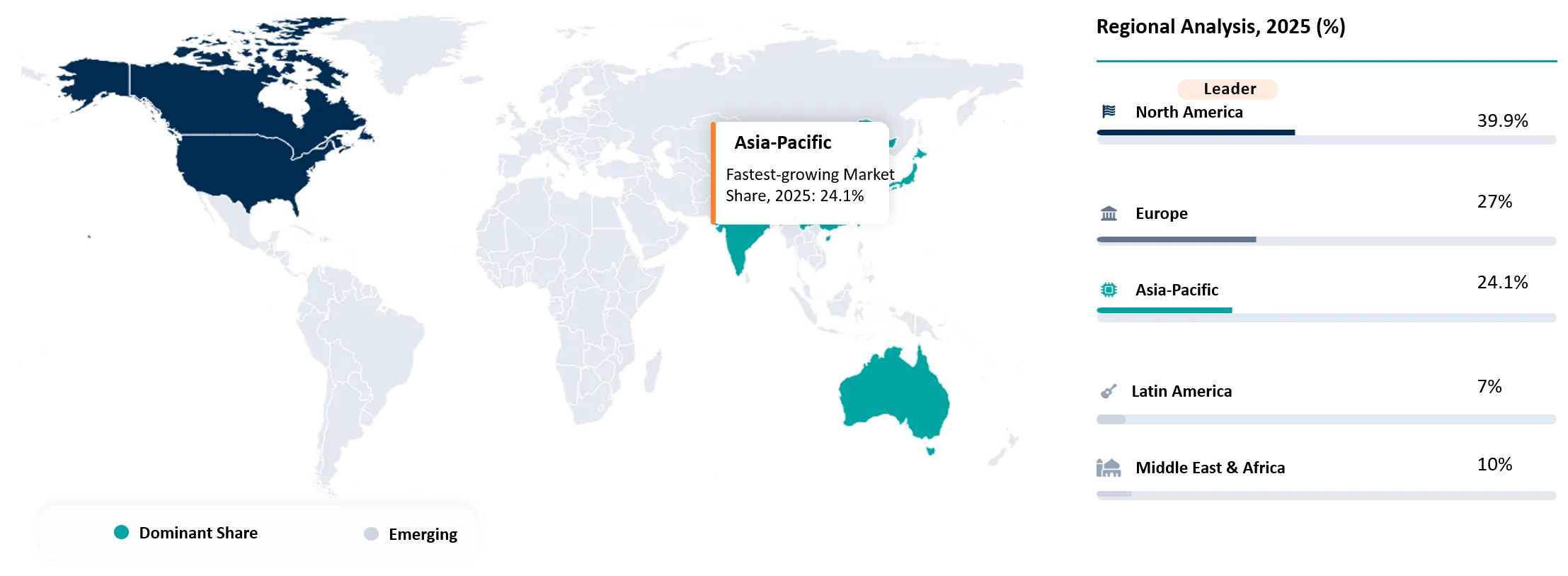
- North America held the largest share of the cloud security market at 39.9% in 2025, driven by major hyperscalers and early enterprise adoption. Asia-Pacific represents the fastest-growing region, accounting for a 24.1% market share in 2025 due to rapid enterprise digitization and cloud expansion.
- Large-scale enterprises dominated application adoption in 2025, capturing 76% of the global market share to protect complex multicloud architectures.
- Third-party software exploitation surged as a primary entry vector for cyberattacks, growing from 2.9% in H1 2025 to 44.5% in H2 2025. Remote code execution attacks significantly expanded in late 2025, rising from 2.9% of initial access vectors in H1 to 13.6% in H2.
- The European Commission dedicated €1.3 billion (USD 1.52 billion) for 2025–2027 to deploy digital technologies, placing top priority on cyber-resilience. EU cybersecurity funding targeted AI solutions with €50 million (USD 58.5 million), including €15 million (USD 17.6 million) specifically for AI-powered security technologies.
Cloud Security Market Industry Trends and Strategic Insight
- AI-Native Cloud Security Is Replacing Rule-Centric Protection. Cloud security platforms are increasingly embedding AI into threat detection, security analytics, policy generation, investigation, and automated response as conventional rule-based controls struggle with dynamic cloud environments.
- Machine Identity Governance Is Moving to the Center of Cloud Security. Security architectures are shifting from predominantly human-focused IAM toward governance of service accounts, workloads, APIs, CI/CD identities, autonomous agents, and other non-human identities that continuously interact with cloud resources.
- Multicloud Security Is Moving Toward Centralized Policy Enforcement. Enterprises operating across multiple cloud providers are prioritizing common identity, configuration, logging, data-protection, and compliance policies because provider-specific security architectures create control gaps. NIST identifies these cross-provider differences as a fundamental architectural challenge.
- The strongest competitive opportunity is shifting toward securing non-human identities and autonomous workloads because traditional human-centric IAM architectures do not adequately govern agent-driven cloud activity.
- Cloud-security providers should prioritize cross-cloud policy portability because enterprises increasingly require consistent security controls across heterogeneous cloud environments rather than provider-specific security configurations.
Cloud Security Market Scope
| Metrics | Details | |
| 2025 Market Size | USD 40.6 Billion | |
| 2035 Projected Market Size | USD 141.5 Billion | |
| CAGR (2026-2035) | 13.3% | |
| Largest Market | North America | |
| Fastest Growing Market | Asia-Pacific | |
| By Type | Email & Web Security, Cloud Database Security, Cloud IAM, Endpoint Security, Data Loss Prevention, Network Security, Cloud Encryption, Application Security, Others | |
| By Deployment | Public Cloud, Multicloud, Private Cloud, Hybrid Cloud | |
| By Solution | Identity and Access Management (IAM), Cloud Security and Risk Strategy, Threat Management, Hybrid Multi-Cloud Security Platform, Workload Protection, Data Protection, Others | |
| By Application | Large-Scale Enterprise, Government Organizations, Small & Medium Enterprises, Institutions, Others | |
| By End-User | Healthcare, BFSI, IT & Telecom, Retail & E-commerce, Others | |
| By Region | North America | U.S., Canada, Mexico |
| Europe | Germany, UK, France, Spain, Italy, Poland, Netherlands, Switzerland | |
| Asia-Pacific | China, India, Japan, Australia, South Korea, Indonesia, Malaysia | |
| Latin America | Brazil, Argentina | |
| Middle East and Africa | UAE, Saudi Arabia, South Africa, Israel, Türkiye | |
| Report Insights Covered | Competitive Landscape Analysis, Company Profile Analysis, Market Size, Share, Growth | |
Cloud Security Market Disruption Analysis
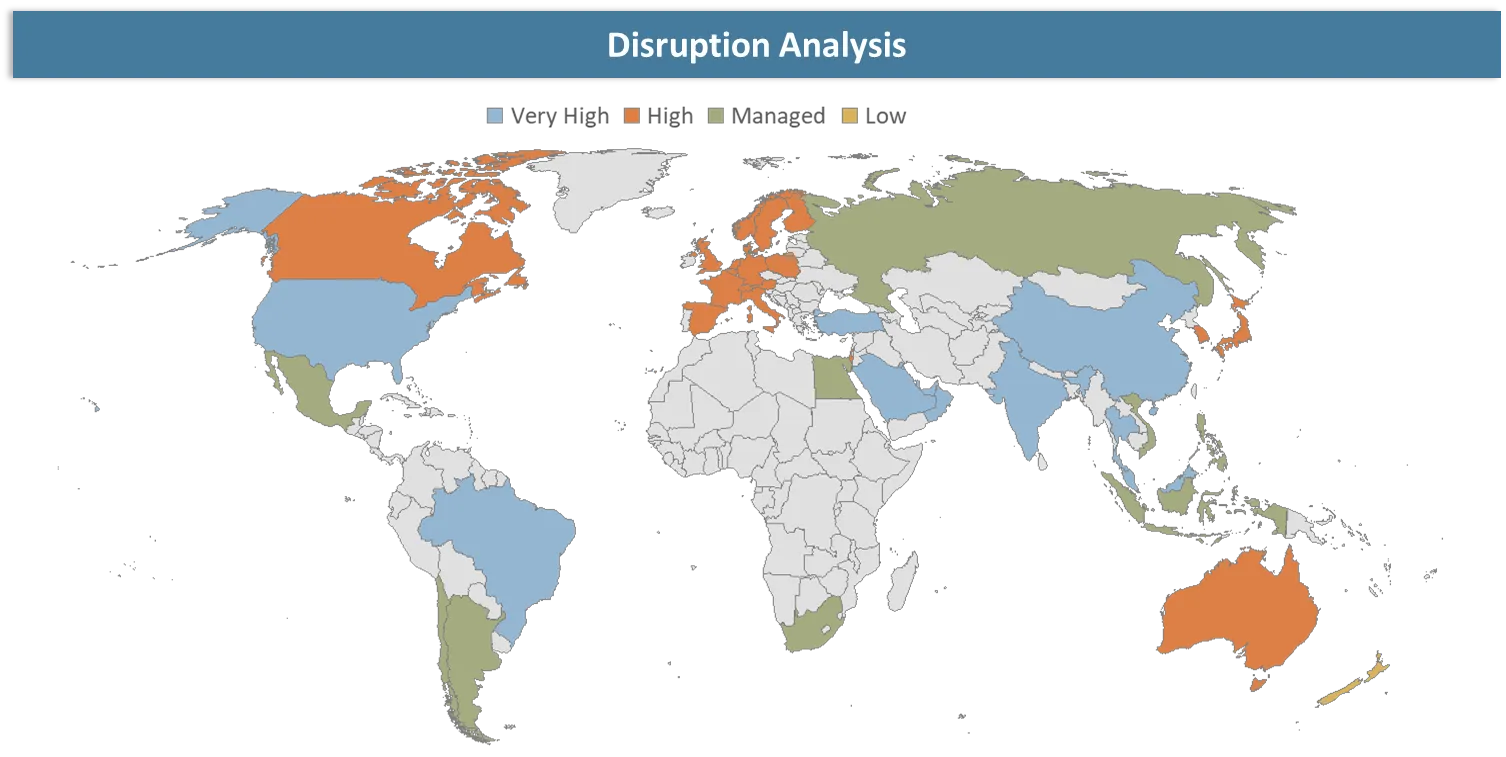
AI-Driven Attacks Reshaping the Cloud Security Threat and Defense Landscape
The disruption in the cloud security market is increasingly associated with the rapid integration of artificial intelligence in cyberattacks, which is affecting the ways threat actors are discovering vulnerabilities, developing malware, conducting reconnaissance, and moving around in the cloud environment. The Google Threat Intelligence Group noted in February 2026 that in late 2025, there was an increasing use of artificial intelligence in different stages of the attack, including reconnaissance, social engineering, malware creation, and vulnerability discovery, in addition to the use of agentic AI in malware and tooling creation. The Mandiant AI Risk and Resilience research in 2026 confirmed the trend from basic AI use to AI-enabled espionage and adaptive malware.
In addition, the growing application of AI-enabled methods is posing a challenge to traditional cloud security approaches by promoting faster exploitation of software vulnerabilities and leading to a shift in attackers’ focus on third-party cloud and software dependencies. In March 2026, according to Infosecurity Magazine, which covered Google Cloud's threat, third-party software exploitation constituted 44.5% of all primary attack vectors for entry in the second half of 2025, which was a significant increase from 2.9% in the first half of 2025. The report mentioned that remote code execution constituted 13.6% of initial access vectors in H2 2025, up from 2.9% in H1 2025. The fast move towards exploitation of vulnerabilities is challenging the traditional perimeter-based approach to cloud security.
Cloud Security Market BCG Matrix: Company Evaluation

Stars include Microsoft, Palo Alto Networks, Amazon Web Services (AWS), and Zscaler, as these companies have strong competitive positions across major cloud-security segments and are expanding their portfolios through cloud-native security, Zero Trust, CNAPP, identity, workload, and AI-security capabilities. Question Marks include Fortinet, Akamai Technologies, Cloudflare, and IBM, which possess established cybersecurity or cloud-infrastructure capabilities but face stronger competition in the rapidly consolidating cloud-security platform market.
Potential includes CrowdStrike, SentinelOne, Cisco Systems, and Netskope, which benefit from strong positions in endpoint, workload, network, data, and Zero Trust security but are continuing to expand their capabilities across the wider cloud security market. Tailenders are not assigned to any of the 12 companies in this evaluation because all selected companies have substantial involvement in cloud security or adjacent security ecosystems.
Cloud Security Market Dynamics
Driver Impact Analysis
| Driver | Market Growth Impact (%) | Demand Concentration | Impacted Use Case | Strategic Impact |
Rapid adoption of cloud and hybrid-cloud environments is increasing the need for continuous protection of cloud workloads, applications, identities, and data. | 32% | Large enterprises, BFSI, IT & telecom, government, and organizations operating hybrid/multicloud environments | Multicloud security, workload protection, cloud IAM, data protection, CSPM, continuous threat monitoring | Drives demand for unified cloud-security platforms that provide centralized visibility, consistent policy enforcement, identity governance, and automated protection across heterogeneous cloud environments. |
Growth of AI and autonomous AI agents is creating new cloud security risks and driving demand for AI-aware security, monitoring, and governance solutions. | 26% | AI-intensive enterprises, technology companies, financial services, healthcare, and organizations deploying AI agents in production | AI workload protection, AI-agent security, model/API protection, identity governance, runtime monitoring, AI risk management | Accelerates the development of AI-native cloud-security controls capable of governing what AI systems can access, modify, and execute across cloud environments. |
Increasing sophistication of cloud-based cyberattacks is accelerating investment in automated threat detection, response, and prevention technologies. | 24% | Enterprises with high-value cloud workloads, SaaS environments, financial services, technology companies, and organizations with exposed cloud applications | Automated threat detection, vulnerability management, runtime protection, SOAR, automated remediation, cloud incident response | Shifts cloud security from periodic assessment toward continuous detection and automated response. |
Growing regulatory and compliance requirements are increasing the need for cloud security controls, data protection, governance, and forensic readiness. | 18% | BFSI, healthcare, government, critical infrastructure, large enterprises, and organizations handling regulated or sensitive data | Data-loss prevention, encryption, IAM, audit logging, compliance monitoring, data sovereignty, forensic readiness | Increases demand for cloud-security platforms that provide continuous compliance evidence, centralized audit trails, data governance, access controls, and jurisdiction-aware protection rather than relying on periodic compliance assessments. |
Rapid adoption of cloud and hybrid-cloud environments is increasing the need for continuous protection of cloud workloads, applications, identities, and data
The rapid expansion of cloud and hybrid-cloud systems is increasing the need for security that operates continuously within workloads, applications, identities, and data as companies deploy their IT infrastructures in multiple cloud platforms and in-house systems. According to Flexera, 73% of firms utilize hybrid-cloud environments compared to the previous year, and multi-cloud usage has also increased. The report goes further to indicate that cloud environments have become complex due to the occurrence of migrations, repatriations, SaaS, and AI workloads simultaneously.
In parallel, the increasing use of hybrid and multicloud architectures is expanding the number of identities, applications, workloads, and data repositories that organizations must secure continuously across interconnected environments. Google Cloud’s H1 2026 Cloud TAhreat Horizons Report found that identity issues were involved in 83% of incidents affecting major cloud and SaaS-hosted environments in H2 2025, while threat actors targeted data in 73% of cloud-related incidents. The report also found that 21% of cases involved compromised third-party relationships, while another 21% involved stolen human or non-human identities, demonstrating the growing security exposure created by interconnected cloud ecosystems.
Restraint Impact Analysis
| Restraint | Drag on Market Growth (%) | Primary Impact Area | Impacted Use Case | Strategic Impact |
Security-tool fragmentation and tool sprawl create disconnected controls and limited visibility, increasing the difficulty and operational burden of managing cloud security. | 28% | Security operations, visibility, integration, and incident response | CNAPP, multicloud monitoring, SIEM/SOAR integration, threat detection, centralized security management | Encourages enterprises to consolidate point solutions into unified cloud-security platforms with shared telemetry, centralized policies, correlated alerts, and automated response. |
Rapid growth of AI-driven cloud workloads is increasing security complexity faster than many organizations can adapt their security teams and processes. | 24% | AI workload governance, visibility, identity, and security operations | AI-agent security, AI workload protection, model/API security, runtime monitoring, AI governance | Forces security vendors to develop AI-aware controls and enterprises to redesign security architectures rather than simply adding AI functionality to existing tools. |
Shortage of skilled cloud cybersecurity professional’s limits organizations’ ability to effectively deploy, manage, and monitor advanced cloud security solutions. | 26% | Cloud-security operations, deployment, threat monitoring, and incident response | Managed cloud security, SOC operations, threat hunting, security engineering, automated detection and response | Increases reliance on managed security services, automation, AI-assisted SOC capabilities, and simplified security platforms that reduce manual workload. |
High operational and integration complexity of cloud security solutions can slow adoption as enterprises struggle to connect security platforms with existing cloud infrastructure and workflows. | 20% | Platform integration, configuration, policy management, and cloud operations | Hybrid/multicloud security, IAM integration, workload protection, compliance monitoring, security orchestration | Increases demand for interoperable APIs, centralized management, unified policy frameworks, and platform-based security architectures that can integrate with existing cloud infrastructure without extensive reconfiguration. |
Security tool fragmentation and tool sprawl create disconnected controls and limited visibility, increasing the difficulty and operational burden of managing cloud security
Security-tool fragmentation and tool sprawl are becoming significant restraints on the cloud security market because enterprises are adding separate solutions for identity, workload protection, application security, data protection, network security, threat detection, and compliance across increasingly complex cloud environments.
In addition, the increasing complexity of hybrid and multicloud architectures is making fragmented security stacks more difficult to manage because security teams must correlate alerts, policies, identities, and risk signals across multiple independent platforms. In January 2026, according to Fortinet, 88% of organizations operate in hybrid or multicloud environments, with 81% relying on two or more cloud providers for critical workloads and 29% using more than three providers. The report also found that 74% of organizations face a shortage of qualified cybersecurity professionals, while 66% of cybersecurity experts lack strong confidence in detecting and responding to cloud threats in real time.
Cloud Security Market Segment Analysis
The global cloud security market is segmented based on type, deployment, solution, application, end-user, and region.
Large-Scale Enterprise Adoption Driving Enterprise Cloud Security Demand
The large-scale enterprises segment holds the dominant position in applications in the cloud security market, as it accounts for 76% of the market share in 2025, as a result of the high utilization of cloud infrastructure, business-critical applications, enterprise data, and distributed workloads by large organizations. The increasing deployment of hybrid and multicloud technologies significantly impacts the demand for cloud security among large enterprises because organizations require cloud workload protection, application protection, identity protection, network protection, and data protection in increasingly complicated IT infrastructures.
Technology and cybersecurity giants like Microsoft, IBM, Palo Alto Networks, AWS, and Wiz have been augmenting their cloud security and AI security offerings to cater to the needs of large enterprise customers. In June 2026, according to the IBM survey in collaboration with Oxford Economics across 2,000 senior tech leaders in 33 geographies and 19 industries, it was established that 77% of firms indicated that their AI implementation had outpaced their governance capability, and only 11% had been ready for the anticipated scale of AI agent deployments. It was also determined from the same report that organizations implementing controls within their AI systems were 25% less likely to have an incident, while 37% of high-severity incidents with AI agents involved data exposure or security breach.
Cloud Security Market Geographical Penetration
North American Cloud Security Adoption and Enterprise Investment Driving Regional Dominance
The North American region continues to dominate the cloud security market, accounting for 39.9% of the market share in 2025, due to the region's early adoption of cloud computing, large concentration of technology companies, and extensive deployment of public, private, and hybrid cloud infrastructure. The presence of major cloud and cybersecurity providers, including Microsoft, AWS, Google Cloud, Palo Alto Networks, Fortinet, and CrowdStrike, has supported the rapid development and adoption of advanced cloud security solutions across enterprises and government organizations.
Amazon’s investment strengthens the U.S. government’s adoption of secure, high-performance cloud infrastructure for sensitive and national-security workloads. In November 2025, Amazon.com, Inc., a U.S.-based technology and e-commerce company, announced that its cloud-computing subsidiary Amazon Web Services (AWS) would invest up to USD 50 billion to expand AI and high-performance computing infrastructure for U.S. government agencies. The investment is expected to add nearly 1.3 GW of AI and supercomputing capacity across AWS Top Secret, AWS Secret, and AWS GovCloud (US), supporting national-security missions including cybersecurity, defense, scientific research, and critical infrastructure protection.
U.S. Cloud Security Market Trends
The U.S. holds a dominant position in the North American cloud security market owing to its mature cloud-computing ecosystem, concentration of leading cloud and cybersecurity companies, and widespread adoption of cloud-based infrastructure across enterprises and government organizations. The availability of major technology providers such as Microsoft, AWS, Google Cloud, Palo Alto Networks, and CrowdStrike supports rapid deployment of cloud security technologies and enables organizations to address increasingly complex threats across cloud workloads, identities, applications, and data.
The agreement expands U.S. federal agencies’ access to enterprise-grade cloud security through a government-wide procurement framework. In December 2025, Tenable Public Sector, the U.S.-based public-sector cybersecurity subsidiary of Tenable Holdings, Inc., entered into a OneGov agreement with the U.S. General Services Administration (GSA), the U.S. federal government’s central procurement agency, to provide federal agencies with its FedRAMP-authorized Tenable Cloud Security Enterprise solution. Under the agreement, agencies receive a 65% discount off list price, with access available through the GSA Multiple Award Schedule until March 31, 2027, while the option years carry escalation rates ranging from 0% in year one to 3% in years two and three.
Canada Cloud Security Market Outlook
Canada is an important country in the North American cloud security market because of its expanding digital infrastructure, increasing adoption of cloud and AI technologies, and growing emphasis on data protection and digital sovereignty. Canadian businesses are increasingly integrating cloud services and AI into their operations, creating greater requirements for protecting data, applications, identities, and cloud environments.
The SECaaS model supports growing demand for AI-enabled threat detection, hybrid-cloud protection, and Canadian data sovereignty. In March 2025, Bell Canada Enterprises Inc. (BCE Inc.), a Canada-based telecommunications and technology company, launched Security-as-a-Service (SECaaS) on its Canadian sovereign cloud to provide organizations with integrated cybersecurity across cloud, hybrid, and on-premises environments. The service combines AI-driven security information and event management (SIEM), real-time threat detection and response, and centralized security visibility, with customer data hosted in Bell data centres across Canada to support data sovereignty.
Rapid Cloud Adoption and Cybersecurity Investment Driving Asia-Pacific Cloud Security Growth
The Asia-Pacific fastest-growing region in the cloud security market, accounting for 24.1% of the global market share in 2025, due to rapid cloud adoption, accelerating digital transformation, expanding AI workloads, and increasing cybersecurity requirements across major economies such as China, Japan, India, Australia, and Singapore. The combination of hyperscale cloud infrastructure, enterprise digitization, growing data-center capacity, and government-led cybersecurity initiatives is increasing demand for cloud security solutions across workloads, applications, identities, and data.
The deal enhances access to cloud, network, identity, threat intelligence, and managed security services across Australia and New Zealand. In August 2025, Accenture plc, a U.S.-based professional services and technology consulting company, agreed to acquire CyberCX, an Australia-based privately owned cybersecurity services company, in Accenture’s largest cybersecurity acquisition to date. CyberCX, headquartered in Melbourne, Australia, employs approximately 1,400 cybersecurity professionals and operates security operations centers across Australia and New Zealand, with additional offices in London and New York.
Japan Cloud Security Market Trends
Japan is a major player in the Asia-Pacific cloud security market owing to its mature digital infrastructure, rapid adoption of cloud services, and increasing emphasis on cybersecurity and data protection. The country's strong presence of technology-intensive enterprises and extensive use of public cloud platforms are creating greater requirements for protecting cloud applications, workloads, identities, and sensitive business data.
The partnership supports secure cloud adoption through enhanced data sovereignty, governance, and integrated cloud protection. In May 2026, Cloudbase Inc., a Japan-based cloud-security technology company, signed a basic business-alliance agreement with SAKURA Internet Inc., a Japan-based cloud-computing and data-center services company, to integrate Cloudbase’s cloud-security platform with SAKURA Internet’s Sakura Cloud public-cloud service. Cloudbase, headquartered in Tokyo, had 40 employees as of December 2025 and JPY 770.76 million (USD 5 million) in capital, while SAKURA Internet, headquartered in Osaka, had 1,135 consolidated employees as of March 2026 and generated JPY 35.3 billion (USD 230 million) in FY2026 revenue.
Cloud Security Market Competitive Landscape
- The market is characterized by three key participant groups: hyperscale cloud and integrated technology providers, specialized cloud and Zero Trust security vendors, and enterprise cybersecurity companies with broad security portfolios. Microsoft, Amazon Web Services (AWS), IBM, and Cisco Systems leverage extensive cloud, identity, network, and enterprise-security ecosystems; Palo Alto Networks, Zscaler, Fortinet, Akamai Technologies, Cloudflare, and Netskope focus on cloud-native, Zero Trust, network, application, and data-security capabilities; while CrowdStrike and SentinelOne emphasize AI-driven endpoint, workload, and cloud threat protection. The competitive landscape is increasingly shaped by platform consolidation, AI-enabled security, multicloud protection, and integrated threat detection.
- Key players include Microsoft (U.S.), Palo Alto Networks (U.S.), Amazon Web Services (AWS) (U.S.), Zscaler (U.S.), Fortinet (U.S.), Akamai Technologies (U.S.), Cloudflare (U.S.), IBM (U.S.), CrowdStrike (U.S.), SentinelOne (U.S.), Cisco Systems (U.S.), and Netskope (U.S.).
Key Developments
- October 2025: Palo Alto Networks, a U.S.-based cybersecurity technology company, expanded its artificial intelligence-powered security offerings to help organizations address increasingly sophisticated cyberattacks.
- November 2025: Aviatrix, a U.S.-based cloud networking and cloud security company, launched Zero Trust for Workloads, a new product line built on its Cloud Native Security Fabric (CNSF) platform to provide runtime zero-trust enforcement across virtual machines, containers, Kubernetes, and serverless workloads.
- November 2025: Blast Security, an Israel-based cybersecurity startup, launched from stealth with a USD 10 million seed funding round co-led by 10D Capital and MizMaa Ventures, both Israel-based venture capital firms.
- June 2025: Omni Federal, a U.S.-based information technology and government services company, was awarded a USD 427.03 million contract by the Defense Counterintelligence and Security Agency (DCSA), a U.S. Department of Defense agency, to support modernization of the National Background Investigation Services (NBIS).
- March 2026: The State of Nevada, a U.S. state government entity, announced a partnership with GovRAMP, a U.S.-based nonprofit organization focused on standardized government cloud-security verification, as its statewide framework for cloud-security verification across executive-branch agencies.
- January 2026: YourSix Inc., a U.S.-based Physical Security as a Service (PSaaS) provider, expanded its YourSixOS cloud-native security platform into Canada with Canadian data residency, enabling video captured in Canada to be stored within Canada by default.
Key Procurement Priorities and Buyer Evaluation Criteria
- Organizations investing in the Cloud Security Market are increasingly selecting providers based on their ability to deliver unified visibility, threat detection, identity protection, workload security, data protection, and automated response across public, private, hybrid, and multicloud environments.
- The decision-making process for procurement is increasingly influenced by AI adoption, multicloud complexity, CNAPP consolidation, Zero Trust architectures, and machine-identity security, as enterprises seek platforms capable of protecting cloud-native applications and AI-enabled workloads throughout their lifecycle.
- Buyers consider factors such as cloud visibility, threat-detection accuracy, integration with existing security infrastructure, automation capabilities, scalability, identity and access controls, compliance support, and alert reduction when selecting cloud security providers.
Why Choose DataM?
- Technological Innovations: Explores advancements in cloud security technologies including Cloud-Native Application Protection Platforms (CNAPP), Zero Trust, AI-driven threat detection, cloud workload protection, identity security, and automated security operations, enabling organizations to secure increasingly distributed cloud, multicloud, and AI environments.
- Product Performance & Market Positioning: Evaluates how cloud security providers differentiate their platforms based on threat-detection accuracy, cloud visibility, identity protection, automation, scalability, interoperability, compliance capabilities, and real-time response, highlighting how leading companies compete through integrated and unified security architectures.
- Real-World Evidence: Highlights adoption of cloud security solutions across large enterprises, government organizations, BFSI, healthcare, IT and telecommunications, and retail, demonstrating benefits such as improved threat visibility, faster incident response, stronger access controls, continuous compliance, and protection of business-critical cloud workloads and data.
- Market Updates & Industry Changes: Tracks key developments such as AI-security initiatives, CNAPP platform expansion, Zero Trust adoption, cloud-security investments, multicloud protection, cybersecurity modernization, and data-sovereignty requirements across North America, Asia-Pacific, and Europe, supporting the evolution toward integrated cloud-security ecosystems.
- Competitive Strategies: Analyzes how leading companies expand through platform consolidation, AI-enabled security, strategic partnerships, acquisitions, product launches, and integration of identity, workload, application, network, and data protection capabilities to address the increasing complexity of enterprise cloud environments.
- Pricing & Market Access: Explains pricing variations based on number of users, protected workloads, cloud resources, data volume, security modules, deployment model, and service level, along with access through direct enterprise sales, cloud marketplaces, managed security service providers, and channel partners.
- Market Entry & Expansion: Identifies growth opportunities driven by hybrid and multicloud adoption, AI workloads and agents, Zero Trust, cloud-native applications, regulatory requirements, and managed security services, while outlining strategies such as regional expansion, platform integration, technology differentiation, ecosystem partnerships, and industry-specific security offerings.
Target Audience
- Cloud Security Vendors and Technology Providers
- Enterprise IT and Cybersecurity Decision-Makers
- Cloud Service Providers and Hyperscalers
- Large Enterprises and Government Organizations
- Managed Security Service Providers (MSSPs) and System Integrators
- Investors and Private Equity Firms
- Government and Regulatory Bodies



























































