


Top 10 Robotaxi Companies Transforming Transportation in 2026: Market Leaders, Technology Trends, and Future Outlook
Tesla, Waymo, Zoox, Uber, and Baidu Are Accelerating the Autonomous Mobility Revolution
The global transportation industry is witnessing a historic shift as autonomous vehicle technologies move from testing environments into real world commercial operations. Robotaxis fully autonomous vehicles capable of transporting passengers without a human driver are rapidly becoming one of the most disruptive innovations in modern mobility.
Driven by advancements in artificial intelligence (AI), machine learning, LiDAR sensors, computer vision systems, and connected transportation infrastructure, robotaxi companies are redefining how people move within cities. What began as experimental pilot programs a decade ago has evolved into a highly competitive global race involving technology giants, automotive manufacturers, mobility platforms, and venture-backed startups.
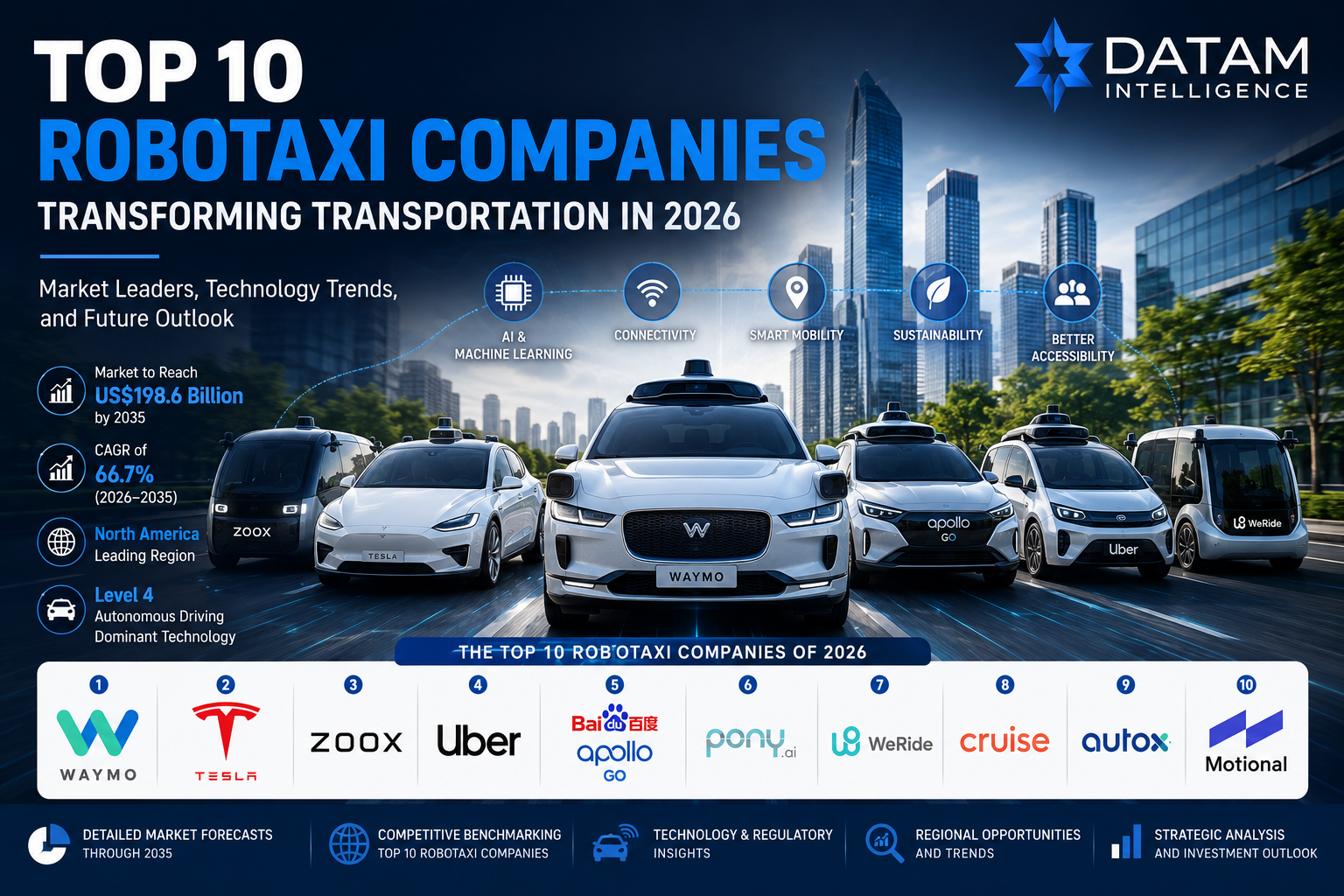
According to DataM Intelligence analysis, the global Robotaxi Market is projected to reach US$198.6 billion by 2033, growing at a CAGR of 66.7% during the forecast period. Growing demand for autonomous ride-hailing services, increasing urbanization, labor shortages, sustainability initiatives, and smart city investments are creating significant opportunities for companies operating within the autonomous mobility ecosystem.
Today, leading companies such as Waymo, Tesla, Zoox, Uber, Baidu Apollo Go, Pony.ai, WeRide, Cruise, AutoX, and Motional are competing to shape the future of transportation. Each organization is pursuing a unique strategy, ranging from purpose built autonomous vehicles and AI-powered driving systems to fleet orchestration platforms and large-scale commercial deployments.
This article explores the top robotaxi companies transforming transportation in 2026, the technologies driving industry growth, and the competitive dynamics that will influence the future of autonomous mobility.
Download a Free Sample of the Robotaxi Market Report
Robotaxis are transforming urban transportation through autonomous driving, AI-powered mobility platforms, and next-generation vehicle technologies. As commercialization accelerates, understanding market dynamics, competitive developments, and investment opportunities is becoming increasingly important.
The Robotaxi Market Report provides insights into:
✔ Market size and growth forecasts
✔ Leading robotaxi companies and strategies
✔ Autonomous vehicle technology trends
✔ Regional deployment opportunities
✔ Investment and partnership analysis
Download the Free Sample Report
What Is a Robotaxi?
A robotaxi is an autonomous vehicle designed to transport passengers without requiring a human driver. Robotaxis utilize advanced artificial intelligence, machine learning algorithms, cameras, radar systems, LiDAR sensors, GPS mapping, and edge computing platforms to navigate roads safely and efficiently.
Robotaxis are one of the fastest-growing applications within the Autonomous Vehicle Market.
Unlike traditional ride-hailing services, robotaxis eliminate driver-related operational costs and have the potential to provide transportation services around the clock. As technology improves and regulations evolve, robotaxis are expected to become a critical component of future urban transportation networks.
Key Characteristics of Robotaxis
- Fully autonomous or highly automated driving capabilities
- AI-powered navigation and decision-making
- Real-time obstacle detection and avoidance
- Electric vehicle (EV) integration
- Connected vehicle infrastructure compatibility
- Fleet-based mobility operations
Robotaxi Market Snapshot
| Market Indicator | Value |
|---|---|
| Market Value (2025) | US$1.25 Billion |
| Forecast Value (2033) | US$198.6 Billion |
| CAGR | 66.7% |
| Leading Region | North America |
| Fastest Growing Region | Asia-Pacific |
| Dominant Vehicle Type | Battery Electric Vehicles (BEVs) |
| Key Technology | Level 4 Autonomous Driving |
The increasing commercialization of autonomous transportation services is creating substantial opportunities for technology providers, automotive manufacturers, investors, mobility platforms, and smart city developers.
For detailed forecasts, competitive benchmarking, regional opportunities, and investment analysis, explore the Robotaxi Market Report.
Top 10 Robotaxi Companies Transforming Transportation in 2026
1. Waymo
Waymo remains the most commercially advanced robotaxi company globally and continues to serve as the benchmark for autonomous ride-hailing operations. As a subsidiary of Alphabet, Waymo has spent years refining its autonomous driving technology and accumulating millions of real-world autonomous driving miles.
The company currently operates commercial robotaxi services across several major U.S. markets and continues expanding its autonomous ride-hailing network. Its proprietary Waymo Driver platform combines LiDAR, radar, cameras, AI perception systems, and high-definition mapping technologies to navigate complex urban environments.
Why Waymo Leads the Industry
- Large-scale commercial deployments
- Extensive autonomous driving dataset
- Advanced AI perception systems
- Strong regulatory engagement
- Proven commercial operations
Waymo's ability to convert autonomous driving research into revenue-generating mobility services positions it as a leader in the global robotaxi market.
2. Tesla
Tesla has dramatically reshaped industry expectations through its Cybercab vision and Full Self-Driving (FSD) technology roadmap.
Unlike many competitors that rely heavily on LiDAR-based systems, Tesla pursues a vision-centric autonomous driving strategy powered by AI neural networks and advanced onboard computing systems. The company's purpose-built Cybercab concept highlights its ambition to create scalable robotaxi networks capable of reducing transportation costs significantly.
Tesla's Competitive Advantages
- Global EV manufacturing scale
- Advanced AI training infrastructure
- Full Self-Driving ecosystem
- Strong consumer brand recognition
- Potential for rapid fleet expansion
Tesla's strategy could fundamentally alter the economics of autonomous transportation if large-scale deployment goals are achieved.
Explore below market reports:
Electric Vehicle Market
Electric Car Market
3. Zoox
Backed by Amazon, Zoox has developed one of the industry's most distinctive robotaxi platforms.
Rather than modifying traditional passenger vehicles, Zoox engineered a fully autonomous vehicle specifically designed for ride-hailing operations. The bidirectional vehicle architecture maximizes passenger space, improves maneuverability, and eliminates the need for conventional driving controls.
Key Strengths
- Purpose-built robotaxi architecture
- Four-wheel steering system
- Passenger-first design
- Amazon-backed infrastructure
- Advanced urban mobility focus
Zoox's approach represents a new category of autonomous transportation designed specifically for shared mobility services.
4. Uber Technologies
Uber has adopted an asset-light strategy focused on integrating autonomous vehicle fleets into its existing ride-hailing platform.
Through strategic partnerships with autonomous vehicle developers, Uber aims to become the primary consumer interface connecting riders with autonomous transportation services.
Competitive Advantages
- Massive global user base
- Established mobility ecosystem
- Strong marketplace infrastructure
- Flexible partnership strategy
Uber's network effects could play a critical role in accelerating robotaxi adoption worldwide.
Explore below reports:
Mobility as a Service Market
Shared Mobility Market
5. Baidu Apollo Go
Baidu Apollo Go has emerged as one of China's most significant robotaxi operators.
Supported by China's expanding autonomous vehicle ecosystem, Apollo Go continues to deploy commercial robotaxi services across multiple cities while leveraging Baidu's AI expertise and mapping technologies.
Growth Drivers
- Strong government support
- Large-scale deployment programs
- Advanced AI capabilities
- Smart city integration
6. Pony.ai
Pony.ai has emerged as one of the most prominent autonomous driving companies operating across both China and the United States, making it a unique player in the global robotaxi market. Founded in Silicon Valley and backed by major automotive and technology investors, the company has built a strong reputation for developing advanced autonomous driving systems capable of operating in complex urban environments.
The company's dual-market strategy provides valuable advantages. By operating in both China and the U.S., Pony.ai gains access to diverse road conditions, regulatory environments, and consumer mobility patterns. This broad operational footprint enables the company to continuously improve its autonomous driving algorithms while accelerating commercialization efforts.
Pony.ai's robotaxi services have been deployed in multiple Chinese cities through partnerships with local governments and transportation authorities. The company is also expanding its autonomous trucking and intelligent mobility solutions, positioning itself as a broader autonomous transportation provider rather than a pure robotaxi operator.
As the global autonomous vehicle market evolves, Pony.ai's ability to bridge Eastern and Western mobility ecosystems could become a significant competitive advantage.
Key Strengths
- Strong presence in both China and the United States
- Advanced autonomous driving technology stack
- Strategic partnerships with automotive OEMs
- Growing robotaxi and autonomous trucking operations
- Extensive real-world testing experience
Explore below report:
Autonomous Freight & Logistics Market
7. WeRide
WeRide has established itself as one of the fastest-growing autonomous driving companies in the world, with a diversified portfolio spanning robotaxis, autonomous buses, autonomous logistics vehicles, and intelligent sanitation solutions. The company's broad approach to autonomous mobility allows it to address multiple transportation use cases while reducing reliance on a single revenue stream.
Unlike many competitors that focus exclusively on robotaxi deployment, WeRide has invested heavily in creating a complete autonomous transportation ecosystem. Its autonomous ride-hailing services are being tested and deployed across several cities, while its autonomous buses and logistics solutions are gaining traction in smart city and industrial environments.
WeRide has also accelerated international expansion efforts, entering new markets across Asia, the Middle East, and Europe. This global strategy enables the company to gather diverse driving data and adapt its technology to different regulatory and traffic environments.
As cities increasingly adopt connected mobility solutions, WeRide's diversified business model could position it as a major beneficiary of the autonomous transportation revolution.
Key Strengths
- Diverse autonomous vehicle portfolio
- Strong international expansion strategy
- Advanced AI-powered mobility platform
- Smart city deployment expertise
- Multiple commercialization pathways
Explore below report:
Autonomous Last Mile Delivery Market
8. Cruise
Cruise remains one of the most recognized names in the autonomous mobility industry. Supported by major automotive and technology investments, the company has played a significant role in advancing the commercialization of self-driving transportation services.
Cruise has spent years developing autonomous driving systems designed specifically for dense urban environments. The company has accumulated extensive operational experience through testing and deployment programs across multiple cities, helping refine its autonomous navigation capabilities and fleet management systems.
Despite facing operational and regulatory challenges, Cruise continues to invest in next-generation autonomous vehicle technologies and remains committed to the long-term vision of driverless mobility. The company's focus on safety, software development, and large-scale fleet operations positions it as an important competitor within the robotaxi ecosystem.
As the industry moves toward broader commercialization, Cruise's experience in autonomous ride-hailing and urban mobility could play an important role in shaping future transportation networks.
Key Strengths
- Extensive autonomous driving expertise
- Strong focus on urban mobility
- Advanced software and fleet management systems
- Significant industry partnerships
- Long-term commitment to robotaxi commercialization
9. AutoX
AutoX has become a leading force in China's rapidly expanding robotaxi market. The company focuses on developing fully autonomous transportation systems capable of operating without safety drivers, positioning itself at the forefront of Level 4 autonomous driving innovation.
The company has conducted large-scale autonomous vehicle testing across major Chinese cities and continues expanding its robotaxi operations through strategic collaborations with local governments and transportation stakeholders. AutoX's emphasis on fully driverless technology reflects its commitment to achieving high levels of automation while maintaining safety and operational efficiency.
AutoX leverages a combination of artificial intelligence, LiDAR sensors, computer vision systems, and high-definition mapping technologies to navigate complex urban environments. Its growing autonomous fleet and strong local market presence make it one of the key players shaping China's autonomous transportation future.
With China expected to remain one of the world's largest autonomous mobility markets, AutoX is well-positioned to capitalize on increasing demand for robotaxi services.
Key Strengths
- Strong presence in China's robotaxi ecosystem
- Focus on fully driverless operations
- Advanced AI and sensor technologies
- Large-scale autonomous vehicle testing
- Strategic local partnerships
Explore below report:
Software Defined Vehicle Market
10. Motional
Motional combines the automotive manufacturing expertise of Hyundai Motor Group with the autonomous driving technology capabilities of Aptiv, creating one of the industry's most strategically positioned robotaxi developers. This unique partnership allows Motional to integrate advanced self-driving systems directly into vehicle platforms designed for commercial deployment.
The company has focused heavily on developing Level 4 autonomous driving technologies for ride-hailing and mobility applications. Through collaborations with transportation providers and mobility platforms, Motional aims to accelerate the commercialization of autonomous passenger services while maintaining high safety and reliability standards.
One of Motional's key advantages is its ability to leverage Hyundai's global manufacturing capabilities, which could support large-scale robotaxi fleet production as commercial demand increases. Combined with Aptiv's expertise in software, sensors, and autonomous systems, Motional has built a strong foundation for long-term growth in the autonomous mobility market.
As robotaxi adoption expands globally, Motional's integrated automotive and technology approach could provide a competitive advantage in scaling autonomous transportation services.
Key Strengths
- Backed by Hyundai and Aptiv
- Strong automotive engineering expertise
- Advanced Level 4 autonomous driving technology
- Strategic mobility partnerships
- Scalable vehicle production capabilities
Explore below report:
Waymo vs Tesla: Who Is Winning the Robotaxi Race?
While Waymo currently leads commercial deployment, Tesla's manufacturing scale and AI-driven strategy create significant long-term competitive potential.
Waymo's advantage lies in operational maturity, while Tesla's advantage lies in scalability and cost optimization.
The future market leader will likely be determined by:
- Regulatory approvals
- Fleet economics
- Consumer adoption
- Autonomous driving performance
- Manufacturing efficiency
The competitive dynamics between Waymo and Tesla are also influencing broader trends across the Autonomous Vehicle Market, Electric Vehicle Market, and emerging Mobility as a Service (MaaS) ecosystem.
Why the Robotaxi Industry Is Growing So Rapidly
Artificial Intelligence Advancements
AI-powered perception systems continue improving safety, reliability, and navigation capabilities.
Smart City Investments
Governments worldwide are investing in connected infrastructure that supports autonomous mobility deployment.
Labor Shortages
Autonomous transportation can help address growing labor shortages across mobility services.
Sustainability Goals
Electric robotaxi fleets support global carbon reduction initiatives.
Future Outlook
The next decade is expected to represent a defining period for the robotaxi industry. As regulations mature and autonomous driving systems continue improving, robotaxis are expected to become an increasingly common component of urban transportation ecosystems.
Organizations capable of combining advanced AI, scalable fleet operations, regulatory compliance, and cost-efficient vehicle production are likely to capture the largest share of future market growth.
Frequently Asked Questions (FAQ)
What is a robotaxi?
A robotaxi is an autonomous vehicle that provides transportation services without requiring a human driver.
Which company leads the robotaxi industry?
Waymo currently leads commercial deployment, while Tesla remains one of the industry's most closely watched competitors.
How large is the robotaxi market?
According to the latest Robotaxi Market Report, the global market is projected to reach US$198.6 billion by 2035.
Are robotaxis safe?
Robotaxi safety depends on autonomous driving technology, regulatory oversight, and real-world operating conditions. Safety performance continues improving as AI systems mature.
Which countries are leading robotaxi adoption?
The United States and China currently lead commercial robotaxi deployment, while Europe continues advancing regulatory frameworks.
Explore the Complete Robotaxi Market Report
DataM Intelligence's comprehensive Robotaxi Market Report provides detailed market forecasts, company benchmarking, technology assessments, investment trends, regulatory analysis, and strategic recommendations for stakeholders operating across the autonomous mobility ecosystem.
Access the full report to gain actionable insights into one of the fastest-growing transportation markets in the world.