


Global Space Robotics Market Size and Forecast
The Global Space Robotics Market reached US$ 5.65 billion in 2025 and is expected to reach US$ 12.99 billion by 2035, growing with a CAGR of 8.7% during the forecast period 2026-2035. Space project complexity and ambition drive deep space robotics industry demand. Governments and private companies heavily invest in missions to the Moon, Mars and beyond, which demand robots to perform planetary surface exploration, sample gathering and infrastructure building. Robots need to function autonomously in hostile, uncontrolled environments, driving innovation in AI, machine learning and robotic mobility.
For example, NASA's Artemis mission and ESA's lunar missions rely on robots to land on the moon and erect habitats. Furthermore, growing interest in asteroid mining and space resource exploitation fuels the demand for specialist robotics. As exploration missions reach further into space, the dependence on robots to accomplish the too dangerous or too impractical for human endeavors will continue to increase, solidifying the role of robotics in deep space exploration.
Space Robotics Market Key Takeaways
- North America accounts for approximately 39-40% of the global market, supported by strong investments from government space agencies and commercial space companies in robotic exploration and satellite servicing.
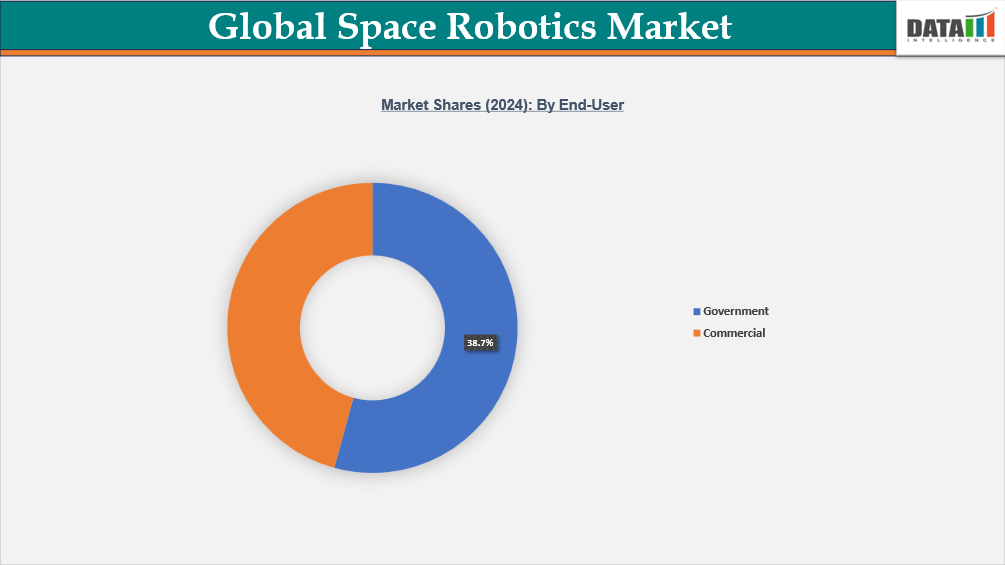
- Government organizations contribute nearly 38-40% of total market demand, driven by increasing investments in lunar exploration, Mars missions, space station operations, and national space programs.
- Remotely operated vehicles (ROVs) and robotic manipulation systems account for nearly 40% of total market revenue, owing to their growing use in satellite servicing, orbital maintenance, and deep-space exploration.
- Satellite servicing and near-space operations represent more than 45% of application demand, reflecting increasing commercial investment in extending satellite lifecycles and orbital infrastructure.
- More than 70% of upcoming deep-space missions are expected to incorporate autonomous robotic systems for planetary exploration, infrastructure assembly, and in-orbit servicing.
- AI-powered autonomous navigation, robotic manipulation, and vision-guided space systems are witnessing annual adoption growth exceeding 20%, improving mission safety, operational efficiency, and autonomy.
- Asia-Pacific is expected to be the fastest-growing regional market, driven by expanding investments from China, India, Japan, and other regional space agencies.
- Commercial space companies are increasingly investing in robotic satellite servicing, debris removal, and in-space manufacturing, creating new long-term revenue opportunities.
- Growing investments in lunar exploration, asteroid mining, autonomous spacecraft, and space infrastructure development are expected to accelerate long-term market growth.
Space Robotics Market Scope
| Metrics | Details |
| Market Size (2025) | US$ 5.65 Billion |
| Market Size (2035) | US$ 12.99 Billion (Calculated) |
| CAGR (2026-2035) | 8.70% |
| Historic Years | 2023-2024 |
| Base Year | 2025 |
| Forecast Period | 2026-2035 |
| Segments Covered | Solution, Application, End User, Region |
| Leading Region | North America |
| Fastest Growing Region | Asia-Pacific |
Space Robotics Market Dynamics
Diverging Adoption of Advanced Technologies
New technologies, like Artificial Intelligence (AI) and Deep Learning (DL), are being extensively implemented in the field of robotics. Some organizations are designing AI-enabled deep space robots that offer improved exploration advantages and increased mobility within space. Robots are able to work with minimum human intervention and carry out very intricate tasks for a longer time.
For example, in June 2023, the International Space Station (ISS) began to use a new device called Int-Ball, which was created by the Japan Aerospace Exploration Agency and operated & managed by a crew of JAXA ground controllers. The major aim of Int-Ball is to minimize photographing time; JAXA has created the JEM Internal Ball Camera ("Int-Ball") which autonomously travels to the target spatial position and takes videos/pictures of the target, with the goal of achieving zero photographing time by the crew.
Restraints-High Cost of Development and Deployment
One of the main constraints in the international deep space robotics industry is the excessive cost involved in the development, testing and deployment of space-grade robotic systems. Designing robots that are capable of withstanding hostile extraterrestrial environments-severe temperatures, radiation and delayed communications-calls for customized materials, high-precision engineering and stringent testing procedures.
The expenses are further augmented by launch costs, which can cost tens of millions of dollars per mission. The high capital costs restrict participation to well-funded government agencies and a handful of private companies, resulting in high barriers to entry for startups and new entrants. The financial burden tends to retard innovation cycles and limit wider adoption among international or commercial players.
Space Robotics Market Segmentation Analysis
The global space robotics market is segmented based on solution, application, end-user and region.
Space Robotics Market Rising Investments in Government Sector to Drive the Segment Growth
Government end-user is expected to hold about 38.7% of the global market in 2024. Government remains at the forefront of the industry as it is national space agencies such as NASA, ESA, Roscosmos, CNSA and ISRO that are the biggest spenders on space missions into the universe. Governments allocate large sums of money to interplanetary research; space station upkeep and planetary exploration and they demand the use of cutting-edge robotic technologies. Government investment in deep space robotics is further established by the growing focus on Mars exploration and asteroid mining due to growing interest in space security.
Additionally, governments are funding research and development in the fields of robotics and space. For example, in February 2023, India's union budget for 2023-2024 provisioned US$ 151.48 million for the Department of Space (DoS). It will aid the development of India's space program by initiating projects from launch vehicles and satellites to other development and operational ones.
Commercial Sector Has a Significant Growth Rate Due to the Expanding Private Companies
The commercial space robotics sector is quickly growing as private companies look for robotic solutions to cut costs, extend satellite lifecycles and enable new business models in space. One of the most obvious applications is satellite servicing, which employs robotic equipment for in-orbit inspection, refueling and repositioning. For example, Northrop Grumman's Mission Extension Vehicle (MEV-1 and MEV-2) successfully docked with Intelsat satellites, extending their operational lifetimes by more than 5 years and saving operators the expense of launching totally new spacecraft. This commercial proof-of-concept opens the door to service-based contracts in GEO and LEO, establishing recurrent income streams for robotic service providers.
Space Robotics Market Geographical Penetration

Rising Investments and Adoption of Technology in Asia-Pacific
Asia-Pacific is the fastest-growing region for space robotics, with strong contributions from China, India, Japan and other regional players. China leads the market, having demonstrated cutting-edge robotics in its Chang’e lunar exploration program, Tianwen-1 Mars rover and robotic arms on the Tiangong space station. China’s roadmap for lunar bases and deep-space exploration ensures long-term investments in autonomous robotics for construction, servicing and planetary mobility.
Beyond the big players, South Korea and Australia are entering the space robotics market. South Korea is using robotics for planned lunar exploration missions and Australia's collaboration with NASA under the Artemis Accords includes the development of a semi-autonomous lunar rover by the mid-2020s. With increasing government financing, regional collaboration and the arrival of commercial entrepreneurs, the Asia-Pacific space robotics market is predicted to become one of the most competitive, contributing not just to national projects but also to global commercial missions.
India Space Robotics Market Outlook
India's space robotics sector is expanding rapidly, fuelled by ISRO's emphasis on lunar and planetary exploration. Robotic technologies were tried in missions such as Chandrayaan-2 and Chandrayaan-3, where autonomous landing and rover systems demonstrated India's expanding capabilities. Looking ahead, ISRO plans to invest in robotic arms and humanoid robots (such as Vyommitra) for the future Gaganyaan human spaceflight mission. The government's effort for commercialization and private sector participation is also projected to create chances for robotics firms meeting satellite servicing and manufacturing needs.
China Space Robotics Market Trends
China's Space Robotics market prognosis remains positive, as it is one of the most advanced countries in space robotics, accounting for more than 40% of the regional market. It has successfully deployed robotic arms on the Tiangong space station, as well as surface rovers on the Moon and Mars. The country's space robotics industry is inextricably connected to its long-term goal of establishing permanent lunar outposts and improving on-orbit servicing capabilities. Chinese enterprises and CASC subsidiaries are developing autonomous satellite servicing and debris removal technologies that are consistent with both national security and commercial purposes. With strong state backing and swift execution, China is poised to be a global leader in robotic applications for human spaceflight, exploration and in-orbit operations.
Presence of Major Companies in North America
North America is expected to be dominant region of the global market holding about 40% of the market in 2024. The region’s strong space exploration programs, sophisticated technological infrastructure and significant R&D expenditures are expected to make it the market leader in the worldwide deep space robotics market. Presence of leading space agencies like NASA and premier private space companies such as SpaceX, Blue Origin and Lockheed Martin gives a competitive advantage in this region. Also, government assistance in policies, financing deep space missions and partnerships with commercial players support North America's market leadership.
Space agencies and companies are building deep space robots that may operate in extreme conditions. An example is NASA, which is currently building its new space-exploring robot, the Shapeshifter. The Shapeshifter is an amphibious aerial robot capable of rolling, flying, floating and swimming. The NASA Innovative Advanced Concepts research program is constructing the robots. When complete, the robots will be able to explore Saturn's moon, Titan, which has liquid (in the form of seas of methane) on its surface.
US Space Robotics Market Insights
US currently dominates the commercial space robotics business, thanks to NASA's legacy and private sector innovation. NASA's contributions include Canadarm2 (on the International Space Station), Mars rovers Curiosity and Perseverance and planned robotic systems for the Artemis lunar program and Lunar Gateway station. Commercially, US businesses are pioneering new uses, including Northrop Grumman's MEV spacecraft for satellite life extension, Redwire's in-space manufacturing robotics and Astrobotic's lunar surface robots for cargo delivery. With billions funded annually through NASA and the Department of Defense, together with a robust commercial sector, US is the largest market and engine of innovation in space robotics globally.
Canada Space Robotics Industry Growth
Canada holds a unique global position as a specialist in space robotics, largely through its legacy of the Canadarm series. The Canadarm and Canadarm2 have been critical to Shuttle missions and ISS operations, while the upcoming Canadarm3 will play a central role on NASA’s Lunar Gateway. Canadian company MDA leads this sector, developing robotic arms, manipulators and autonomous servicing systems for both government and commercial clients. Beyond government contracts, Canada is increasingly targeting the commercial servicing market, leveraging its decades of expertise to expand into robotic satellite repair, inspection and orbital logistics services.
Why Space Robotics Is Becoming Mission Critical
Space missions are becoming increasingly complex. Future lunar bases, Mars exploration programs, asteroid resource extraction projects, and orbital infrastructure initiatives require robotic systems capable of operating independently in environments characterized by radiation, communication delays, and extreme temperatures.
Programs such as NASA's Artemis initiative, future lunar habitat projects, and robotic exploration missions are increasing demand for advanced mobility systems, robotic manipulators, autonomous navigation software, and intelligent servicing platforms. As human presence expands beyond low-Earth orbit, robotics will serve as the primary workforce supporting construction, maintenance, inspection, and scientific operations.
Space Robotics Market Trends and Insights
Increasing Autonomous Operations
Autonomy is emerging as a key direction in space robotics as missions become more complex and increasingly operate beyond the practical limits of continuous human control. Modern robotic systems are being developed with the ability to interpret their surroundings, identify objects, navigate unfamiliar terrain and adjust their movements in response to changing conditions. These capabilities are particularly valuable for lunar and deep-space missions, where communication delays can make continuous remote operation impractical. Recent research involving JAXA-related robotic systems has also examined coordinated movement among multiple robots, highlighting the potential for autonomous teams to perform transportation and other surface activities with limited intervention from Earth.
Robotic Satellite Servicing
The rapid expansion of commercial satellite fleets is creating new opportunities for robotic inspection, maintenance and servicing. Instead of replacing an entire spacecraft when a component fails or its fuel supply becomes limited, future servicing missions could use robotic systems to inspect equipment, perform refueling, relocate satellites or replace selected components. These capabilities could extend satellite operating lives and improve the economics of increasingly expensive orbital infrastructure. The development of on-orbit servicing also creates opportunities for robotic manipulators, autonomous rendezvous systems, docking technologies and specialized servicing spacecraft.
Expansion of Lunar Robotics
Growing investment in lunar exploration is creating a broader role for robotic systems beyond conventional scientific missions. Future lunar robots are expected to support surface exploration, sample collection, cargo transportation, construction, infrastructure deployment and resource prospecting. Robots could also be used to prepare landing areas, transport equipment and install power or communications infrastructure before sustained human activity begins. This shift is creating demand for durable machines capable of repeated operations in extreme temperatures, abrasive dust and uneven terrain rather than robots designed solely for short-duration exploration missions.
Advancements in Planetary Rovers
Planetary rovers continue to represent one of the most established applications of space robotics, but their capabilities are moving well beyond basic remote-controlled mobility. Newer systems are incorporating autonomous navigation, improved terrain recognition, scientific instrument management and automated route planning. These capabilities allow rovers to make more effective use of mission time by identifying suitable routes and responding to obstacles without requiring instructions for every movement. Future missions are also expected to explore coordinated rover operations, in which multiple machines can divide exploration and scientific tasks across larger areas.
Development of Advanced Robotic Manipulators
Robotic arms and manipulators remain central to space robotics because many orbital and surface activities require precise physical interaction with equipment. Applications include cargo handling, spacecraft assembly, inspection, scientific experiments and satellite servicing. Recent NASA work demonstrates the direction of development toward robots that can recognize spacecraft components and perform manipulation tasks using perception-based software rather than simply executing predetermined movements. This transition toward more intelligent manipulation could make robotic systems more useful for complex maintenance and servicing activities.
Growth of Multi-Robot Cooperation
The industry is also moving toward the concept of multiple smaller robots working together instead of depending on one large and highly complex machine. A distributed robotic system can provide greater operational flexibility because individual units can perform different tasks simultaneously, while the failure of one robot does not necessarily terminate the entire mission. Potential benefits include wider surface coverage, parallel transportation, redundancy and improved fault tolerance. Research into coordinated lunar transportation has demonstrated how reinforcement-learning approaches can be used to manage cooperative robotic movement, supporting the longer-term development of multi-robot planetary operations.
AI and Machine Vision Integration
Artificial intelligence and machine vision are becoming important components of space robotic systems because robots must operate in environments where terrain, lighting, dust and equipment conditions can change significantly. Camera systems and other sensors can provide information about obstacles, terrain characteristics and spacecraft components, while AI-based software can interpret this information and support navigation or manipulation decisions. Practical applications include object identification, terrain classification, autonomous route selection, robotic grasping, equipment inspection and collision avoidance. As onboard computing capabilities improve, more of this processing can be performed directly on the spacecraft or robot, reducing dependence on continuous communication with Earth.
In-Space Manufacturing and Construction
The development of larger orbital and lunar infrastructure could create a significant future role for robotic construction systems. Robots may eventually be used to assemble large antennas, deploy solar arrays, construct structural components, install equipment and maintain space-based facilities. On the lunar surface, autonomous construction machines could potentially prepare sites and assemble infrastructure before permanent human operations begin. Manufacturing or assembling selected structures in space could also reduce the need to launch very large, fully assembled components from Earth, particularly as commercial space stations and other large orbital facilities develop.
Space Resource Utilization
Space-resource utilization represents a longer-term opportunity for robotic technology. Robotic systems could eventually be used to locate, collect and process materials from lunar or asteroid environments. Water ice is of particular interest because it could potentially provide water and, after processing, oxygen and hydrogen for future space operations. Robots would be essential for prospecting, excavation, transportation and processing because these activities could initially need to take place without continuous human presence. Research into autonomous asteroid rendezvous and exploration is also contributing to the development of navigation and robotic capabilities required for future resource-oriented missions.
Robotic Inspection and Maintenance
Inspection and maintenance are expected to become increasingly important as the amount of equipment operating in space grows. Robotic systems can potentially examine spacecraft surfaces, solar arrays, thermal-protection components and external equipment without requiring astronauts to undertake every inspection manually. This could reduce crew exposure to hazardous environments while allowing operators to monitor spacecraft condition more frequently. Over time, inspection robots could evolve into multifunctional servicing platforms capable of identifying faults, manipulating components and carrying out selected maintenance activities.
Overall Trend
The Space Robotics Market is gradually moving from mission-specific robotic systems toward autonomous, reusable and collaborative robotic infrastructure. The combination of AI, machine vision, autonomous navigation, advanced manipulators and multi-robot coordination is expanding the role of robotics across orbital servicing, lunar exploration, planetary science and future space construction. As commercial space activity increases, the market opportunity is likely to extend beyond government exploration programs toward satellite operators, private space stations, lunar infrastructure developers and in-space service providers.
Space Robotics Market Regulatory Landscape
Space robotics is subject to a combination of international space law, national licensing requirements, spacecraft safety standards, export controls and mission-specific regulations.
International Space Law
Space activities are governed by international treaties and principles addressing state responsibility, peaceful use, registration, liability and the treatment of space objects.
Robotic spacecraft therefore require regulatory consideration even when they operate without human crews.
Space Debris and Orbital Sustainability
Satellite-servicing and robotic systems must be designed with increasing attention to debris mitigation.
Robots operating around satellites need to minimize collision risks and ensure that servicing operations do not unintentionally create additional debris.
Planetary Protection
Robotic missions to other celestial bodies may be subject to planetary-protection requirements designed to reduce biological contamination.
This is particularly relevant to missions targeting Mars and other scientifically sensitive environments.
Spectrum and Communications
Space robots depend heavily on communications links for telemetry, command and data transfer. Frequency coordination and spectrum-management requirements therefore influence system design.
Export Controls
Advanced robotic arms, navigation systems, sensors, processors and autonomous-control technologies may have dual-use applications. International trade in these technologies can therefore be affected by national export-control regimes.
AI and Autonomous Systems
As robotic systems become more autonomous, mission operators increasingly need to demonstrate predictable behavior, fault tolerance and appropriate human oversight.
For high-consequence applications, certification and verification of autonomous software will become increasingly important.
Space Robotics Market Opportunities Through 2035
The most attractive opportunities are emerging where robotics intersects with long-term space infrastructure development.
For manufacturers, demand is growing for robotic manipulators, mobility systems, autonomous navigation technologies, and AI-enabled mission software.
For technology companies, opportunities exist in perception systems, machine learning algorithms, sensor fusion technologies, and autonomous decision-making platforms.
For investors, companies focused on satellite servicing, orbital logistics, in-space manufacturing, and robotic construction systems offer exposure to recurring revenue opportunities rather than one-time mission contracts.
For procurement organizations, robotic solutions provide a path toward reducing mission costs while improving operational reliability and asset longevity.
Space Robotics Market Competitive Landscape
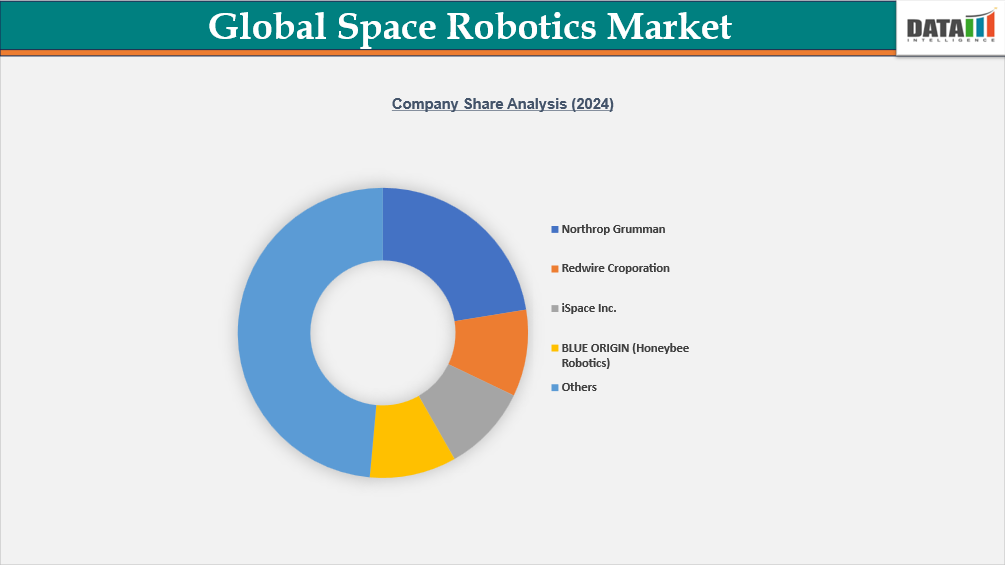
The space robotics market is competitive, driven by a mix of global and regional players striving for technological efficiency and cost leadership.
Key players include Northrop Grumman, Redwire Corporation, iSpace Inc., BLUE ORIGIN (Honeybee Robotics), Motiv Space Systems Inc., Maxar Technologies, Astrobotic Technology, Space Applications Services, Ceres Robotics Inc. and Lunar Resources, Inc.
Players are investing highly in robotics, robotic servicing technologies and seek robotic solutions to reduce costs, extend satellite lifecycles and enable new business models in orbit, to gain an edge.
Key Developments in Space Robotics Market
- June 2026 - Redwire Corporation: Expanded its in-space robotics portfolio with advanced robotic technologies to support satellite servicing and space infrastructure missions.
- June 2026 - Northrop Grumman Corporation: Advanced its autonomous space servicing capabilities with new robotic technologies for on-orbit maintenance and satellite life extension.
- May 2026 - Blue Origin (Honeybee Robotics): Expanded lunar robotics technologies to support future Moon exploration and in-situ resource utilization missions.
- May 2026 - Maxar Technologies: Introduced advanced space robotics and autonomous navigation technologies for satellite servicing and deep-space exploration.
- April 2026 - ispace Inc.: Announced progress in its lunar exploration program with robotic technologies supporting upcoming commercial Moon missions.
- April 2026 - Astrobotic Technology: Advanced the development of robotic lunar payload delivery systems for future commercial and government space missions.
- March 2026 - Motiv Space Systems Inc.: Expanded its space robotics portfolio with robotic arms and autonomous systems for orbital servicing applications.
- March 2026 - Space Applications Services: Strengthened its robotic systems portfolio by advancing technologies for in-orbit servicing and space exploration missions.
Space Robotics Market Investment and Strategic Collaboration Analysis
Public and private sector investments supporting intelligent space robotics innovations continue creating substantial commercialization opportunities across global markets. Space organizations are increasingly allocating resources toward autonomous robotic technologies, lunar infrastructure programs, orbital servicing capabilities, and intelligent spacecraft automation initiatives designed to improve mission outcomes significantly.
Strategic collaborations involving space agencies, robotics manufacturers, aerospace organizations, and autonomous technology developers are substantially accelerating technological innovation activities worldwide. NASA's STRIDE initiative recently selected organizations including Astrobotic, AeroVironment, Venturi Astrolab, and Honeybee Robotics to advance next-generation robotic mobility systems supporting future Mars exploration programs. Furthermore, Australia's and Canada's increasing investments supporting autonomous space technologies are anticipated to substantially strengthen future market competitiveness globally. Growing commercialization initiatives across the emerging space economy continue creating attractive investment opportunities throughout the forecast period.
Why Choose DataM?
Technological Innovations: DataM explores advancements across artificial intelligence-enabled space robotics technologies, autonomous lunar mobility systems, intelligent robotic manipulators, orbital servicing platforms, and connected space infrastructures that are enabling organizations worldwide to improve mission effectiveness and operational efficiencies across next-generation space environments. Recent examples include GITAI's S3 robotic satellite mission supporting autonomous orbital servicing capabilities and NASA's ISAM initiatives designed to enable sustainable in-space manufacturing and robotic assembly operations.
Product Performance & Market Positioning: The report evaluates how leading market participants deliver space robotics solutions based on critical performance parameters such as mission endurance capabilities, autonomous operational characteristics, payload management functionalities, intelligent analytics capabilities, deployment flexibility, and orbital survivability considerations, highlighting how organizations differentiate through technological innovation and intelligent space capabilities globally.
Real-World Evidence: DataM highlights the adoption of intelligent space robotics technologies across commercial space missions, lunar exploration initiatives, and autonomous satellite servicing programs worldwide. NASA's Astrobee robotic platform aboard the International Space Station and Canadarm3's autonomous robotic capabilities supporting future lunar infrastructures demonstrate the substantial commercialization potential associated with intelligent robotic technologies across next-generation space ecosystems.
Market Updates & Industry Changes: The report tracks key developments including Rocket Lab's acquisition of Motiv Space Systems during 2026, NASA's STRIDE robotic mobility initiatives supporting Mars exploration technologies, GITAI's autonomous orbital servicing mission developments, and increasing investments supporting commercial lunar infrastructure programs across North America, Europe, and Asia-Pacific.
Competitive Strategies: DataM analyzes how leading organizations expand through artificial intelligence innovations, strategic collaborations, autonomous space technologies, cloud-enabled mission management capabilities, and regional commercialization programs designed to address increasing demand for intelligent space infrastructures worldwide.
Pricing & Market Access: The report explains pricing variations based on robotic system configurations, mission requirements, autonomous capabilities, deployment complexities, and aerospace integration considerations, along with market access opportunities through governmental space programs, commercial space organizations, strategic technology partnerships, and international space collaborations supporting global commercialization initiatives.
Market Entry & Expansion: DataM identifies attractive growth opportunities driven by increasing investments supporting commercial space economies, accelerating adoption of autonomous robotic technologies, expanding lunar exploration initiatives, and growing demand for intelligent space infrastructures globally. The report further outlines strategic approaches involving regional expansion initiatives, technology differentiation strategies, customized robotic platforms, and collaborative commercialization models designed to support successful market entry and long-term business expansion across emerging and established space robotics markets.
Target Audience
The report is strategically developed for stakeholders operating across the global space robotics, autonomous systems, aerospace, and intelligent space infrastructure ecosystem. It provides actionable market intelligence for space agencies, commercial space organizations, satellite manufacturers, autonomous robotics developers, aerospace technology companies, and intelligent spacecraft solution providers seeking to strengthen their competitive positioning within rapidly evolving space markets. Furthermore, regulatory organizations, academic institutions, investment firms, government agencies, defense organizations, and strategic business leaders can utilize the report to evaluate emerging technological innovations, commercialization trends, lunar exploration initiatives, and future growth opportunities shaping the Space Robotics Market through 2035.


























































