


The ADC Race Has Moved Beyond Individual Products
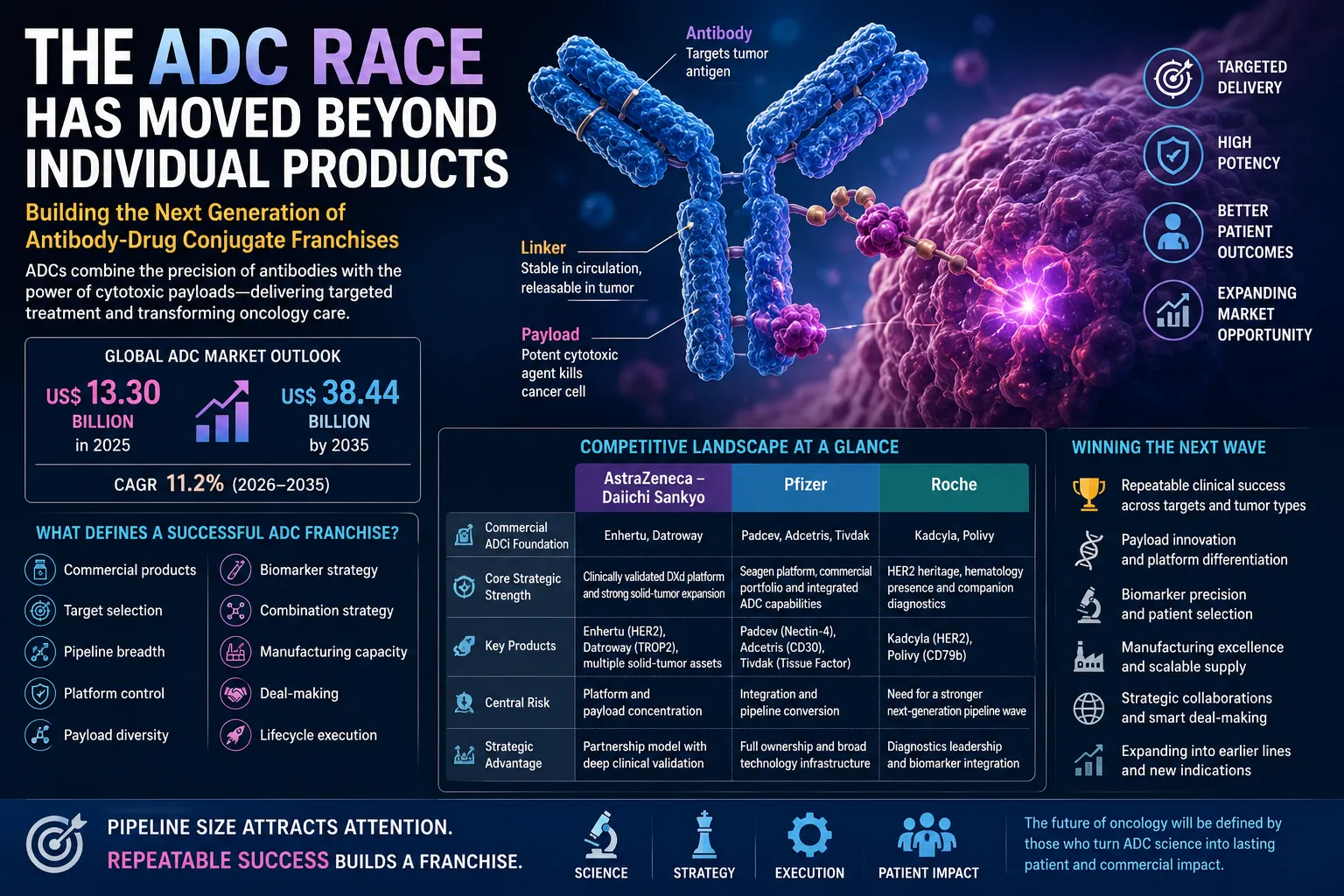
Antibody-drug conjugates, or ADCs, have become one of oncology’s most competitive drug-development categories. Their appeal is conceptually straightforward: connect a tumor-targeting antibody to a potent cytotoxic payload through a chemical linker, then use the antibody to deliver that payload preferentially to cancer cells.
Commercial success is considerably more complicated. An effective ADC requires the right antigen, an appropriate antibody, controlled conjugation, a stable but releasable linker, a payload with the necessary potency and a tolerable safety profile. Patient selection, manufacturing consistency and treatment sequencing add further layers of risk.
The leading companies are consequently trying to build ADC franchises, not isolated assets.
- AstraZeneca and Daiichi Sankyo are expanding a clinically validated ADC platform across HER2, TROP2 and additional targets.
- Pfizer acquired Seagen to obtain marketed products, proprietary technology, manufacturing capabilities and a broad clinical pipeline.
- Roche combines established ADC products with deep HER2 experience, hematology capabilities and one of the industry’s strongest companion-diagnostics businesses.
DataM Intelligence values the global antibody-drug conjugates market at US$13.30 billion in 2025. It projects the market to reach US$38.44 billion by 2035, representing an 11.2% CAGR during 2026-2035.
The competitive winner will not necessarily be the company with the largest number of clinical candidates. It will be the one that repeatedly converts ADC science into approved indications, earlier treatment use, reliable manufacturing and durable clinical differentiation.
Request for Sample: https://www.datamintelligence.com/download-sample/antibody-drug-conjugates-market
What Defines a Successful ADC Franchise?
A complete ADC franchise requires more than pipeline volume.
| Competitive factor | Why it matters |
| Commercial products | Provide revenue, physician familiarity and real-world safety experience |
| Target selection | Determines addressable cancers, biomarker requirements and competitive intensity |
| Pipeline breadth | Spreads clinical risk across targets, tumor types and development stages |
| Platform control | Reduces dependence on external technology and supports repeatable development |
| Payload diversity | Helps address resistance and avoid concentrating toxicity in one payload class |
| Biomarker strategy | Determines which patients can be identified and treated |
| Combination strategy | Creates opportunities with immunotherapy, targeted therapy and other ADCs |
| Manufacturing capacity | Controls quality, supply, cost and launch readiness |
| Deal-making | Provides access to targets and technologies not available internally |
| Lifecycle execution | Expands products into new indications, earlier lines and geographic markets |
Against this framework, AstraZeneca-Daiichi Sankyo currently holds the strongest momentum, Pfizer owns the broadest acquired ADC infrastructure, and Roche possesses a distinctive diagnostics advantage.
Request for Sample: https://www.datamintelligence.com/download-sample/antibody-drug-conjugates-market
Competitive Position at a Glance
| Company | Commercial ADC foundation | Core strategic strength | Central risk |
| AstraZeneca-Daiichi Sankyo | Enhertu and Datroway | Clinically validated DXd platform and strong solid-tumor expansion | Platform and payload concentration |
| Pfizer | Padcev, Adcetris and Tivdak | Seagen platform, commercial portfolio and integrated ADC capabilities | Integration and pipeline conversion |
| Roche | Kadcyla and Polivy | HER2 heritage, hematology presence and companion diagnostics | Need for a stronger next-generation pipeline wave |
AstraZeneca-Daiichi Sankyo: The Current Franchise Leader
AstraZeneca and Daiichi Sankyo have created the most important current ADC partnership through Enhertu and Datroway.
Enhertu, or trastuzumab deruxtecan, transformed the competitive landscape by expanding HER2-directed ADC treatment beyond conventionally defined HER2-positive disease. Its development in HER2-low and HER2-ultralow breast cancer showed that ADCs can expand a market by changing how target expression is interpreted.
That is strategically different from capturing share within an existing biomarker segment. It creates a larger treatable population through a more sensitive understanding of antigen expression.
Why Enhertu created a franchise rather than a single-product success
Enhertu established several capabilities simultaneously:
- Clinical validation of the DXd ADC platform
- Regulatory and commercial experience across multiple markets
- Physician familiarity with deruxtecan-based treatment
- A development model spanning breast, gastric, lung and other solid tumors
- Experience managing class-related safety considerations
- A foundation for earlier-line and combination studies
AstraZeneca’s 2025 annual report highlighted continued development of Enhertu in earlier HER2-positive breast cancer settings. Moving an ADC from heavily pretreated metastatic disease into earlier treatment is commercially significant because eligible populations may become larger and treatment duration may change. It also raises the evidentiary standard: patients with potentially curable disease may have lower tolerance for serious toxicity.
Datroway extends the model into TROP2
Datroway, or datopotamab deruxtecan, gives the partnership a second commercial pillar. It targets TROP2, an antigen expressed across several epithelial tumors.
The strategic value is not merely another approval. Datroway demonstrates that the companies are attempting to reproduce the DXd platform across targets. Its development program creates opportunities in breast and lung cancers, including combinations with immunotherapy and other targeted agents.
The challenge is differentiation. TROP2 is already a validated and competitive target. Datroway must establish where its efficacy, tolerability, dosing and combination potential provide an advantage over existing and emerging options.
Deal-making is central to the partnership
The AstraZeneca-Daiichi Sankyo relationship divides scientific, development and commercial risk while combining different strengths:
- Daiichi Sankyo contributes proprietary ADC engineering and platform expertise.
- AstraZeneca contributes global oncology development, regulatory and commercialization capabilities.
- Both parties share the economics of successful products under negotiated terms.
This structure allowed AstraZeneca to enter a leading ADC platform without acquiring the entire company. It also enabled Daiichi Sankyo to retain substantial economic participation in assets originating from its research.
The principal strategic risk
The portfolio’s strength is also a concentration risk. Several important candidates use related deruxtecan payload and linker technology. Success validates the platform, but safety, resistance, or manufacturing issues affecting the class could influence multiple programs.
A durable franchise will therefore require continued differentiation in:
- Targets
- Antibodies
- Payload delivery
- Dosing
- Biomarker selection
- Toxicity management
- Combination regimens
Current assessment: AstraZeneca-Daiichi Sankyo leads the contest because it has demonstrated the strongest combination of clinical differentiation, commercial validation and indication expansion.
Pfizer: The Broadest Acquired ADC Platform
Pfizer’s approximately US$43 billion acquisition of Seagen in 2023 was not simply a purchase of oncology revenue. It provided Pfizer with an established ADC organization encompassing marketed products, linker-payload knowledge, clinical candidates, manufacturing experience and specialized development talent.
Its commercial portfolio includes:
- Padcev for urothelial cancer
- Adcetris for CD30-expressing lymphomas
- Tivdak for cervical cancer
These assets give Pfizer exposure to both solid tumors and hematologic malignancies.
Padcev is Pfizer’s most important ADC growth engine
Padcev, or enfortumab vedotin, targets Nectin-4. Its position in urothelial cancer has been strengthened through combination with pembrolizumab, demonstrating an important franchise principle: ADC value can expand when the drug becomes part of a combination that changes the treatment standard.
Pfizer reported US$1.94 billion in Padcev revenue for 2025, making it one of the company’s ten largest medicines by revenue. The figure demonstrates meaningful commercial scale, although Padcev is developed and commercialized with Astellas under their collaboration.
Adcetris provides maturity and hematology experience
Adcetris, or brentuximab vedotin, is one of the industry’s most established ADCs. It targets CD30 and has accumulated extensive development and commercial experience across lymphomas.
Its strategic importance extends beyond current revenue. Adcetris helped validate vedotin-based ADC technology and provided Seagen-and now Pfizer-with manufacturing, safety-management and regulatory capabilities that can support additional candidates.
Pfizer’s pipeline is broad, but clinical conversion is the test
Pfizer’s ADC pipeline includes programs against newer targets such as integrin beta-6 and PD-L1, as well as candidates using topoisomerase I and auristatin-class payloads.
That breadth potentially reduces dependence on a single target or payload family. It also creates an execution challenge: Pfizer must decide which candidates merit continued investment and which should be discontinued before late-stage spending increases.
The risk was illustrated in June 2026 when Pfizer announced that Phase III sigvotatug vedotin did not produce a statistically significant overall-survival improvement over docetaxel in the overall population of previously treated metastatic non-squamous non-small cell lung cancer. Pfizer reported a more encouraging trend in patients treated after one prior line and continues evaluating the program in earlier-line combinations, but the result shows why pipeline quantity cannot substitute for successful randomized evidence.
Pfizer’s strategic advantage is internal control
Unlike AstraZeneca’s partnership-led position, Pfizer acquired the underlying Seagen organization. This provides greater control over:
- Portfolio prioritization
- Platform investment
- Manufacturing
- Business development
- Combination development
- Global commercial strategy
Full ownership also means Pfizer carries the complete integration and development risk. The company must retain specialized ADC talent, align Seagen’s research culture with a much larger organization and translate multiple clinical candidates into commercially differentiated medicines.
Current assessment: Pfizer has the strongest infrastructure to challenge AstraZeneca-Daiichi Sankyo, but its position depends on turning acquired breadth into repeatable post-acquisition clinical successes.
Roche: The Diagnostics-Led ADC Competitor
Roche should not be underestimated because its ADC position includes two established commercial products and decades of biomarker-led oncology development.
Kadcyla established an early HER2 foundation
Kadcyla, or trastuzumab emtansine, demonstrated that an ADC could become an important HER2-directed therapy. Although Enhertu has changed the competitive hierarchy in several metastatic settings, Kadcyla remains strategically relevant, including in early breast cancer treatment.
Roche’s challenge is that being an early leader does not guarantee leadership in the next platform generation. The company must build beyond Kadcyla while defending its broader HER2 franchise.
Polivy gives Roche a hematology pillar
Polivy, or polatuzumab vedotin, targets CD79b and is used in diffuse large B-cell lymphoma. It gives Roche a commercial ADC position in hematology that complements its wider portfolio of antibodies, bispecifics and targeted therapies.
The value of Polivy depends partly on regimen integration. Roche can develop the ADC alongside its hematology portfolio rather than treating it as an isolated medicine.
Roche’s strongest differentiator may be diagnostics
Roche operates major pharmaceutical and diagnostic businesses within the same group. This creates a potentially important advantage as ADC development becomes more dependent on accurately measuring antigen expression.
The company can connect therapeutic development with:
- Immunohistochemistry assays
- Companion diagnostics
- Pathology workflows
- Biomarker cutoffs
- Patient-selection algorithms
- Clinical laboratory adoption
Roche’s FDA-approved VENTANA MET companion diagnostic for AbbVie’s c-Met-directed ADC Emrelis illustrates the reach of this capability-even when the corresponding therapy belongs to another company.
This diagnostic strength becomes more valuable as the market moves beyond binary “positive versus negative” biomarkers. HER2-low and HER2-ultralow disease have already shown how expression thresholds can expand or redefine treatment populations.
Roche’s challenge is pipeline renewal
Roche has strong commercial heritage, oncology relationships and diagnostic infrastructure. Its relative weakness is the visibility of its next major internally controlled ADC wave compared with AstraZeneca-Daiichi Sankyo and Pfizer-Seagen.
Roche can close that gap through:
- Internal ADC innovation
- Licensing from emerging biotechnology companies
- Acquisitions of differentiated platforms
- Companion-diagnostic partnerships
- Combinations with its immunotherapy and bispecific-antibody portfolio
Current assessment: Roche is the strongest biomarker and diagnostics competitor, but it must replenish its therapeutic ADC pipeline to lead the next franchise cycle.
Target Selection Will Decide the Next Phase of Competition
The first major ADC franchises concentrated on validated targets such as HER2 and CD30. The next competitive phase is moving toward targets that combine sufficient tumor expression with acceptable normal-tissue exposure.
| Target | Relevant company position | Strategic issue |
| HER2 | AstraZeneca-Daiichi Sankyo and Roche | Large commercial market but intense competition |
| TROP2 | AstraZeneca-Daiichi Sankyo and other competitors | Broad tumor expression, crowded development field |
| Nectin-4 | Pfizer/Astellas | Commercially validated through Padcev |
| CD30 | Pfizer | Mature hematology target validated through Adcetris |
| CD79b | Roche | Established hematology position through Polivy |
| Tissue factor | Pfizer/Genmab | Validated in cervical cancer through Tivdak |
| Integrin beta-6 | Pfizer | Novel potential, but late-stage evidence has been mixed |
Emerging solid-tumor targets | All three | Opportunity depends on expression, internalization, and safety |
The most attractive target is not necessarily the newest antigen. It must support internalization, adequate payload delivery, and a therapeutic window that separates tumor effects from normal-tissue toxicity.
Payload and Linker Strategies Matter as Much as the Antibody
An ADC’s antibody determines where it binds, but the linker and payload strongly influence stability, cell killing, bystander activity, and toxicity.
AstraZeneca-Daiichi Sankyo
The DXd platform uses a topoisomerase I inhibitor payload and cleavable linker technology. Its bystander effect can help address heterogeneous antigen expression, but safety monitoring remains critical.
Pfizer-Seagen
Pfizer inherited extensive experience with vedotin ADCs using a microtubule-disrupting payload. Its pipeline is expanding toward additional auristatin configurations and topoisomerase I payloads, potentially improving platform diversity.
Roche
Roche’s marketed ADCs demonstrate experience with both maytansinoid and vedotin approaches. The strategic question is whether the next portfolio can add sufficiently differentiated payloads and conjugation methods.
Future competition will increasingly involve:
- Novel DNA-damaging payloads
- Topoisomerase inhibitors
- Immune-stimulating payloads
- Dual-payload constructs
- Bispecific ADCs
- Site-specific conjugation
- Improved hydrophilic linkers
- Biomarker-guided dosing
No technology should be assumed superior without comparative clinical evidence. Greater potency can increase tumor killing but may also narrow the safety margin.
Deal-Making Strategies Reveal Different Competitive Models
| Company | Primary ADC deal model | Strategic implication |
| AstraZeneca | Large product-level collaborations with Daiichi Sankyo | Gains access to a validated platform while sharing costs and economics |
| Daiichi Sankyo | Retains platform ownership and partners selected assets | Preserves long-term participation while accessing global commercial scale |
| Pfizer | Full acquisition of Seagen | Obtains platform, products, talent and manufacturing under one owner |
| Roche | Internal development plus targeted licensing and diagnostics partnerships | Maintains flexibility but needs visible next-generation therapeutic assets |
AstraZeneca’s model is capital-efficient compared with acquiring Daiichi Sankyo, but it does not provide full platform ownership. Pfizer paid substantially more upfront for control of Seagen but can prioritize the entire portfolio internally.
Roche has more freedom to choose external assets across platforms. However, licensing attractive ADC programs has become increasingly expensive, particularly when early clinical data validate a target or payload.
Who Has the Strongest Commercial Position?
Current leader: AstraZeneca-Daiichi Sankyo
Enhertu provides the most strategically important current ADC franchise because it has expanded HER2 treatment across tumor types and biomarker categories. Datroway adds a second commercial platform asset.
Broadest owned platform: Pfizer
Pfizer controls multiple commercial products and an integrated ADC organization following the Seagen acquisition. Padcev provides significant growth, while Adcetris supplies established franchise depth.
Strongest diagnostics position: Roche
Roche can integrate therapies with biomarker assays and pathology infrastructure. That advantage will become more important as target-expression thresholds grow more complex.
Best positioned to build the next franchise
AstraZeneca-Daiichi Sankyo currently has the strongest probability of extending an existing franchise. Pfizer is the best-positioned challenger to build a broader multi-asset franchise. Roche remains a strategically credible competitor but needs stronger pipeline renewal.
This assessment can change quickly. A successful Phase III study against a differentiated target can materially alter the competitive hierarchy, while a safety problem can affect multiple programs using the same platform.
Five Factors the ADC Market May Be Underestimating
1. Earlier-line treatment changes the safety standard
ADCs moving into first-line or potentially curative settings will be evaluated against therapies with established long-term outcomes. Tolerability and treatment discontinuation may become as important as response rate.
2. Biomarker definitions can create markets
HER2-low disease showed that a franchise can grow by redefining which patients are target-positive. Similar strategies may emerge around other antigens, but diagnostic reproducibility must be demonstrated.
3. Manufacturing is a competitive advantage
ADCs combine biologics production, high-potency payload handling, and controlled conjugation. Scaling production without changing product quality requires specialized facilities and analytical expertise.
AstraZeneca reported progress on a US$1.5 billion ADC manufacturing facility in Singapore, demonstrating that supply capacity is becoming part of long-term competitive strategy.
4. Payload resistance could reshape pipelines
Tumors exposed to one ADC may develop resistance involving antigen expression, internalization, lysosomal processing, or payload sensitivity. Sequential ADC use may require different payload mechanisms rather than merely a different antibody.
5. Combination strategies will determine franchise depth
The largest opportunity may come from combining ADCs with checkpoint inhibitors, bispecific antibodies, or targeted treatments. The winning companies will need both a strong ADC and a complementary oncology portfolio.
What Should Investors and Partners Evaluate?
Decision-makers should ask:
- How many commercial ADCs does the company control or co-commercialize?
- Is pipeline breadth created by genuinely different targets or multiple versions of the same platform?
- How concentrated is the portfolio in one payload class?
- Which candidates have randomized Phase III evidence?
- Can the company identify patients with a reproducible biomarker test?
- Does the ADC improve survival or mainly response-based endpoints?
- Can the asset move into earlier treatment lines?
- What toxicities could limit treatment duration or combinations?
- Who controls manufacturing and commercial supply?
- How are development costs and profits divided with partners?
- Does the company have complementary immunotherapy or targeted agents?
- What evidence supports differentiation from competing ADCs against the same target?
Frequently Asked Questions About the ADC Competitive Landscape
What is an antibody-drug conjugate?
An antibody-drug conjugate is a targeted therapy combining a monoclonal antibody, a chemical linker, and a potent payload. The antibody binds a tumor-associated antigen and helps deliver the payload to cancer cells.
How large is the antibody-drug conjugates market?
DataM Intelligence values the market at US$13.30 billion in 2025 and projects it to reach US$38.44 billion by 2035. The forecast represents an 11.2% CAGR during 2026-2035.
Which company currently leads the ADC market?
AstraZeneca and Daiichi Sankyo have the strongest current clinical momentum through Enhertu and Datroway. Pfizer has the broadest acquired commercial platform following its purchase of Seagen, while Roche remains strong in HER2, hematology, and companion diagnostics.
Why is Enhertu commercially important?
Enhertu expanded HER2-directed treatment beyond traditionally HER2-positive tumors. Its development in HER2-low and HER2-ultralow breast cancer demonstrated how an ADC can enlarge its addressable market through a new biomarker definition.
What did Pfizer gain by acquiring Seagen?
Pfizer gained marketed ADCs, development candidates, technology expertise, manufacturing capabilities, and specialized research talent. The acquisition gave Pfizer greater control than a product-level licensing agreement, but it also created substantial integration and pipeline-execution risk.
What is Roche’s principal ADC advantage?
Roche’s principal differentiator is the combination of oncology medicines and companion diagnostics. Its pathology and biomarker capabilities can help identify eligible patients as ADC treatment becomes increasingly dependent on precise antigen measurement.
What are the main safety challenges for ADCs?
ADC safety can be affected by the target, linker, payload, and systemic exposure. Relevant risks vary by product and may include hematologic toxicity, neuropathy, ocular effects, liver toxicity, or interstitial lung disease.
Will ADCs replace chemotherapy?
ADCs will not eliminate conventional chemotherapy. They use cytotoxic payloads more selectively and may replace or complement chemotherapy in specific biomarker-defined settings, depending on comparative efficacy, safety, and cost.
Outlook: Who Builds the Next ADC Franchise?
The present competitive ranking is clear but not permanent.
AstraZeneca-Daiichi Sankyo leads today because Enhertu has demonstrated major clinical and market expansion, while Datroway provides a second commercial pillar.
Pfizer is the strongest challenger because Seagen delivered multiple marketed assets, proprietary technology, and an integrated ADC organization. Its next task is to convert pipeline breadth into differentiated approvals beyond the acquired commercial portfolio.
Roche remains the strategic wildcard. It has established ADC products, oncology scale and a diagnostics capability that neither competitor can easily replicate. Its ability to lead the next cycle depends on adding new therapeutic assets with competitive clinical profiles.
The next ADC franchise will be built by the company that best combines:
Target selection + payload differentiation + biomarker strategy + clinical execution + manufacturing + combinations + commercialization
Pipeline size attracts attention. Repeatable clinical success creates a franchise.
DataM Intelligence’s Antibody-Drug Conjugates Market report examines market size, target antigens, technologies, clinical trends, regional dynamics, and the competitive landscape through 2035.