


Aluminium Equipment & Processing Infrastructure Perspective
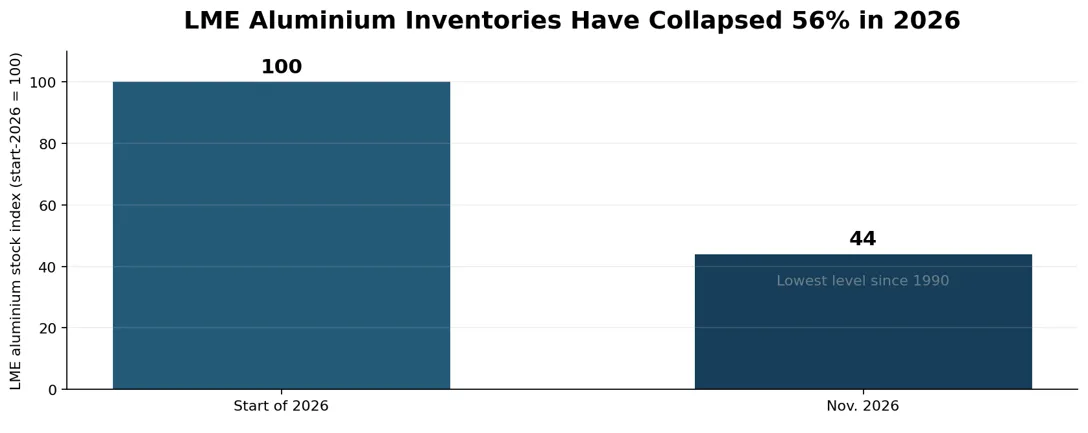
| INVENTORY SHOCK | LME aluminium stocks have fallen 56% in 2026 to their lowest level since 1990, leaving buyers exposed to a much thinner pool of deliverable metal. |
| CONTRACT SQUEEZE | Two entities controlled positions equivalent to at least 60% of readily available LME stocks, while the cash-to-3-month spread briefly reached a record $151/t. |
| EQUIPMENT QUESTION | When prompt metal becomes scarce, where do producers and processors spend first: recycling and remelt, casthouse flexibility, rolling debottlenecks or extrusion capacity? |
The Aluminium Squeeze Has Moved From Price Risk to Physical Availability
The current aluminium dislocation is unusual because the stress is concentrated at the front of the curve. Buyers that can wait months may see a softer forward market, but buyers that need immediately deliverable metal are paying a steep premium. That is the operational problem: fabrication plants, casthouses and rolling operations cannot consume a futures contract. They need metal in the right alloy, format, location and delivery window.
Request Executive Sample: https://www.datamintelligence.com/download-sample/aluminium-equipment-market
By November, LME stocks had fallen 56% from the start of the year and were reported at the lowest level since 1990. Bloomberg separately reported total exchange stocks of about 226,350 tonnes on November 13. A smaller deliverable pool makes every cancelled warrant, regional logistics disruption and large long position more consequential.
The Cash Market Is Signaling an Immediate Delivery Problem
The clearest signal is backwardation. On November 12, spot aluminium traded $151/t above the benchmark three-month contract, the highest cash-to-3-month premium in more than 30 years of available data. Four days later, LME official prices still showed cash aluminium around $3,150/t versus roughly $3,017/t for three-month metal - a premium of about $133/t.
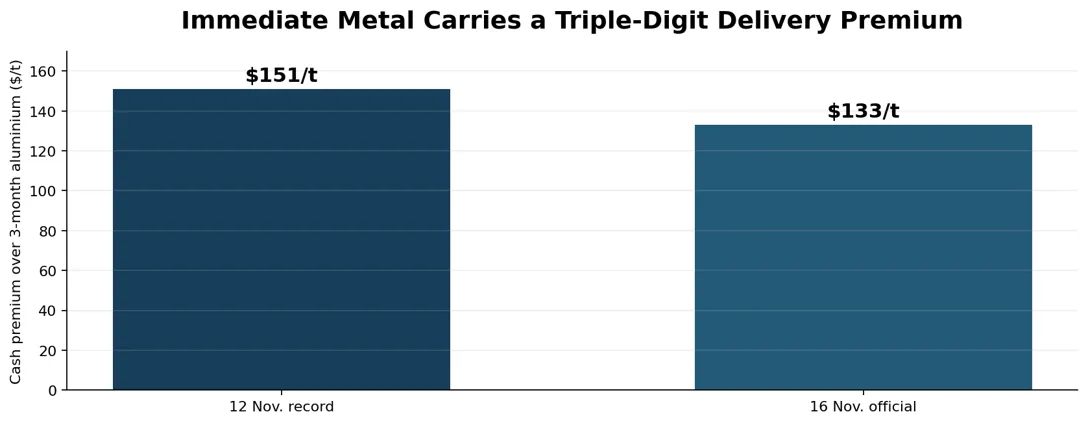
That shape matters for equipment suppliers because a sustained prompt-metal premium changes the economics of internal metal recovery. Scrap sorting, decoating, melting, alloy adjustment and casthouse flexibility become more valuable when replacing primary metal is expensive or uncertain. The equipment decision moves from a sustainability project to a feedstock-security project.
Concentration Makes the Thin Inventory Pool Even More Fragile
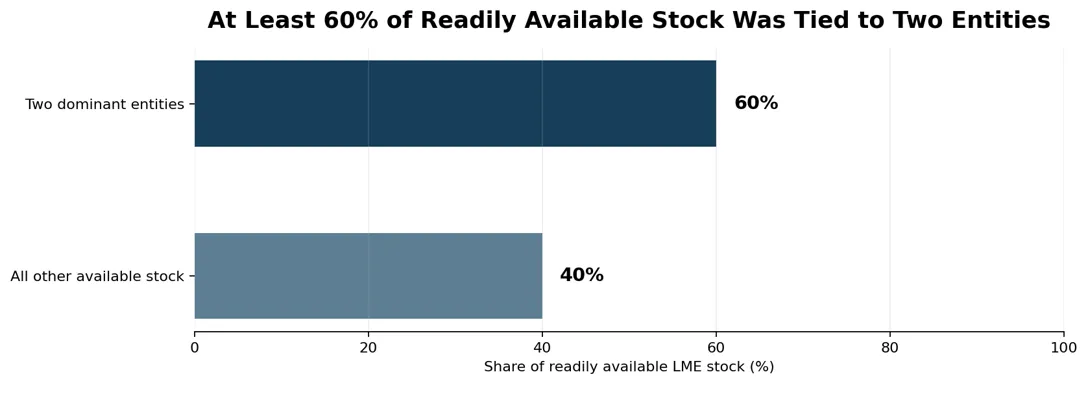
LME position data cited by Bloomberg showed two entities holding accumulated long positions and warrants equivalent to between 60% and 80% of readily available stocks. The chart uses the minimum reported 60%, not a midpoint estimate. This does not mean the exchange is literally “owned” by two traders, but it does mean a thin deliverable pool is unusually sensitive to position management and physical flows.
Why an LME Squeeze Can Pull Forward Aluminium Equipment Spending
The equipment opportunity is not simply “higher aluminium prices = more machines.” The more important change is that processors place a higher value on metal flexibility. Facilities that can consume post-consumer scrap, remelt internal scrap, switch alloy recipes or debottleneck casting and rolling can reduce dependence on a tight prompt market.
| LME SQUEEZE | METAL SECURITY | PROCESS RESPONSE | EQUIPMENT NEED | COMMERCIAL EFFECT |
56% stock decline + record backwardation | Less reliance on prompt primary metal | Recover, remelt, cast and process more internally | Furnaces, sorters, casthouse lines, rolling and extrusion equipment | Higher value on throughput, scrap yield and alloy flexibility |
This is why the squeeze matters to machinery OEMs even if Indonesian primary supply eventually eases the physical market. Equipment investments are being justified on resilience and circularity, not only on the assumption of permanently high LME prices.
The Equipment Response Is Already Visible in 2026 Capex
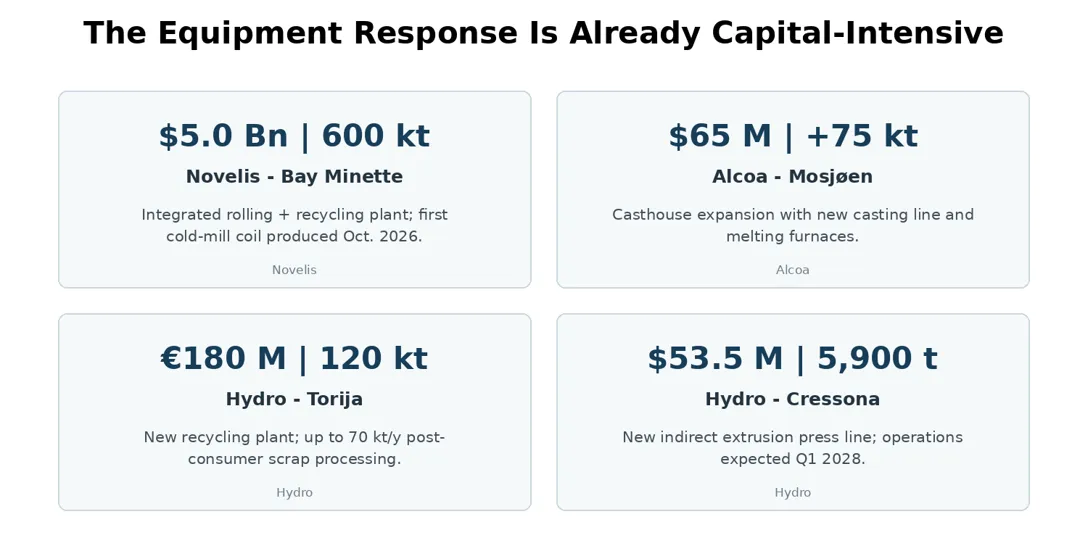
The projects are not identical, but together they show the same direction of travel. Novelis is commissioning one of the largest integrated rolling and recycling investments in decades. Alcoa is adding melting and casting flexibility. Hydro is adding both post-consumer scrap processing and specialized extrusion capacity. These are exactly the equipment categories that become strategically important when primary-metal availability is volatile.
Recycling Equipment Is Becoming the Fastest Route to “New Metal”
Primary smelting capacity is slow, energy intensive and geographically constrained. China reached the policy ceiling of roughly 45 million tonnes of primary aluminium capacity in 2024, according to the IEA. New Indonesian smelting capacity is expected to help the global balance, but it cannot instantly solve regional alloy, logistics and qualification requirements. Recycling and remelt equipment can often address those constraints closer to the customer.
850 kt scrap recycling capacity by end-2025 | 120 kt/y Hydro Torija planned annual production capacity | 85 kt/y Novelis Latchford additional recycling capacity from its upgrade |
Source: Hydro ALUMINIUM; Novelis Latchford, IEA Global Critical Minerals Outlook 2025.
For equipment suppliers, this expands the addressable stack beyond furnaces alone: scrap sorting, LIBS-based alloy separation, shredding, decoating, dross handling, melting, filtration, casting and material-handling systems all become part of a metal-security package.
Five Commercial Signals Aluminium Equipment Suppliers Should Track
| Signal | What it reveals | Likely equipment opportunity | Commercial action |
LME stocks keep falling | Prompt metal remains difficult to source | Remelt, recycling, casting and scrap-processing upgrades | Prioritize processors exposed to spot purchases |
Backwardation stays elevated | Immediate delivery remains valuable | Debottlenecking and throughput equipment | Quantify payback from higher internal recovery |
Long-term metal contracts expand | Processors seek feedstock certainty | Alloy-flexible casthouse and remelt systems | Sell flexibility, not only capacity |
Regional tariffs / trade barriers rise | Imported metal and equipment economics shift | Localized presses, furnaces and rolling upgrades | Map capex by country and duty exposure |
Recycled-content mandates tighten | More post-consumer scrap must enter production | Sorting, decoating, melting and filtration | Target plants with scrap-quality bottleneck |
The 2027 Question Is Not “Will Aluminium Supply Recover?”
Physical supply can recover while the equipment opportunity keeps expanding. Indonesia may add new primary aluminium, LME stocks may rebuild and backwardation may normalize. But processors have now been reminded that exchange liquidity and physical deliverability are not the same thing. The strategic response is to own more flexibility inside the plant.
That changes what buyers need from an Aluminium Equipment market study. A useful report should not stop at total equipment demand. It should identify where primary-metal dependence is highest, which regions are accelerating recycling and remelt capacity, where rolling and extrusion assets are being debottlenecked, which projects are commissioning and which equipment OEMs are positioned to capture the next round of capex.
Request a Customized Report According to Your Business Strategy: https://www.datamintelligence.com/customize/aluminium-equipment-market
What the Aluminium Equipment Report Needs to Answer
CAPEX PIPELINE casthouses, rolling mills and extrusion plants are adding equipment through 2030? | EQUIPMENT MIX Where is spending shifting toward furnaces, scrap sorting, casting lines, rolling mills, presses and automation? |
REGIONAL BOTTLENECKS the highest exposure to prompt-metal scarcity, tariffs, energy costs and import dependence? | SUPPLIER POSITIONING Which equipment OEMs and integrators are winning projects, and where are replacement or retrofit gaps emerging? |
The companies with the best view of that capex map will be able to sell into the squeeze before equipment orders become obvious in headline spending data.
See where aluminium supply risk is turning into recycling, casting, rolling and extrusion equipment demand. | EXPLORE THE ALUMINIUM EQUIPMENT REPORT |