


Wearable EEG Monitors Market Size
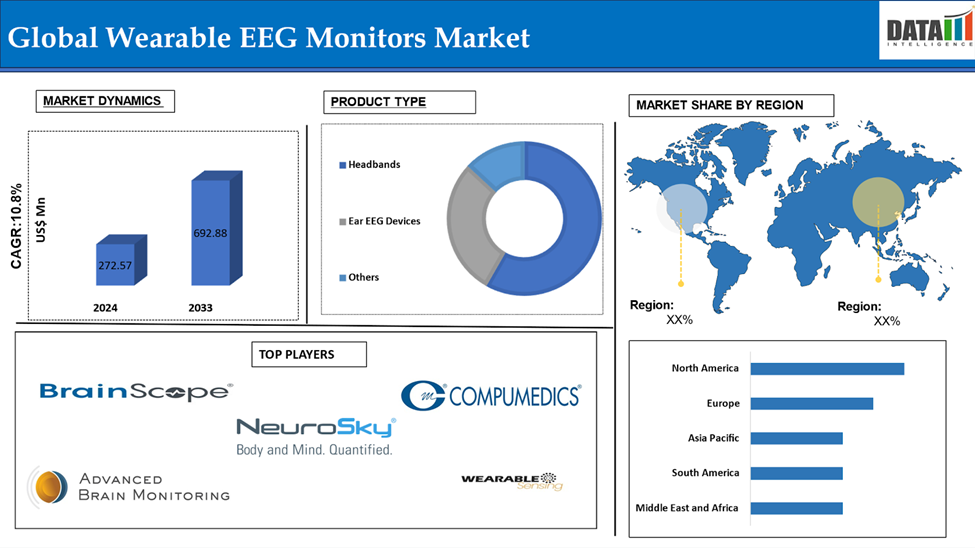
The Global Wearable EEG Monitors Market reached US$302.01 million in 2025and is expected to reach US$845.31 million by 2035, growing at a CAGR of 10.8% during the forecast period 2026-2035, according to DataM intelligence report.
Wearable EEG devices are lightweight, wireless, and comfortable systems that measure and record brain activity through electrodes placed on the scalp. They are used in healthcare for diagnosing neurological disorders, tracking mental states, and monitoring brain activity. They are also popular in research, cognitive studies, mental wellness, and BCI applications, providing real-time data to enhance clinical outcomes and consumer health insights.
Wearable EEG Monitors Market Key Takeaways
- US$302.01 million in 2025, the wearable EEG monitors market is projected to reach US$845.31 million by 2035, expanding at a CAGR of 10.8%.
- Headbands lead the market owing to their portability, comfort, wireless connectivity, and growing use in neurological monitoring and cognitive assessment.
- Hospitals represent the fastest-growing end-user segment as wearable EEG systems support continuous patient monitoring and improved clinical workflows.
- North America accounts for the largest regional share, driven by advanced healthcare infrastructure, digital health adoption, and high neurological disease prevalence.
- Europe is expected to witness the fastest growth, supported by an aging population, increasing Parkinson's disease cases, and greater adoption of home-based monitoring.
- Rising cases of Parkinson's disease, Alzheimer's disease, epilepsy, and stroke continue to strengthen demand for wearable EEG monitoring technologies across healthcare settings.
Wearable EEG Monitors Market Scope
| Metrics | Details |
| Market Size (2025) | US$302.01 Million |
| Forecast Market Size (2035) | US$845.31 Million |
| CAGR | 10.80% |
| Historic Years | 2023-2024 |
| Base Year | 2025 |
| Forecast Period | 2026-2035 |
| Segments Covered | Product Type, Channel, Application, End User, Region |
| Leading Region | North America |
| Fastest Growing Region | Europe |
Wearable EEG Monitors Executive Summary
For more details on this report – Request for Sample
Wearable EEG Monitors Market Dynamics: Drivers & Restraints
Increasing Prevalence of Neurological Disorders
The global wearable EEG monitors market is driven by the increasing prevalence of neurological disorders like epilepsy, Alzheimer's, Parkinson's, and stroke. These conditions require continuous brain activity monitoring for early diagnosis, treatment planning, and disease progression tracking. Wearable EEG devices offer a non-invasive, convenient solution for real-time brain wave monitoring, reducing hospital visits. As aging populations and lifestyle factors increase, demand for advanced EEG monitoring solutions is expected to grow. Additionally, increasing awareness of mental health conditions like depression and anxiety expands the application of wearable EEG devices.
For instance, according to Parkinson’s Foundation, Parkinson's disease affects one million people in the U.S. and is expected to rise to 1.2 million by 2030. The second-most common neurodegenerative disease after Alzheimer's, it affects 90,000 people in the U.S. and over 10 million people worldwide. The disease increases with age, with an estimated 4% diagnosed before age 50. Men are 1.5 times more likely to have Parkinson's disease.
High Costs Associated with Advanced Wearable EEG Devices
The global market for advanced wearable EEG devices faces challenges due to high costs, including high production and retail prices. These devices, which incorporate advanced technologies like wireless applications and AI-based analytics, are expensive and may be out of reach for healthcare institutions and patients in low- and middle-income regions. Home-based EEG monitoring solutions may also be financially out of reach for those requiring long-term neurological monitoring. This financial barrier hinders market expansion.
Wearable EEG Monitors Market Segment Analysis
The global Wearable EEG Monitors market is segmented based on Product Type, Channel, Application, End User, and Region.
Product Type:
headband segment is expected to dominate the Wearable EEG Monitors market share
The headbands segment holds a major portion of the Wearable EEG Monitors market share and is expected to continue to hold a significant portion of the Wearable EEG Monitors market share during the forecast period.
Headbands are a key player in the wearable EEG monitor market, offering a comfortable, user-friendly, and non-invasive method for continuous brain activity monitoring. They are used in neurofeedback, cognitive research, mental wellness tracking, and sleep studies. Their portability and ease of use reduce reliance on traditional EEG systems. The integration of AI and wireless technology enhances their accuracy and real-time data transmission, making them popular in medical and consumer applications.
For instance, in May 2024, Neurotechnology has upgraded its BrainAccess HALO headband, a dry-contact EEG solution, with a 4-channel system and Bluetooth connectivity. The new headband is smaller, lighter, and more mechanically flexible, allowing better adaptation to different head shapes. It also features semi-flexible back electrodes with softer springs.
End User:-
Hospitals segment is the fastest-growing segment in the Wearable EEG Monitors market share
The hospitals segment is the fastest-growing segment in the Wearable EEG Monitors market share and is expected to hold the market share over the forecast period.
Hospitals are a major user of wearable EEG monitors, primarily used for diagnosing and managing neurological disorders like epilepsy, stroke, and brain injuries. These devices offer an efficient, patient-friendly alternative to traditional wired EEG systems, allowing continuous monitoring without restricting patient movement. They are also used in ICUs and emergency settings for rapid brain activity assessment. Wearable EEG solutions facilitate remote patient monitoring, enabling early intervention and improved disease management.
Wearable EEG Monitors Market Geographical Analysis
North America is expected to hold a significant position in the Wearable EEG Monitors market share
North America holds a substantial position in the Wearable EEG Monitors market and is expected to hold most of the market share due to its high prevalence of neurological disorders like epilepsy, Alzheimer's, and Parkinson's. The region benefits from advanced healthcare infrastructure, digital health technologies, and strong neuroscience research. Consumer awareness of mental health and cognitive wellness drives demand for EEG devices, and government support and favorable reimbursement policies further stimulate market growth.
For instance, in January 2025, Emotiv has introduced its next-generation EEG Active Noise-Cancelling Earphones, which integrate advanced EEG technology to provide insights into cognitive performance and overall well-being. The MW20, built on Emotiv's MN8 earphones, offers premium audio and neurotechnology to deliver actionable wellness insights and BCI capabilities in an intuitive form factor. The earphones are made of machined aluminum and sapphire glass, featuring an ergonomic design for optimal fit and precise acoustics.
Europe is growing at the fastest pace in the Wearable EEG Monitors market
Europe holds the fastest pace in the Wearable EEG Monitors market and is expected to hold most of the market share due to rising healthcare costs, rise in the prevalence of neurological disorders, and home-based monitoring. The region emphasizes early diagnosis and preventive healthcare, encouraging the use of wearable EEG devices. Technological advancements, research initiatives, and collaborations between academic institutions and medical device companies contribute to market expansion. Awareness of neurofeedback therapy and supportive regulatory frameworks further fuel this growth.
For instance, Parkinson's is the fastest-growing neurological condition globally, with 153,000 people living with it in the UK. By 2030, the number is expected to rise to 172,000 due to population growth and ageing. Every hour, 2 more people are diagnosed, equivalent to 18,000 people annually.
Hence, the increasing prevalence of Parkinson's and other neurodegenerative disorders is driving the demand for advanced neurological monitoring solutions, such as wearable EEG monitors. These devices enable real-time brain activity tracking, early detection of abnormalities, and remote patient monitoring, enhancing Parkinson's management and treatment.
Wearable EEG Monitors Key Players
The major global players in the Wearable EEG Monitors market include BrainScope Company, Inc, NeuroSky, Compumedics Limited, Emotiv, Advanced Brain Monitoring, Wearable Sensing, Interaxon Inc, Cognionics, Inc, Mitsar Co. Ltd., BitBrain Technologies sand among others.
Wearable EEG Monitors Market Key Developments
June 2026: Philips expanded its wearable neurodiagnostics portfolio by introducing AI-enabled wearable EEG monitoring solutions that provide continuous brain activity tracking, supporting early neurological disorder detection and remote patient monitoring.
May 2026: Nihon Kohden strengthened its EEG monitoring portfolio by enhancing wearable electroencephalography systems with wireless connectivity and cloud-based data management, enabling real-time neurological assessment and improved clinical workflows.
April 2026: EMOTIV advanced its wearable EEG platform by expanding AI-powered brain signal analysis and mobile neurotechnology capabilities, supporting applications in neurological research, cognitive assessment, and mental wellness monitoring.
March 2026: Ceribell enhanced its rapid EEG monitoring solutions by integrating advanced wearable technologies with AI-driven seizure detection algorithms, enabling faster diagnosis and continuous neurological monitoring in hospital settings.
February 2026: Neuroelectrics expanded its wearable EEG device portfolio by advancing wireless brain monitoring and neurostimulation technologies, supporting personalized neurological care, remote monitoring, and clinical research applications.
Why Purchase the Report?
- Pipeline & Innovations: Reviews ongoing clinical trials, product pipelines, and forecasts upcoming advancements in medical devices and pharmaceuticals.
- Product Performance & Market Positioning: Analyzes product performance, market positioning, and growth potential to optimize strategies.
- Real-World Evidence: Integrates patient feedback and data into product development for improved outcomes.
- Physician Preferences & Health System Impact: Examines healthcare provider behaviors and the impact of health system mergers on adoption strategies.
- Market Updates & Industry Changes: Covers recent regulatory changes, new policies, and emerging technologies.
- Competitive Strategies: Analyzes competitor strategies, market share, and emerging players.
- Pricing & Market Access: Reviews pricing models, reimbursement trends, and market access strategies.
- Market Entry & Expansion: Identifies optimal strategies for entering new markets and partnerships.
- Regional Growth & Investment: Highlights high-growth regions and investment opportunities.
- Supply Chain Optimization: Assesses supply chain risks and distribution strategies for efficient product delivery.
- Sustainability & Regulatory Impact: Focuses on eco-friendly practices and evolving regulations in healthcare.
- Post-market Surveillance: Uses post-market data to enhance product safety and access.
- Pharmacoeconomics & Value-Based Pricing: Analyzes the shift to value-based pricing and data-driven decision-making in R&D.
Market Impact Analysis
The transition toward remote healthcare delivery and digital neurology is reshaping neurological monitoring practices worldwide. Wearable EEG systems improve patient accessibility, enable long-term neurological observation, reduce hospital dependence, and support earlier clinical intervention.
Continued advancements in artificial intelligence, wireless communication, and brain-computer interface technologies are expected to further improve diagnostic efficiency while expanding commercial applications beyond traditional healthcare environments.
Report Benefits
The report supports strategic decision-making by providing detailed analysis of market size, competitive positioning, technological innovation, product pipelines, pricing considerations, reimbursement trends, regulatory developments, and regional investment opportunities.
It also evaluates product performance, physician adoption, healthcare system trends, supply chain considerations, commercialization strategies, and market entry opportunities to help manufacturers, investors, suppliers, and healthcare organizations make informed business decisions.
Target Audience
The report is designed for:
- Medical device manufacturers
- Pharmaceutical and biotechnology companies
- Hospitals and healthcare providers
- Research institutions
- Contract manufacturers
- Healthcare investors and venture capital firms
- Regulatory and compliance professionals
- AI and digital health technology providers
- Clinical trial managers
- Healthcare consultants
- Distribution and supply chain managers
- Academic institutions
- Patient advocacy organizations
- Insurance providers
- Strategy, procurement, and business development teams
Conclusion
The wearable EEG monitors market is positioned for sustained expansion as healthcare systems increasingly prioritize continuous neurological monitoring, remote patient care, and digital diagnostic technologies. Rising neurological disease prevalence, growing investment in connected healthcare, and ongoing innovation in AI-enabled wearable neurotechnology continue to strengthen long-term commercial potential.
While device affordability remains an important consideration, manufacturers capable of delivering clinically validated, user-friendly, and cost-effective wearable EEG solutions are likely to strengthen their competitive position through 2035. Organizations monitoring developments in neurotechnology, brain-computer interfaces, and digital healthcare should closely follow this market as it continues to expand across both clinical and consumer applications.



























































