


Alzheimer’s Disease Therapeutics Size & Growth
The global alzheimer’s disease therapeutics market size reached US$ 5.38 billion in 2025 and is expected to reach US$ 17.98 billion by 2033, growing at a CAGR of 14.32 % during the forecast period 2026-2033.
The global Alzheimer’s disease therapeutics market is witnessing a structural transition from symptomatic management toward disease-modifying treatments, driven by advancements in neurobiology, biomarker-based diagnostics, and monoclonal antibody development. Traditionally dominated by cholinesterase inhibitors and NMDA receptor antagonists, the market is now evolving with the introduction of anti-amyloid therapies targeting underlying disease pathology. Growing aging populations, particularly in North America, Europe, and parts of Asia-Pacific, continue to increase the patient pool, thereby sustaining long-term demand for therapeutic interventions. Additionally, improved diagnostic capabilities, including PET imaging and cerebrospinal fluid biomarkers, are enabling earlier detection and expanding the addressable treatment population. Pharmaceutical companies are intensifying R&D investments, with a strong pipeline focused on amyloid, tau, and neuroinflammation pathways. However, factors such as high treatment costs, safety concerns, and reimbursement challenges may influence adoption rates. Overall, the market is poised for significant growth, supported by innovation, regulatory momentum, and increasing clinical awareness.
For more details on this report – Request for Sample
Alzheimer’s Disease Therapeutics Dynamics
Rising Prevalence of Alzheimer's Disease
The growing prevalence of Alzheimer’s disease is poised to be a major driver of the healthcare market in the coming years. With aging populations, the number of Alzheimer’s cases is rising rapidly, creating an urgent demand for improved diagnostic tools, effective treatments, and comprehensive care solutions. Alzheimer’s affects approximately 50-60% of people suffering from dementia.
For instance, according to CSIR-NIScPR, Alzheimer's disease presents a significant global health burden in 2023, with the latest estimates indicating that more than 57.4 million people are currently affected by the condition. The Global Burden of Disease Study (GBDS) 2019 predicts that between 2019 and 2050, the number of dementia cases will increase by a staggering 166%, impacting approximately 152.8 million individuals. These projections align closely with those made by the World Health Organization (WHO), highlighting the growing prevalence of the disease and its substantial impact on global healthcare systems.
According to the Alzheimer’s Disease International Organization estimated that, the number of individuals with dementia will reach about 78 million in 2030 and 139 million in 2050. With the increasing dementia, the individuals with alzheimer’s is expected to grow, increasing the demand for alzheimer’s therapeutics and further driving the market growth.
This trend is prompting increased investment from pharmaceutical companies, healthcare providers, and biotech firms focused on developing innovative therapies and early detection methods. At the same time, governments and private organizations are boosting funding for public awareness, caregiver support, and long-term care infrastructure.
As a result, the Alzheimer’s care ecosystem is expanding, presenting both a pressing public health challenge and a significant opportunity for growth across multiple sectors of the healthcare industry.
Regulatory and Approval Challenges
Regulatory and approval challenges pose a significant barrier to the growth of the Alzheimer’s disease therapeutics market. Developing drugs for Alzheimer’s is particularly complex due to the disease’s slow and variable progression, which makes it difficult to demonstrate clear clinical benefits in trials. Regulatory bodies such as the FDA and EMA require extensive data to prove not only safety but also long-term efficacy, often through large, multi-year Phase III studies. These requirements significantly extend development timelines and increase costs, while offering no guarantee of approval.
Key Takeaways
- The increasing shift toward disease-modifying Alzheimer’s therapies is emerging as a key industry trend, with pharmaceutical companies advancing anti-amyloid, anti-tau, and other targeted approaches designed to slow disease progression rather than solely manage cognitive symptoms.
- North America maintains a dominant position in the global Alzheimer’s disease therapeutics market, supported by a high prevalence of Alzheimer’s disease, advanced healthcare infrastructure, substantial research and development investments, favorable reimbursement conditions, and the presence of leading pharmaceutical companies.
- The cholinesterase inhibitors segment continues to hold the largest market position, supported by the established clinical use, affordability, and broad application of therapies such as donepezil, rivastigmine, and galantamine, particularly for patients with mild to moderate Alzheimer’s disease.
- The rising prevalence of Alzheimer’s disease and the rapid aging of populations worldwide are becoming major factors driving demand for effective therapeutic interventions, while improvements in diagnosis and biomarker-based assessment are helping identify patients at earlier stages of the disease.
- The expansion of disease-modifying treatments is creating new opportunities across the Alzheimer’s therapeutics landscape, with therapies such as LEQEMBI and KISUNLA highlighting the growing commercial focus on amyloid-targeting treatments for patients with early symptomatic Alzheimer’s disease.
- Pharmaceutical and biotechnology companies are increasingly strengthening their Alzheimer’s pipelines through clinical development, licensing agreements, strategic collaborations, and research into amyloid, tau, neuroinflammation, metabolic pathways, and neuroprotection.
- Advances in blood-based biomarkers, PET imaging, cerebrospinal fluid biomarkers, and precision treatment selection are creating significant opportunities for earlier diagnosis and more targeted therapeutic intervention, while high treatment costs, safety considerations, reimbursement challenges, and complex regulatory requirements remain important market constraints.
Alzheimer’s Disease Therapeutics Pipeline Analysis
Top phase III pipeline products for Alzheimer’s disease:
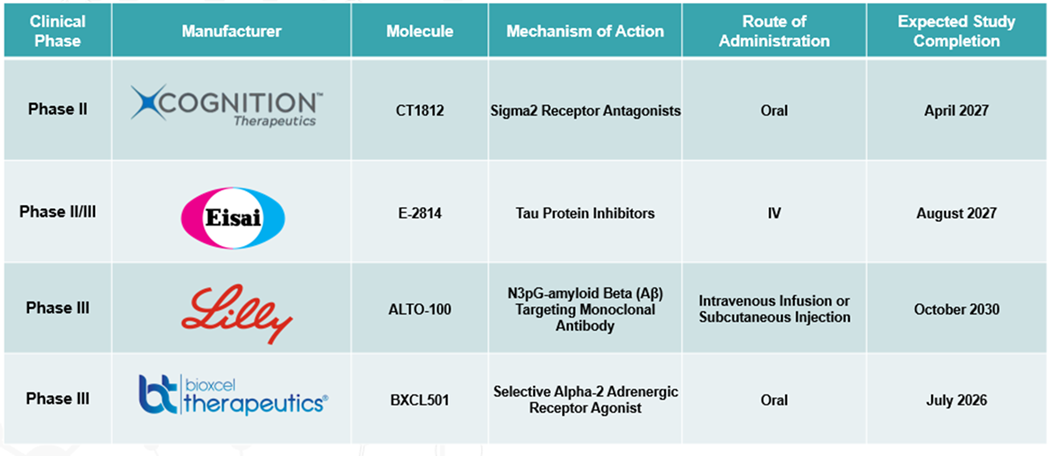
Alzheimer’s Disease Therapeutics Segmentation Analysis
The global alzheimer’s disease therapeutics market is segmented based on stage, drug class, and region.
Drug Class:
The cholinesterase inhibitors segment is expected to dominate the alzheimer’s disease therapeutics market with the highest market share
The cholinesterase inhibitors segment is expected to remain dominant in the alzheimer’s disease therapeutics market due to their established efficacy, affordability, and broad clinical application. Drugs like donepezil, rivastigmine, and galantamine work by inhibiting the breakdown of acetylcholine, a neurotransmitter crucial for memory and cognitive function. This mechanism helps alleviate symptoms, particularly in patients with mild to moderate Alzheimer’s, offering modest improvements in cognitive abilities.
The rising global prevalence of Alzheimer’s disease, which is expected to affect over 150 million people by 2050, further strengthens the demand for these therapies.
Additionally, ongoing clinical trials aim to assess its efficacy and safety across various patient populations, ensuring continued innovation within this drug class. The approval of new formulations that reduce gastrointestinal side effects also enhances the market's appeal. As the global prevalence of Alzheimer’s increases, the continued research, effectiveness, and cost-effectiveness of cholinesterase inhibitors will solidify their dominant position in the market.
Alzheimer’s Disease Therapeutics Geographical Analysis
North America is expected to hold a significant position in the global alzheimer’s disease therapeutics market
North America is expected to maintain a dominant position in the global Alzheimer’s disease therapeutics market, driven by several key factors. The growth is supported by a high prevalence of Alzheimer’s, significant investments in research and development. For instance, according to the Alzheimer's Association, an estimated 7.2 million Americans aged 65 and older are living with Alzheimer's disease in 2025, with 74% of them being 75 years or older. By 2050, this number is expected to nearly double, reaching close to 13 million. Approximately 1 in 9 individuals aged 65 and older will be affected by Alzheimer's. Furthermore, the health and long-term care costs for people living with dementia are projected to reach $384 billion in 2025 and nearly $1 trillion by 2050.
The presence of major pharmaceutical companies, favorable reimbursement policies, and strong government support for Alzheimer’s research further bolsters the region's market growth. North America continues to lead in Alzheimer's treatment developments. For instance, in July 2024, Eli Lilly and Company announced that the U.S. Food and Drug Administration had approved Kisunla (donanemab-azbt). This once-monthly injection for early symptomatic Alzheimer's, including mild cognitive impairment (MCI) and mild dementia with confirmed amyloid pathology, is the first amyloid plaque-targeting therapy with evidence supporting stopping treatment after plaque removal.
This breakthrough therapy not only offers potential clinical benefits but also promises lower treatment costs and fewer infusions, further solidifying North America's dominant position in the Alzheimer's therapeutics market. Additionally, advancements in treatment options contribute to North America's market leadership.
Alzheimer’s Disease Therapeutics Top Companies
Top companies in the alzheimer’s disease therapeutics market include Eli Lilly and Company, Eisai Co., Ltd., Biogen Inc., F. Hoffmann-La Roche Ltd., Johnson & Johnson, Novo Nordisk A/S, AbbVie Inc., TauRx Pharmaceuticals Ltd., Alzheon, Inc., Annovis Bio, Inc. among others.
Key Developments in the Alzheimer’s Disease Therapeutics Market
August 2026: Eisai and Biogen made LEQEMBI IQLIK® (lecanemab-irmb) available in the U.S. as a once-weekly subcutaneous autoinjector for initiation therapy in early Alzheimer’s disease. The development introduces an at-home treatment option from the start of therapy, providing an alternative to intravenous administration and advancing patient-friendly anti-amyloid treatment delivery.
- August 2026: Roche received FDA clearance for its Elecsys® pTau217 plasma blood test to support the assessment of amyloid pathology associated with Alzheimer’s disease. The single-biomarker diagnostic technology enables both rule-in and rule-out assessment and could help expand access to earlier identification of eligible patients for Alzheimer’s therapies.
- July 2026: Biogen presented positive Phase 2 CELIA data for diranersen at AAIC 2026, demonstrating clinical outcomes and robust reductions in tau biomarkers in early Alzheimer’s disease. The study positioned diranersen as a notable tau-targeting R&D candidate, with reductions in both cerebrospinal fluid tau and brain tau pathology measured through PET imaging.
- July 2026: Eisai and Biogen presented clinical data supporting LEQEMBI’s subcutaneous autoinjector formulation as having comparable efficacy and safety to intravenous administration in early Alzheimer’s disease. The technological advancement supports a potential treatment pathway using subcutaneous dosing for both initiation and maintenance, improving administration convenience for patients and caregivers.
- May 2026: Roche received CE Mark for Elecsys® pTau217, a blood-based test developed in collaboration with Eli Lilly to detect Alzheimer’s-related amyloid pathology. The minimally invasive diagnostic innovation is designed to provide a more accessible alternative to established biomarker assessment approaches and support earlier patient identification.
Alzheimer’s Disease Therapeutics Market Scope
| Metrics | Details | |
| CAGR | 14.32 % | |
| Market Size Available for Years | 2022-2033 | |
| Estimation Forecast Period | 2025-2033 | |
| Revenue Units | Value (US$ Bn) | |
| Segments Covered | Stage | Early-stage Alzheimer's (Mild), Middle-stage Alzheimer's (Moderate), Late-stage Alzheimer's (Severe) |
| Drug Class | Cholinesterase Inhibitors, NMDA Receptor Antagonists, Combination Drugs, Immunotherapy | |
| Regions Covered | North America, Europe, Asia-Pacific, South America, and the Middle East & Africa | |
Why Choose DataM?
Technological Innovations: Explores advancements in Alzheimer’s disease therapeutics, including anti-amyloid monoclonal antibodies, anti-tau therapeutic approaches, disease-modifying treatments, neuroinflammation-targeted therapies, precision medicine strategies, and biomarker-guided treatment approaches, supporting earlier diagnosis, improved patient stratification, and the development of therapies designed to address underlying disease mechanisms.
Product Performance & Market Positioning: Evaluates Alzheimer’s disease therapies based on critical parameters such as clinical efficacy, impact on cognitive and functional decline, safety profile, treatment eligibility, route and frequency of administration, biomarker requirements, monitoring needs, and accessibility, highlighting how pharmaceutical companies differentiate through disease-modifying potential, clinical evidence, and patient-focused treatment strategies.
Real-World Evidence: Highlights the growing importance of real-world evidence and post-marketing data in evaluating the long-term safety, effectiveness, treatment adherence, healthcare utilization, and patient outcomes associated with Alzheimer’s disease therapeutics, particularly as newer disease-modifying therapies move into broader clinical practice.
Market Updates & Industry Changes: Tracks key developments including clinical trial progress, regulatory approvals and label updates, expansion of Alzheimer’s diagnostic and biomarker capabilities, advancements in amyloid and tau research, pipeline developments, strategic collaborations, and evolving reimbursement and healthcare infrastructure across major markets, particularly in North America, Europe, and Asia-Pacific.
Competitive Strategies: Analyzes how pharmaceutical and biotechnology companies strengthen their market position through clinical research and development, expansion of late-stage pipelines, strategic collaborations, licensing agreements, biomarker and diagnostic partnerships, lifecycle management strategies, and investments in next-generation disease-modifying therapies targeting different stages and biological pathways of Alzheimer’s disease.
Pricing & Market Access: Examines pricing and market access considerations based on treatment type, administration requirements, diagnostic testing, patient monitoring, healthcare infrastructure, reimbursement policies, and regulatory requirements, along with the role of hospitals, specialty clinics, neurologists, infusion centers, and integrated healthcare systems in supporting patient access to Alzheimer’s disease therapeutics.
Market Entry & Expansion: Identifies growth opportunities driven by the increasing global burden of Alzheimer’s disease, aging populations, improved disease awareness, advances in early diagnosis and biomarker testing, expanding research into disease-modifying therapies, and growing investment in neuroscience and neurodegenerative disease research, while outlining strategies such as clinical differentiation, geographic expansion, strategic partnerships, and improved patient access pathways.
The global alzheimer’s disease therapeutics market report delivers a detailed analysis with 57 key tables, more than 46 visually impactful figures, and 168 pages of expert insights, providing a complete view of the market landscape.
Target Audience
- Pharmaceutical & Biotechnology Companies
- Neuroscience Drug Developers
- Alzheimer’s Disease Therapeutics Manufacturers
- Clinical Research Organizations (CROs)
- Hospitals & Specialty Neurology Centers
- Neurologists, Geriatricians & Healthcare Professionals
- Diagnostic & Biomarker Testing Companies
- Investors, Venture Capital Firms & Private Equity Companies



























































