


Wearable Heart Monitoring Devices Market Size - Industry Trends & Outlook
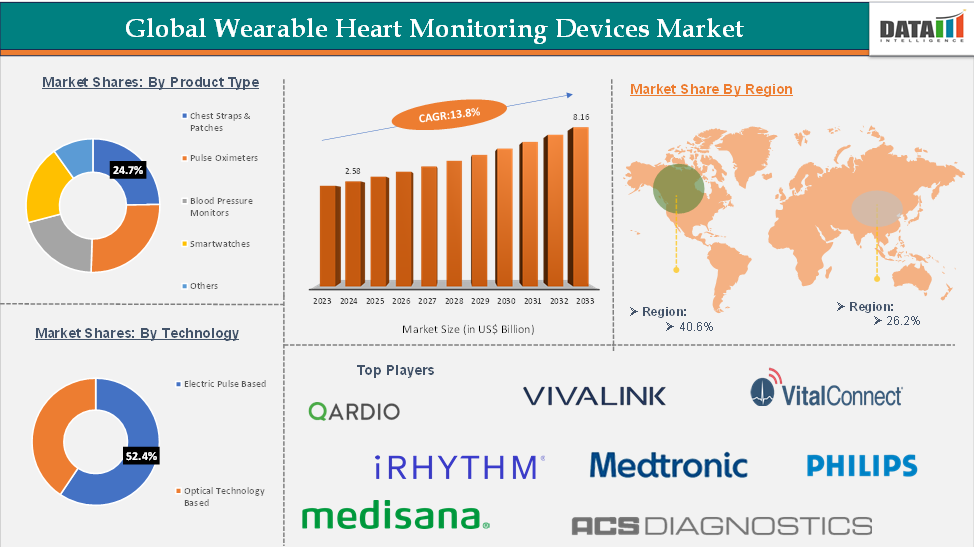
The wearable heart monitoring devices market size reached US$ 2.94 billion in 2025 and is expected to reach US$ 10.66 billion by 2035, growing at a CAGR of 13.8% during the forecast period 2026-2035.
Wearable heart monitor devices are popular tools for tracking heart rate and pulse rate, offering personal use convenience and wireless connectivity to smartphones and computers for easy data access. These devices are available in various forms, including chest straps, wristbands, rings, and smartwatches. Their accuracy depends on the type of detection and user activity while wearing them.
The global wearable heart monitoring devices market is experiencing robust growth, driven by rising incidences of cardiovascular diseases, increasing health awareness, and the growing adoption of advanced wearable technologies. The integration of AI and IoT in healthcare wearables, coupled with the demand for real-time patient monitoring, presents significant growth opportunities, especially in remote patient management and fitness tracking applications.
Moreover, the shift toward preventive healthcare and the rising geriatric population further fuel market expansion. North America currently dominates the market due to its advanced healthcare infrastructure, high consumer awareness, and early adoption of innovative health technologies, while Asia-Pacific is emerging as a key growth region owing to its large population base and increasing healthcare investments.
Wearable Heart Monitoring Devices Market Key Takeaways
- The wearable heart monitoring devices market is estimated at US$ 2.94 billion in 2025 and is forecast to exceed US$ 10.66 billion by 2035, reflecting sustained demand for connected cardiovascular monitoring solutions.
- North America maintains market leadership with an expected 41.8% regional share, supported by strong healthcare infrastructure, regulatory approvals, and early technology adoption.
- Chest straps and patches continue to represent the largest product opportunity, accounting for 39.3% of the market in 2024 and projected to reach 44.2% market share during the forecast period.
- AI-powered cardiac analytics and IoT-enabled remote monitoring platforms are enhancing the clinical value of wearable heart-monitoring devices for hospitals and homecare providers.
- The expansion of remote patient monitoring programs and the increasing consumer adoption of smart health wearables are creating new revenue opportunities for device manufacturers and digital health companies.
- Data privacy regulations and cybersecurity requirements remain important considerations for vendors seeking wider healthcare adoption.
Wearable Heart Monitoring Devices Market Scope
| Metrics | Details |
| Market Size (2025) | US$ 2.94 Billion |
| Market Size (2035) | US$ 10.66 Billion |
| CAGR (2026-2035) | 13.80% |
| Historic Years | 2023-2024 |
| Base Year | 2025 |
| Forecast Period | 2026-2035 |
| Segments Covered | Product Type, Technology, Application, End User, Region |
| Leading Region | North America |
| Fastest Growing Region | Asia-Pacific |
Executive Summary
For more details on this report – Request for Sample
Wearable Heart Monitoring Devices Market Dynamics: Drivers & Restraints
A rise in technological advancements is expected to drive the wearable heart monitoring devices market
Technological advancements have played a significant role in the development of wearable heart rate monitor devices, enhancing their functionality, accuracy, and usability. These advancements include the integration of various sensors, such as electrocardiogram (ECG) sensors, photoplethysmography (PPG) sensors and accelerometers, which provide real-time data on heart rate, blood oxygenation levels, blood pressure and physical activity.
For instance, in April 2025, LifeSignals, Inc. unveiled its latest innovation at Heart Rhythm 2025 in San Diego. Launched in partnership with UltraLinQ Healthcare Solutions, this new Holter solution streamlines cardiac monitoring by significantly reducing diagnostic report turnaround times and eliminating the need to mail or retrieve the biosensor device, offering a faster and more efficient workflow for healthcare providers.
The high cost of hospital beds is expected to hinder the wearable heart monitoring devices market
Personal health data breaches pose significant challenges to both healthcare providers and clients, undermining trust and potentially exposing sensitive patient information to misuse. In the context of wearable heart monitoring devices, data security and privacy concerns are expected to hinder market growth. These devices continuously collect and transmit personal health metrics, making them vulnerable to cyberattacks and unauthorized access.
Regulatory compliance with data protection laws such as HIPAA and GDPR further increases the complexity and cost of deploying these technologies. As a result, concerns over data integrity, potential misuse, and lack of transparency in how health data is stored and shared may discourage both consumers and healthcare institutions from adopting wearable heart monitoring solutions at scale.
Wearable Heart Monitoring Devices Market Segment Analysis
The global wearable heart monitoring devices market is segmented based on product type, technology, application, end user, and region.
Product Type:
The chest straps & patches segment is expected to hold 44.2% of the global wearable heart monitoring devices market
The chest straps & patches from the product type segment accounted for approximately 39.3%. Wearable devices for ECG monitoring include patches, clothing-based monitors, chest straps, upper arm bands, devices that one can touch with fingers from different arms, and wristbands. Patches are popular for long-term ambulatory monitoring.
Several recent solutions include patches on the left side of the chest that can be monitored for several weeks (e.g., Vital Connect Patch). Others include a small device attached to a strip or two electrodes on the chest (e.g., Body Guardian Heart). Devices often measure temperature and impedance and have accelerometers to detect motion.
For instance, in December 2023, Neuranics launched a magnetic sensor development kit for monitoring the magnetic activity of the heart. The company designed the kit to record heart activity and wirelessly transfer recordings over Bluetooth. It provides live, 24/7 recording and analysis straight to a smartphone, tablet, or laptop.
Wearable Heart Monitoring Devices Market Geographical Analysis
North America is expected to hold 41.8% of the global wearable heart monitoring devices market
North America is expected to hold a significant portion of the global wearable heart monitoring devices market. Significant factors like rising incidences of CVDs, FDA approvals, novel product launches by key players, and the presence of major market players and their strategic initiatives are expected to drive the region’s market growth.
For instance, in July 2023, Biostrap USA introduced the new wearable Biostrap Kairos device for stress resilience measurement and insights into heart rate variability (HRV). Biostrap offers a data visualisation of the autonomic nervous system, accompanied by the innovative Vital Science app, for quantifying the sympathetic and parasympathetic branches from a wrist-worn device. The device features a modular design, which enables it to be easily positioned on the forearm or bicep.
Wearable Heart Monitoring Devices Market Top Companies
The top companies in the wearable heart monitoring devices market include Medtronic, Qardio Inc, VitalConnect, ACS Diagnostics, medisana GmbH, iRhythm Inc., Koninklijke Philips N.V., VivaLNK, Inc., Abbott, SmartCardia Inc., among others.
Wearable Heart Monitoring Devices Market Key Developments
June 2026: Philips expanded its wearable cardiovascular monitoring portfolio by introducing next-generation AI-enabled ECG patches and smart wearable solutions capable of continuous heart rhythm monitoring, supporting the early detection of atrial fibrillation and improving remote cardiac care.
May 2026: Medtronic strengthened its connected cardiac monitoring ecosystem by enhancing wearable heart monitoring technologies with cloud-based analytics and AI-driven diagnostics, enabling real-time patient monitoring and personalized cardiovascular disease management.
April 2026: iRhythm Technologies advanced its wearable ECG monitoring platform by expanding AI-powered cardiac rhythm analysis capabilities, improving the accuracy of arrhythmia detection and enabling faster clinical decision-making for long-term cardiac monitoring.
March 2026: VitalConnect enhanced its wearable biosensor platform with advanced continuous ECG and vital sign monitoring features, supporting remote monitoring of patients with cardiovascular conditions across hospitals, ambulatory care, and home healthcare settings.
February 2026: Biofourmis expanded its AI-driven wearable health monitoring solutions by integrating advanced cardiovascular analytics into its remote patient monitoring platform, enabling earlier detection of cardiac deterioration and improving clinical outcomes through continuous heart monitoring.
Market Impact Assessment
The growing adoption of AI-enabled wearable monitoring devices is reshaping cardiovascular care by enabling continuous patient observation outside hospital environments. At the same time, increasingly stringent cybersecurity and healthcare privacy regulations are influencing product development strategies, encouraging manufacturers to prioritize secure cloud connectivity, encrypted data transmission, and regulatory compliance throughout the device lifecycle.
How This Report Supports Business Decisions
This report provides valuable intelligence for:
- Medical device manufacturers evaluating product development strategies.
- Investors assessing high-growth opportunities within connected healthcare.
- Healthcare providers implementing remote patient monitoring programs.
- Technology companies developing AI-enabled healthcare platforms.
- Procurement teams comparing wearable cardiac monitoring solutions.
- Strategy teams monitoring competitive positioning and regional expansion opportunities.
Target Audience
- Medical Device Manufacturers
- Cardiovascular Care Providers
- Hospitals and Health Systems
- Cardiac Centers
- Home Healthcare Providers
- Digital Health Companies
- AI Healthcare Technology Providers
- Healthcare Investors
- Medical Device Distributors
- Procurement and Supply Chain Managers
- Healthcare Strategy Consultants
- Government Healthcare Organizations
Conclusion
The wearable heart monitoring devices market presents a compelling long-term opportunity as healthcare increasingly transitions toward continuous, connected, and preventive cardiac care. Rising cardiovascular disease prevalence, broader adoption of remote patient monitoring, and sustained advances in AI-enabled wearable technologies are expected to support market expansion through 2035. Companies capable of delivering clinically accurate, secure, and interoperable monitoring platforms will be well positioned to benefit from evolving healthcare delivery models. As hospitals, providers, and consumers continue prioritizing proactive heart health management, wearable cardiac monitoring solutions are expected to become an increasingly important component of modern healthcare infrastructure.
The global wearable heart monitoring devices market report delivers a detailed analysis with 57 key tables, more than 46 visually impactful figures, and 168 pages of expert insights, providing a complete view of the market landscape.



























































