


Tyrosine Kinase Inhibitors Market Size and Trends
The global tyrosine kinase inhibitors market reached US$ 57.77 billion in 2025 and is expected to reach US$ 107.42 billion by 2035, growing at a CAGR of 6.4% during the forecast period 2026–2035. The global tyrosine kinase inhibitors (TKIs) market is witnessing strong growth, driven by the rising incidence of cancer, expanding applications of targeted therapies, and continuous advancements in oncology research. The increasing prevalence of cancers such as lung, breast, leukemia, and gastrointestinal stromal tumors has accelerated the adoption of TKIs due to their high specificity and ability to block aberrant signaling pathways involved in tumor growth and proliferation. Moreover, growing emphasis on personalized medicine, along with the development of next-generation TKIs with improved efficacy and reduced toxicity, is further propelling market expansion. Continuous R&D efforts, favorable regulatory approvals, and the emergence of novel combination therapies are also enhancing clinical outcomes and driving sustained market growth globally.
Tyrosine Kinase Inhibitors Market Key Takeaways
- North America leads the tyrosine kinase inhibitors (TKIs) market, accounting for approximately 41.3% of global revenue. The region’s leadership is supported by its advanced oncology infrastructure, high adoption of targeted cancer therapies, and strong presence of key pharmaceutical companies actively engaged in TKI research and commercialization. Robust clinical trial activity and favorable reimbursement frameworks further contribute to regional market dominance.
- Asia–Pacific represents the fastest-growing market for TKIs, holding around 20.3% of the global share. The region’s rapid expansion is driven by a rising cancer burden, increasing healthcare expenditure, and accelerated approval of innovative targeted therapies in countries such as China, Japan, and India. Growing investments in precision oncology and enhanced access to advanced treatment modalities are further supporting market growth.
- BCR-ABL Tyrosine Kinase Inhibitors dominate the global market, contributing approximately 26.4% of total revenue. Their strong market position is attributed to their proven efficacy in treating chronic myeloid leukemia (CML) and acute lymphoblastic leukemia (ALL), widespread clinical adoption, and the availability of multiple generations of inhibitors that address resistance mechanisms and improve patient survival outcomes.
Tyrosine Kinase Inhibitors Market Dynamics: Drivers & Restraints
Driver: Rising Prevalence of Neurological Disorders
The rising global incidence of cancer and the expanding adoption of targeted therapies are major forces driving the growth of the Tyrosine Kinase Inhibitors (TKIs) market. According to the World Health Organization (WHO), cancer cases are projected to exceed 30 million annually by 2040, with lung, breast, leukemia, and gastrointestinal cancers among the most prevalent. Many of these malignancies are effectively treated using TKIs that specifically block abnormal kinase signaling pathways responsible for tumor proliferation. For instance, Imatinib (Gleevec) revolutionized the treatment of chronic myeloid leukemia (CML) by targeting the BCR-ABL fusion protein, setting a precedent for molecularly targeted oncology. Similarly, Erlotinib (Tarceva) and Osimertinib (Tagrisso) have significantly improved outcomes in EGFR-mutated non-small cell lung cancer (NSCLC), while Sunitinib (Sutent) and Sorafenib (Nexavar) are widely used for renal cell carcinoma and hepatocellular carcinoma.
As oncologists increasingly prioritize precision and personalized medicine, TKIs have become a cornerstone of cancer therapy due to their high efficacy and reduced toxicity compared to conventional chemotherapy. The growing use of genomic profiling and companion diagnostics to identify actionable mutations has further expanded the eligible patient pool.
Restraint: Development of Drug Resistance
The development of drug resistance is a significant factor expected to hamper the growth of the Tyrosine Kinase Inhibitors (TKIs) market. While TKIs have transformed the treatment of cancers such as chronic myeloid leukemia (CML), non-small cell lung cancer (NSCLC), and gastrointestinal stromal tumors (GISTs), long-term use often leads to the emergence of resistance mutations that reduce drug efficacy.
For more details on this report, Request for Sample
Tyrosine Kinase Inhibitors Market Segmentation Analysis
The global tyrosine kinase inhibitors market is segmented by type, application, distribution channel and region.
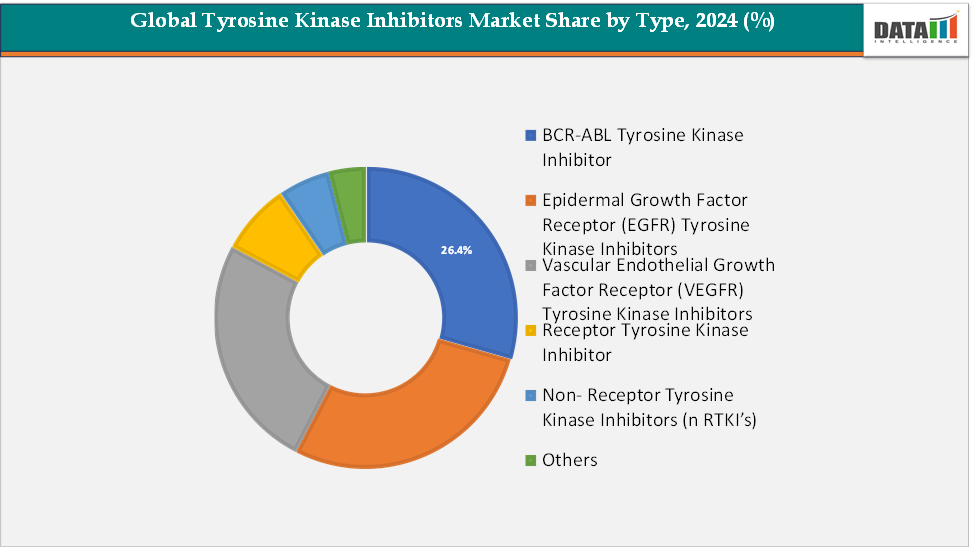
Type: The BCR-ABL tyrosine kinase inhibitor segment is estimated to have 44.8% of the tyrosine kinase inhibitors market share.
The BCR-ABL tyrosine kinase inhibitor segment is poised to dominate the global TKIs market, accounting for the largest revenue share. This dominance is largely due to its established efficacy in treating chronic myeloid leukemia (CML) and acute lymphoblastic leukemia (ALL), where the BCR-ABL fusion protein serves as a primary oncogenic driver. Drugs such as Imatinib (Gleevec), Dasatinib (Sprycel), and Nilotinib (Tasigna) have revolutionized treatment paradigms, offering high remission rates and significantly improved survival outcomes. The segment benefits from multiple generations of inhibitors that address resistance mutations and enhance therapeutic durability. Additionally, widespread adoption across developed and emerging markets, strong clinical validation, and continued inclusion in treatment guidelines reinforce the segment’s market leadership.
The EGFR tyrosine kinase inhibitor segment is estimated to have 21.4% of the Tyrosine Kinase Inhibitors market share.
The EGFR tyrosine kinase inhibitor segment is expected to experience the fastest growth among all TKI classes. This is driven by the increasing prevalence of EGFR-mutated non-small cell lung cancer (NSCLC), which represents a significant proportion of global lung cancer cases. Targeted therapies such as Osimertinib (Tagrisso), Erlotinib (Tarceva), and Gefitinib (Iressa) have demonstrated superior efficacy, reduced systemic toxicity, and the ability to overcome common resistance mutations, contributing to rapid adoption. Growth is further supported by the rising use of companion diagnostics that identify eligible patients, expanding the treatment-eligible population. Ongoing research for next-generation EGFR inhibitors and combination therapies with immunotherapy is also expected to propel this segment’s expansion.
Tyrosine Kinase Inhibitors Market Geographical Analysis
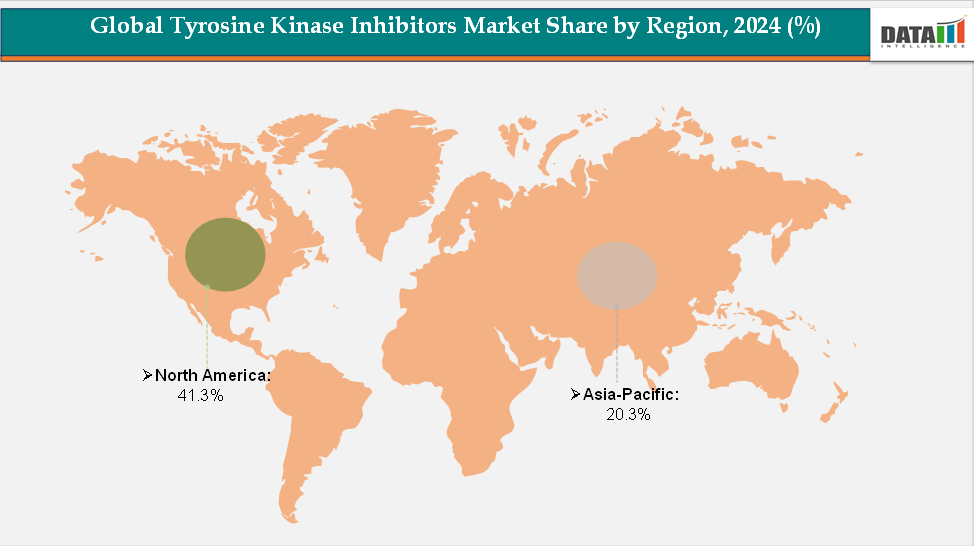
The North America tyrosine kinase inhibitors market was valued at 41.3% market share in 2024
North America leads the global tyrosine kinase inhibitors market, accounting for the largest revenue share. The region’s dominance is driven by its advanced healthcare infrastructure, widespread access to precision oncology treatments, and high adoption of targeted therapies. A strong presence of leading pharmaceutical and biotechnology companies actively engaged in TKI research, development, and commercialization further reinforces the region’s leadership.
Additionally, robust clinical trial activity, favorable regulatory frameworks, and well-established reimbursement systems ensure early access to novel TKIs, supporting continued growth. The increasing prevalence of cancers such as lung, breast, and hematologic malignancies, combined with a strong emphasis on personalized medicine, positions North America as the primary revenue contributor to the global TKIs market.
The Europe tyrosine kinase inhibitors market was valued at 22.8% market share in 2024
Europe holds a significant share in the global TKIs market, supported by advanced healthcare systems, well-established oncology protocols, and strong clinical research capabilities. The region benefits from widespread access to targeted therapies, comprehensive cancer registries, and robust reimbursement frameworks that facilitate patient adoption. Countries such as Germany, France, and the UK are at the forefront of clinical trials for both first- and next-generation TKIs, ensuring early availability of innovative treatments. The increasing prevalence of cancers, coupled with growing emphasis on precision medicine and personalized oncology, reinforces Europe’s position as a key market contributor while complementing the growth seen in North America and Asia–Pacific.
The Asia-Pacific tyrosine kinase inhibitors market was valued at 20.3% market share in 2024
The Asia–Pacific region is expected to be the fastest-growing market for TKIs, driven by a rising cancer burden and expanding healthcare access. Countries such as China, Japan, and India are witnessing increasing incidences of lung, breast, and gastrointestinal cancers, coupled with growing investments in oncology infrastructure and molecular diagnostics. Rapid regulatory approvals for innovative TKIs, coupled with government initiatives to enhance cancer care accessibility, are accelerating market adoption. Additionally, increasing awareness of targeted therapies among healthcare professionals and patients, along with rising healthcare expenditure, is fueling the demand for TKIs, making Asia–Pacific the fastest-growing regional market globally.
Tyrosine Kinase Inhibitors Market Competitive Landscape
The major players in the tyrosine kinase inhibitors market include Quanterix, Alamar Biosciences, Inc., Thermo Fisher Scientific Inc., F. Hoffmann-La Roche Ltd, Siemens Healthineers AG and Sysmex Corporation, among others.
Tyrosine Kinase Inhibitors Market Scope
| Metrics | Details | |
| CAGR | 6.4% | |
| Market Size Available for Years | 2022-2033 | |
| Estimation Forecast Period | 2025-2033 | |
| Revenue Units | Value (US$ Bn) | |
| Segments Covered | Type | BCR-ABL Tyrosine Kinase Inhibitor, Epidermal Growth Factor Receptor (EGFR) Tyrosine Kinase Inhibitors, Vascular Endothelial Growth Factor Receptor (VEGFR) Tyrosine Kinase Inhibitors, Receptor Tyrosine Kinase Inhibitor, Non-Receptor Tyrosine Kinase Inhibitors (n RTKI’s), Others |
| Application | Chronic Myeloid Leukemia, Lung Cancer, Breast Cancer, Renal Cell Cancer, Others | |
| Distribution Channel | Hospital Pharmacies, Retail Pharmacies, Online Pharmacies, Others | |
| Regions Covered | North America, Europe, Asia-Pacific, South America, and the Middle East & Africa | |
The global tyrosine kinase inhibitors market report delivers a detailed analysis with 70 key tables, more than 66 visually impactful figures, and 195 pages of expert insights, providing a complete view of the market landscape.
Suggestions for Related Report
For more pharmaceuticals-related reports, please click here



























































